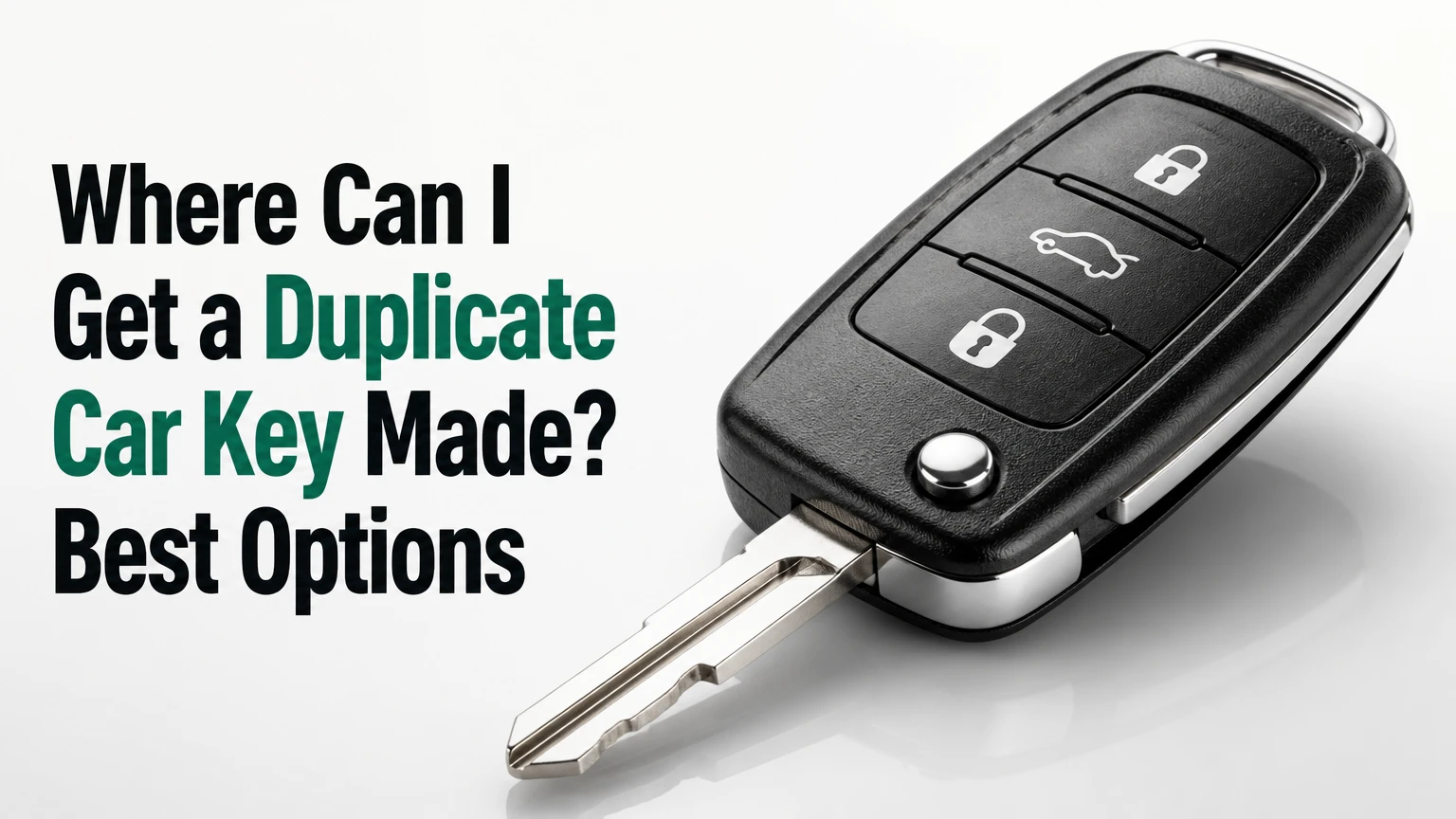
You can get a duplicate car key made by an automotive locksmith, a car dealership, or a hardware store that offers automotive key services. A locksmith is usually the fastest and least expensive choice for transponder keys and remote fobs, while a hardware store usually handles only simple metal keys and a dealership provides the broadest OEM programming coverage.
Key Facts at a Glance
A basic mechanical car key typically costs $10-$30 and can take 5-15 minutes.
A transponder or remote-head duplicate commonly costs $75-$250 and requires programming.
A smart key or proximity fob often costs $150-$600, depending on the vehicle.
Hardware stores usually cut metal keys but cannot program most immobilizer chips.
An automotive locksmith can often cut and program a duplicate at your location.
Bring photo identification, proof of ownership, the VIN, and every existing key.
Where Can I Get a Duplicate Car Key Made?
The best place depends on the key technology and whether you still have a working key. Use a hardware store for a plain, non-electronic blade, an automotive locksmith for most transponder and remote keys, and a dealership when the vehicle uses restricted software, an unusual key system, or a manufacturer-specific replacement process.
An automotive locksmith is the practical first call for most drivers. A qualified technician can identify the blade profile, supply an OEM or compatible aftermarket key, cut it with a code or decoding tool, and program the immobilizer or remote. Mobile service also avoids towing when the vehicle is parked at home, work, or roadside.
A dealership is the safer choice when the locksmith cannot support the vehicle’s security system. Dealers can order keys by VIN and use manufacturer-authorized diagnostic systems, although ordering, identity verification, and appointment availability can make the process slower and more expensive.
Hardware stores, home-improvement stores, and automated kiosks are useful only after you identify the key as mechanical. A key that unlocks the door but does not start the engine is not a successful duplicate.
Which Provider Should You Choose?
Choose an automotive locksmith for the best balance of price, speed, and programming capability; choose a dealership for guaranteed OEM support; and choose a hardware store only for a confirmed non-chip key. The provider comparison below applies to typical U.S. services, where prices vary by vehicle, region, and key design.
| Provider | Typical price | Typical time | Programming capability | Best use |
|---|---|---|---|---|
| Hardware store | $10-$40 | 5-20 minutes | Mechanical keys only at most locations | Older plain-blade keys |
| Automated key kiosk | $10-$40 | 5-15 minutes | Limited model coverage | Simple duplicate blades |
| Automotive locksmith | $75-$350 | 20-90 minutes | Many transponder, remote, and smart systems | Most spare keys |
| Car dealership | $150-$600 | 1-3 days, or 30-120 minutes if stocked | Broad OEM coverage | Restricted or newer systems |
| Online key seller plus local programmer | $25-$250 before labor | 1-7 days | Depends on the local technician | Cost-sensitive owners who verify compatibility |
Ask each provider these questions before approving work:
- Does the quoted price include the key blade, electronics, cutting, programming, and sales tax?
- Is the replacement OEM, refurbished OEM, or aftermarket?
- Can you program this exact year, make, model, trim, and market version?
- Does the price include a mobile-service fee or emergency callout?
- What happens if the supplied key does not communicate with the vehicle?
- Do you need the vehicle present, or can you cut from the VIN and program later?
A low advertised price often covers only a metal blank. The final invoice can increase after cutting, immobilizer programming, remote synchronization, tax, and travel charges are added.
What Type of Car Key Do You Need?
Identify the key type before comparing prices, because the electronics determine the work more than the metal blade does. A vehicle may use a plain key, transponder key, remote-head key, flip key, or proximity smart key.
| Key type | Physical identifier | Vehicle function | Typical duplicate cost | Typical service time |
|---|---|---|---|---|
| Mechanical blade | Metal blade with no buttons or chip | Locks and ignition | $10-$30 | 5-15 minutes |
| Laser or side-milled key | Center track or complex side cuts | Locks and ignition, sometimes with chip | $25-$100 | 15-30 minutes |
| Transponder key | Chip embedded in plastic head | Starts engine after immobilizer authorization | $75-$180 | 20-60 minutes |
| Remote-head key | Blade and lock buttons in one housing | Starts engine and controls remote locks | $100-$250 | 30-75 minutes |
| Smart proximity fob | Push-button start, no normal ignition slot | Unlocks and authorizes starting by proximity | $150-$600 | 30-120 minutes |
A transponder chip is not simply a copy of the blade. The blade controls the mechanical lock or ignition, while the immobilizer checks an electronic identifier before permitting the engine to run. Remote buttons add another function, and remote locking can work even when immobilizer programming is incomplete.
The AI Overview’s description of every chip as RFID and every programming event as a simple ECU code match is too broad. Manufacturers use different immobilizer architectures, cryptographic methods, antennas, body control modules, and authorization procedures. A technician needs the exact vehicle data, not only a photo of the old key.
How Can You Tell Whether a Key Has a Chip?
A plastic-headed key may contain a transponder, but appearance alone is not conclusive. Check the owner’s manual, search the vehicle’s exact key part number, ask a dealer to confirm the immobilizer system, or have a locksmith test the key with a suitable diagnostic or transponder tool.
Common clues include a security or immobilizer indicator on the instrument panel, a vehicle manufactured after the mid-1990s, and a key head that contains no obvious battery despite starting the engine. The decisive test is whether the engine starts with the key, not whether the blade enters the ignition.
A remote fob is different from a transponder. Remote buttons transmit lock commands, while the immobilizer chip authorizes engine starting. Some keys contain both components, and a proximity fob may contain an emergency mechanical blade for a dead battery or manual door entry.
What Should You Bring to the Key-Cutting Appointment?
Bring the vehicle, one working key, photo identification, proof of ownership, the VIN, and the exact make, model, year, trim, and market version. A working original reduces diagnostic time and usually costs less than creating a key when every original has been lost.
Useful ownership documents include a current registration, title, insurance card, or lease agreement. Requirements vary by provider and jurisdiction, but legitimate locksmiths and dealerships should verify that the requester has authority to obtain a key.
Bring all existing keys, including damaged or intermittent ones. Some vehicles have a limited key-memory capacity, and certain programming procedures may erase keys that are not present during registration. Ask whether the technician will add the new key or erase and re-enroll the complete key list.
Record the key’s part number and frequency only after confirming them against the vehicle. A North American fob may not work with an otherwise similar vehicle configured for another market. Frequency, encryption generation, blade profile, FCC authorization, and manufacturer part number can all affect compatibility.
How Is a Duplicate Car Key Made?
A duplicate car key is made through identification, cutting, programming, and testing. A plain blade may require only a code or an existing key, while a modern vehicle usually requires a compatible electronic key, a programming tool, security authorization, and the vehicle at the technician’s location.
Step 1: Confirm the Vehicle and Key System
Provide the VIN, registration details, and existing key to the provider. The technician confirms the blade profile, immobilizer type, remote frequency, key-memory procedure, and whether the vehicle needs a PIN, security subscription, or manufacturer gateway authorization.
You will know this step is complete when the provider gives a vehicle-specific quote rather than a generic “car key” price. A common mistake is accepting a quote based only on the key’s shape.
Step 2: Select the Blank or Fob
Choose between OEM, refurbished OEM, and aftermarket equipment. OEM parts generally provide the most predictable fit and electronics, while reputable aftermarket keys can reduce cost when the supplier supports the exact part number and the provider offers a programming guarantee.
You will know the selection is correct when the part number, button layout, blade style, frequency, and vehicle application all match. Avoid a listing that says only “fits many models.”
Step 3: Cut the Mechanical Blade
The technician cuts the blade from the working key, a factory key code, or a decoding measurement. Laser and side-milled blades require the correct profile and calibrated equipment because a visually similar cut can bind in the ignition or damage the cylinder.
Test the new blade in the driver’s door and ignition before programming. The key should enter, turn, and withdraw smoothly without force. A common mistake is programming electronics before confirming that the physical cut is accurate.
Step 4: Program the Immobilizer and Remote
The technician connects a compatible diagnostic tool, often through the OBD-II port, and follows the vehicle’s security procedure. The immobilizer chip, remote buttons, and proximity functions may use separate registration steps, so a key can start the engine while its lock buttons remain unsynchronized.
You will know programming worked when the engine starts normally and every requested remote function responds. The vehicle may require two existing keys for owner programming, a security PIN, a paid manufacturer connection, or a technician-level tool.
Step 5: Test Every Function
Test the driver and passenger locks, trunk release, panic button, remote range, proximity unlock, push-button start, emergency blade, and dashboard warning lights. Confirm that the new key does not merely turn the ignition but actually authorizes the engine.
Ask the technician to demonstrate the procedure for replacing the fob battery and to explain whether the new key is covered if the chip fails. Keep the receipt and part number with the vehicle records.
How Much Does a Duplicate Car Key Cost?
A duplicate car key typically costs $10-$30 for a plain mechanical blade, $75-$250 for a transponder or remote-head key, and $150-$600 for a smart proximity fob. The vehicle’s programming method, key source, region, urgency, and number of existing keys determine the final price.
| Service situation | Typical parts cost | Typical labor or service cost | Typical total | Typical time |
|---|---|---|---|---|
| Plain metal duplicate | $5-$15 | $5-$20 | $10-$35 | 5-15 minutes |
| Side-milled transponder key | $40-$120 | $40-$100 | $80-$220 | 20-60 minutes |
| Remote-head duplicate | $60-$180 | $40-$120 | $100-$300 | 30-75 minutes |
| Smart proximity fob | $100-$450 | $50-$150 | $150-$600 | 30-120 minutes |
| All keys lost, standard system | $75-$250 | $100-$300 | $175-$550 | 1-3 hours |
| All keys lost, restricted or luxury system | $200-$500 | $200-$600 | $400-$1,100+ | 2 hours to several days |
These are labeled typical U.S. ranges, not guaranteed prices. Luxury brands, encrypted systems, imported vehicles, high-security blades, emergency nighttime service, towing, and dealer-only software can raise the total.
Duplicating a working key is usually cheaper because the technician can test the original, copy its mechanical pattern, and use the existing key authorization process. Losing every key can require vehicle entry, key-code retrieval, immobilizer reset or re-registration, and additional security verification.
Is a Locksmith Cheaper Than a Dealership?
An automotive locksmith is typically cheaper than a dealership by $50-$300 for a supported vehicle, and a mobile locksmith may also eliminate towing. A dealership becomes the better choice when the locksmith lacks the required software, the key is restricted, or an OEM-only procedure protects compatibility.
| Decision factor | Automotive locksmith | Dealership | Hardware store |
|---|---|---|---|
| Plain blade price | $10-$40 | $20-$75 | $10-$30 |
| Transponder support | Common, model-dependent | Broad OEM coverage | Rare |
| Smart-fob support | Common for supported models | Broadest factory coverage | Usually unavailable |
| Mobile service | Often available | Rare | No |
| OEM part access | OEM and aftermarket | OEM | Limited blanks |
| All-keys-lost service | Often available | Available, sometimes requires tow | Not available |
| Appointment speed | Same day in many areas | Same day to several days | Immediate for stocked blanks |
| Main risk | Unsupported model or poor aftermarket part | High price and waiting time | Mechanical-only service |
The phrase “factory-grade” does not automatically mean a dealer is required. Many established locksmiths use professional vehicle-key programmers and current manufacturer subscriptions. The relevant question is whether the provider supports your exact vehicle and can state what happens if programming fails.
The main limitation of a locksmith is coverage. New model years, encrypted gateway systems, and certain luxury platforms may require credentials or equipment that independent providers do not have. Ask for a specific compatibility confirmation before the van arrives.
Can a Hardware Store or Kiosk Copy Your Car Key?
A hardware store or kiosk can usually copy a plain metal car key, but it generally cannot program a transponder, remote-head key, or proximity fob. Some retailers offer limited automotive services for selected models, so confirm the exact service before traveling.
Look at the original key rather than the vehicle’s age. A plain metal blade with no buttons and no immobilizer indicator may be suitable for a basic cutter. A plastic head, remote buttons, push-button start, or security light indicates that cutting alone may not produce a usable duplicate.
A kiosk may scan a key profile and cut a blank automatically, but inventory is limited. Kiosks also may not handle side-milled blades, worn original keys, unusual profiles, or vehicles requiring a second-stage immobilizer registration.
Hardware-store duplication is useful as a low-cost door or emergency blade when the vehicle does not require electronic authorization. It is not a substitute for a programmed spare when the objective is reliable engine starting.
Should You Buy a Car Key Online?
Buying a car key online can reduce parts cost, but only when the exact part number, frequency, blade profile, encryption type, and return policy are verified before purchase. Online buying is most suitable when a local locksmith agrees in advance to cut and program customer-supplied equipment.
| Online purchase risk | What can be wrong | Result | Safer check |
|---|---|---|---|
| Wrong frequency | 315 MHz versus 433 MHz configuration | Buttons do not communicate | Match regional part number |
| Wrong transponder | Incompatible chip or encryption generation | Engine will not start | Confirm immobilizer chip |
| Uncut blade mismatch | Similar-looking profile | Blade binds or will not turn | Match blade code |
| Locked used fob | Previously enrolled or damaged unit | Programming fails | Buy new or verified refurbished |
| Poor return terms | Cut or programmed part becomes nonreturnable | Lost parts cost | Read the written policy |
| Missing battery | Empty or incorrect battery compartment | Weak remote response | Confirm battery type and polarity |
An online listing that claims universal compatibility should be treated cautiously. Vehicle trim, production date, market, and keyless-entry package can change the required part even within one model year.
The cheapest path is not always the lowest total cost. A $35 incompatible fob can become more expensive than a $150 local replacement after cutting, failed programming, shipping, and a second service appointment.
What If You Lost Every Car Key?
If you lost every key, contact a mobile automotive locksmith or the dealership, because a duplicate cannot be copied without an original unless the key code and immobilizer system can be reconstructed. Bring proof of ownership and expect more programming, security verification, and possibly vehicle-access work.
A locksmith may retrieve a mechanical key code, decode the lock, generate a blade, and program a new transponder or fob. Some vehicles require the technician to erase missing keys from memory, while others retain old keys unless the complete key list is reprogrammed.
A dealership may require the vehicle to be present and can require towing when no mobile programming option exists. Ask whether the quoted service deletes the missing keys, because replacing the physical key without removing the lost electronic credentials may leave a security exposure.
Do not describe an all-keys-lost job as a normal duplicate when requesting prices. State the vehicle’s location, whether it is locked, whether it has push-button start, and whether any damaged key or fob remains.
What Common Mistakes Cause Key Duplication Problems?
The most common failures come from confusing a cut blade with a programmed key, buying an incompatible fob, and failing to test every function before leaving. Each problem has a specific recovery path.
- The blade works in the door but the engine will not start: the transponder is absent, incompatible, or unprogrammed. Return to the provider for chip diagnosis and immobilizer registration.
- The remote buttons work but push-button start fails: remote locking and immobilizer authorization are separate systems. Check the vehicle’s key-recognition procedure and have the immobilizer function tested.
- The key turns stiffly: the blade may be cut from a worn original or the profile may be wrong. Request a code-based cut or a new blank rather than forcing the ignition.
- The new fob has poor range: install the specified battery, confirm polarity, inspect the battery contacts, and check whether the fob uses the correct frequency.
- Existing keys stop working: the programming session may have erased keys that were not present. Ask the provider to re-register every key you want to retain.
- The quote increases at the vehicle: the advertised amount may exclude programming, travel, emergency hours, or a high-security blade. Request an itemized written price before authorization.
One practitioner rule is worth remembering: test the mechanical operation before paying for electronic programming, then test immobilizer starting before evaluating remote buttons. That sequence isolates faults and prevents a bad cut from being mistaken for a software problem.
How Do You Find a Reliable Local Car-Key Provider?
Search for “automotive locksmith car key programming” plus your city, then verify licensing, insurance, business identity, reviews, and vehicle-specific capability before booking. A reliable provider gives a complete quote, requests ownership proof, and explains whether the replacement is OEM or aftermarket.
Use the following screening checklist:
- Confirm the technician handles your exact year, model, trim, and key type.
- Request the total price in writing, including cutting, programming, travel, tax, and emergency fees.
- Ask whether the technician will test the key before closing the job.
- Verify the company’s legal name, local address, phone number, and licensing requirements.
- Avoid providers that refuse ownership verification or demand cash before inspecting the vehicle.
- Ask how failed programming or an incompatible supplied fob will be resolved.
- Keep the invoice, key part number, and warranty terms.
For a routine spare, schedule during business hours and bring the vehicle to the shop if possible. For a locked or stranded vehicle, a mobile locksmith usually minimizes delay and towing expense.
Frequently Asked Questions
Can I Get a Spare Key Made Without the Original?
Yes, a locksmith or dealership can often create a key without the original by using the VIN, a key code, lock decoding, and immobilizer programming. The process costs more because the provider must generate the mechanical pattern and establish electronic authorization rather than copy a known working key.
Can I Program a Car Key Myself?
Some older vehicles support owner programming when two working keys are already present, but many modern vehicles require a diagnostic tool, security PIN, or manufacturer authorization. Follow the vehicle’s owner manual exactly, and do not assume a remote-button synchronization procedure also programs the engine immobilizer.
How Long Does a Duplicate Car Key Take?
A plain mechanical key usually takes 5-15 minutes. A transponder or remote key commonly takes 20-75 minutes, while a smart fob can take 30-120 minutes when the part is available and the vehicle accepts the programming procedure without a security delay.
Does a VIN Let Any Store Make My Key?
A VIN can help a dealership or qualified locksmith identify the vehicle and retrieve a key code, but the VIN alone does not make or authorize every key. The provider may still need proof of ownership, the vehicle present, a compatible blank, security credentials, and a diagnostic programming session.
Is an Aftermarket Key Safe to Use?
A reputable aftermarket key can work reliably when its part number, frequency, blade profile, and transponder system match the vehicle. OEM keys reduce compatibility uncertainty, but neither label guarantees success if the wrong regional specification or programming procedure is used.
Should I Delete a Lost Key From the Vehicle?
Yes, ask whether a lost electronic key can be removed from the vehicle’s authorized-key memory. Deleting the missing key reduces the chance that someone who finds it can start the vehicle, although physical door access and remote functions depend on the vehicle’s specific security design.
The Bottom Line
For most drivers, an automotive locksmith is the best place to get a duplicate car key made because the service commonly combines cutting, programming, and mobile convenience at a lower price than a dealership. Use a hardware store only for a confirmed mechanical blade, and use a dealer when the vehicle requires restricted OEM software or the locksmith cannot verify compatibility. Bring ownership documents, the VIN, every existing key, and the exact vehicle details, then test the blade, immobilizer, remote, and proximity functions before the job is closed.