Local independent automotive locksmiths usually make car keys for less than dealerships, especially for transponder keys, remote-head keys, and smart fobs. Hardware stores are cheapest for simple metal keys, while reputable DIY kits can reduce labor costs on compatible vehicles. The lowest safe price depends on the key type and whether a working key remains.
Key Facts at a Glance
- A basic non-electronic car key typically costs $5-$15 at a hardware store or key kiosk.
- An independent automotive locksmith commonly charges $50-$250 for programmed keys, depending on vehicle and fob type.
- Dealership replacement keys often cost $150-$600 or more, before towing or transport charges.
- A duplicate made from a working key normally costs less than an all-keys-lost replacement.
- Cutting the blade does not automatically program the immobilizer chip or remote buttons.
- A mobile automotive locksmith can often make and program a replacement at the vehicle without a dealership tow.
Who Makes Car Keys for Cheap?
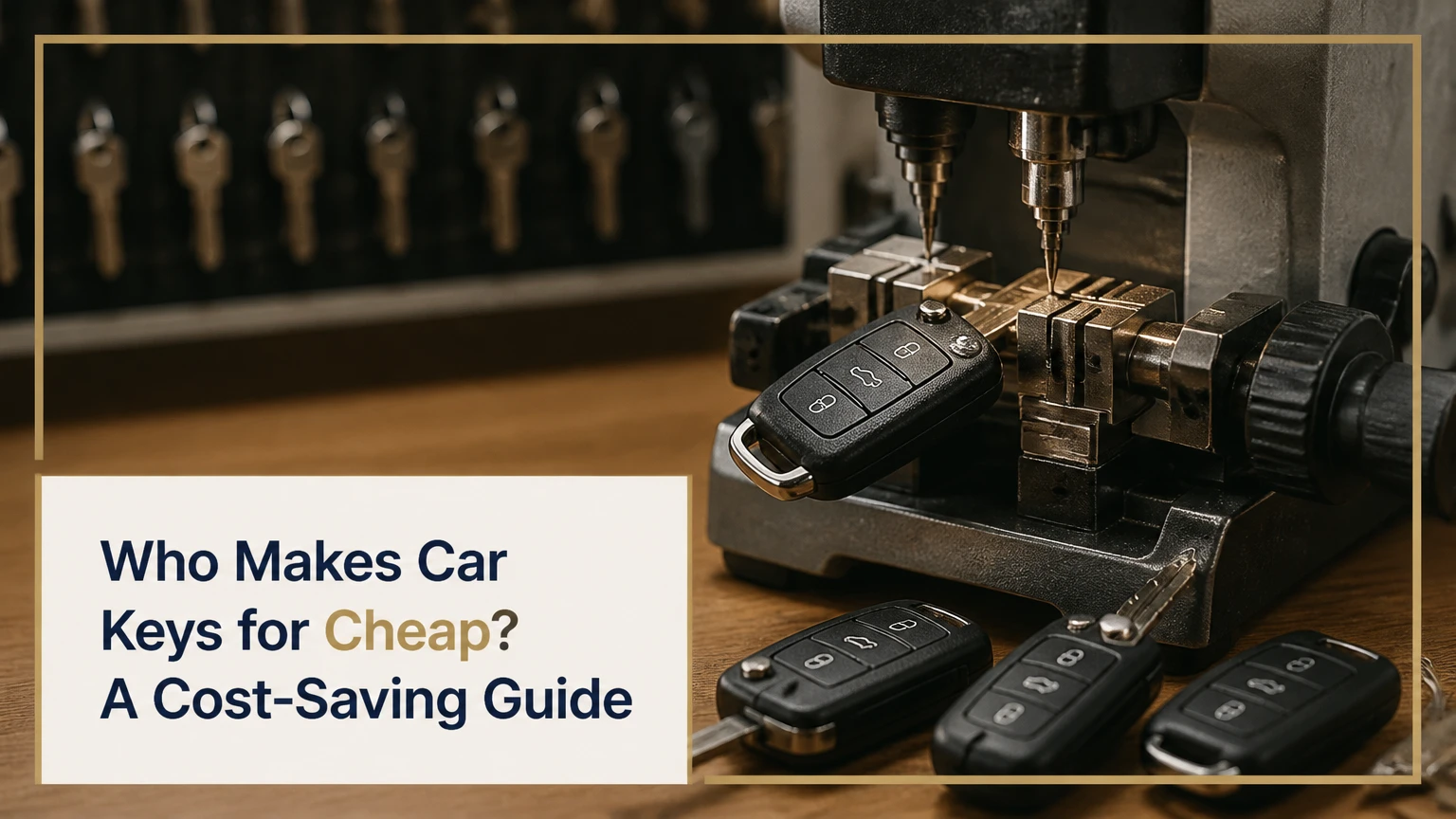
The cheapest provider is usually a local independent automotive locksmith for electronic keys, or a hardware store for a plain metal key. A mobile locksmith costs more than a walk-in duplicate for some jobs, but the total can still be lower than dealership pricing because the vehicle does not need to be transported.
The right provider depends on the vehicle’s security system. A hardware store may cut a blade accurately but lack the equipment to program a transponder. A locksmith with automotive diagnostic tools can generally cut, clone, or program more key types, although coverage varies by make, model, year, and immobilizer system.
Quick provider comparison
| Provider | Typical total cost | Typical time | Best-supported key types |
|---|---|---|---|
| Hardware store | $5-$40 | 2-20 minutes | Plain metal keys, some basic transponder blanks |
| Key kiosk | $10-$80 | 5-15 minutes | Common duplicate blades and selected electronic keys |
| Independent locksmith | $50-$300 | 15-90 minutes | Transponder, laser-cut, remote, and many smart keys |
| DIY kit provider | $40-$250 | 30-120 minutes | Selected domestic and high-volume models |
| Dealership | $150-$600+ | 1-5 hours or several days | OEM keys for nearly all supported vehicles |
Prices are typical US consumer ranges, not guaranteed quotes. Luxury brands, European vehicles, restricted key systems, emergency callouts, and after-hours work can raise the final bill.
How Does Car Key Replacement Actually Work?
Car key replacement has three separate jobs: cutting the mechanical blade, pairing the remote functions, and authorizing the immobilizer transponder. A key can pass one or two of these tests while failing the third, which explains why a replacement may unlock the doors but fail to start the engine.
A traditional metal key only needs the correct profile and cut. A transponder key also contains a passive chip that communicates with the vehicle’s immobilizer. A remote fob adds radio buttons, while a proximity fob communicates with the car when the fob is inside or near the cabin.
The three functions
- Mechanical cutting: A duplicator or code-cutting machine shapes the blade to match the lock cylinder.
- Remote synchronization: The lock, unlock, trunk, or panic buttons are paired with the vehicle’s receiver.
- Immobilizer programming: A diagnostic tool or approved procedure registers the chip or smart fob with the vehicle security system.
The immobilizer does not rely on the blade alone. If the cut is perfect but the chip is not accepted, the engine may crank without running, or the vehicle may display a security warning.
How Do You Identify the Key You Need?
Identify the vehicle’s year, make, model, trim, ignition system, and existing key design before buying a blank. The most reliable sources are the owner’s manual, the vehicle identification number, a parts catalog matched to the VIN, and a locksmith who verifies the key platform before ordering.
Key type identification table
| Key type | Physical clue | Electronic requirement | Typical replacement price |
|---|---|---|---|
| Plain metal key | Metal blade and no buttons or plastic chip head | None | $5-$15 |
| Transponder key | Plastic head, often with no buttons | Immobilizer chip programming | $50-$120 |
| Laser-cut key | Thick blade with central track or complex profile | Cutting machine, sometimes chip programming | $90-$180 |
| Remote-head key | Blade attached to buttons in one housing | Remote pairing plus immobilizer programming | $60-$150 |
| Smart proximity fob | Push-button ignition and no conventional ignition slot | Proximity registration and sometimes emergency blade cutting | $150-$600+ |
Vehicle year is only a starting point. Two cars with the same model name can use different key frequencies, FCC IDs, blade profiles, or immobilizer generations because of trim, market, and production changes.
How Much Does Each Key Type Cost?
Typical replacement prices range from $5 for a plain duplicate to more than $600 for some smart fobs. A working original key, the provider’s location, the vehicle’s security system, and whether programming is included determine the final cost more than the word “key” itself.
| Key category | Locksmith or other low-cost option | Dealer range | Typical completion time |
|---|---|---|---|
| Plain metal key | $5-$15 at hardware store | $20-$50 | 2-10 minutes |
| Standard transponder | $50-$120 | $150-$250 | 15-30 minutes |
| Laser-cut transponder | $90-$180 | $200-$350 | 20-60 minutes |
| Remote-head key | $60-$150 | $200-$400 | 15-45 minutes |
| Smart proximity fob | $150-$300 | $300-$600+ | 30-90 minutes |
A quote should state whether it includes the blank, blade cutting, programming, mobile attendance, service-call fee, tax, and disposal or deletion of a lost fob. A low advertised price can become expensive when each required operation appears as a separate charge.
What makes the price increase?
- All keys are lost rather than one spare being copied.
- The vehicle requires a PIN, security code, or online immobilizer access.
- The key is a proximity fob rather than a conventional transponder.
- The vehicle is disabled in a parking garage, roadside location, or restricted-access area.
- The job occurs overnight, on a holiday, or outside the provider’s normal service area.
- The customer supplies an incompatible aftermarket blank.
- The vehicle uses a high-security blade, encrypted key system, or luxury-brand fob.
What Can Hardware Stores and Kiosks Do?
Hardware stores and automated kiosks are usually the lowest-cost choice for a plain metal duplicate, but their electronic coverage is limited and model-specific. Many can copy an ordinary blade in minutes, while only selected locations offer transponder duplication or remote-key services.
A store cannot normally help when every key is lost because it needs an original pattern or a removable key code. It also may not have the diagnostic equipment required to add a new key to the vehicle’s immobilizer.
Use a hardware store when
- The original key has no buttons, chip, or security warning.
- The store confirms the exact blade blank is available.
- You need a backup for a vehicle with a basic ignition system.
- The vehicle starts with the copied key after cutting.
Choose another provider when
- The car has push-button start.
- The key has a laser or sidewinder profile.
- The engine cranks but refuses to run with the new key.
- Every key is lost.
- The key includes a transponder, remote, or proximity function that the store cannot program.
A kiosk is convenient, but convenience does not guarantee compatibility. Confirm the return policy before accepting an electronic key because some sellers treat cut or programmed products as nonreturnable.
Can You Save Money With a DIY Key Kit?
A DIY key kit can reduce labor costs on compatible vehicles, but it is only economical when the kit matches the vehicle and the customer follows the programming process precisely. DIY replacement is most practical for common models with documented procedures, available blanks, and a functioning original key.
Some kits include a blank, remote, and temporary programming device. Others require a separate diagnostic programmer, subscription, vehicle security PIN, or app. The product description must match the exact year, model, trim, key frequency, blade style, and FCC ID where applicable.
DIY compatibility checklist
- Compare the original fob’s FCC ID and part number with the replacement.
- Verify the blade profile, button layout, and frequency for the specific vehicle.
- Confirm whether the kit programs the immobilizer, the remote, or both.
- Check whether the vehicle needs two existing programmed keys.
- Calculate shipping, tool rental, taxes, and return restrictions.
- Keep the original key available until the replacement is tested.
An online key that costs $25 may not be a bargain if cutting costs $20, programming requires a $70 tool, and the wrong frequency makes the remote unusable. Aftermarket quality also varies. Weak buttons, poor battery contacts, and inaccurate blades create failures that a reputable locksmith may diagnose more quickly.
How Do You Get an Accurate Locksmith Quote?
Give the locksmith the vehicle year, make, model, trim if known, location, key status, and key type, then request one written total. The quote should identify mobile service, cutting, programming, parts, taxes, and after-hours charges rather than presenting only a low starting price.
Use this exact question:
“What is the all-in price to cut and program a key for my [year, make, model], including the service call, blank, programming, and tax?”
Ask whether the locksmith can work with a working key, create a key when all keys are lost, and guarantee that the vehicle starts before payment. Confirm the business name, physical or registered service address, license requirements in your state, online reviews, and payment terms.
Information to prepare
| Information | Why the locksmith needs it | Where to find it |
|---|---|---|
| Vehicle year, make, model | Determines key platform and software coverage | Registration or owner’s manual |
| VIN | Confirms vehicle identity and possible key code | Dashboard, title, registration |
| Working-key status | Changes cutting and programming procedure | Customer description |
| Ignition type | Separates blade, transponder, and proximity jobs | Dashboard and key design |
| Vehicle location | Determines mobile access and travel fee | Parking lot, driveway, garage |
| Proof of ownership | Protects against unauthorized key creation | Title, registration, insurance, ID |
A legitimate provider should request ownership documentation for an all-keys-lost job. Refusal to verify ownership is a security warning, not a convenience.
What Should You Do If Every Key Is Lost?
When every key is lost, call a qualified mobile automotive locksmith before arranging a dealership tow, unless the vehicle manufacturer requires dealer-only programming. The locksmith will usually verify ownership, identify the vehicle from its VIN, cut a key by code or decode the lock, and program the immobilizer at the vehicle.
The vehicle must be accessible. A locked steering column, dead battery, damaged ignition, blocked parking space, or underground garage can add time and equipment requirements. Some vehicles also require a manufacturer security gateway or online authorization that an independent locksmith may not possess.
All-keys-lost procedure
- Locate the VIN and gather a government-issued ID plus registration or title.
- Photograph the ignition, dashboard, existing fob shell, and vehicle identification label.
- Call two or three automotive locksmiths and describe the exact situation.
- Ask whether the quoted price includes a new emergency blade, fob, programming, and travel.
- Confirm that the locksmith can erase missing keys if the vehicle supports that function.
- Test engine start, door locks, trunk release, panic alarm, and every supplied key before paying.
Deleting a missing key from the vehicle’s authorized-key list can reduce theft risk, but not every model supports deletion through the same procedure. Ask the locksmith what happens to the lost key after replacement.
Is a Locksmith Cheaper Than a Dealership?
An independent automotive locksmith is usually cheaper than a dealership for a replacement or duplicate, particularly when the locksmith can provide mobile service and program the vehicle on-site. A dealership remains useful when the vehicle requires factory-only software, a restricted OEM fob, warranty documentation, or a complex security reset.
| Decision factor | Mobile locksmith | Dealership |
|---|---|---|
| Typical transponder price | $50-$120 | $150-$250 |
| Typical smart-fob price | $150-$300 | $300-$600+ |
| Vehicle transport | Usually unnecessary | Often required for immobilized cars |
| Parts selection | OEM and compatible aftermarket | Primarily OEM |
| Same-day availability | Often 15-90 minutes | Same day to several days |
| Programming coverage | Varies by make and year | Broad factory coverage |
| After-hours service | Often available at added cost | Rarely available |
| Best use case | Emergency replacement and spare keys | Dealer-only security or warranty cases |
A dealer quote may omit towing and programming until the vehicle arrives. Compare the complete job cost, not the advertised key price.
When is the dealership the better choice?
The dealership is more defensible when the car has a new encrypted immobilizer, a warranty claim, a recall-related key problem, or a manufacturer requirement for online programming. Dealer service can also reduce compatibility uncertainty for uncommon trims and luxury vehicles.
The dealership is usually poor value for a common older vehicle when a working key exists and a qualified locksmith has the required equipment. A genuine OEM part is not automatically necessary for every duplicate.
What Are the Most Common Replacement Failures?
The most common failures involve an incorrect blank, incomplete programming, an incompatible radio frequency, or a damaged aftermarket fob. Diagnosis starts by separating mechanical operation from remote operation and immobilizer authorization.
Key turns but the engine does not start
The blade is probably cut correctly, but the transponder is missing, unprogrammed, damaged, or incompatible. A flashing security indicator often supports this diagnosis, although the exact warning varies by manufacturer.
Remote buttons work but the car will not start
Remote synchronization and immobilizer programming are separate functions on many vehicles. A locksmith may have paired the lock buttons while failing to register the transponder chip.
Key will not turn in the ignition
The blade may have the wrong profile, an inaccurate code cut, burrs, or excessive wear. Do not force the ignition, because a damaged cylinder costs more to repair than a replacement key.
Smart fob is not detected
Install the correct battery, verify its orientation, and use the vehicle’s emergency fob location described in the owner’s manual. If the emergency start works but passive detection does not, the fob battery, antenna, or proximity programming may be at fault.
Expert rules that prevent wasted money
- Program before cutting whenever possible: Some providers can verify electronic compatibility before permanently cutting a blank, which reduces return disputes.
- Keep the original key until testing ends: A replacement should never become the only available key before engine start, remote buttons, and emergency functions have been checked.
- A spare is cheaper insurance: Duplicating a working key commonly avoids mobile attendance, lock decoding, and all-keys-lost programming costs.
- Do not assume “OEM” means complete: An OEM fob can still require cutting, immobilizer registration, and remote synchronization before it works.
- Do not diagnose from the remote alone: Door-button operation proves radio communication, not engine authorization.
How Can You Get the Lowest Safe Price?
The lowest safe price comes from matching the provider to the key’s actual function, obtaining an all-in quote, and making a spare before the last working key fails. The cheapest provider is not always the lowest total-cost provider when a wrong blank, tow, or second programming visit is involved.
Follow this cost-control sequence:
- Determine whether the key is plain metal, transponder, remote-head, laser-cut, or smart.
- Test the existing key and replace its battery if remote buttons are weak.
- Ask a hardware store for a plain duplicate only when no electronic function exists.
- Compare at least two automotive locksmith quotes for electronic keys.
- Check online blanks only after confirming part number, frequency, FCC ID, and return terms.
- Request a spare while the vehicle still recognizes the original.
- Verify the finished key at the vehicle before leaving the provider.
Insurance and roadside plans sometimes reimburse lost-key services, emergency locksmith attendance, or towing, but coverage varies by policy. Call the insurer or roadside provider before authorizing work if the vehicle is safe and accessible.
Which Provider Should You Choose?
Choose a hardware store for a verified plain metal key, an independent automotive locksmith for most electronic replacements, a DIY kit only for a confirmed compatible vehicle, and a dealership for dealer-only programming or warranty work. The best choice changes when the original key is missing, the vehicle cannot move, or the fob is unusually complex.
Budget-conscious owner with an older car
Use a hardware store or locksmith that confirms the key has no transponder. A plain duplicate costing $5-$15 is less risky than purchasing a remote shell that the vehicle never needed.
Owner with one working chipped key
Use an automotive locksmith and request a programmed duplicate. This is usually the best cost-to-risk balance because the existing key can be used for identification and testing.
Owner with a push-button-start vehicle
Use a mobile locksmith experienced with the exact make and year. Ask whether the price includes proximity registration, emergency blade cutting, and a compatible battery.
Owner who has lost every key
Call a mobile automotive locksmith first, then compare the complete cost with a dealership. Have ownership documents ready and confirm that the vehicle is accessible to the technician.
Owner considering an online blank
Buy only when the exact part number and programming method are verified. Skip the online purchase if the seller cannot confirm frequency, FCC ID, blade profile, compatibility, or returns after cutting.
FAQ
Can I get a car key made without the original?
Yes, a qualified automotive locksmith can often create a key without the original by decoding the lock, using a VIN-based key code, or programming a replacement directly to the vehicle. Ownership verification is normally required, and some newer vehicles need dealer software or manufacturer authorization.
Does AutoZone make and program car keys?
Some AutoZone locations sell replacement blanks, remotes, and selected key products, but service availability varies by store and vehicle. Confirm whether the location cuts the exact blade and programs the immobilizer for your year, make, and model before purchasing.
Does insurance pay for a lost car key?
Some comprehensive auto policies, roadside plans, warranties, and membership programs cover locksmith attendance, replacement keys, or towing. Many policies exclude routine duplicate keys or impose a reimbursement limit, so verify the deductible and claim process before ordering service.
How long does a locksmith take to make a car key?
A plain metal duplicate can take 2-10 minutes, while a programmed transponder usually takes 15-30 minutes. Laser-cut keys and smart fobs commonly take 20-90 minutes, with additional time possible for all-keys-lost jobs, difficult access, or security-code retrieval.
Can a copied key damage my car?
A poorly cut key can damage or prematurely wear an ignition cylinder, especially if the driver forces a blade that binds. Incorrect programming normally does not damage the engine, but repeated failed procedures can create security lockouts on some vehicles.
The Bottom Line
For most electronic replacements, a reputable independent automotive locksmith makes car keys for cheap compared with a dealership, especially when the technician can work at the vehicle. Hardware stores remain the lowest-cost option for plain metal duplicates, while DIY kits work only when compatibility and programming requirements are confirmed.
Call before buying, state the exact vehicle details, and demand an all-in price. If you still have one working key, make a spare now, because a duplicate is usually faster, cheaper, and less complicated than an all-keys-lost replacement.