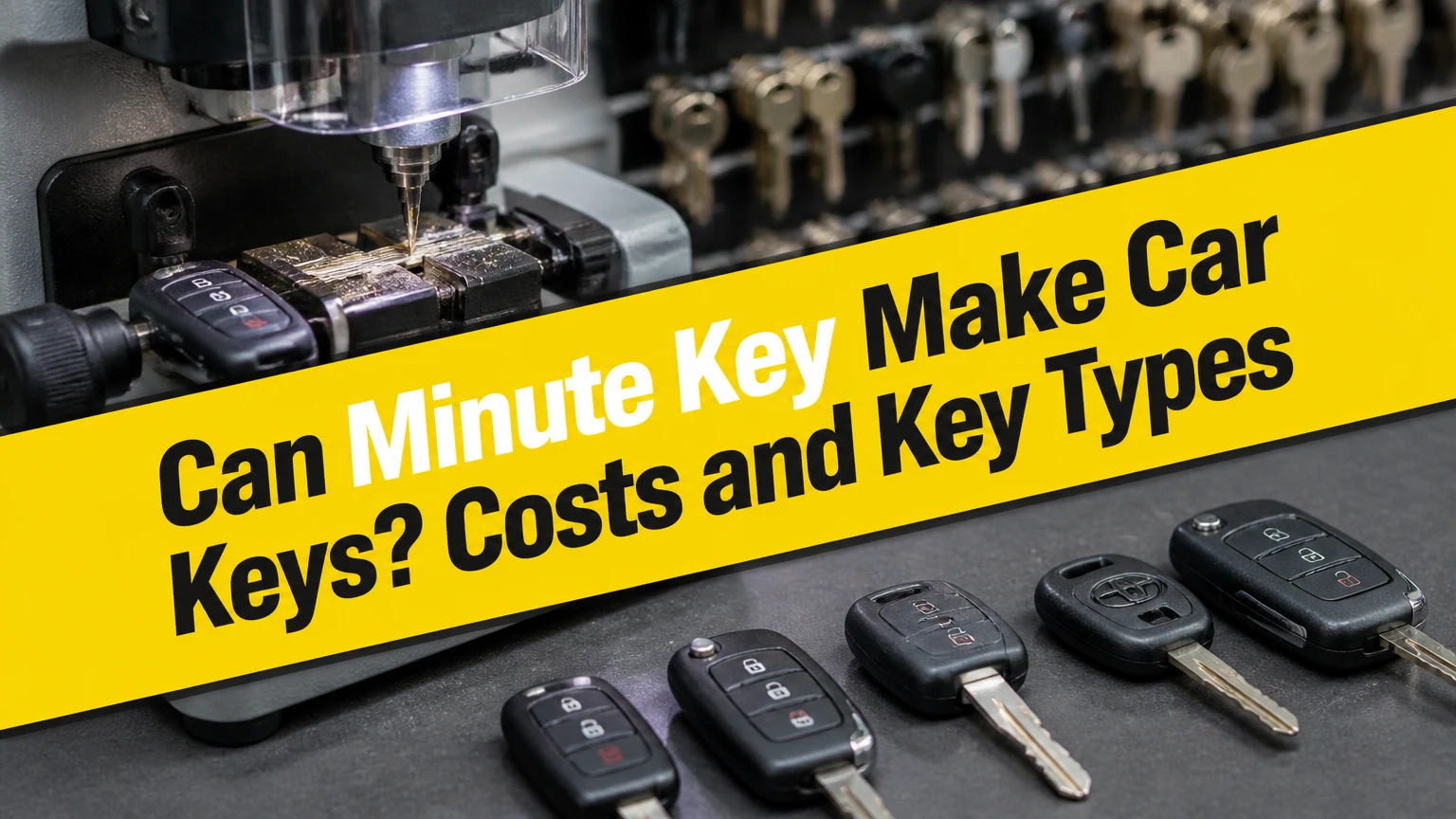
Yes, Minute Key can make some replacement car keys, but availability depends on the vehicle, key type, location, and whether you have a working key to copy. Mechanical keys may be cut at a kiosk, while transponder keys, remote-head keys, and smart fobs require electronic compatibility and programming that may involve ordering and a separate service appointment.
Key Facts at a Glance
- Minute Key automotive service is intended primarily for duplicating an existing, working vehicle key.
- A correctly cut blade does not guarantee that the replacement will start the vehicle.
- Transponder chips must be recognized by the vehicle’s immobilizer before the engine will run.
- Push-to-start vehicles use proximity fobs with electronic identity and communication functions.
- Typical replacement prices range from about $10 for a simple metal key to more than $200 for some smart fobs.
- All-keys-lost cases usually require a mobile automotive locksmith or dealership because there is no original key to scan.
Can Minute Key Make Car Keys?
Minute Key can make car keys when its automotive service supports the exact vehicle and key format. The practical answer is “yes, for eligible vehicles,” rather than “yes, for every car,” because a kiosk’s supported inventory and programming route vary by make, model, year, trim, and location.
Minute Key’s official automotive FAQ describes a replacement-key process that begins with a working key and a vehicle lookup. That distinction matters: duplicating a key is different from originating a key after every key has been lost. A kiosk can often read the shape of an original, but it cannot automatically recover every vehicle’s immobilizer credentials.
The simplest case is an older, purely mechanical key. The machine cuts a matching blade, and the finished key works if the original was accurate and the lock cylinder is healthy. Modern vehicles add an electronic layer, so the replacement may need a compatible transponder, remote circuit board, or proximity-fob system.
The service is therefore best viewed as a lower-cost spare-key route, not a universal emergency solution. Confirm compatibility and the final price before payment.
What Type of Car Key Do You Have?
The key type determines whether Minute Key only needs to cut metal or must also supply and pair electronics. Check the key head, buttons, ignition system, and starting method before using a kiosk.
| Key type | Physical identifier | Electronic function | Typical replacement complexity |
|---|---|---|---|
| Mechanical edge-cut key | Thin blade with edge teeth | No chip or remote circuit | Low, often kiosk-cut |
| Laser-cut or side-milled key | Thick blade with central groove | May include transponder | Moderate, specialized cutter |
| Transponder key | Metal blade with plastic head | Immobilizer identification chip | Moderate, cutting plus programming |
| Remote-head key | Blade attached to button housing | Lock, unlock, panic, and often chip | High, cutting, battery, programming |
| Smart or proximity fob | No conventional ignition blade on many models | Wireless authorization and push-button start | High, fob matching and programming |
Mechanical Edge-Cut Keys
Mechanical keys use a blade profile that physically moves pins or wafers inside a lock cylinder. They do not send an authorization signal to the engine computer, so a precise copy can operate the doors and ignition without electronic programming.
Many older vehicles use this format, but vehicle age alone is not proof. Some cars built before 2000 had electronic security systems, and some newer utility vehicles still use a simple blade for a secondary function. Look for a visible chip capsule or a security indicator in the owner’s manual.
Transponder Keys
A transponder key contains a small RFID-style chip in or near the plastic head. The vehicle’s immobilizer system reads the chip’s identification code and permits fuel injection or engine operation only after authentication.
The blade and chip perform separate jobs. A key can turn the ignition correctly while the engine starts and then stalls because the metal is cut properly but the transponder is not programmed. That symptom points to authorization, not necessarily a bad cut.
Laser-Cut and Side-Milled Keys
“Laser-cut” usually describes a thicker blade with a groove milled along one or both faces. The term does not by itself identify the programming system, and many modern side-milled keys also contain transponders.
Side-milled blanks require the correct cutter, clamp, and key code. Copying a worn original can reproduce inaccurate groove dimensions, so a locksmith may prefer a code-based cut or a factory-style blank when the original has visible wear.
Remote-Head Keys and Smart Fobs
A remote-head key combines a physical blade, lock-control buttons, and an immobilizer component in one housing. A smart fob may omit the conventional ignition blade entirely, using proximity detection and a start button instead.
Remote buttons and engine authorization are separate circuits. Lock and unlock buttons can work while the car refuses to start, or the vehicle can start while a damaged button circuit prevents remote locking. Diagnose each function independently.
How Does the Minute Key Car-Key Process Work?
The Minute Key process normally starts with vehicle identification and an existing key, followed by a compatibility check, payment, key fulfillment, and any required programming. The exact sequence varies by product and location, so the kiosk’s displayed terms control when they differ from general expectations.
Step 1: Identify the Vehicle and Key
Enter the exact make, model, year, and, where requested, trim or key style. Compare the displayed shape with your current key, including blade thickness, button layout, emergency blade, and remote housing.
Do not choose a similar-looking result simply because the brand matches. A 2018 Toyota Camry key, for example, may differ by trim, proximity system, or regional equipment. The vehicle identification number can help a locksmith or dealer verify the configuration, but a VIN does not guarantee that a kiosk stocks the needed product.
Step 2: Bring One Working Original
Bring the best available working key. The original should operate the relevant locks and start the vehicle without intermittent security warnings.
Minute Key’s automotive duplication model is most suitable when at least one functional key exists. If the only key is bent, cracked, heavily worn, or intermittently recognized, ask for professional guidance before using it as the pattern.
Step 3: Scan or Present the Key
Follow the kiosk’s orientation instructions exactly. Optical readers and cutting systems depend on straight placement, correct insertion depth, and a clean blade.
The scan reads the physical profile, not necessarily the electronic secret stored in a transponder. A copied chip normally requires a compatible replacement component and a programming step. Treat the scan as a mechanical and product-matching stage, not proof that the finished key is already authorized.
Step 4: Review the Complete Price
Check whether the displayed price includes the blank, cutting, shipping, programming, appointment, taxes, and any service charge. Automotive pricing can differ sharply from the price of a standard house key.
Ask what happens if programming fails, the key arrives with the wrong shell, or the vehicle is incompatible. A low initial price is less useful if a separate technician fee, return shipment, or second appointment changes the total.
Step 5: Receive the Key and Complete Programming
Mechanical keys may be available immediately, while electronic products may require fulfillment before programming. Minute Key or its service partner should provide the applicable instructions for scheduling and vehicle access.
Programming generally requires the technician to connect an approved diagnostic tool to the vehicle and complete a security procedure. Some vehicles require an existing key, a PIN, two-key sequencing, or manufacturer-specific authorization. The technician, not the kiosk, determines whether the vehicle accepts the new electronic identity.
Step 6: Test Every Function Before Leaving
Test ignition operation, engine starting, lock and unlock buttons, panic function, trunk release, remote range, and the emergency blade if present. A replacement is not complete merely because the shell looks identical.
Keep the original key nearby during testing, but do not assume that a remote signal proves immobilizer programming. The strongest checkpoint is a normal start, followed by confirmation that each requested button and mechanical lock works.
How Much Does a Minute Key Car Key Cost?
A simple mechanical car key typically costs about $8-$25, while electronic replacements commonly range from $75 to $250 or more before unusual vehicle-specific charges. These are typical market planning ranges, not a universal Minute Key price list; the kiosk or provider must confirm the exact total.
| Replacement format | Typical planning range | Typical timing | Programming requirement |
|---|---|---|---|
| Basic metal blade | $8-$25 | 5-15 minutes | None |
| Side-milled transponder key | $75-$150 | 1-3 days if ordered | Usually required |
| Remote-head key | $100-$200 | 1-3 days plus appointment | Usually required |
| Standard replacement fob | $125-$250 | 1-5 days | Usually required |
| Push-to-start smart fob | $175-$400+ | 1-5 days plus appointment | Required on most vehicles |
Dealership quotes can exceed $300-$600 for certain late-model, luxury, or proximity systems, especially when the dealer orders a vehicle-specific part and includes programming. A mobile automotive locksmith often quotes approximately $150-$350 for common vehicles, with emergency, travel, after-hours, and all-keys-lost charges affecting the total.
The comparison must use the same scope. A $40 online shell is not equivalent to a programmed key, and a dealer quote may include code retrieval, cutting, programming, and warranty support. Ask each provider for a complete, vehicle-specific price.
How Long Does Automotive Key Replacement Take?
A mechanical duplicate may take 5-15 minutes, while an electronic replacement often takes one to five days for fulfillment plus approximately 20-45 minutes for programming. Same-day availability depends on stock, vehicle coverage, technician scheduling, and whether the provider can complete the security procedure.
| Situation | Typical elapsed time | Main delay | Practical expectation |
|---|---|---|---|
| Simple metal duplicate | 5-15 minutes | Kiosk queue | Often completed during one visit |
| In-stock transponder service | 30-90 minutes | Technician availability | Same-day possible |
| Ordered transponder key | 1-3 business days | Shipping and appointment | Plan ahead |
| Ordered smart fob | 1-5 business days | Part sourcing and programming | Not an emergency kiosk fix |
| All keys lost | 1-6 hours for mobile service | Vehicle access and security data | Locksmith or dealer route |
Minute Key’s public materials describe automotive replacements as a process that can involve ordering and later programming rather than an instant kiosk transaction. Do not schedule a critical trip around a same-hour result until the specific location confirms stock and service timing.
Minute Key, Dealer, or Locksmith: Which Is Better?
Minute Key is usually the most economical option for a spare key when a working original exists and the vehicle is supported. A mobile automotive locksmith is usually better for an all-keys-lost emergency, while a dealership offers the strongest manufacturer-specific route when security credentials, unusual fobs, or warranty documentation matter.
| Decision factor | Minute Key | Dealership | Mobile automotive locksmith |
|---|---|---|---|
| Existing working key | Usually preferred | Helpful but not always required | Helpful, not always required |
| Typical common-key cost | $8-$250 | $150-$600+ | $100-$350 |
| Emergency driveway service | Usually limited | Usually requires vehicle visit | Common |
| All-keys-lost support | Often limited | Available through VIN and security process | Common for supported models |
| Same-day electronic service | Location and stock dependent | Often possible if stocked | Often possible if equipped |
| Manufacturer-specific fob | Coverage varies | Strongest source | Varies by equipment |
| Warranty and records | Product terms vary | Formal dealer records | Provider-specific |
When Minute Key Makes Sense
Choose Minute Key when you have one fully working key, the vehicle appears in the kiosk lookup, and the main goal is an inexpensive spare. The option is particularly practical for older mechanical keys and planned duplication before the primary key fails.
Minute Key is less suitable when the car is immobilized, the only key is missing, or the key must be delivered immediately. Verify programming coverage for unusual imports, newly released model years, high-security systems, and vehicles with multiple proximity keys.
When a Mobile Locksmith Makes Sense
A mobile automotive locksmith can come to a locked or stranded vehicle, cut from a lock or code in some cases, and program supported transponders at the location. The provider may also handle an all-keys-lost procedure, which requires more than copying a visible blade.
Ask for the locksmith’s automotive license or registration where applicable, business identification, exact make and model experience, and complete quote. “Locksmith” does not automatically mean the technician owns the equipment for every smart-key platform.
When a Dealership Makes Sense
A dealership is the conservative choice for uncommon, high-security, warranty-sensitive, or manufacturer-restricted systems. Dealers can use factory ordering channels and vehicle records, although the trade-off is often higher cost and less convenient scheduling.
A dealer may still require proof of ownership, government identification, registration, or a title. Those requirements protect against unauthorized key creation and can also apply to reputable locksmiths.
What Happens If You Lost Every Car Key?
Minute Key is generally not the first choice when every car key is lost because a kiosk-based duplication process depends on an available key and may not originate the vehicle’s security credentials. Contact a mobile automotive locksmith or the vehicle dealership, and prepare the VIN, registration, identification, and vehicle location.
The correct route depends on the immobilizer architecture. A locksmith may decode the vehicle, obtain a compatible blank, erase or add keys through diagnostic equipment, and cut a blade from code or lock data. A dealer may order a VIN-associated key and program it through manufacturer procedures.
Do not buy a visually matching online fob before confirming compatibility. Frequency, encryption, board revision, emergency-blade profile, and regional configuration can all differ within one model year.
Why Can a New Key Turn the Ignition but Not Start the Car?
A replacement key can turn the ignition yet fail to start because the blade operates the lock cylinder while the transponder or smart-fob identity remains unauthorized. The engine may crank, start briefly, or remain disabled while a security warning appears on the dashboard.
Use this diagnostic order:
- Confirm the key is the correct vehicle product, not only the correct brand.
- Test the original key, if available, to separate vehicle faults from key faults.
- Check whether the new key’s transponder programming was completed.
- Replace the fob battery when remote buttons fail, but remember that a new battery does not program an immobilizer chip.
- Keep other keys and strong electronic devices away during testing.
- Ask the provider to verify the programming result with a scan tool.
A failing vehicle antenna ring, immobilizer module, low fob battery, damaged chip, or incorrect key frequency can imitate a cutting problem. Forcing the blade or repeatedly cycling the ignition will not add the key to the vehicle.
What Are the Most Common Minute Key Problems?
The most common problems are unsupported vehicle selection, copying a worn original, confusing remote operation with immobilizer programming, and expecting an electronic key to be ready immediately. Each failure has a different remedy, so replacing the battery or recutting the blade will not solve every symptom.
| Symptom | Likely cause | First response | Escalation point |
|---|---|---|---|
| Kiosk rejects the key | Dirty blade, wrong orientation, unsupported profile | Clean and reinsert once | Contact provider if repeated |
| New blade will not enter | Wrong blank or inaccurate cut | Stop, do not force it | Request inspection or recut |
| Key enters but will not turn | Worn cut or stressed lock cylinder | Try the original key | Locksmith diagnoses cylinder |
| Engine cranks and stalls | Unprogrammed transponder | Confirm programming appointment | Technician rescans vehicle |
| Buttons do not work | Dead battery or wrong remote board | Install specified battery | Verify frequency and pairing |
| Smart fob is not detected | Incorrect fob, low battery, antenna issue | Use emergency-start procedure | Dealer or automotive locksmith |
Expert Rule: Copy the Best Key, Not the Most Convenient Key
A heavily worn original is a poor template because its teeth and valleys no longer represent the factory dimensions. The duplicate may work in a loose door lock but bind in a tighter ignition cylinder, creating a failure that appears random.
If two keys exist, compare them and use the one with sharper, less flattened cuts. For a badly worn key, a locksmith can often cut by key code instead of copying accumulated wear.
Expert Rule: Separate Three Independent Functions
A car key can have three distinct functions: mechanical access, remote control, and engine authorization. Testing only the door buttons or only the blade leaves a major failure untested.
Record which function fails. That detail quickly narrows the repair from cutting, to battery replacement, to remote pairing, to immobilizer programming.
Expert Rule: Confirm the Return and Warranty Terms First
Automotive keys are often vehicle-specific, and opened electronic packaging may not qualify for a simple return. Before ordering, ask whether an incompatible selection, failed programming, defective board, or wrong vehicle lookup receives a replacement or refund.
Save the receipt, order number, kiosk location, packaging, and technician report. Those records matter when the key works mechanically but fails electronically.
What Should You Check Before Ordering?
Check the vehicle identification, key type, working-key condition, final price, programming responsibility, and return terms before submitting payment. Five minutes of verification can prevent the more expensive mistake of purchasing a compatible-looking shell that lacks the correct chip or frequency.
Use this checklist:
- Confirm make, model, year, trim, and market region.
- Photograph the current key’s front, back, blade, buttons, and part markings.
- Test the original key in the ignition and every lock.
- Determine whether the vehicle uses a metal ignition key or push-button start.
- Ask whether programming is included or separately scheduled.
- Confirm shipping time and technician availability.
- Request the complete out-the-door price.
- Prepare identification and proof of ownership.
- Keep the original key until the replacement passes every test.
- Do not discard a damaged key before a professional inspects its chip.
Minute Key is not a good substitute for roadside recovery when the vehicle is locked, the only key is gone, or the immobilizer has already failed. A mobile locksmith normally offers the fastest path in those circumstances.
The Bottom Line
Can Minute Key make car keys? Yes, Minute Key can duplicate eligible automotive keys, especially when you have a working original and the kiosk supports the exact vehicle. Simple metal keys may be cut in minutes; transponder keys, remote-head keys, and smart fobs require compatible electronics and programming, with typical total costs from roughly $75 to $250 or more.
Choose Minute Key for a planned spare when price matters and time is flexible. Choose a mobile automotive locksmith for an emergency or all-keys-lost situation, and choose a dealership when manufacturer-specific security support or documentation outweighs the higher price.
Frequently Asked Questions
Can Minute Key program a transponder key?
Minute Key automotive service may support transponder-key replacement for eligible vehicles, but cutting and programming are separate operations. The exact vehicle must appear in the available lookup, and the replacement may require fulfillment plus a technician appointment. Confirm that programming is included before paying.
Can I get a car key made without the original?
You can often get a car key made without the original, but a kiosk is usually not the best route. A mobile automotive locksmith may decode the lock or use vehicle security data, while a dealership can order and program a VIN-associated key after verifying ownership.
Is a locksmith cheaper than a dealership for a car key?
A locksmith is often cheaper than a dealership for common transponder and remote keys, with typical mobile quotes around $100-$350 compared with approximately $150-$600 or more from dealers. Compare complete prices, because after-hours travel, emergency access, unusual fobs, and programming can change the result.
Does a new car-key battery program the key?
A new battery does not program a car key. Battery replacement restores power to many remote buttons and proximity transmitters, but immobilizer authorization requires a pairing or learning procedure specific to the vehicle and key system.
Why does my spare key unlock the door but not start the car?
The spare may have a correctly cut mechanical blade but an unprogrammed, damaged, or incompatible transponder. Door locks can respond to the blade or remote circuit without proving that the engine immobilizer recognizes the key. Have the provider verify chip programming and vehicle compatibility.