Yes, an automotive locksmith can often make a car key on the spot, including cutting the blade and programming a transponder, remote-head key, or proximity fob at the vehicle’s location. A mobile locksmith typically needs the car present, proof of ownership, the vehicle identification number, and a compatible key blank or fob.
Key Facts at a Glance
- A mobile automotive locksmith can usually cut and program a replacement key without towing the vehicle.
- Typical service time ranges from 10 minutes for a basic mechanical key to 60 minutes or more for a smart key.
- Typical US prices range from $50-$100 for a mechanical key and $200-$450 or more for a proximity fob.
- A key that unlocks the door may still need transponder programming before the engine will start.
- A changed ignition or door lock can make the VIN-derived key code physically incompatible.
- Newer encrypted vehicles, including some BMW, Mercedes-Benz, Volvo, and high-security models, may require dealership access.
Can a Locksmith Make a Car Key on the Spot?
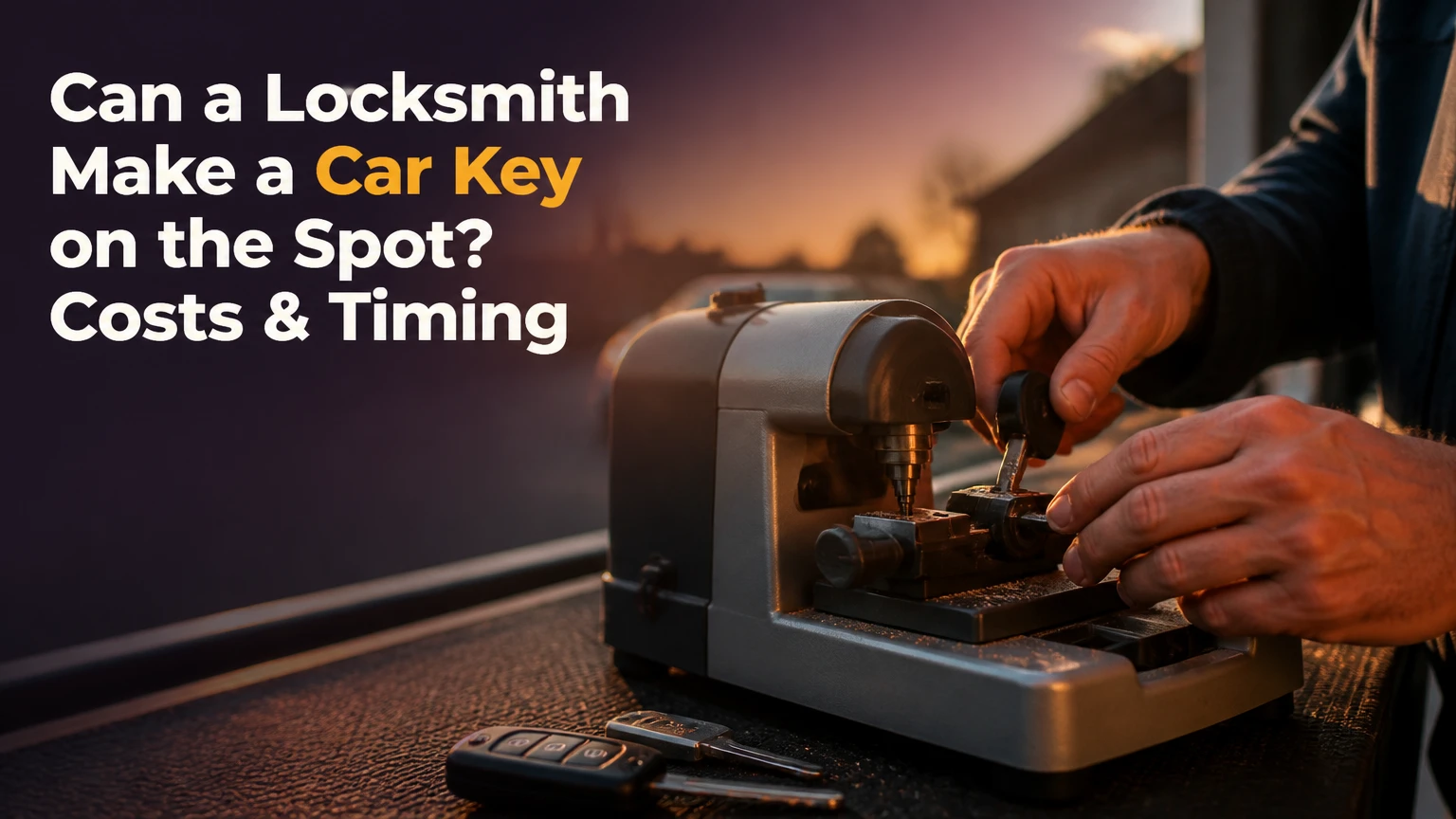
An automotive locksmith can make a car key on the spot when the technician has the correct blank, cutting equipment, programming access, and vehicle-specific software. Mobile locksmith vans commonly carry code-cutting machines, transponder tools, diagnostic programmers, batteries, and multiple key formats.
The main limitation is electronic authorization. Cutting a blade is a mechanical task, but starting a modern vehicle requires the immobilizer to recognize a programmed transponder or smart key. Some manufacturers restrict programming to factory-linked systems, so a locksmith may need to refer certain vehicles to a dealer.
“On the spot” also means at the vehicle’s location, not necessarily immediately after the phone call. A technician may need to source a rare key, verify a restricted vehicle system, or obtain a security code before completing the job.
How Does Mobile Car-Key Replacement Work?
A mobile locksmith generally completes a replacement in six stages: ownership verification, vehicle identification, key-code retrieval or lock decoding, blade cutting, electronic programming, and final testing. The process is usually completed at the parked vehicle because programming requires communication with the car’s immobilizer system.
What should you prepare before calling?
Prepare a government-issued photo ID, vehicle registration or title, the VIN, the vehicle’s exact year, make, model, and trim, and information about any remaining keys. A leasing company, rental agency, or fleet operator may need to authorize the work directly.
Tell the locksmith whether the problem involves lost keys, a broken blade, a damaged ignition, a dead fob battery, or a locked vehicle. Those details determine whether the technician needs a replacement shell, a complete fob, a decoder, or an ignition repair.
Step 1: Verify ownership
The locksmith checks identification and vehicle documents before cutting or programming a key. This theft-prevention step protects the owner and limits unauthorized access to immobilizer systems.
A registration document may list a different current address after a move, so carry a title, insurance card, lease agreement, or fleet authorization when applicable. The technician may record the VIN and document details for the service invoice.
Step 2: Identify the vehicle and key system
The technician confirms the vehicle identification number and determines the correct key profile, transponder type, remote frequency, immobilizer generation, and programming procedure. The VIN provides useful vehicle information, but it does not guarantee that the existing locks are original.
The VIN appears commonly on the dashboard near the windshield and on a label inside the driver-side door area. The locksmith may also read vehicle data electronically through the diagnostic connector.
Step 3: Retrieve the key code or decode the lock
The locksmith may obtain a factory key code from an authorized database or decode the vehicle’s lock when the code is unavailable. A decoder reads the internal positions of wafers or pins so the technician can cut a blade that matches the cylinder.
A physical lock decode becomes especially important when the vehicle has an aftermarket ignition or replacement door lock. In that situation, a VIN-based code may produce a key that fits the original factory specification but does not turn the modified lock.
Step 4: Cut the mechanical key
A computerized duplicator or code-cutting machine creates the blade from a compatible blank. Standard edge-cut keys and laser-cut, also called sidewinder, keys require different blanks and cutting equipment.
A proper cut should turn the lock smoothly without excessive force. A key that works only after wiggling can damage a worn ignition cylinder, even when the blade pattern is technically correct.
Step 5: Program the transponder or remote
The technician connects a diagnostic programmer to the vehicle, often through the OBD-II port, and follows the manufacturer-specific immobilizer procedure. The transponder’s electronic identity must be accepted by the vehicle’s immobilizer or engine control system.
Remote buttons and engine authorization are separate functions on many vehicles. A remote may lock and unlock the doors while the immobilizer still rejects the key, or the engine may start while remote buttons remain unsynchronized.
Step 6: Test every function
The locksmith tests the door locks, ignition, engine start, remote buttons, trunk release, panic button, and proximity detection when those features apply. Testing should include repeated starts and stops rather than one successful ignition cycle.
Ask whether the technician can remove a missing key from the vehicle’s stored key list. Deleting a lost key can prevent that key from starting the vehicle, although the old blade may still mechanically unlock a door on some models.
What Types of Car Keys Can a Locksmith Make?
Automotive locksmiths can make most common vehicle key formats, but capability depends on the vehicle year, manufacturer security system, blank availability, and programming authorization. Mechanical keys are simplest; proximity fobs and encrypted smart-key systems require more equipment and software.
| Key type | Physical feature | Electronic requirement | Typical service time |
|---|---|---|---|
| Standard mechanical key | Edge-cut metal blade | None | 10-15 minutes |
| Laser-cut sidewinder key | Center groove and thicker blade | None or transponder | 15-30 minutes |
| Transponder key | Plastic head with immobilizer chip | Immobilizer programming | 20-40 minutes |
| Remote-head key | Blade and lock/unlock buttons in one body | Chip and remote synchronization | 25-45 minutes |
| Proximity smart key | Push-button vehicle access | Proximity and immobilizer programming | 30-60 minutes |
Standard mechanical keys
Older vehicles and some commercial equipment use a metal key without an electronic chip. A locksmith can cut this type by duplicating an existing key, using a code, or decoding a lock.
A mechanical key may open doors and turn the ignition, but that does not mean every older vehicle lacks an immobilizer. Some vehicles adopted chipped keys before proximity systems became common.
Laser-cut and sidewinder keys
Sidewinder keys have a precision groove or track cut into the blade’s face. They need a compatible high-security cutter, and a standard edge-cut duplicator cannot produce the correct profile.
The term “laser-cut” does not mean every key was literally cut by a laser. Many are produced by computerized milling machines. The important attributes are the blade profile, groove pattern, and vehicle-specific transponder.
Transponder keys
A transponder key contains a coded chip that communicates with an antenna near the ignition. The engine control system allows starting only after the vehicle validates the chip.
A freshly cut transponder key may unlock the doors and turn the ignition while failing to start the engine. That result indicates a programming, chip, antenna, or immobilizer issue rather than necessarily an incorrect blade.
Remote-head keys
A remote-head key combines the mechanical blade, transponder, and keyless-entry buttons. Replacement requires matching both the immobilizer chip and the radio-frequency remote system.
An online replacement may have the correct appearance but the wrong FCC ID, frequency, chip type, or button configuration. The locksmith should verify the original part number and vehicle compatibility before attempting programming.
Proximity smart keys
A smart key allows passive entry and push-button starting when the fob is within the vehicle’s detection range. The fob communicates through low-frequency antennas and radio-frequency signals, while the immobilizer verifies authorization.
A locksmith may supply a complete smart fob or cut and insert an emergency blade for door access. The emergency blade does not replace the electronic programming required for push-button starting.
How Much Does a Replacement Car Key Cost?
A typical mobile locksmith car-key replacement costs about $50-$450 or more in the United States, depending on the key type, vehicle security system, time, location, and whether all keys are lost. A dealer quote may add towing, parts, programming, and appointment delays.
| Replacement type | Typical parts and service price | Typical completion time | Main cost driver |
|---|---|---|---|
| Mechanical key | $50-$100 | 10-15 minutes | Blade profile and service call |
| Sidewinder key | $90-$150 | 15-30 minutes | High-security blank and cutting |
| Transponder key | $120-$250 | 20-40 minutes | Immobilizer programming |
| Remote-head key | $175-$350 | 25-45 minutes | Remote and chip synchronization |
| Proximity fob | $200-$450+ | 30-60 minutes | Fob price and restricted programming |
| Dealer replacement | $250-$900+ | Same day to several days | OEM part, labor, and towing |
These are typical planning ranges, not universal prices. Night, weekend, highway, and remote-area calls may add $25-$150 or more, while a rare imported vehicle can require a special-order key.
Request an itemized quote that separates the mobile service call, key or fob, cutting, programming, emergency surcharge, and tax. A low advertised price may cover only unlocking the vehicle, not creating a functioning replacement key.
How Long Does the Service Take?
Most mobile car-key jobs take 20-60 minutes after the locksmith arrives, although a basic mechanical duplicate may take 10-15 minutes and a restricted smart-key replacement may take longer than an hour. The vehicle’s security architecture and blank availability usually determine the actual duration.
A spare key made while one working key remains is often faster than an all-keys-lost job. The locksmith can duplicate the blade and may use an existing authorized key to simplify programming, depending on the vehicle.
All-keys-lost service can take longer because the technician may need to retrieve security data, reset the immobilizer, decode a lock, and program the first replacement key. Waiting for a rare blank or manufacturer authorization creates the longest delays.
Can a Locksmith Replace a Lost Key Without the Original?
A qualified automotive locksmith can often replace a lost car key without the original by retrieving a key code, decoding a lock, and programming a new transponder or smart key. The vehicle must be present, and ownership verification is required before the locksmith performs the work.
The missing original is not always necessary because the vehicle’s lock configuration and immobilizer data provide alternative ways to create a replacement. A locksmith may use the door lock, ignition cylinder, VIN, or diagnostic system.
Ask for lost-key deletion when security matters. The technician may erase the missing key from the immobilizer’s authorized list, but that electronic deletion does not always prevent the old metal blade from opening a door.
What If the Ignition or Door Lock Was Replaced?
A VIN-based key may fail when a previous owner, repair shop, or vehicle thief replaced the ignition cylinder or door lock. The locksmith must identify which lock the new key needs to operate and may decode that cylinder directly.
This issue is common in older vehicles with worn ignitions and vehicles repaired after theft. A key can match the factory VIN code while failing to turn the replacement ignition, creating the misleading impression that the cutting machine made an error.
A locksmith may cut a key to the current cylinder, rekey the lock, or replace the cylinder so multiple locks use one key. Mechanical rekeying does not automatically program a transponder, so electronic authorization remains a separate task.
Can a Locksmith Program a Transponder or Smart Key?
A mobile automotive locksmith can program many transponder keys, remote-head keys, and smart fobs at the vehicle, but programming access varies by manufacturer and model year. The technician needs a compatible programmer, the correct key or fob, and an authorized security procedure.
Some vehicles permit independent programming after a security PIN or immobilizer challenge. Other vehicles require a live manufacturer account, online authorization, or a dealer-only process, particularly newer luxury models with encrypted key systems.
Do not assume that physical compatibility equals programming compatibility. The key must match the vehicle’s frequency, chip family, firmware, blade profile, and immobilizer generation.
Is a Locksmith Cheaper Than a Dealership?
A locksmith is usually cheaper when the technician can supply and program the correct key at the vehicle, because the owner avoids dealership labor rates and towing. A dealership becomes the practical choice when the manufacturer restricts immobilizer programming or the vehicle needs an OEM-only component.
| Decision factor | Mobile locksmith | Dealership | DIY or online seller |
|---|---|---|---|
| Vehicle location | At the parked vehicle | Dealer lot | Owner handles transport |
| Mechanical cutting | On-site equipment | Dealer machine | Owner or separate cutter |
| Immobilizer access | Model-dependent | Factory system | Model-dependent and limited |
| Typical total price | $50-$450+ | $250-$900+ | $40-$300 before failures |
| Lost-key deletion | Often available | Usually available | Frequently unavailable |
| Warranty and fit | Provider-specific | OEM policy | Seller-specific |
| Main delay | Rare blank or software | Appointment or parts order | Incorrect part or failed programming |
A dealer may provide a factory part with predictable warranty support. A locksmith may provide a compatible aftermarket fob at lower cost, but the owner should confirm the warranty, source, and return policy before work begins.
When Does DIY Key Programming Make Sense?
DIY replacement makes sense mainly for a planned spare when the vehicle supports owner programming and at least one working key remains. It is a poor emergency option when all keys are lost, the car is immobilized, or the key requires specialized diagnostic access.
Before buying online, verify the vehicle’s year, model, trim, FCC ID, frequency, chip type, blade profile, and programming method. A visually identical fob can contain incompatible electronics.
| DIY situation | Working key needed | Typical parts cost | Risk level |
|---|---|---|---|
| Mechanical duplicate | Yes, usually | $5-$30 | Low |
| Basic remote replacement | Usually yes | $30-$100 | Moderate |
| Transponder spare | Often yes | $40-$150 | Moderate |
| Smart-key replacement | Model-dependent | $80-$300 | High |
| All-keys-lost programming | No | $100-$400 | High |
The cheapest online key can become expensive after a failed programming attempt, a nonreturnable purchase, or a second mobile service call. Confirm compatibility before cutting the blade because some sellers reject cut or programmed returns.
Why Does the New Key Turn but Not Start the Car?
A new key that turns the ignition but does not start the engine usually has a correct mechanical cut but an unprogrammed, incompatible, or damaged transponder chip. A flashing security indicator often accompanies an immobilizer rejection, although dashboard behavior varies by vehicle.
Ask the locksmith to test the key’s chip, confirm the programming result, and inspect the immobilizer antenna around the ignition. A failed antenna ring, low vehicle battery, or incorrect immobilizer procedure can produce the same symptom.
A remote that locks the doors does not prove that the transponder is authorized. Remote entry and engine-start authorization frequently use separate electronic functions.
What If the Buttons Work but Push-Button Start Does Not?
Working remote buttons with failed push-button starting usually indicate a proximity-fob, immobilizer, vehicle-battery, or emergency-start procedure problem. The fob battery may be weak, but replacing the battery alone will not fix an incorrectly programmed fob.
Hold the fob against the manufacturer-specified backup location, such as a marked steering-column area, start button, or center console, if the owner’s manual identifies one. This test can distinguish a weak fob battery from a missing authorization.
If the vehicle still rejects the fob, the locksmith should verify the fob part number, proximity signal, immobilizer registration, and vehicle voltage. Repeated button presses rarely resolve a programming failure.
Which Vehicles May Require a Dealership?
Newer vehicles with manufacturer-restricted immobilizer systems may require dealership involvement, especially when independent programmers cannot obtain security authorization. Examples can include certain late-model BMW, Mercedes-Benz, Volvo, Audi, Jaguar, Land Rover, and other high-security platforms, but capability changes by model, year, market, and module.
Call the locksmith first with the full VIN rather than relying on the badge alone. Some independent technicians have legitimate online access for vehicles that other locksmiths cannot service, while a dealer may still be necessary for a particular immobilizer generation.
A dealer referral is a limitation, not evidence that the locksmith lacks basic skill. Security credentials and factory network permissions determine access.
What Mistakes Should You Avoid?
The most expensive mistakes involve ordering the wrong electronic part, omitting an aftermarket lock change, accepting an incomplete quote, and towing the vehicle before checking mobile availability. Accurate vehicle information prevents most avoidable delays.
- Do not quote only the model name. Provide year, trim, VIN, key type, and whether the engine starts with a blade or button.
- Do not buy by appearance. Match the FCC ID, part number, frequency, chip, and button layout.
- Do not hide a replacement ignition. A VIN code may not match the current cylinder.
- Do not accept a vague price. Ask whether cutting, programming, taxes, and after-hours charges are included.
- Do not skip ownership documents. The technician may legally refuse service without verification.
- Do not tow first. Confirm whether a mobile locksmith can program the vehicle where it sits.
A practical rule is to request two quotes and ask each provider to state the exact key technology they will supply. The cheapest quote is not comparable if one provider includes only a blade while another includes immobilizer programming.
How Can You Choose a Reliable Mobile Locksmith?
Choose a locksmith who identifies the exact vehicle and key system before giving a final estimate, explains ownership verification, and states whether the replacement is OEM, aftermarket, or refurbished. A credible provider also gives a business name, service area, arrival estimate, and payment terms.
Check licensing requirements in your state or locality, insurance information, recent reviews, and whether the business uses a verifiable physical or registered service address. A technician who refuses to explain programming limits may be outsourcing the job or advertising an incomplete service.
Ask these questions before dispatch:
- What is the total price, including the service call, cutting, programming, and tax?
- Is the replacement key new, used, aftermarket, or OEM?
- Can you program this exact year, model, and VIN on site?
- Can you delete the lost key from the immobilizer memory?
- What happens if the supplied key fails or does not match the vehicle?
- What ownership documents should I show?
Does Insurance or Roadside Assistance Pay for a New Key?
Roadside assistance often covers vehicle entry, jump starts, or towing but may exclude the actual replacement key and programming charge. Comprehensive auto insurance may cover stolen keys in some policies, while lost-key coverage, rental agreements, and manufacturer roadside plans differ.
Call the insurer or roadside provider before authorizing work if the situation is safe and the vehicle is not creating a hazard. Ask whether using an outside locksmith is permitted and whether the claim requires photographs, a police report, an invoice, or preapproval.
A locksmith invoice should identify the vehicle, service performed, key type, programming, and payment. Keep the old damaged key, broken fob shell, or theft report when the policy requests evidence.
Frequently Asked Questions
Can a locksmith make a car key from the VIN?
A locksmith can often use the VIN to retrieve a factory key code, but the VIN alone does not physically create or program every replacement key. The vehicle must usually be present, ownership must be verified, and an aftermarket ignition or door lock may require direct decoding instead.
Can a locksmith make a key for a car that is locked?
A mobile locksmith can usually unlock the vehicle and then create a replacement key, provided the technician has the correct equipment and proof of ownership. Unlocking the doors does not automatically solve transponder programming, so the vehicle may need additional diagnostic work before it starts.
Can a locksmith make a key if the car battery is dead?
A locksmith can often cut the blade with a dead vehicle battery, but electronic programming may require a charged battery or an external power supply. The technician may connect a stabilized power source before using the diagnostic programmer to prevent interrupted immobilizer communication.
Is a spare car key cheaper than an all-keys-lost replacement?
A spare key is usually cheaper than an all-keys-lost replacement because an existing authorized key can simplify duplication and programming. Typical savings vary by vehicle, but the owner also avoids emergency dispatch charges, lock decoding, security resets, and possible towing.
Can a locksmith repair a broken car key instead of replacing it?
A locksmith can often replace a damaged shell, transfer a working transponder, repair buttons, or cut a new blade when the electronic component remains functional. A crushed, water-damaged, or intermittently recognized chip usually requires a complete replacement and programming test.
Should you make a spare key before losing the last one?
Making a spare key before losing the last working key is usually the lowest-risk option. A planned duplicate avoids an all-keys-lost reset, gives the technician a reference for the blade and fob, and may reduce both service time and total price.
The Bottom Line
Can a locksmith make a car key on the spot? In most cases, yes: a mobile automotive locksmith can cut the blade and program the electronic key at the vehicle in roughly 20-60 minutes. Confirm the total price, bring ownership documents, disclose any replaced locks, and verify programming capability for the exact VIN before dispatch.