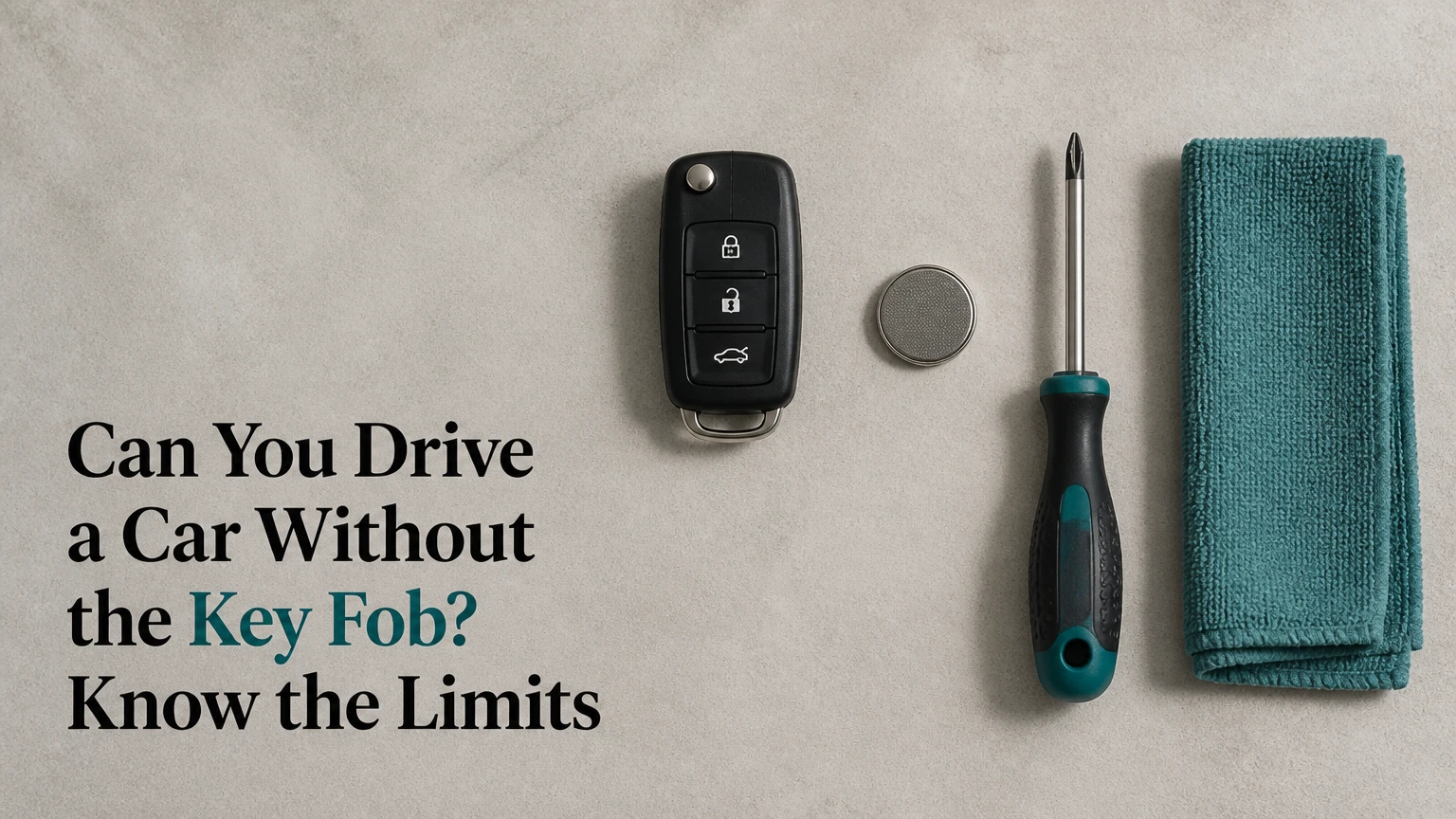
Yes, a car can usually be driven without the physical key fob if the engine has already started, but the vehicle may display a “Key Not Detected” warning and may not restart after shutdown. A dead fob battery is different: most modern vehicles provide a backup transponder-reading location that can authorize starting when the fob battery cannot transmit.
Key Facts at a Glance
- A running vehicle usually continues operating after its key fob leaves the detection area, but restart behavior depends on the manufacturer and model.
- A dead coin-cell battery does not always make a smart key unusable because many fobs contain a passive immobilizer transponder.
- The backup starting location may be the start button, center console, cup holder, steering column, or another position specified in the owner’s manual.
- A smartphone key works only when the vehicle supports that feature and the phone, account, Bluetooth connection, and digital-key setup meet the manufacturer’s requirements.
- Remote start does not automatically mean the vehicle can be driven without a recognized key, because some cars require a valid fob before shifting out of Park.
- Turning off a car that cannot detect its key can leave the driver stranded, especially at a fuel station or unfamiliar location.
Can You Drive a Car Without the Key Fob?
You can generally drive a push-button-start car without the key fob only when the engine was authorized and started before the fob disappeared. The immobilizer normally checks for the credential during startup, while the vehicle’s control modules do not continuously stop a moving engine merely because the fob is no longer nearby.
The dashboard may show “No Key Detected,” “Key Not in Vehicle,” or a similar message. The warning does not necessarily mean the engine will stop immediately. It does mean the next start attempt is uncertain, and some vehicles impose additional restrictions after a door is opened or the ignition cycle changes.
The safest rule is simple: drive directly to a safe destination, avoid switching the engine off, and arrange for the original fob, a spare, or manufacturer-approved roadside assistance. Do not treat a running engine as proof that the vehicle can be restarted later.
What changes when the engine is already running?
The vehicle’s immobilizer has already accepted a valid authentication event. Depending on the vehicle architecture, the engine control module can then maintain operation without repeated proximity confirmation.
That behavior is not universal. Some models may issue repeated warnings, restrict certain functions, or shut down after a remote-start cycle. Read the owner’s manual for the exact year and trim rather than relying on another vehicle’s behavior.
| Situation | Can the car move? | Can it restart later? | Main risk |
|---|---|---|---|
| Engine started with recognized fob, fob then removed | Usually yes | Often no | Stranding after shutdown |
| Fob battery dead, physical fob present | Usually yes after backup start | Usually yes | Incorrect backup-reader location |
| Fob completely missing before startup | Usually no | No, without another credential | Immobilizer denies authorization |
| Remote-started vehicle without fob | Often engine runs only | Usually not for normal driving | Shift lock remains active |
| Traditional metal key left outside the car | No new start | No | Mechanical ignition or transponder requirement |
How Does a Keyless Ignition System Recognize a Fob?
A keyless ignition system uses a vehicle antenna, a cryptographic transponder, and an immobilizer controller to confirm that an authorized credential is present. Passive keyless-entry systems commonly use low-frequency vehicle-to-fob signaling and a higher-frequency radio response, although exact frequencies, encryption methods, and antenna layouts vary by manufacturer and region.
A typical sequence works like this:
- The vehicle antenna sends a short-range request.
- The fob wakes and identifies itself.
- The vehicle checks the response against its stored authorization data.
- The body control module or immobilizer authorizes ignition.
- The engine control module permits starting when the brake or clutch conditions are satisfied.
The fob’s remote-locking functions generally rely on its coin-cell battery. The immobilizer transponder may use a separate passive circuit that receives energy from a nearby backup antenna, which explains why a fob with a dead battery can still start some vehicles.
Published automotive documentation describes several radio bands, including 125 kHz low-frequency challenge signals and 315 MHz or 433 MHz responses in some markets. Those figures are examples, not a universal specification. The owner’s manual remains the authoritative source for the vehicle’s procedure.
Is the key fob checked continuously while driving?
The key fob is commonly checked during authorization and periodically monitored for presence, but a lost signal does not usually cause an immediate shutdown while the vehicle is moving. Manufacturers avoid suddenly disabling propulsion in traffic, yet the warning and restart consequences differ by model.
A missing-key warning can also result from radio interference, a weak fob battery, a failing vehicle antenna, or a discharged vehicle battery. Treat the warning as a real credential problem until testing proves otherwise.
What Happens if the Fob Battery Dies?
A dead key-fob battery usually prevents remote locking and passive entry, but it may not prevent engine starting. Many vehicles place a passive transponder inside the fob and provide a designated backup reader that can read the credential at very close range.
The exact procedure is vehicle-specific. Nissan, Toyota, Honda, Ford, Hyundai, Kia, General Motors, Volkswagen, and other manufacturers place the emergency reader in different locations. Some instruct the driver to hold the fob against the start button; others specify a console pocket, cup holder, steering-column area, or floor console.
Do not assume every fob contains the same passive technology. Some newer systems use a digital key or a different emergency procedure, and some vehicles require a replacement battery before normal operation resumes.
How do you start a car with a dead key fob?
Use the vehicle’s hidden mechanical key to enter, then place the fob at the manufacturer-designated backup reader before pressing the start control. The process normally takes 1-5 minutes when the location is known, but the alarm and exact pedal sequence vary by model.
- Remove the emergency key blade. Press the release latch on the fob and slide out the metal key. Do not force the casing, because some housings use a second locking tab.
- Unlock the driver’s door manually. A plastic cap may conceal the lock cylinder beneath or beside the handle. Use the key blade carefully to avoid scratching painted trim.
- Expect an alarm response. Manual entry can trigger the horn or security alarm. Keep the fob available and proceed to the starting procedure.
- Locate the backup reader. Check the owner’s manual, roadside-assistance guide, or manufacturer support app. Common locations include the start button, a console pocket, a cup-holder recess, or the steering column.
- Press the brake or clutch. Automatic vehicles normally require the brake pedal; manual-transmission vehicles may require the clutch.
- Touch or place the fob at the reader. Hold the fob in the specified position while pressing the start button.
- Confirm authorization. The “Key Not Detected” message should disappear, the instrument cluster should enter its normal start sequence, and the engine should run.
A common mistake is replacing the fob battery but installing it upside down. Another is holding the fob near the start button when the vehicle requires direct contact with a console slot. Success depends on the model’s antenna location, not on a universal “best” position.
Can You Drive With the Key Fob Left at Home?
You can often drive away after starting the car with the fob, but you should not plan to operate the vehicle this way. The dashboard warning may appear immediately or after the vehicle moves away from the credential, and the car may not restart after the engine is turned off.
The vehicle will not normally know whether the fob is at home, in another vehicle, or blocked by radio interference. It recognizes only whether a valid credential is detected. If the fob was left behind, return for it before starting whenever possible.
How far can a car drive without the key fob?
There is usually no fixed mileage or distance limit once the engine is running. The practical limit is the amount of fuel, battery charge, and mechanical reliability remaining before shutdown, not a guaranteed radio range.
This does not mean the vehicle can travel safely for an unlimited time. A stop for fuel, a battery fault, an accidental ignition press, or a traffic incident can end the journey. The sensible response is to drive only to a safe destination and retrieve a valid credential.
Can You Start a Car Without the Fob at All?
You normally cannot start a modern immobilized vehicle without an authorized fob, programmed transponder, manufacturer digital key, or approved emergency credential. A push-button ignition is not a bypass device; the button starts the authorization sequence, but the immobilizer must still accept the credential.
A vehicle that has been remote-started creates a frequent misunderstanding. Remote start may allow the engine to run while the doors remain locked, but the car can still require the fob, phone key, PIN, or other credential before the transmission shifts from Park.
Do not attempt wiring changes, immobilizer bypasses, signal replay, or unauthorized programming. Those actions can damage body-control modules, invalidate insurance coverage, create theft exposure, or violate local law. A dealer, licensed automotive locksmith, or roadside provider can verify ownership and program a replacement.
Which Key-Fob Alternatives Can Replace the Physical Fob?
A manufacturer-supported smartphone key, NFC card, keypad PIN, or mechanical emergency key can sometimes replace daily fob carrying, but each option has different prerequisites and failure modes. The alternative must be approved for the exact vehicle, software version, market, and trim.
| Alternative | Typical setup time | Typical cost | Credential requirement | Main limitation |
|---|---|---|---|---|
| Smartphone app unlock | 5-20 minutes | Free to about $150 per year | Active owner account and cellular service | Cloud outage or poor signal |
| Bluetooth phone-as-key | 5-15 minutes | Often included | Compatible phone, app, Bluetooth, digital-key enrollment | Dead or reset phone |
| NFC smart card | 5-10 minutes | About $20-$50 | Vehicle-specific enrolled card | Very short tap distance |
| Manufacturer keypad PIN | 5-15 minutes | Usually included if equipped | Stored vehicle PIN | Only available on equipped models |
| Mechanical backup key | Immediate if supplied | Included with original fob | Physical lock cylinder | Usually unlocks doors, not ignition |
| Dealer or locksmith replacement | 1-3 hours typically | About $150-$600 | Ownership verification and vehicle data | Price varies by brand and key type |
Phone-as-key systems may use Bluetooth Low Energy, NFC, ultra-wideband, or a combination. Some vehicles permit passive unlocking when the phone is nearby; others require opening an app or tapping the phone against a reader.
Cellular service is not always required for the final act of unlocking or starting when a digital key is stored locally, but cellular service may be needed for account authentication, remote commands, or initial enrollment. Manufacturer instructions determine the exact dependency.
What Is the Best Option for Different Situations?
The best solution depends on whether the problem is a dead battery, a lost credential, a dead phone, or a deliberate desire to carry less equipment. A physical spare remains the most broadly reliable option because it does not depend on a mobile app, cloud service, or phone battery.
| Situation | Best first choice | Backup choice | Avoid relying on |
|---|---|---|---|
| Fob coin cell is dead | Backup reader procedure | New CR2032 or CR2025 cell | Repeatedly pressing the start button |
| Fob is lost nearby | Spare fob retrieval | Dealer or automotive locksmith | Driving until the engine eventually stops |
| Phone battery is dead | Physical fob or NFC card | Vehicle keypad PIN | Cloud-only remote unlock |
| Outdoor activity | Waterproof NFC card if supported | Mechanical key and secured fob | Leaving an active fob loose inside the car |
| Rental vehicle problem | Rental company assistance | Manual and supplied spare | Programming an unofficial replacement |
| Vehicle battery is discharged | Jump-start or roadside service | Battery replacement | Assuming the fob battery caused the issue |
A Faraday pouch can reduce passive keyless-entry exposure when storing a fob, but it does not make a vehicle theft-proof. The pouch must actually attenuate the relevant radio signals, and a damaged or poorly closed pouch may provide little protection.
What Does a Replacement Fob Cost?
A replacement key fob typically costs about $150-$600 after the hardware, cutting, programming, and labor are included. Basic remote transmitters can cost less, while proximity fobs for luxury vehicles, newer security systems, and dealer-only programming can cost substantially more.
| Repair or replacement | Typical parts cost | Typical total cost | Typical time |
|---|---|---|---|
| CR2032 or CR2025 battery | $2-$8 | $2-$15 | 2-10 minutes |
| Physical emergency key blade | $10-$40 | $20-$80 | 15-60 minutes |
| Compatible aftermarket fob | $40-$180 | $100-$350 | 30-120 minutes |
| OEM proximity fob | $100-$400 | $250-$600 | 1-3 hours |
| Automotive locksmith visit | Included in service | $100-$400 | 30-120 minutes |
| Dealer replacement and programming | Included in service | $200-$800 | 1-4 hours |
Prices are typical United States ranges, not fixed quotes. A dealer may require every remaining key to be present during programming, while some locksmiths can add a credential after verifying ownership and vehicle compatibility.
The cheapest online fob is not necessarily usable. Frequency, encryption generation, FCC or regional certification, button layout, transponder type, and programming compatibility all matter.
Why Does the Car Say “Key Not Detected”?
A “Key Not Detected” warning usually means the vehicle cannot validate a fob or digital credential at that moment. The common causes are a weak fob battery, excessive distance, radio interference, a damaged fob, a failed vehicle battery, or a fault in the vehicle’s antenna or immobilizer module.
Try the following diagnostic order:
- Move the fob into the passenger compartment and away from metal objects.
- Remove the fob from a wallet, RFID sleeve, wireless charger, or other electronic device.
- Replace the coin cell with the correct type and polarity.
- Use the emergency reader position described in the owner’s manual.
- Test the spare fob if one exists.
- Check whether the vehicle battery is weak or the interior electronics are behaving abnormally.
- Contact the manufacturer, dealer, or licensed locksmith if both credentials fail.
A phone charger, dash camera, security gate, or other transmitter can create local interference, although persistent failure in multiple locations points more strongly to a battery, antenna, or programming problem.
Can a jump-start fix a key-fob problem?
A jump-start can restore a vehicle with a discharged 12-volt battery, but it does not normally repair a dead fob coin cell or erase an immobilizer failure. Low vehicle voltage can temporarily create misleading key-recognition messages because body-control modules and antennas need stable power.
Do not disconnect the negative battery terminal as a routine reset. Modern vehicles can lose window settings, radio codes, learned idle values, alarm settings, or diagnostic data, and battery disconnection does not reliably resynchronize rolling codes. Follow the service manual or use roadside assistance.
What Should You Do if the Fob Is Completely Lost?
If the fob is completely missing, use a registered digital key, an enrolled NFC card, a keypad PIN, a spare fob, or verified roadside assistance. An app that can unlock the doors may not authorize driving, so confirm that the alternative supports both entry and ignition.
A dealer or automotive locksmith will typically request the vehicle identification number, registration, identification, and proof of ownership. Some providers can delete the missing fob from the vehicle’s authorized-key list, which reduces the risk that a finder can use it later.
If the lost fob may have been stolen, ask for all missing credentials to be erased and the remaining keys to be re-enrolled. Also inspect connected services, change account passwords, and remove unknown digital keys from the manufacturer’s app.
What Common Mistakes Leave Drivers Stranded?
The most damaging mistake is shutting down a vehicle that has already warned that its key is absent. A second mistake is assuming that a dead fob battery and a missing fob require the same solution, because the first may be recoverable through a passive transponder while the second requires another authorized credential.
Mistake 1: Turning off the engine at a short stop
A vehicle that started without a present fob may not restart after a fuel stop, store visit, or delivery. If the warning is active, reach a safe destination before switching off the ignition.
Mistake 2: Assuming every start button is the backup reader
Some vehicles require the fob to touch the button, while others use a separate console pocket. Pressing the fob against the wrong surface wastes time and may trigger repeated alarm cycles.
Mistake 3: Keeping a spare fob in the glove box
A fob stored inside the vehicle can keep proximity antennas active and may make theft easier if the vehicle detects the credential. Use a secure off-car location, and follow the manufacturer’s guidance for disabling passive entry.
Mistake 4: Buying the first replacement fob online
An apparently identical case can contain a different frequency, transponder, or encryption generation. Verify the exact part number and programming method before purchasing.
Mistake 5: Treating a phone app as a complete spare key
Remote door unlocking, remote start, and phone-as-key are separate functions. Test the phone key before an emergency and keep a physical or wallet-sized fallback.
How Can You Prepare for a Future Fob Failure?
Replace the fob coin cell when the vehicle displays a low-battery warning or the remote range becomes noticeably shorter. Most common cells are CR2032 or CR2025, but the correct size and polarity are printed on the existing battery or specified in the manual.
Keep the emergency key blade with the fob rather than separating it and forgetting its location. Store the owner’s manual digitally, record the vehicle identification number, and confirm where the backup reader is before a failure occurs.
A practical preparedness setup includes:
- One tested spare fob stored away from the vehicle.
- One new, correctly sized coin cell.
- The manufacturer roadside-assistance number.
- A note identifying the emergency reader location.
- A charged phone and active vehicle app account.
- A waterproof wallet card or keypad PIN when the vehicle supports one.
The most useful practitioner rule is to test the backup start procedure while parked at home, not for the first time in a dark car park. The test confirms whether the fob, vehicle battery, alarm, and backup antenna all function together.
Frequently Asked Questions
Will a car shut off if the key fob leaves while driving?
Most modern vehicles do not immediately shut off propulsion when the authorized key fob leaves the cabin. The vehicle usually displays a warning and permits continued driving until the engine is turned off, but model-specific exceptions exist, particularly with remote-start systems or unusual security configurations.
Can someone drive away with my key fob?
Someone may drive away if the vehicle has already been started with the fob, even after the fob is removed. The vehicle will commonly warn that the key is absent rather than stop immediately. Once the engine is switched off, the missing fob generally prevents another normal start.
Can you start a push-button car with only the emergency metal key?
The emergency metal key usually unlocks the door but does not authorize a push-button ignition. Starting normally requires the electronic fob, a passive transponder, a registered digital key, an NFC card, or another credential supported by that vehicle.
Does remote start let you drive without a key fob?
Remote start usually lets the engine run without placing the fob in the vehicle, but many cars keep the transmission locked in Park until a recognized fob or digital key is present. Remote-start capability and drive authorization are separate security functions.
How long does a key-fob battery usually last?
A key-fob coin cell commonly lasts about 1-3 years, depending on button use, passive-entry polling, temperature, and storage conditions. Reduced operating range, delayed locking, or a dashboard low-battery message indicates that replacement should happen before the battery fails completely.
Is a dead car battery the same as a dead key-fob battery?
No. A dead fob battery affects the credential’s remote and proximity functions, while a dead vehicle battery prevents the car’s electronics, starter, and antennas from operating normally. A passive backup reader may overcome a dead fob cell, but it cannot start a vehicle with no usable 12-volt power.
The Bottom Line
Can you drive a car without the key fob? Usually, yes, if the engine was already started with an authorized credential, but the vehicle may not restart after shutdown. A dead fob battery often has a manufacturer-provided backup procedure, while a completely missing fob requires a spare, digital key, NFC card, PIN, dealer, locksmith, or roadside service. Keep driving only to a safe destination, avoid switching off the engine, and use the owner’s manual for the exact vehicle-specific procedure.