Your car says “No Key Detected” because the immobilizer or keyless-start system cannot validate the electronic key fob’s signal. The most common causes are a weak fob battery, a discharged 12-volt vehicle battery, signal obstruction, or a failed fob, antenna, receiver, or control module. The warning may prevent the engine from starting.
Key Facts at a Glance
- A dead key-fob battery usually disables remote buttons first, but many cars still start when the fob is placed at a designated backup reader.
- A weak 12-volt battery can cause “No Key Detected,” dim lights, clicking, multiple warning messages, or erratic electronic behavior.
- The emergency-start location varies by make, model, and year; common locations include the Start button, center console, cupholder, glovebox, and steering-column area.
- Testing a spare fob is more informative than guessing because it separates a bad key from a vehicle-side communication fault.
- Replacing a coin cell does not repair a damaged, unprogrammed, water-contaminated, or physically broken key fob.
- A typical fob battery costs $3-$10, while diagnosis and programming can cost $100-$600 depending on the vehicle.
Why Does My Car Say No Key Detected?
A “No Key Detected” message appears when the vehicle’s passive keyless entry and start system fails to complete authentication with the key fob. The failure can occur because the fob is not transmitting, the vehicle cannot receive the transmission, the car’s 12-volt supply is too low, or the immobilizer does not recognize that particular key.
The warning does not always mean the key is far away. A fob can be inside the cabin and still remain unreadable if its coin-cell battery is depleted, its internal antenna is damaged, or the vehicle has a receiver or wiring fault. Some vehicles also display the message when the fob is outside the permitted cabin detection zone.
A single occurrence after leaving the fob beside a wireless charging pad is less concerning than a warning that becomes more frequent over several weeks. Reduced locking range, intermittent detection, and a weak fob LED point toward the fob battery. Normal fob operation combined with dead dashboard electronics points toward the vehicle battery.
What does the warning prevent?
The immobilizer prevents engine authorization until the vehicle validates an approved transponder or smart key. Door locking and engine starting are related but separate functions, so a car can unlock with a mechanical key or remote button yet still refuse to start.
Some cars show “Key Not Detected,” “No Key,” “Key Fob Not Detected,” or “Hold Key Near Start Button.” The wording differs, but the diagnostic principle is the same: the car did not receive an acceptable key response at the required time.
How Does the Car Recognize the Key Fob?
A passive keyless system uses short-range vehicle antennas to send a low-frequency challenge, then receives an authenticated response from the fob through a radio-frequency transmitter. The body control module, smart-key ECU, or immobilizer control unit checks the response before allowing the powertrain control system to authorize starting.
Typical passive keyless systems use LF communication around 125 kHz for localization or wake-up and an RF response commonly near 315 MHz or 433 MHz, although regional allocations and vehicle designs differ. Some newer systems add Bluetooth Low Energy or ultra-wideband features for phone-based access and more accurate location detection.
The exchange generally follows this sequence:
- A cabin antenna sends a challenge to locate an authorized fob.
- The fob wakes and responds with encrypted identification data.
- The vehicle checks the response against its stored key credentials.
- The immobilizer authorizes starting only after successful validation.
The system is not a simple broadcast radio remote. A key fob can light its buttons and still fail the vehicle’s immobilizer authentication because the transponder, internal circuit board, synchronization data, or antenna has failed.
What Should I Do First?
Start with the fastest isolation test: remove the fob from a crowded pocket, place it inside the cabin, press the brake firmly, and use the manufacturer’s emergency detection position. This process takes approximately 2-10 minutes and requires no tools unless the fob battery must be replaced.
Step 1: Remove likely obstructions
Take the fob away from a smartphone, smartwatch, laptop, magnetic wallet, metal key ring, loose coins, and another electronic key. Do not leave the fob inside a metal storage box or bag. Move aftermarket USB chargers, wireless charging accessories, and radar detectors away from the center console.
Signal interference is possible, but it is often overdiagnosed. A phone in the same pocket usually does not permanently disable a healthy automotive key; a weak fob battery or poor vehicle voltage is more likely when the problem repeats in multiple locations.
Success checkpoint: The car detects the key normally after the fob is isolated.
Common mistake: Repeatedly pressing the Start button without holding the brake. Many push-button vehicles will not begin the detection and authorization sequence correctly unless the brake pedal is fully depressed.
Step 2: Use the backup detection position
Hold the entire fob against the Start button while pressing the brake, unless the owner’s manual specifies another location. If that fails, check the center console, cupholder, glovebox, armrest, or steering-column shroud for a marked slot or reader.
The backup reader is usually a passive antenna that can detect the fob’s immobilizer transponder even when the coin-cell battery has no usable power. The exact procedure is not universal, and forcing the fob into an unmarked compartment can damage the case or fail to activate the correct antenna.
Success checkpoint: The engine starts and the warning disappears or changes to a normal ignition message.
Common mistake: Assuming the emergency position is always the Start button. On some Nissan, Hyundai, Kia, Toyota, Lexus, BMW, Mercedes-Benz, and General Motors vehicles, the designated location differs by model year.
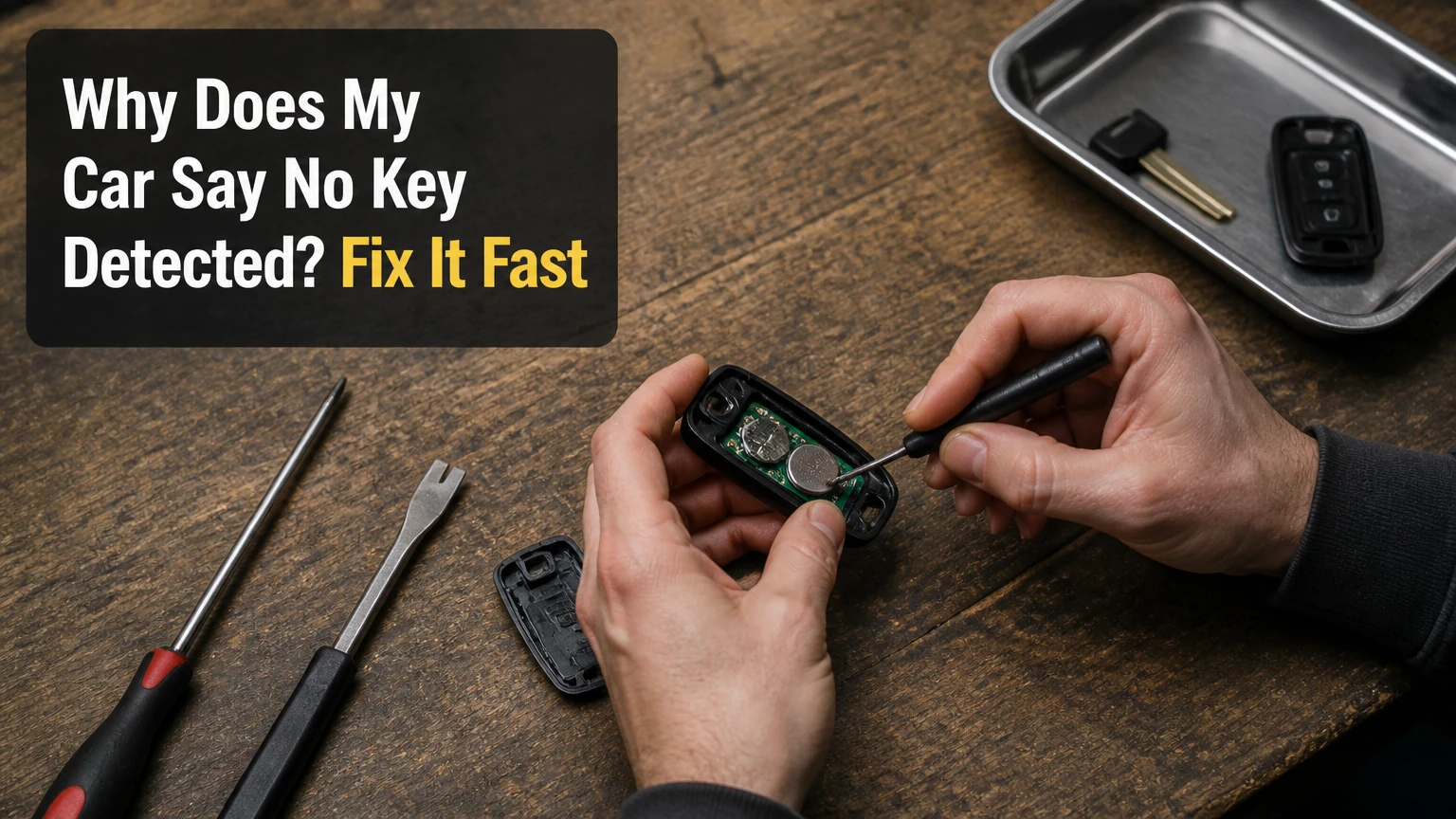
Step 3: Test the fob battery
Press a lock or unlock button while watching the fob’s indicator LED. A missing LED response suggests a depleted coin cell, but a working LED does not prove that the battery has adequate voltage under load.
Replace the battery with the exact type printed on the old cell or in the owner’s manual, commonly CR2032 or CR2025. Match the positive and negative orientation, avoid bending the contacts, and keep the circuit board free from fingerprints and moisture.
Success checkpoint: Remote range returns and the vehicle detects the fob without the backup position.
Common mistake: Installing a correctly sized battery upside down. Another common error is fitting a CR2025 where the case requires a CR2032, which can create poor contact even though both cells have the same nominal voltage.
Step 4: Check the vehicle’s 12-volt battery
Turn on the headlights, cabin lights, radio, and instrument panel. Dim lights, rapid relay clicking, a slow starter, flickering displays, or several unrelated warning messages indicate a possible low-voltage condition.
A fully charged 12-volt battery typically measures about 12.6 volts at rest, while readings near 12.2 volts indicate partial discharge and readings below approximately 12.0 volts indicate a deeply discharged battery. Measure with a multimeter after the vehicle has been off for at least 30 minutes; hybrid and electric vehicles still use a separate 12-volt system for many control functions.
Success checkpoint: The vehicle starts normally after a proper jump-start or battery recharge, and the key warning does not return.
Common mistake: Replacing the fob battery when the interior lights cannot turn on. A failed vehicle battery must be tested and repaired first.
How Can I Tell Which Battery Failed?
The fob battery is the leading suspect when the car’s electronics work normally, the remote range declined gradually, and a spare key operates the vehicle. The 12-volt battery is more likely when both keys fail simultaneously and the dashboard, locks, headlights, or starter behave abnormally.
| Diagnostic observation | More likely cause | Immediate test | Typical next action |
|---|---|---|---|
| Remote range declined over weeks | Fob coin cell | Install CR2032 or CR2025 | Retest remote and backup start |
| Fob LED stays dark | Fob battery or circuit | Fit a verified new cell | Inspect contacts and case |
| Both fobs fail together | Vehicle battery or receiver | Measure 12-volt voltage | Charge, test, or replace battery |
| Dim lights and clicking starter | Low 12-volt supply | Jump-start or load-test battery | Battery service and charging-system test |
| One fob fails, spare works | Damaged or unprogrammed fob | Compare both keys | Repair or program failed fob |
| Car starts only against button | Weak fob transmission or receiver issue | Try new cell and spare key | Diagnose fob and antenna system |
A battery tester is more useful than a voltage reading alone because a worn 12-volt battery can show acceptable resting voltage yet collapse under starter load. Aftermarket accessories that remain powered overnight can also discharge the battery without creating a key-fob fault.
Can a Phone or Charger Block the Signal?
A phone, metal object, or accessory can reduce detection reliability in a particular location, but ordinary smartphones are not the most common explanation for a persistent warning. The stronger practical suspects are a weak fob battery, low vehicle voltage, damaged fob, incorrect key programming, or a failed antenna.
Move the fob at least 30 centimeters away from wireless charging pads, USB hubs, high-power inverters, and other transmitters. Unplug inexpensive aftermarket chargers from the 12-volt socket because poor electrical filtering can introduce radio-frequency noise or drain the vehicle battery.
High-voltage infrastructure and commercial radio equipment can produce localized interference, but drivers should not assume that a nearby power line or radio tower is responsible without a repeatable pattern. If the warning occurs in one parking location and disappears several blocks away, record the location and conditions before requesting component replacement.
What Other Faults Cause the Warning?
A persistent warning after a new fob battery and a healthy 12-volt battery points toward a vehicle-side fault, a damaged key, or lost key registration. The fault may involve an interior antenna, exterior door-handle antenna, receiver, body control module, immobilizer ECU, wiring connector, or software configuration.
| Symptom pattern | Probable fault area | Diagnostic evidence | Usual repair route |
|---|---|---|---|
| One key fails, spare works | Failed fob or lost programming | Spare starts and locks normally | Fob repair or programming |
| Both keys fail in cabin | Receiver, antenna, or vehicle voltage | Battery tests pass | Scan smart-key and body modules |
| Doors detect key, start does not | Interior antenna or immobilizer path | Passive entry works outside | Antenna and wiring diagnosis |
| Start works at backup slot only | Weak transmission or primary antenna | Emergency reader detects fob | New cell, fob test, antenna test |
| Warning began after water exposure | Fob circuit or cabin module | Corrosion or moisture visible | Drying, circuit inspection, replacement |
| Warning follows a flat battery | Lost synchronization or low voltage | Multiple stored codes | Battery service and module scan |
| New replacement fob fails | Incorrect part or programming | Part number mismatch | Verify frequency, region, and coding |
A damaged fob case deserves inspection after a drop. The coin cell can remain secure while the circuit board solder joints, button membrane, or antenna trace cracks. Water damage is especially deceptive because the fob may work intermittently before corrosion becomes visible.
A scan tool capable of reading body-control and immobilizer modules is usually required for receiver or antenna diagnosis. A generic engine-code scanner may report no fault because keyless-entry problems often reside outside the powertrain diagnostic system.
Expert insight: starting and unlocking use different paths
A car that unlocks does not necessarily have a healthy start-authentication system. Remote locking may use the fob’s powered RF transmitter, while emergency starting can rely on a passive transponder and a separate interior antenna. Testing only the door locks gives an incomplete diagnosis.
Expert insight: a new battery cannot fix lost authorization
A replacement coin cell supplies power, but it does not program a fob into the vehicle. If the fob was erased, replaced with the wrong part number, or separated from the car during a module repair, programming with manufacturer-compatible equipment is required.
How Do I Start the Car With a Dead Key Fob?
Place the dead key fob at the vehicle’s designated backup reader, then press the brake and Start button according to the owner’s manual. The backup reader supplies the short-range detection method needed to read the fob’s immobilizer transponder without relying on normal remote-battery operation.
| Common backup location | Vehicles that may use the arrangement | What to verify |
|---|---|---|
| Directly against Start button | Various Honda, Ford, Hyundai, Kia models | Hold fob flat against button |
| Center-console slot | Some Toyota, Lexus, Nissan vehicles | Look for a molded key symbol |
| Cupholder or console bin | Selected Chevrolet, GMC, Cadillac vehicles | Check the console insert |
| Glovebox or armrest pocket | Selected European and Asian models | Confirm in owner’s manual |
| Steering-column reader | Some older push-button systems | Use marked side or backup zone |
These examples are not universal by brand. A 2020 model and a 2024 model from the same manufacturer may use different readers, so the owner’s manual or manufacturer support page is the controlling source.
If the car starts only by this method, drive directly to a safe destination or repair facility. Do not assume the emergency method will continue working indefinitely, especially when the fob is physically damaged or the vehicle battery is weak.
What If the Warning Appears While Driving?
If the engine is already running, a “No Key Detected” warning usually means the vehicle no longer sees the fob inside the cabin, not that the engine will immediately shut off. Keep driving only to a safe location, and do not switch the ignition off until you know the car can detect or restart with the available key.
Place the fob inside the cabin away from metal and electronic accessories. If the warning continues, avoid turning off the engine in traffic or an isolated area. A vehicle with a keyless system generally does not require continuous authentication to keep a running engine alive, but restart behavior varies by manufacturer.
If the instrument panel shows a red immobilizer indicator, steering or power warnings, rapidly declining electrical power, or overheating, stop safely and request roadside assistance. The key warning may be secondary to a charging-system or 12-volt failure.
How Much Does a No-Key-Detected Repair Cost?
A simple coin-cell replacement typically costs $3-$10 and takes 5 minutes, while fob replacement or programming commonly costs $100-$400 and dealer diagnosis can raise the total to $200-$600. A tow, damaged module, or failed antenna can add substantially more.
| Repair or service | Typical parts cost | Typical total cost | Typical time |
|---|---|---|---|
| CR2032 or CR2025 battery | $3-$10 | $5-$20 | 5-10 minutes |
| Fob case or button repair | $10-$60 | $40-$150 | 30-90 minutes |
| Replacement aftermarket fob | $40-$150 | $100-$300 | 30-120 minutes |
| OEM fob and programming | $100-$350 | $200-$500 | 1-3 hours |
| Mobile locksmith diagnosis | $0-$50 | $100-$300 | 30-90 minutes |
| Antenna or receiver diagnosis | $50-$200 | $150-$600 | 1-4 hours |
| Flatbed or roadside tow | $75-$200 | $75-$250 | 30-120 minutes |
Prices are typical North American ranges, not fixed quotes. Luxury brands, encrypted systems, proximity-key replacements, proof-of-ownership requirements, and regional labor rates can push programming costs higher.
A mobile automotive locksmith is often the most practical choice when one key is lost or damaged and the vehicle is stranded. A dealership is preferable when the vehicle requires proprietary immobilizer access, a control module has failed, or the locksmith cannot verify the correct key part number and programming procedure.
When Do I Need a Locksmith or Dealership?
Call a locksmith when the car is accessible, ownership documents are available, and the likely problem is a lost, damaged, or replacement fob. Use a dealership or manufacturer-authorized repairer when both keys fail, a control module or antenna is suspected, the vehicle has complex security programming, or the locksmith lacks compatible diagnostic equipment.
Choose professional service immediately when:
- The fob was stolen, because remaining keys may need deletion from the vehicle.
- The key case is cracked, wet, crushed, or missing its internal transponder.
- A replacement fob has the wrong regional frequency or part number.
- The car was recently jump-started, flooded, repaired, or fitted with a replacement body module.
- The warning remains with two known-good, correctly programmed keys.
- The vehicle cannot power its dash, locks, or interior lights.
Bring every available key to the appointment. Technicians can test both fobs and may need to register all keys together; presenting only one can leave a previously working key unregistered on some systems.
Common Mistakes That Make Diagnosis Harder
- Replacing the wrong battery type: Confirm CR2032 versus CR2025 and check the polarity mark before closing the case.
- Assuming a working LED proves a healthy fob: The LED may use very little current, while the radio transmitter requires a stronger supply.
- Ignoring the 12-volt battery: Multiple electronic warnings often indicate low system voltage rather than several simultaneous component failures.
- Buying an unverified online fob: Matching the appearance is insufficient; frequency, immobilizer generation, part number, and region must also match.
- Repeatedly attempting to start: Long accessory use can further discharge a weak vehicle battery and obscure the original fault.
- Forcing the fob into a slot: Backup readers may be a shallow marked area rather than a physical cavity.
The unsupported claim that 90% of “No Key Detected” warnings are fixed by replacing a CR2032 or CR2025 should not guide diagnosis. No universal manufacturer or industry dataset establishes that percentage, and the actual probability changes substantially between a car with dim lights, a car with one failed fob, and a car with two failed fobs.
FAQ
Will a new key fob battery always fix the problem?
No. A new battery fixes a depleted coin cell, but it cannot repair a cracked circuit board, damaged antenna, water intrusion, incorrect battery contact, lost programming, or a failed vehicle receiver. If the spare key works, the original fob is the stronger suspect; if both fail, test vehicle voltage and the keyless system.
Can I drive my car if the key fob battery is dead?
Usually, yes, if the vehicle starts through its designated backup reader. Keep the fob in the cabin and replace the coin cell soon because remote locking, passive entry, and a later restart may remain unavailable. Confirm the procedure in the vehicle owner’s manual before relying on it.
Why does my car say no key detected when the key is inside?
The fob may have a depleted battery, a damaged transponder, poor positioning, or interference from metal and electronics. The vehicle may also have a failed interior antenna or low 12-volt voltage. Try the backup reader, then compare the result with a spare fob.
Can a dead car battery cause a key-not-detected message?
Yes. A low 12-volt battery can prevent the body-control module, keyless receiver, or interior antennas from operating normally. Dim lights, a clicking starter, flickering displays, and several unrelated warning messages support this diagnosis. Measure or load-test the vehicle battery before replacing expensive keyless components.
Does the backup key location vary by car?
Yes. The location varies by make, model, year, market, and equipment package. Common positions include the Start button, center console, cupholder, glovebox, armrest, and steering-column area. The owner’s manual provides the correct location and orientation for that specific vehicle.
Can a car start without its original key fob?
A car generally cannot start without an authorized programmed key or an approved replacement. A mechanical emergency blade may unlock the door but normally does not satisfy the electronic immobilizer. A locksmith or dealership must verify ownership and program a compatible replacement before normal starting is restored.
The Bottom Line
A “No Key Detected” warning means the vehicle cannot authenticate the electronic key fob at that moment. Start with the fob’s battery and backup reader, then check the 12-volt battery before blaming antennas or immobilizer modules. Test a spare key whenever possible, because that single comparison quickly separates a failed fob from a vehicle-side fault.
If the warning persists with a new correctly installed battery, normal vehicle voltage, and more than one key, professional diagnosis is appropriate. A mobile locksmith can often resolve lost or damaged fob problems for $100-$300, while a dealership is more likely to handle proprietary programming and module faults. Use the exact procedure for your vehicle rather than relying on a universal button-holding rule.