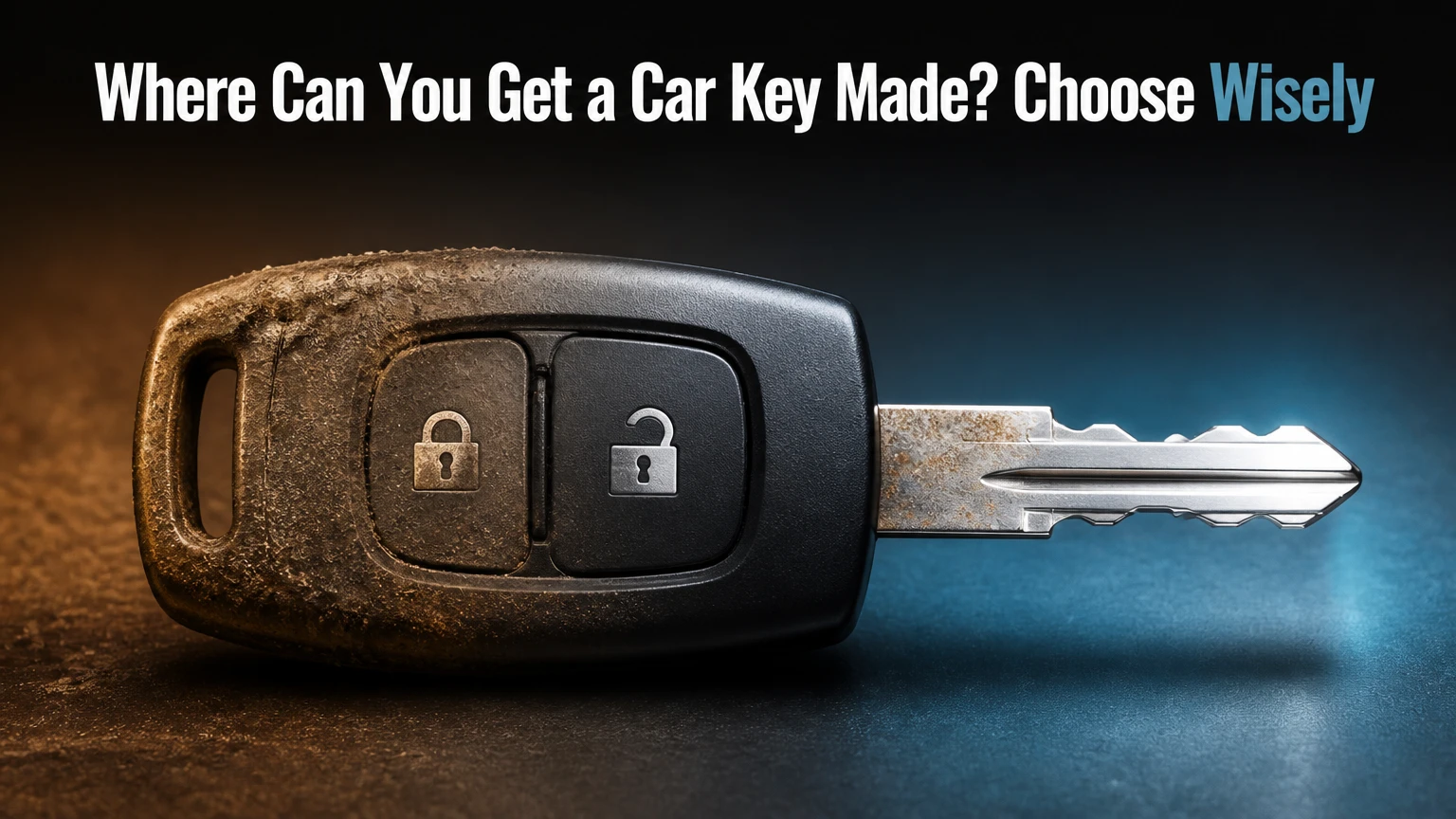
You can get a car key made by an automotive locksmith, car dealership, hardware store, key kiosk, or online key supplier. An automotive locksmith is usually the best first call for a lost or programmed key because a mobile technician can cut and pair many keys at the vehicle, while dealerships remain the safest choice for restricted systems and some luxury models.
Key Facts at a Glance
- A mechanical key may cost about $5-$20 and take 2-5 minutes to duplicate.
- A transponder key usually needs both blade cutting and immobilizer programming.
- A mobile automotive locksmith commonly handles a duplicate or replacement in 15-60 minutes.
- A dealership provides manufacturer-backed parts and software, but often charges more and may require towing.
- A key fob that unlocks doors may still fail to start the engine if its transponder is not programmed.
- A dead fob battery usually affects remote buttons, but many vehicles still start with an emergency procedure.
Where Can You Get a Car Key Made?
The best place depends on the key technology, whether you still have a working key, and whether the vehicle is accessible. Use an automotive locksmith for most ordinary replacements, a dealership for restricted or unusually complex systems, and a hardware store only when the key is a simple mechanical blank or a supported duplicate.
| Provider | Typical price | Typical time | Programming capability | Best situation |
|---|---|---|---|---|
| Mobile automotive locksmith | $75-$350 | 20-90 minutes | Many transponders, remotes, and smart keys | Lost key, roadside replacement, spare |
| Dealership parts and service department | $150-$600+ | 1-7 days | OEM systems and proprietary procedures | Newer, restricted, luxury vehicle |
| Hardware store or locksmith kiosk | $5-$175 | 2-30 minutes | Mechanical keys and selected supported chips | Simple duplicate with working key |
| Online key supplier plus local cutting | $20-$250 for part | 1-7 days plus service time | Depends on vehicle and equipment | Informed buyer seeking a lower part price |
| Vehicle manufacturer support | $150-$600+ | 1-14 days | VIN-based ordering and brand procedures | Replacement through an authorized network |
Prices are typical United States ranges, not guaranteed quotations. Taxes, emergency callout fees, keyless-entry technology, vehicle location, and the number of keys required can change the total substantially.
Automotive Locksmith
An automotive locksmith is usually the most practical option for a replacement, duplicate, or all-keys-lost event. Mobile technicians carry key blanks, cutting equipment, diagnostic programmers, and battery-support equipment, so they can often complete the work without transporting the vehicle.
A locksmith may create a key by duplicating an existing blade, decoding a lock, retrieving a manufacturer key code, or using vehicle identification information. Capability is not universal. Ask for confirmation using the exact year, model, trim, VIN, and key type before authorizing the visit.
Dealership
A dealership is the strongest option when the vehicle uses a restricted programming system, requires an original-equipment fob, or belongs to a brand with limited independent-tool coverage. The service department can order a VIN-matched component and follow the manufacturer’s security procedure.
The trade-off is price and logistics. A dealership may require proof of ownership, an appointment, and a tow if no valid key can turn on the vehicle. Ask whether the quoted price includes the key, cutting, programming, labor, diagnostic fees, and disposal or deletion of missing keys.
Hardware Store or Key Kiosk
A hardware store or automated kiosk is suitable for a plain mechanical key and some supported transponder duplicates. The low price is attractive when a working key is available and the vehicle has an older or widely supported system.
A kiosk normally cannot solve an all-keys-lost situation, recover a key code, unlock a disabled vehicle, or program every smart key. A blade that fits the lock is not proof that the engine immobilizer will accept the key.
Online Supplier
Online purchasing can reduce the part cost, but the buyer must identify the exact component. Match the original key’s FCC ID where applicable, part number, button layout, blade style, frequency, transponder family, and vehicle compatibility. Some used fobs are locked to another vehicle, while some aftermarket products have poor compatibility.
Online ordering is best for a spare when one working key remains and a local professional has agreed to cut and program the supplied part. It is a poor emergency option when the vehicle is stranded or every key is missing.
What Kind of Car Key Do You Need?
The key type determines whether cutting alone is enough. Traditional blades need no electronic pairing, while transponder keys, remote-head keys, and proximity fobs may require separate immobilizer and remote programming.
| Key type | Physical feature | Electronic function | Typical cost | Typical service time |
|---|---|---|---|---|
| Mechanical key | Edge-cut metal blade | None | $5-$20 | 2-5 minutes |
| Transponder key | Metal blade with coded plastic head | Immobilizer authorization | $75-$175 | 15-30 minutes |
| Laser or sidewinder key | Center-cut blade with precise grooves | Usually includes transponder | $150-$250 | 20-45 minutes |
| Remote-head key | Blade attached to lock and unlock buttons | Remote entry plus immobilizer | $200-$400 | 30-60 minutes |
| Smart or proximity fob | Electronic fob with emergency blade | Keyless entry and push-button authorization | $250-$600+ | 30-90 minutes |
Mechanical Keys
A mechanical key contains a blade cut to match the vehicle’s lock wafers or pins. Older vehicles and some utility applications use this design, so a duplicate can often be produced by a hardware store or general locksmith.
The cut must still be accurate. A rough duplicate may turn the lock while binding, damaging the cylinder over time. Test a new blade in the driver’s door and ignition, if fitted, before leaving the shop.
Transponder Keys
A transponder key combines a cut blade with a coded chip. The vehicle’s immobilizer checks the chip before enabling engine operation, so a correctly cut key can unlock the door and still fail to start the vehicle.
A professional may clone a supported existing key or add a new chip to the car’s authorized-key memory. Cloning and adding a key are different procedures, and the available method varies by vehicle security system.
Remote and Smart Keys
A remote key fob operates door locks, trunk release, panic functions, or remote start. A smart fob communicates with proximity antennas so the vehicle can authorize a push-button start without a conventional ignition slot.
These systems may involve two distinct functions: remote-button pairing and immobilizer authorization. Replacing the coin-cell battery can restore buttons, but battery replacement does not create a new authorized key.
How Is a Replacement Car Key Made?
A professional replacement normally involves ownership verification, vehicle identification, key selection, mechanical cutting, electronic programming, and final testing. A duplicate made from one working key may take 15-60 minutes, while an all-keys-lost job can take longer because the technician must establish access and program the vehicle securely.
- Verify ownership and vehicle identity.
Prepare photo identification, registration or title, and the VIN. The VIN is usually visible through the windshield, on a door-jamb label, or in vehicle records. A reputable provider may refuse service without documentation because key programming can enable vehicle theft.
Checkpoint: The technician confirms the exact year, model, trim, and security system.
Common mistake: Giving only the model name, such as “Civic,” when several key systems may exist in one generation. - Determine the required component.
The provider identifies whether the vehicle needs a blade, transponder key, remote-head key, or proximity fob. The technician may inspect the existing key, decode a lock, check the part number, or use the VIN.
Checkpoint: The quotation identifies the component and lists programming separately from cutting.
Common mistake: Accepting a quote for a “key” when the vehicle actually needs a smart fob. - Cut the physical blade.
A duplicator can copy a conventional blade, while a code machine or CNC cutter produces laser and sidewinder profiles. When no original exists, the provider may use a key code, lock decoding, or vehicle-specific data.
Checkpoint: The blade turns the door lock smoothly without excessive force.
Common mistake: Testing only the door and assuming the immobilizer has also been completed. - Program the immobilizer.
The technician connects an approved diagnostic tool, often through the vehicle’s OBD-II port, and registers the transponder or fob. Some vehicles require a security PIN, a time delay, two existing keys, or an online manufacturer account.
Checkpoint: The engine starts and the security indicator behaves normally.
Common mistake: Interrupting programming with a weak vehicle battery or disconnected diagnostic connection. - Pair remote functions and test every feature.
The technician verifies lock, unlock, trunk, panic, remote-start, proximity detection, emergency blade operation, and engine starting where applicable.
Checkpoint: Each requested function works from a normal operating distance.
Common mistake: Leaving before checking the spare key, because a button layout or frequency error may not be obvious. - Secure the vehicle’s key memory.
If a key was stolen or permanently lost, ask whether the provider can erase missing keys from the vehicle’s authorized list. Not every system permits the same deletion procedure, and remote-entry memory can differ from immobilizer memory.
Checkpoint: The provider explains which missing keys were removed and which functions remain active.
Common mistake: Replacing the key without discussing stolen-key deactivation.
How Much Does a Car Key Cost?
A car key typically costs $5-$20 for a mechanical duplicate, $75-$175 for a transponder key, $200-$400 for a remote-head key, and $250-$600 or more for a smart fob. All-keys-lost service, luxury vehicles, emergency callouts, towing, and manufacturer-restricted programming can raise the final bill.
| Job type | Typical parts cost | Typical labor or service cost | Common total | Main price driver |
|---|---|---|---|---|
| Mechanical duplicate | $3-$10 | $2-$15 | $5-$20 | Blade profile and local rates |
| Spare transponder key | $30-$100 | $45-$100 | $75-$175 | Chip type and programming |
| Remote-head replacement | $80-$220 | $75-$180 | $200-$400 | OEM versus aftermarket fob |
| Proximity-fob replacement | $150-$450 | $100-$250 | $250-$600+ | Encryption and brand software |
| All-keys-lost locksmith visit | $75-$300 | $100-$350 | $175-$650+ | Access, key code, and security reset |
| Dealer all-keys-lost service | $150-$450 | $150-$500 | $300-$950+ | Towing, OEM part, and labor |
The cheapest comparison is not always the lowest total. A $40 online fob becomes expensive if the wrong frequency, locked chip, incompatible part number, or separate cutting fee forces a second purchase.
Which Factors Change the Price?
Vehicle age, key technology, brand, number of keys, programming access, and location affect the quotation. An ordinary duplicate with one working key is usually cheaper than creating a key from scratch because the existing key supplies the blade pattern and may permit a simpler programming route.
Emergency service can add a callout fee outside normal business hours. Premium European vehicles may require security credentials, manufacturer access, or specialist equipment. Ask for a written all-in estimate before the technician begins.
Which Provider Is Cheapest and Safest?
A mobile automotive locksmith is generally the best value for a standard replacement or all-keys-lost event, provided the technician confirms compatibility and ownership requirements. A dealership is safer for restricted systems and OEM-only requirements, while a hardware store offers the lowest price only when the key is simple and already supported.
| Decision factor | Locksmith | Dealership | Hardware store or kiosk | Online plus local service |
|---|---|---|---|---|
| Mechanical duplicate | $5-$30 | $30-$100 | $5-$20 | $20-$60 |
| Mobile vehicle service | Often available | Rarely available | No | No |
| All-keys-lost capability | Often available | Available with tow or access | Usually unavailable | Unavailable alone |
| OEM part access | OEM or aftermarket | OEM | Limited blanks | Depends on seller |
| Advanced smart-fob coverage | Brand and tool dependent | Strongest for own brand | Limited | Fit and programming uncertain |
| Same-day completion | 20-90 minutes when stocked | 1-7 days common | 2-30 minutes | Shipping adds 1-7 days |
| Stolen-key deletion | Vehicle dependent | Manufacturer procedure | Rare | Requires separate professional |
| Ownership verification | Commonly required | Required | May be required | Seller may not verify |
When Should You Call a Mobile Locksmith?
Call a mobile automotive locksmith when the vehicle is locked, stranded, or missing every key, or when you need a same-day duplicate without towing. Mobile service is especially useful when the vehicle cannot be driven to a store or dealership.
Before dispatch, ask five questions: Does the technician support the exact year and model? Is the quoted price all-inclusive? Can the technician make a key without the original? What documents are required? Can missing or stolen keys be deleted?
When Is the Dealership the Better Choice?
Choose the dealership when the manufacturer restricts programming, the vehicle has a difficult proximity system, the key must be OEM, or an independent locksmith has confirmed that the platform is unsupported. Dealership service can also be appropriate when warranty records, recall work, or a manufacturer security code are involved.
Dealership service is not automatically faster. Parts may need to be ordered, and all-keys-lost cases may require towing and an appointment.
Can a Hardware Store Copy a Car Key?
A hardware store can copy a plain mechanical car key and may duplicate selected transponder keys, but store capability varies by vehicle, blank, chip, and equipment. A hardware store usually cannot create every smart key, recover a key code, program a restricted immobilizer, or handle an all-keys-lost emergency.
Call before visiting. Give the employee the vehicle year, make, model, and whether the existing key starts the engine. Bring the working key, not only the remote shell, because a remote that unlocks doors may not contain a usable transponder.
A hardware-store duplicate should be tested immediately. Confirm door operation, ignition operation, engine starting, and remote buttons before discarding the original or leaving the area.
What Should You Bring to the Key Appointment?
Bring photo identification, vehicle registration or title, the VIN, every remaining key, and the vehicle itself when programming is required. A provider may also request a finance or lease authorization if the registered owner is not present.
Use this preparation checklist:
- Photograph the front and back of the existing key.
- Record the key’s part number and FCC ID, if printed.
- Note whether the vehicle uses a metal ignition key or push-button start.
- Bring all working keys because some vehicles require them during registration.
- Charge the vehicle battery or arrange a jump pack.
- Confirm the provider’s warranty on parts and programming.
- Ask whether the quote includes tax, emergency fees, cutting, and programming.
The VIN identifies the vehicle, but it does not always identify the exact key configuration. Trim level, production date, market, and mid-generation security changes can alter compatibility.
Can You Get a Car Key Made Without the Original?
A qualified automotive locksmith or dealership can often make a car key without the original, but the process requires vehicle identification, ownership verification, and a compatible method for recovering the blade pattern and programming the immobilizer. The provider may use a VIN-linked key code, lock decoding, diagnostic software, or manufacturer authorization.
All-keys-lost work is more expensive because the technician may need to unlock the vehicle, create a blade from code, program new credentials, and remove missing keys from memory. The vehicle must generally be physically present for programming.
Do not order a generic key solely from the make and model. Exact compatibility can depend on the production year, market, transmitter frequency, transponder type, and security module version.
What If the Car Key Was Stolen?
If a car key was stolen, request key-memory erasure rather than treating the problem as an ordinary duplicate. A technician or dealership may be able to remove the missing transponder from the immobilizer authorization list and reprogram the remaining keys, although remote-entry and immobilizer records may use separate procedures.
Change the vehicle’s exposure immediately. Park in a secure location, use a steering-wheel lock where appropriate, and tell the provider that the key was stolen. If the stolen key was attached to an address or registration document, treat the risk as higher and contact the vehicle manufacturer or insurer for additional guidance.
A replacement fob does not automatically deactivate an old one. Ask for written confirmation of what the programming session changed.
How Do You Troubleshoot a New Key That Fails?
A new key that unlocks the door but will not start the engine usually has an unprogrammed or incompatible transponder, not a bad blade. A key that starts the engine but does not operate the buttons usually needs remote pairing, a new coin-cell battery, or the correct transmitter frequency.
| Symptom | Likely cause | First check | Correct response |
|---|---|---|---|
| Blade will not enter lock | Wrong profile or rough cut | Compare blade shape | Recut or replace the blank |
| Door unlocks, engine will not start | Transponder not programmed | Security or padlock light | Reprogram compatible chip |
| Buttons do not work, engine starts | Dead battery or remote pairing | Coin-cell voltage and polarity | Replace battery or pair remote |
| Key works intermittently | Worn blade, weak chip position, interference | Test spare and inspect shell | Repair, recut, or replace |
| No key works after service | Low vehicle voltage or module fault | Battery voltage and fuses | Stabilize battery, then diagnose |
| Push-button vehicle says key not detected | Dead fob battery or antenna issue | Emergency-start location in manual | Replace battery and test backup position |
A low vehicle battery can interrupt programming and create misleading symptoms. Stabilize the battery before repeating a programming procedure, because repeated failed attempts may trigger a security lockout on some vehicles.
Is a Replacement Key Covered by Insurance or Warranty?
Insurance, roadside assistance, extended warranties, and manufacturer plans may reimburse some replacement-key costs, but coverage depends on the contract and the cause of loss. Collision policies may cover a damaged key only in connection with a covered incident, while roadside plans may cover lockout labor without paying for the new fob.
Call the insurer or roadside provider before authorizing non-emergency work when possible. Ask about the maximum benefit, deductible, approved providers, documentation, and whether aftermarket parts qualify. Keep the invoice, proof of ownership, old key, police report for theft, and programming receipt.
Coverage is often more limited than owners expect. A separate key-replacement benefit may be required.
How Do You Choose a Reputable Automotive Locksmith?
Choose a locksmith that confirms vehicle compatibility before dispatch, provides a complete written estimate, verifies ownership, identifies the key part, and explains its programming warranty. A legitimate provider should be willing to state whether the replacement is OEM, aftermarket, refurbished, or customer supplied.
Check the business name, physical or service address, local licensing rules, insurance information, and independent reviews. Avoid a caller who quotes an unrealistically low price and increases it after arriving, refuses to identify the company, or asks for no ownership documentation.
Expert Rules That Prevent Expensive Errors
- Make the spare before the last key fails. A duplicate made from a working key avoids lock decoding, emergency access, and some all-keys-lost programming steps.
- Separate three jobs in the quote. Cutting, immobilizer programming, and remote-button pairing can carry different fees.
- Never judge compatibility by appearance. Two fobs with identical shells can use different frequencies or transponder systems.
- Test the emergency blade separately. A proximity fob may start the vehicle electronically while its hidden blade does not fit the door lock.
- Ask about old-key deletion after theft. Replacing the shell or battery leaves the security status unchanged.
Special Cases: EVs, Luxury Cars, and Older Vehicles
Electric vehicles still use electronic access credentials, even when they have no conventional engine immobilizer in the traditional sense. Tesla, BMW, Mercedes-Benz, Audi, Land Rover, and other brands may use app credentials, digital keys, encrypted proximity fobs, or brand-specific authorization, so independent coverage varies by model and year.
Older vehicles with plain blades are easier and cheaper. Mid-generation vehicles are less predictable because manufacturers often change chip families, remote frequencies, or programming procedures without changing the model name.
| Vehicle situation | Likely key system | Best first provider | Main caution |
|---|---|---|---|
| 1980s-early 1990s sedan | Mechanical blade | Hardware store or locksmith | Confirm lock and ignition wear |
| Late 1990s-2010s mass-market car | Transponder or remote-head key | Automotive locksmith | Programming is separate from cutting |
| 2010s push-button vehicle | Smart proximity fob | Locksmith with model coverage or dealer | Verify emergency-start procedure |
| New luxury European vehicle | Encrypted smart fob | Authorized dealer or specialist locksmith | OEM access and security credentials |
| Electric vehicle with digital key | App, card, or proximity credential | Manufacturer network or trained specialist | Account access and backup credential |
| All-keys-lost vehicle | Unknown until diagnosed | Mobile automotive locksmith or dealer | Vehicle must be present for secure programming |
What Is the Fastest Way to Get a Key Made?
The fastest route is a mobile automotive locksmith with the correct blank and programming equipment already in stock. Simple mechanical duplicates can take 2-5 minutes, while programmed keys commonly take 20-90 minutes; dealer ordering can take one to seven days when the part is not in inventory.
Call with complete information rather than searching only for “key made near me.” State the vehicle year, make, model, trim, location, key type, number of working keys, and whether the vehicle starts. That information lets the provider screen equipment and stock before arrival.
For a dead fob battery, a battery retailer or hardware store may solve the problem in minutes. For an immobilizer failure, a battery will not substitute for programming or vehicle diagnosis.
Frequently Asked Questions
Can a locksmith make a key from the VIN?
A locksmith may use the VIN to obtain or verify a manufacturer key code, but the VIN alone does not create a complete working key. The technician still needs ownership proof, a compatible blank, blade cutting, and immobilizer or remote programming when the vehicle requires electronic authorization.
Do all replacement car keys need programming?
No. A plain mechanical key does not need electronic programming. Transponder keys, remote-head keys, and smart fobs generally need programming, although some vehicles support user pairing for limited remote functions while still requiring professional immobilizer registration.
How long does it take to get a spare car key?
A mechanical duplicate may take 2-5 minutes, a transponder key 15-30 minutes, and a remote or proximity fob 30-90 minutes when the part is available. Online orders and dealership orders can take one to fourteen days because shipping or manufacturer supply adds time.
Can a dead key-fob battery stop the car from starting?
A dead fob battery can stop remote buttons or passive proximity detection from working, but many vehicles provide an emergency-start method. The exact backup location may be a marked slot, steering-column area, center console, or push-button contact point, so use the vehicle manual.
Is an aftermarket key fob safe to use?
An aftermarket fob can work safely when its part number, FCC ID, frequency, transponder type, and vehicle compatibility are correct. Quality is inconsistent, and some used or locked fobs cannot be programmed. Have a professional verify the part before cutting or opening the vehicle’s security system.
What should you do after losing every key?
Call a mobile automotive locksmith or the dealership, keep the vehicle accessible, and prepare photo ID, registration or title, and the VIN. Tell the provider whether the keys were lost or stolen, because stolen keys may require deletion from the vehicle’s authorized-key memory.
The Bottom Line
For most people asking where can you get a car key made, the best first option is a reputable mobile automotive locksmith that supports the exact vehicle. Expect about $5-$20 for a mechanical duplicate, $75-$175 for many transponder keys, and $250-$600 or more for a proximity fob. Use a dealership for restricted or high-security systems, and use a hardware store only when a simple supported duplicate is all you need. Prepare the VIN and ownership documents, confirm cutting and programming fees separately, and test every function before the provider leaves.