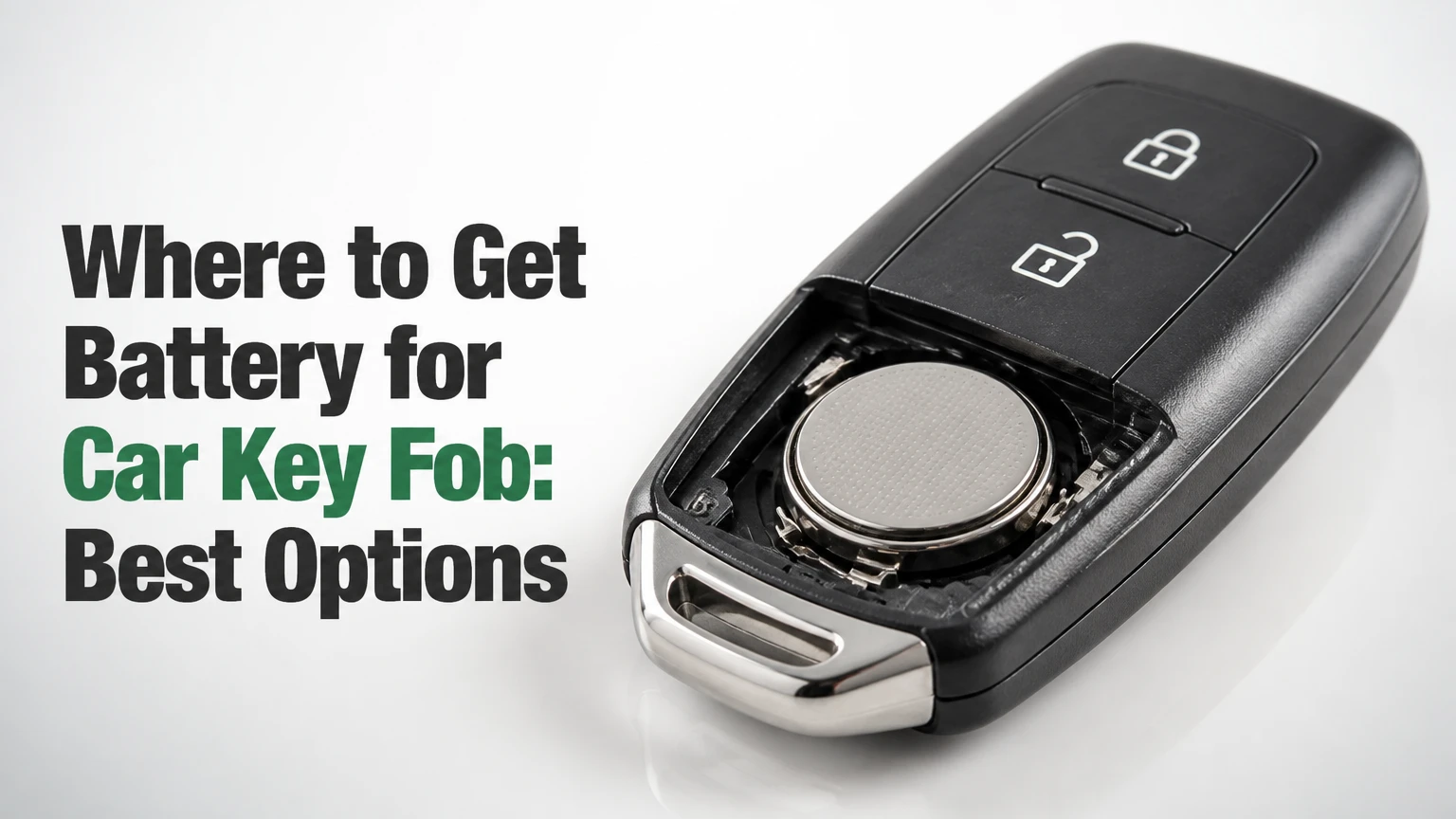
You can get a battery for a car key fob at an auto parts store, Walmart, a pharmacy, a hardware retailer, a dealership, a locksmith, a battery specialist, or an online marketplace. Auto parts stores usually offer the best balance because they stock common CR2032 cells and may install the battery when you buy it there.
Key Facts at a Glance
Most car key fobs use a 3-volt lithium coin cell, commonly a CR2032, CR2025, or CR2016.
The battery number must match the fob’s specified thickness and voltage; similar-looking cells are not automatically interchangeable.
Auto parts stores typically charge about $4-$9 for a retail battery and may provide installation with purchase.
A basic battery replacement usually takes 2-5 minutes and requires a coin or small flat screwdriver.
A dead remote battery usually does not erase the vehicle’s programming, but some models require a resynchronization procedure.
If a fresh battery does not restore operation, the fault may involve contacts, water damage, the fob shell, or the vehicle receiver.
Where to Get Battery for Car Key Fob
The best place depends on whether you value immediate installation, low price, diagnosis, or convenience. For most drivers, an auto parts store is the practical first choice; online sellers cost less, while a dealership or automotive locksmith is safer for sealed, expensive, or damaged smart keys.
Purchase options compared
| Source | Typical battery price | Installation or diagnosis | Typical availability |
|---|---|---|---|
| Auto parts store | $4-$9 for 1-2 cells | Often free with purchase, policy varies | Same day, common CR2032 stock |
| Walmart or pharmacy | $3-$8 for 1-2 cells | Usually self-service | Same day, common sizes |
| Hardware retailer | $4-$10 for 1-2 cells | Usually self-service | Same day, varies by location |
| Online marketplace | $0.50-$2 per cell in multipacks | No installation | 1-5 days, seller-dependent |
| Dealership | $5-$15 battery, $20-$50 service possible | Correct-part check and installation | Same day or appointment |
| Automotive locksmith | $5-$15 battery, $10-$30 service typical | Installation and fob diagnosis | Appointment or mobile service |
| Battery specialist | $5-$15 battery, plan pricing varies | Installation and battery testing | Location-dependent |
AutoZone, O’Reilly Auto Parts, Advance Auto Parts, and NAPA are useful when the fob is already weak but still working. Bring the fob to the counter rather than relying only on a vehicle lookup, because trim level, model year, replacement key shells, and regional equipment can change the battery specification.
Walmart, Target, CVS, Walgreens, Home Depot, and Lowe’s commonly sell coin cells in the electronics, automotive, hardware, or watch-battery section. These locations are convenient, but employees may not open or install the battery because the case can break and the fob may contain delicate electronics.
Online purchases make sense when the battery number is confirmed and the car is not urgently needed. Buy a small pack from a recognized battery manufacturer, check the expiration or best-before information, and avoid listings with vague brand names, unusually low prices, or no manufacturing details.
Which Retailer Is Best for Installation?
An auto parts store or automotive locksmith is usually the best installation choice for a standard replaceable fob. Dealership service is the safest option for a sealed smart key or a high-value luxury fob, but the labor charge can exceed the cost of the coin cell by several times.
| Driver situation | Best source | Reason | Main limitation |
|---|---|---|---|
| Needs the car today | Nearby auto parts store | Battery stock and quick replacement | Installation policy varies |
| Wants the lowest unit price | Reputable online seller | Multipacks reduce price per cell | Shipping and stale-stock risk |
| Does not want to open the fob | Locksmith | Installation plus fault diagnosis | Service fee may apply |
| Owns a sealed smart key | Dealer or specialist locksmith | Lower risk of shell damage | Higher labor cost |
| Needs help identifying the cell | Parts counter with fob present | Visual and catalog verification | Staff expertise differs |
| Has a water-damaged or cracked fob | Locksmith or dealer | Can inspect electronics and shell | Battery replacement alone may not help |
Batteries Plus and similar battery specialists can be useful when the local branch provides key-fob service. Some locations offer replacement plans, but calculate the break-even point before buying one: a plan costing $15-$20 may require several future replacements to outperform ordinary retail batteries.
An automotive locksmith is preferable to a dealership when the fob has a broken housing, loose buttons, water exposure, or an intermittent signal. A locksmith can often test the remote, replace the shell, inspect the contacts, and determine whether the vehicle needs programming.
How Do You Identify the Correct Battery?
Read the number printed on the old coin cell, check the owner’s manual, or use the vehicle manufacturer’s key-fob instructions. The number printed on the battery is more reliable than the vehicle year alone because one model can use different remotes across trims and production periods.
Common coin-cell specifications
| Battery | Diameter and thickness | Voltage | Typical fob use |
|---|---|---|---|
| CR2032 | 20 mm x 3.2 mm | 3 volts | Common standard remote and smart keys |
| CR2025 | 20 mm x 2.5 mm | 3 volts | Slim fobs and selected compact remotes |
| CR2016 | 20 mm x 1.6 mm | 3 volts | Thin fobs, sometimes two cells stacked |
| CR1616 | 16 mm x 1.6 mm | 3 volts | Smaller older remotes |
| CR1620 | 16 mm x 2.0 mm | 3 volts | Compact vehicle remotes |
| CR2450 | 24 mm x 5.0 mm | 3 volts | Larger, higher-capacity smart keys |
The first two digits generally describe the diameter in millimeters, while the last two describe thickness in tenths of a millimeter. A CR2032 is therefore 20 millimeters wide and 3.2 millimeters thick.
CR2025 and CR2032 share a 20-millimeter diameter and 3-volt chemistry, but they do not have the same thickness. A CR2025 may work temporarily in a compartment designed for a CR2032 if the contacts maintain firm pressure, yet a loose fit can cause intermittent locking, reduced range, or complete failure.
A CR2016 must not replace two stacked CR2016 batteries with one CR2032. Two CR2016 cells produce approximately 6 volts in series, while one CR2032 produces 3 volts. Installing the wrong arrangement can damage the remote circuit.
Which coin cell should you buy?
Buy the exact number specified by the old battery or the owner’s manual. Choose a fresh, name-brand lithium cell from Energizer, Duracell, Panasonic, Maxell, or an equivalent manufacturer, and inspect the package for an intact seal and a future expiration date.
Battery capacity varies by manufacturer and discharge conditions, so the thickest cell is not automatically the longest-lasting choice. The fob’s circuit, transmission frequency, button use, passive-entry polling, temperature, and time spent near the vehicle affect service life.
How Much Does a Key Fob Battery Cost?
A replacement battery typically costs $3-$10 at a local retailer, $0.50-$2 per cell online in a multipack, and $10-$30 when a locksmith performs the installation. Dealership service may cost $20-$50 or more if the dealer applies a diagnostic or service charge.
| Service type | Typical total cost | Typical time | Best use |
|---|---|---|---|
| DIY retail battery | $3-$10 | 2-5 minutes | Standard accessible fob |
| DIY online multipack | $3-$12 for 5-10 cells | Shipping: 1-5 days | Confirmed battery number |
| Auto parts installation | $4-$15 | 5-15 minutes | Standard fob with store assistance |
| Locksmith replacement | $10-$30 | 10-30 minutes | Installation and diagnosis |
| Dealership replacement | $20-$50 | 15-60 minutes | Complex or sealed smart key |
| New replacement fob | $100-$600+ | Same day to several days | Broken or unrepairable remote |
Prices vary by region, brand, vehicle make, and service policy. A $5 coin cell does not justify a $50 dealer visit unless the dealer is also diagnosing a communication, immobilizer, or sealed-case problem.
A typical key-fob battery lasts 2-5 years. Passive-entry remotes can drain faster because the vehicle and fob communicate periodically, especially when the key is stored close to the parked car. Heat, accidental button pressure in a pocket, and repeated short-range searching can also shorten battery life.
How to Replace a Car Key Fob Battery
Most replaceable car key fob batteries can be changed in five steps: confirm the number, open the shell, remove the old cell, install the new cell with correct polarity, and test every function. The factor that determines success is the fob design, because some cases use a pry slot while others require screws or a sealed housing.
Before you start
| Requirement | Typical specification |
|---|---|
| Time | 2-5 minutes for an accessible case |
| Difficulty | Easy for a pry-open shell, moderate for a sealed shell |
| Battery | 1 exact replacement cell, or 2 if the fob specifies two |
| Tools | Coin, plastic pry tool, or small flat screwdriver |
| Protection | Clean dry surface and optional nitrile gloves |
| Reference | Owner’s manual or a photograph of the open battery compartment |
Step 1: Confirm the battery number
Read the old cell before discarding it, or consult the manual using the vehicle identification details. Photograph the battery position if the polarity marking is difficult to see.
Success checkpoint: The replacement has the same number, diameter, thickness, and voltage as the old cell.
Common mistake: Buying a CR2032 because it is common when the fob requires a CR2025, CR2016, or CR2450.
Step 2: Remove the mechanical key
Slide or press the release latch and pull out the emergency key where the design provides one. The exposed key channel often reveals the case’s intended pry point.
Success checkpoint: The emergency key comes out without bending, and the case seam is visible.
Common mistake: Prying at the button face, where the plastic clips and rubber buttons are more vulnerable.
Step 3: Open the fob shell
Insert a coin or plastic pry tool into the marked slot and twist gently. If a small Phillips or Torx screw holds the case together, remove it first and store it in a tray.
Success checkpoint: The two halves separate along the factory seam without cracking or bending.
Common mistake: Using excessive force when the case does not open, which usually means a screw, latch, or second seam has been missed.
Step 4: Install the new cell
Note whether the positive side faces upward before lifting out the old battery. Remove the cell with a plastic tool or fingernail, then seat the replacement under the retaining clip without bending the metal contacts.
Success checkpoint: The battery lies flat, the marked positive side matches the original orientation, and the retaining clip holds it firmly.
Common mistake: Touching the circuit board unnecessarily or trapping a rubber gasket under the case seam.
Step 5: Close and test the remote
Align the shell halves and press around the perimeter until the clips engage. Reinsert the emergency key, then test lock, unlock, trunk, panic, passive entry, and push-button starting functions.
Success checkpoint: Every button responds at the expected distance and the shell closes evenly.
Common mistake: Testing only the lock button, while the trunk, panic, or proximity function remains inoperative.
Why Is the Key Fob Still Not Working?
A new battery may fail because of a protective sticker, poor contact pressure, reversed polarity, water damage, a damaged circuit board, a broken button membrane, or a vehicle-side receiver problem. Check the simple physical causes first, then test the battery and consult the vehicle’s synchronization procedure.
Use this recovery sequence:
- Remove any shipping sticker. Some coin cells have a thin film over one surface.
- Recheck polarity. The plus sign usually faces the visible side, but the fob design controls the correct orientation.
- Inspect the contacts. The metal tabs must touch the battery firmly and evenly.
- Check the shell. A cracked housing can let the cell move away from the contacts.
- Test a second fresh cell. A new battery can be defective or stale.
- Try the spare fob. If both remotes fail, the vehicle may have a receiver, fuse, or programming issue.
- Check for synchronization instructions. Older Honda, Toyota, Nissan, Ford, and other models can use model-specific procedures.
Do not aggressively bend contacts or bridge them with metal tools while the battery is installed. A contact that breaks from the circuit board can turn a two-minute battery replacement into a board-level repair.
A voltage reading above 3.0 volts is a useful basic check for a fresh CR2032, but voltage alone does not prove the cell can supply current under load. A locksmith or electronics technician can test the fob signal when a good battery produces no response.
Can You Drive With a Dead Key Fob Battery?
Most vehicles can still be unlocked and started with a dead key-fob battery, but the procedure differs by manufacturer and model. The hidden mechanical key usually unlocks the driver’s door, while the vehicle may start when the fob is placed against a designated backup location or the push-to-start button.
Common backup locations include:
- Directly touching the key fob to the start button.
- Placing the fob in a marked console, cupholder, or backup slot.
- Holding the fob near the steering column or an emergency reader.
- Using the hidden key to unlock the door, then following the dashboard instructions.
The immobilizer’s passive transponder may remain readable without the coin cell, but that arrangement is not universal. Read the owner’s manual before assuming a dead remote battery means the vehicle can start.
A dead fob battery normally does not delete key programming. Replacing the cell should restore the remote without pairing it again, although some older systems can lose synchronization after repeated button presses outside the vehicle or after unrelated electrical work.
When Should a Locksmith or Dealer Replace It?
Choose a locksmith or dealership when the fob is sealed, cracked, water-damaged, expensive, or still nonfunctional after a verified battery replacement. A locksmith often offers lower-cost diagnosis, while a dealer has direct access to vehicle-specific programming information and replacement parts.
A standard pry-open Toyota, Honda, Ford, Hyundai, Kia, Nissan, or Chevrolet remote is usually suitable for a parts-store replacement. A sealed Mercedes-Benz, BMW, Audi, Porsche, or newer proximity key deserves more caution because opening the case can damage waterproofing, clips, rechargeable components, or the electronics.
Dealership service is appropriate when:
- The vehicle displays an immobilizer or key-not-detected warning.
- The fob requires programming after replacement.
- The remote has been exposed to water.
- The case is heat-welded or cannot be opened without cutting.
- The vehicle has no working spare key.
- The fob must be replaced rather than merely repaired.
A locksmith is often the better first call when the key still starts the vehicle but its buttons fail. That pattern points toward a remote battery, contact, switch, or shell problem rather than a complete immobilizer failure.
What Should You Do With the Old Battery?
Recycle or dispose of a lithium coin cell through a local battery collection program rather than placing it loose in household waste. Coin cells can short against metal objects, and their small size makes them a swallowing hazard for children and pets.
Cover both sides of the old cell with nonconductive tape before transport if the recycling provider recommends it. Keep replacement cells in their original packaging, away from keys, coins, tools, and temperatures above normal indoor conditions.
Do not store a spare battery inside the key fob case, where it can short against the installed cell or circuit contacts. A labeled drawer or sealed package in the glove compartment is safer, although extreme vehicle heat can shorten shelf life.
The Bottom Line
For most drivers, the best answer to where to get battery for car key fob is a nearby auto parts store: take the fob, match the printed battery number, and ask whether installation is included with purchase. Buy online for the lowest price when the exact cell is known, and use a locksmith or dealer when the fob is sealed, damaged, expensive, or still fails with a verified fresh battery.
Frequently Asked Questions
Can I buy a key fob battery at a gas station?
Some larger gas stations and convenience stores sell CR2032 and CR2025 batteries, but selection and freshness are inconsistent. Use a gas station only when the battery number is already confirmed and the vehicle is urgently needed; an auto parts store usually provides more reliable inventory and possible installation.
Does changing a key fob battery erase the programming?
Changing a coin-cell battery normally does not erase the remote’s programming or the vehicle’s immobilizer authorization. If the buttons stop responding afterward, check polarity, contact pressure, shell alignment, and the model-specific synchronization procedure before paying for a new fob.
Can I use a CR2025 instead of a CR2032?
A CR2025 can sometimes operate in a CR2032 compartment because both cells are 20 millimeters wide and rated at 3 volts, but the thinner cell may not contact securely. Use the specified battery rather than treating the substitution as a permanent repair.
How often should a spare key fob battery be replaced?
Replace a spare battery when it reaches its expiration date, shows corrosion or package damage, or has been stored for several years in high heat. Keep the spare fob away from the vehicle when possible, since passive-entry communication can consume energy even when the buttons are not pressed.
Will roadside assistance replace a key fob battery?
Some roadside assistance programs provide basic battery help, but coverage varies by membership, location, and service contractor. Call before requesting service and state the exact battery number, because a roadside technician may unlock or jump-start the vehicle without carrying the required coin cell.
Why does the key fob work only when I stand close to the car?
Short operating range usually indicates a weak battery, poor battery contact, a damaged antenna, water exposure, or radio interference. Replace the cell with the correct fresh battery first; if range remains poor while a spare fob works normally, the original fob likely needs repair.