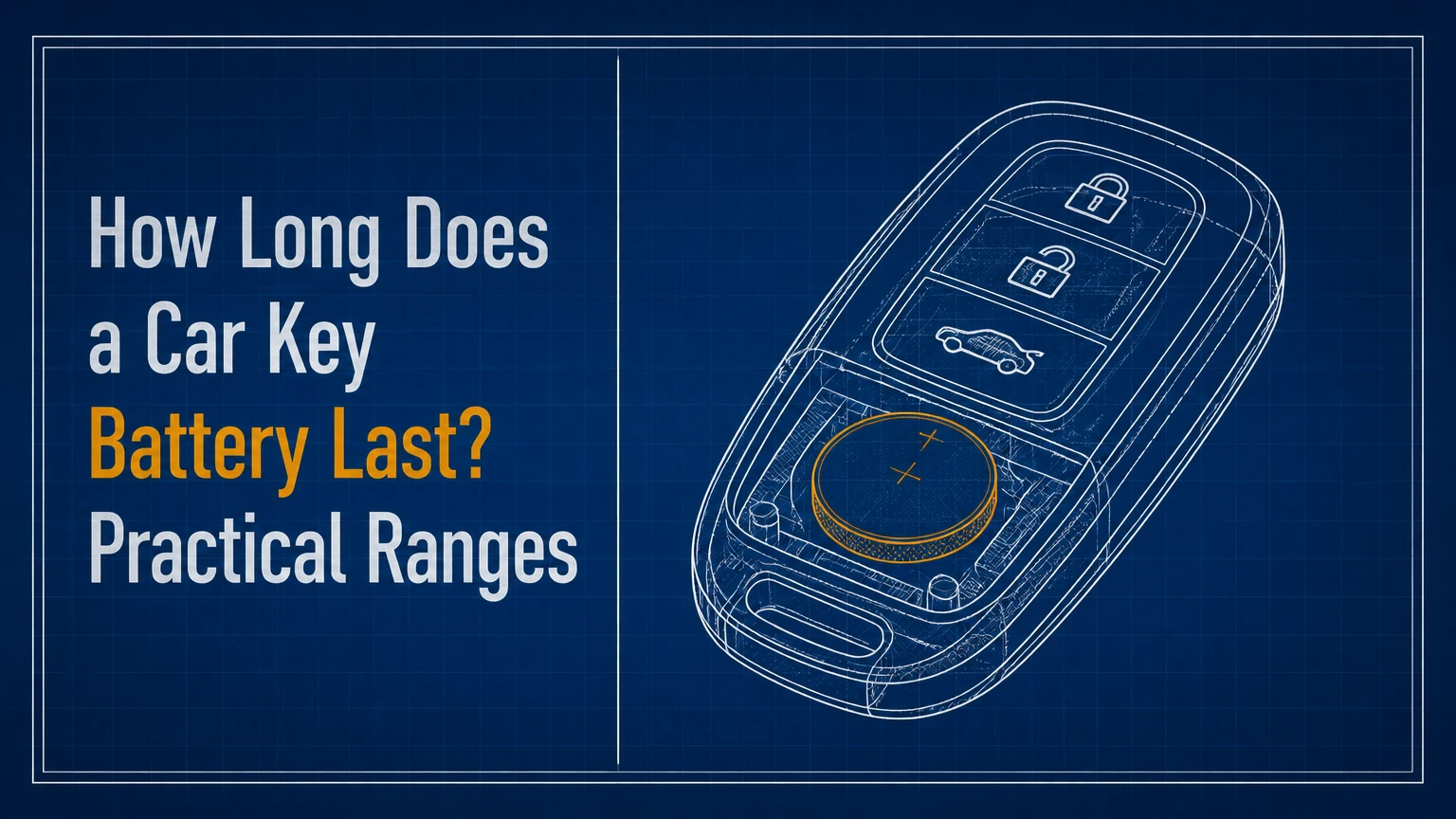
A car key battery typically lasts 3-4 years in a conventional remote key fob and 1-2 years in a proximity smart key. Actual life depends on battery size, button use, standby design, temperature, storage age, and whether the fob is repeatedly transmitting or waking near the vehicle.
Key Facts at a Glance
- A conventional remote key fob commonly uses one 3-volt lithium coin cell for 3-4 years.
- A proximity smart key commonly lasts 1-2 years because it responds to more frequent vehicle detection and authentication requests.
- CR2032, CR2025, CR1632, and CR1620 batteries are different physical sizes or thicknesses and are not automatically interchangeable.
- Reduced operating range, repeated button presses, and a “Key Battery Low” message usually indicate replacement is due.
- A dead fob battery usually does not erase the vehicle’s immobilizer programming.
- A new coin cell typically costs $2-$8 and takes 5-15 minutes to install, while dealer pricing often reaches $20-$80.
How Long Does a Car Key Battery Last?
A standard car key battery lasts about 36-48 months, while a smart key battery lasts about 12-24 months under typical use. The range is a practical ownership estimate rather than a universal manufacturer guarantee, because key-fob electronics, daily button presses, climate, and battery freshness vary by vehicle.
A conventional remote fob generally sleeps until a button is pressed. A smart key has additional proximity functions, such as detecting vehicle antennas, responding to requests, and supporting passive unlock or push-button starting. That extra activity can shorten the replacement interval, although smart-key designs do not all consume power in the same way.
Battery capacity also matters. A CR2032 contains more material than a CR2025 of the same diameter, but the correct battery is the one specified for the fob. A larger-capacity cell cannot compensate for poor contacts, a damaged housing, or a counterfeit product.
Typical Lifespan by Key Design
| Key design | Typical interval | Common battery examples | Main drain source |
|---|---|---|---|
| Metal key with remote buttons | 3-5 years | CR2032, CR2025 | Button presses and standby leakage |
| Integrated flip key | 2-4 years | CR2032, CR1620 | Frequent folding, buttons, transmitter use |
| Passive-entry smart key | 1-2 years | CR2032, CR2025, CR2450 | Proximity detection and authentication |
| High-use fleet or taxi fob | 8-24 months | CR2032, CR2025 | Heavy daily use and heat exposure |
| Backup key stored unused | 4-8 years installed | CR2032, CR2025 | Age, leakage, and occasional testing |
These figures are typical, not promises. A remote fob used ten times daily in a moderate climate can exceed four years, while a smart fob left beside a parked vehicle may need a cell much sooner.
Why Do Smart Keys Drain Batteries Faster?
Smart keys often drain batteries faster because they participate in proximity detection and passive-entry authentication rather than transmitting only when a button is pressed. The vehicle usually sends a low-frequency wake-up request through nearby antennas, and the fob answers with a radio-frequency identification signal.
The exact architecture differs by manufacturer. Some fobs remain mostly asleep and respond only to low-frequency vehicle queries, so describing every smart key as “constantly transmitting” is inaccurate. A key stored several feet from a vehicle can still wake repeatedly if the vehicle repeatedly searches for it, especially in a garage.
A 2024 Nissan, Toyota, Ford, or BMW smart key may also support touch sensors, motion detection, encrypted rolling credentials, and an immobilizer transponder. Those systems can draw more energy than a two-button remote, but the coin cell still powers the radio and control circuitry, not the engine immobilizer in the ordinary sense.
What the Battery Actually Powers
The coin cell powers the fob’s transmitter, receiver or wake-up circuit, button circuitry, status LED, and proximity electronics. The vehicle’s receiver validates the transmitted credential, while a passive transponder may allow immobilizer recognition through electromagnetic coupling even when the coin cell is exhausted.
Rolling codes create a fresh or synchronized authentication value for successive transmissions. The rolling-code process improves security, but it does not itself explain most battery use. Wake frequency, radio design, button activity, and proximity to the vehicle have a larger practical effect.
Which Car Key Battery Size Is Correct?
The correct car key battery size is the model printed on the old cell, inside the fob cover, or in the vehicle owner’s manual. CR2032 is common, but a CR2025, CR1632, CR1620, CR2450, or rechargeable pack may be specified for a particular housing.
The code identifies dimensions and chemistry. “CR” normally indicates a lithium manganese-dioxide coin cell, the first number identifies approximate diameter in millimeters, and the final two digits identify thickness to one-tenth of a millimeter. Thus, a CR2032 is approximately 20 mm wide and 3.2 mm thick.
A CR2032 and CR2025 share a 20 mm diameter but differ in thickness. Forcing the thicker CR2032 into a CR2025 holder can deform spring contacts or crack plastic. Using the thinner CR2025 in a CR2032 design may cause intermittent contact, even if the fob appears to work initially.
| Battery | Diameter | Thickness | Nominal voltage | Typical fob use |
|---|---|---|---|---|
| CR2032 | 20 mm | 3.2 mm | 3.0 V | Toyota, Honda, Subaru, Ford remotes |
| CR2025 | 20 mm | 2.5 mm | 3.0 V | Thin Mazda, Mercedes-Benz, and remote housings |
| CR1632 | 16 mm | 3.2 mm | 3.0 V | Compact integrated key designs |
| CR1620 | 16 mm | 2.0 mm | 3.0 V | Small flip keys and older remotes |
| CR2450 | 24 mm | 5.0 mm | 3.0 V | Higher-capacity smart-key housings |
Capacity varies by manufacturer and discharge conditions, so thickness alone does not predict installed lifespan. Panasonic, Energizer, and Maxell publish individual capacity and operating-temperature specifications for each cell family.
Can You Test a Car Key Battery?
You can test a car key battery with a multimeter, but an open-circuit voltage reading is only a screening result. A fresh 3-volt coin cell often reads near 3.2 volts without load; a reading below about 2.8 volts suggests replacement, while a normal reading does not guarantee strong performance during radio transmission.
Set a digital multimeter to DC voltage and touch the red probe to the positive face and the black probe to the negative face. Avoid shorting the two faces with the probe tips. Replace the cell if the result is low, unstable, or inconsistent with the vehicle’s warning message.
A battery tester that applies a small load can provide more useful evidence than an unloaded multimeter. Coin cells can recover voltage after resting, so a weak cell may look acceptable until the fob transmits.
Battery Test Results
| Measured condition | Typical reading or symptom | Likely action | Confidence |
|---|---|---|---|
| Fresh, unloaded cell | 3.1-3.3 V | Install if correct size | High |
| Usable cell under light load | 2.9-3.1 V | Monitor if range is normal | Moderate |
| Suspect cell | 2.7-2.8 V | Replace promptly | High |
| Failed cell | Below 2.6 V | Replace immediately | High |
| Normal voltage, weak range | 3.0 V or higher unloaded | Inspect contacts, buttons, or vehicle | Low for battery diagnosis |
The vehicle’s low-battery warning and a sharply reduced range are more useful ownership signals than an isolated voltage reading.
What Are the Signs a Key Fob Battery Is Dying?
The clearest signs of a dying key fob battery are shorter operating range, delayed button response, multiple required presses, and a dashboard warning. A passive-entry vehicle may stop unlocking by touch before the lock and unlock buttons stop working because proximity functions require more frequent communication.
A normal remote may work from 30-100 feet in open conditions, but buildings, other vehicles, metal objects, and radio interference reduce that distance. A gradual range reduction is more consistent with battery depletion than a sudden total failure.
The following pattern helps separate battery symptoms from other faults:
- Works only next to the car: weak cell, shielding, or antenna interference.
- One button fails while others work: worn button membrane or circuit-board damage.
- Both keys fail together: vehicle receiver, antenna, or vehicle power problem.
- Warning appears after a recent replacement: wrong battery, poor contact, or an unregistered warning reset.
- Fob works after being squeezed: loose cell, bent terminal, or cracked housing.
- Fob fails after water exposure: corrosion or shorted electronics, not necessarily a depleted cell.
How Do You Replace a Car Key Battery?
Most car key batteries can be replaced in 5-15 minutes with the correct coin cell and a small plastic pry tool. The main success factor is identifying the exact battery number and preserving the positive and negative orientation before opening the case.
Before You Start
| Requirement | Typical specification | Practical note |
|---|---|---|
| Time | 5-15 minutes | Allow extra time for a sealed smart key |
| Battery | 1 correct 3 V coin cell | Check the printed code, not appearance alone |
| Tools | 1 plastic pry tool or small flat screwdriver | Use the mechanical key where the case provides a slot |
| Cost | $2-$8 DIY | Dealer pricing can exceed $20 |
| Prerequisite | Spare mechanical key available | Useful if the fob locks during the procedure |
Step 1: Confirm the Replacement Cell
Read the code on the installed battery or consult the owner’s manual. Buy a reputable cell from a retailer with controlled stock rotation, and check the expiration date and intact packaging.
You will know this step worked when the new cell has the same diameter, thickness, voltage, and polarity arrangement as the old one. A CR2032 is not a universal substitute for every 3-volt coin cell.
Step 2: Remove the Mechanical Key
Slide the release latch and pull out the emergency metal key if the fob has one. The exposed slot often identifies the intended opening point.
You will know this step worked when the key comes out without force and the case seam remains undamaged. Avoid inserting a screwdriver into a button or decorative trim seam.
Step 3: Open the Fob Case
Insert a plastic tool or the mechanical key tip into the designated notch and twist gently. Work around the seam rather than bending one corner sharply.
You will know this step worked when the two halves separate evenly and the circuit board remains seated. Excessive force can break clips that are difficult to replace.
Step 4: Record Polarity and Remove the Old Cell
Photograph the battery position before lifting it from the retaining clip. Most fobs place the positive side upward, but the molded markings inside the case control the installation.
You will know this step worked when the old cell releases without bending the contact prongs. Do not pry against the circuit board.
Step 5: Install and Test the New Cell
Slide the replacement under the fixed clip, press it down evenly, and close the housing until every clip engages. Test lock, unlock, trunk, panic, passive entry, and push-button starting functions.
You will know it worked when the vehicle responds from normal range and the instrument display no longer reports a low key battery. If the remote works but passive entry does not, the fob may require a model-specific synchronization procedure.
Finger oils are not a major cause of rapid self-discharge in ordinary use. The more significant risks are a counterfeit cell, an old cell, a short circuit during installation, poor contact pressure, and storage in high heat.
Does a New Battery Require Key-Fob Programming?
A coin-cell replacement usually does not require key-fob programming because programming stores the fob’s identity and security credentials in the vehicle. Some vehicles may need a resynchronization sequence after prolonged battery removal, while aftermarket or newly cut keys can require separate programming.
A lost pairing is different from a low battery. If the fob LED illuminates and the battery measures normally but the vehicle does not respond, follow the owner’s manual synchronization procedure before paying for a new key.
Do not assume a dealer is required. Many locksmiths can test the fob signal, replace the cell, synchronize the remote, and diagnose a damaged transponder at a lower labor rate, although immobilizer programming often needs vehicle-specific equipment.
How Much Does Replacement Cost?
DIY car key battery replacement typically costs $2-$8 for one reputable coin cell and takes 5-15 minutes. A locksmith commonly charges about $10-$30 for a simple replacement, while a dealership may charge $20-$80 depending on labor policy, vehicle brand, and whether programming or diagnosis is included.
Prices vary by country, key design, and retailer. A $1 bulk cell may be genuine, but unusually low prices increase the risk of old inventory or counterfeit branding, particularly when the seller cannot provide a traceable manufacturing or expiration date.
| Service or purchase | Typical price | Typical time | What is included |
|---|---|---|---|
| Single retail coin cell | $2-$8 | 2-5 minutes | Battery only |
| Two-cell branded pack | $5-$12 | 5-10 minutes | Two sealed batteries |
| Locksmith replacement | $10-$30 | 10-20 minutes | Cell and basic function check |
| Dealership replacement | $20-$80 | 15-45 minutes | Cell, labor, possible diagnosis |
| New programmed smart key | $100-$500+ | 30-120 minutes | Key, cutting, programming, labor |
A dealership is justified when the vehicle still reports a key fault after a verified battery change, when the fob is water-damaged, or when immobilizer programming is involved. It is usually unnecessary for a routine coin-cell swap.
Can a Car Start With a Dead Key Fob Battery?
A car can often start with a dead key fob battery because the passive immobilizer transponder and the remote battery perform different functions. The driver normally holds the fob against the Start/Stop button, places it in a marked backup pocket, or touches it to a specified steering-column area before pressing the brake and start button.
The exact backup location varies. Toyota may provide a designated pocket in the center console, Ford often identifies a backup slot, and some Nissan and Honda systems instruct the driver to touch the fob to the start button. The owner’s manual is authoritative for the specific model.
A dead remote battery may prevent wireless unlocking, so remove the hidden mechanical key from the fob and use the driver-door lock cylinder. The alarm may sound briefly after manual entry; placing the fob at the backup reader usually authenticates the key and stops the alarm.
Why Does a New Key Battery Die Quickly?
A new key battery that dies within days or weeks usually indicates counterfeit stock, an incorrectly fitted cell, bent contacts, moisture damage, a stuck button, or abnormal proximity activity. Replacing the battery repeatedly without inspecting the fob can conceal a circuit-board fault.
Keep the spare key away from the vehicle during testing. If a smart fob is stored beside the car, repeated wake-up requests can increase consumption. Moving it several meters away, or placing it in a manufacturer-approved signal-blocking pouch, can reveal whether proximity activity is involved.
Common Failure Modes and Recovery
| Failure mode | Diagnostic clue | Recovery | Typical result |
|---|---|---|---|
| Wrong thickness | Loose or overly tight fit | Install the specified size | Stable contact |
| Bent contact tab | Fob works when squeezed | Restore contact carefully or replace housing | Intermittent fault removed |
| Stuck button | LED remains lit or button feels soft | Clean exterior, inspect membrane | Lower drain |
| Water intrusion | Green corrosion or cloudy contacts | Dry only if minor; replace damaged fob | May require locksmith |
| Counterfeit or old cell | New cell fails quickly | Buy sealed stock from trusted seller | Normal lifespan restored |
| Vehicle antenna fault | Both known-good keys fail | Diagnose vehicle receiver | Battery replacement ineffective |
A fob that becomes hot, smells unusual, leaks, or shows severe corrosion should not remain in service. Lithium coin cells can injure children if swallowed, so store loose batteries in sealed packaging away from children and pets.
How Do Heat and Cold Affect the Battery?
Heat accelerates chemical aging, while cold temporarily reduces available power and can shorten remote range. A key fob left on a dashboard in summer or in an unheated vehicle during winter may perform worse than the same battery used indoors.
Panasonic’s specialty-battery guidance places many coin cells in a broad operating range near -30°C to 60°C, but the vehicle fob and its plastic housing may have narrower limits. A cold cell can recover some voltage after warming, whereas a heat-aged cell may not recover its lost capacity.
Extreme-weather drivers should keep the spare battery sealed at room temperature and avoid storing it in the glove box during prolonged heat. Replace a marginal cell before a winter trip if range has already declined.
Is the Key Fob Battery Draining the Car Battery?
A key fob battery normally does not drain the vehicle’s 12-volt battery because the two batteries are separate. A smart key can contribute to vehicle battery drain indirectly if the vehicle repeatedly wakes its proximity system while the key remains close, but a healthy vehicle should manage that load.
A car battery that goes flat overnight is more likely to involve an aging 12-volt battery, an aftermarket accessory, a door or hatch sensor, a stuck relay, or a vehicle control module that fails to enter sleep mode. The key-fob coin cell is not a substitute explanation for a vehicle parasitic draw.
Move both keys away from the vehicle and measure the 12-volt system with a qualified technician if the problem continues. Replacing the fob cell will not repair a failing vehicle battery or a defective body-control module.
Which Battery Brand and Storage Method Are Best?
A reputable lithium coin-cell brand with intact packaging and a future expiration date is the safest practical choice. Panasonic, Energizer, Maxell, and Duracell publish product specifications, while the seller’s stock rotation and authenticity matter as much as the logo.
Manufacturers commonly state that unused lithium coin cells can retain charge for many years under suitable storage. Panasonic specialty-battery materials, for example, describe approximately ten years of shelf life for some coin-cell products under recommended conditions, but that figure applies to sealed storage, not a battery installed in an active smart key.
| Buying choice | Typical shelf life before use | Installed-risk profile | Best use |
|---|---|---|---|
| Sealed branded cell | 5-10 years, product dependent | Low | Primary or emergency replacement |
| Discount branded cell | 2-6 years remaining | Moderate | Immediate installation after date check |
| Unbranded bulk cell | Unknown, often under 3 years | High | Avoid for a primary key |
| Used or loose cell | Unknown | Very high | Do not install |
| Rechargeable substitute | Chemistry and voltage vary | High | Use only if the fob specifies it |
Do not stack two cells, recharge a non-rechargeable CR battery, or carry loose coin cells with keys and metal objects. A shorted lithium cell can heat rapidly.
When Is a Battery Replacement Not the Fix?
Battery replacement is not the fix when both keys fail simultaneously, the fob has visible corrosion, one button remains permanently pressed, or the vehicle continues to show a key-recognition error with a verified new cell. Those symptoms point toward the fob circuit, vehicle antenna, immobilizer system, or wiring.
A damaged shell can also create a false battery problem. If the cell moves inside the holder, the contacts may open during movement even though the battery is full. A replacement housing may solve that fault when the circuit board remains undamaged.
An honest limitation matters here: no generic lifespan table can diagnose a specific vehicle. Manufacturer service information, the exact key part number, and a signal test are more reliable than replacing cells on a fixed calendar schedule.
FAQ
Does pressing the key fob repeatedly shorten battery life?
Repeated button presses consume more energy because each press activates the transmitter, but ordinary use rarely explains a battery failure after only a few weeks. A stuck button, key stored beside a smart vehicle, poor-quality cell, or damaged circuit usually causes unusually rapid depletion.
Should I replace both car key batteries at once?
Replace both batteries if the keys were installed at the same time and show similar range loss, especially before a long trip. A second key stored unused may still have a healthy cell, so test its operation rather than replacing it solely because the primary key needed service.
Can a car key battery leak?
Lithium coin cells can leak or vent after damage, severe heat, manufacturing defects, or long storage, although leakage is less common than simple capacity loss. Remove a swollen, corroded, or damaged cell without touching residue, ventilate the area, and replace a contaminated fob professionally.
Why does my key work only when I hold it near my chin?
Holding a remote near the head can sometimes increase apparent range because the body changes the antenna’s electrical environment. The effect does not restore battery capacity. A remote that needs this technique should receive the correct fresh cell and inspection if normal range does not return.
Can I keep driving if the dashboard says key battery low?
You can usually keep driving if the vehicle has already recognized the key, but remote and passive-entry functions may stop after the next shutdown. Replace the cell promptly and locate the mechanical-key and backup-start procedures before parking somewhere unfamiliar.
The Bottom Line
How long does a car key battery last? Expect about 3-4 years from a conventional remote fob and about 1-2 years from a proximity smart key, with shorter life in heavy use, extreme temperatures, or poor storage conditions. Confirm the exact CR battery number, replace it when range declines or a warning appears, and use the emergency key and backup reader if the cell dies. A verified replacement normally restores operation without key programming, but repeated failures require fob or vehicle diagnosis rather than another battery.