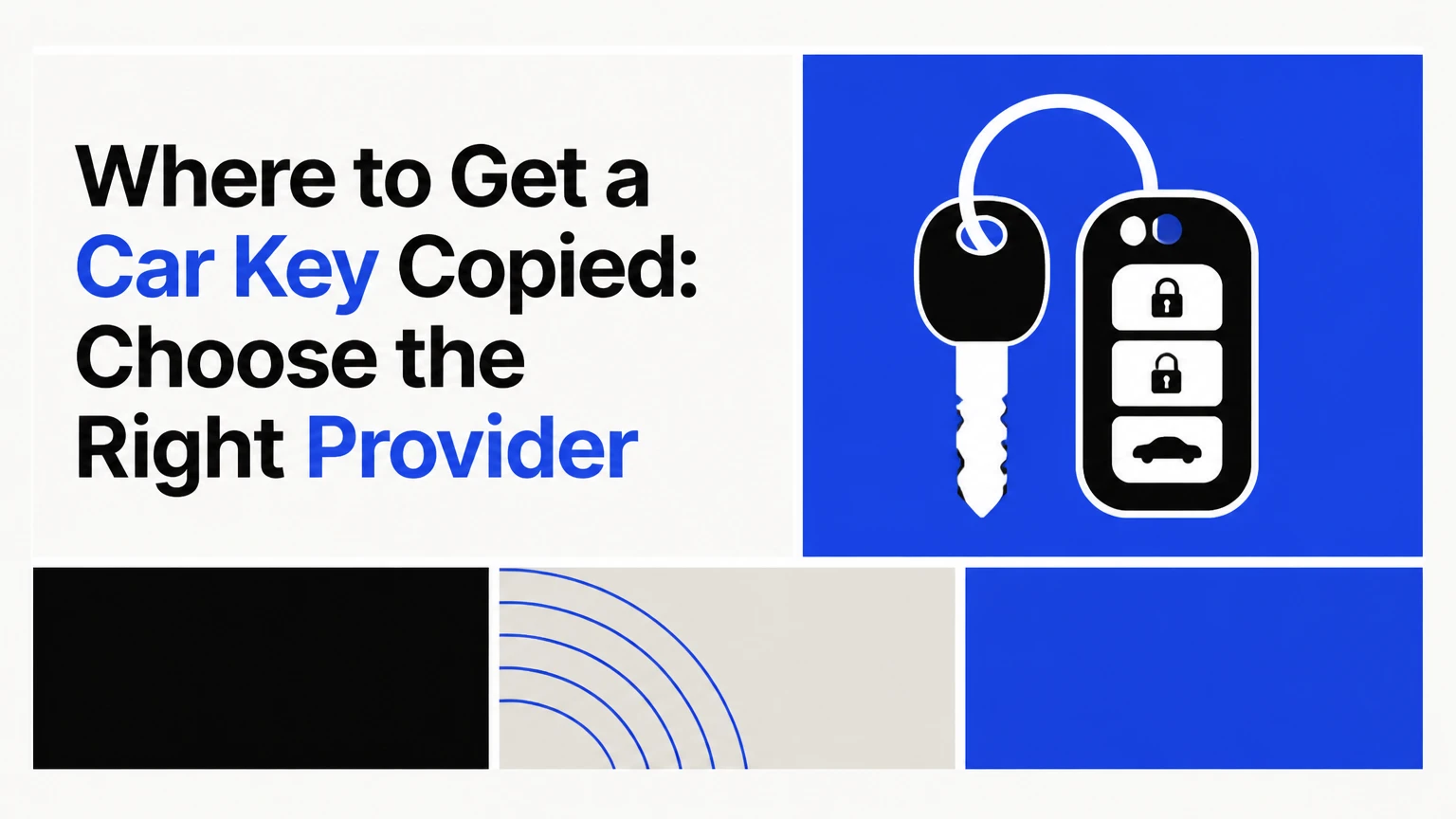
The best place to get a car key copied is usually a qualified automotive locksmith when you have a working key, because the locksmith can cut and program most replacement keys on site for less than a dealership. Use a dealer for restricted or unusually complex systems, and use a hardware store only when your vehicle has a basic, compatible key.
Key Facts at a Glance
- A functioning car key may require both physical cutting and electronic immobilizer programming.
- A remote can lock and unlock the doors while its separate transponder remains unable to start the engine.
- Typical duplicate-key prices range from $5-$25 for an older metal key to $200-$600 or more for some smart keys.
- An automotive locksmith usually takes 15-60 minutes, while a dealership may require an appointment and vehicle transport.
- Bring the working key, vehicle identification number, registration or title, government identification, and every spare key.
- A replacement fob must match the vehicle’s year, make, model, frequency, immobilizer system, and programming method.
Where to Get a Car Key Copied
For most drivers, a reputable automotive locksmith is the best first call. A mobile locksmith can come to a parked vehicle, identify the key system, cut a compatible blank, program the immobilizer or smart key, and test the result without requiring a tow.
A dealership is the safer choice when the manufacturer restricts key enrollment, the vehicle uses a newer encrypted system, or the locksmith cannot verify compatibility. A hardware store or self-service kiosk is suitable only when the key is a simple metal blade or the retailer explicitly supports your exact transponder model.
The decisive question is not simply whether a provider can cut metal. The provider must be able to complete every function you need: door and trunk access, ignition operation, remote buttons, proximity detection, and engine authorization.
Best Provider by Situation
| Driver situation | First choice | Typical price | Typical time |
|---|---|---|---|
| Older car with plain metal key | Hardware store or locksmith | $5-$25 | 5-15 minutes |
| Working transponder key available | Automotive locksmith | $70-$175 | 15-30 minutes |
| Laser-cut or sidewinder key | Automotive locksmith or dealer | $150-$300 | 20-60 minutes |
| Push-to-start smart key | Automotive locksmith with model support | $200-$600+ | 30-90 minutes |
| All keys lost | Mobile automotive locksmith or dealer | $150-$800+ | 1-4 hours |
| Restricted luxury or high-security system | Authorized dealer, sometimes specialist locksmith | $300-$1,000+ | 1-14 days |
These are typical United States consumer ranges, not fixed prices. Vehicle location, after-hours service, key brand, programming method, regional labor rates, and whether the original key is available can change the quote substantially.
How Modern Car Key Copying Works
Modern car key duplication has three separate jobs: cutting the physical blade, pairing the remote functions, and authorizing the engine-start transponder. A plain key needs only the first job, while a push-to-start vehicle may need a replacement smart fob, proximity registration, emergency blade cutting, and security-module synchronization.
The immobilizer is the engine-security component. When the key is inserted or a recognized fob enters the vehicle, the immobilizer system checks a coded electronic identity. A correct mechanical cut can open the door and turn an ignition cylinder, but the engine may still crank briefly or refuse to run if the electronic identity is absent.
Remote keyless entry is a different function. The lock and unlock buttons communicate with a receiver, while the transponder or proximity system communicates with the immobilizer. That separation explains why a copied remote may operate the locks but fail to start the car.
What Happens During a Professional Duplication?
- Identify the vehicle and key. The technician records the year, make, model, trim, ignition type, VIN, and key part number.
- Verify authorization. A legitimate provider normally requests government identification and proof that you own or possess the vehicle lawfully.
- Choose a compatible blank or fob. Compatibility includes blade profile, chip type, radio frequency, button layout, and vehicle security generation.
- Decode or duplicate the cut. The technician reads the original key or obtains a manufacturer key code. Cutting a worn copy can reproduce its accumulated errors.
- Program the electronic system. Depending on the model, the technician uses an onboard diagnostic tool, a manufacturer system, or a vehicle-specific learning procedure.
- Test every function. The new key should operate the relevant locks, trunk, ignition, buttons, panic function, proximity detection, and engine start.
The exact programming route varies by manufacturer. “OBD programming” is common terminology, but not every vehicle uses the same port procedure, and some systems require security credentials, a PIN, a token, or an online manufacturer account.
Which Car Key Types Can Be Copied?
The key type determines the provider, price, equipment, and failure risk. A key’s appearance is not enough for identification because two visually similar blades can contain different transponder systems or radio frequencies.
| Key type | Identifying feature | Typical replacement cost | Programming need | Typical completion |
|---|---|---|---|---|
| Traditional metal key | No plastic head or chip | $5-$25 | None | 5-10 minutes |
| Basic transponder key | Plastic head with embedded chip | $70-$175 | Immobilizer chip | 15-30 minutes |
| Laser-cut or sidewinder key | Thick blade with central or winding groove | $150-$300 | Usually required | 20-60 minutes |
| Switchblade key | Folding blade inside remote housing | $175-$350 | Remote and chip | 30-60 minutes |
| Smart or proximity fob | Push-to-start, no normal ignition key | $200-$600+ | Proximity registration | 30-90 minutes |
| Integrated aftermarket fob | Separate blade and remote electronics | $80-$250 | Model-dependent | 20-60 minutes |
A traditional edge-cut key can often be copied at a hardware store. A transponder key cannot be considered complete until the immobilizer recognizes its chip. Laser-cut keys require suitable milling equipment, and smart fobs require model-specific programming rather than ordinary key duplication.
The hidden emergency blade inside many smart keys deserves separate attention. Ask the provider to cut it before leaving, because the blade may be the only way to unlock the driver’s door when the vehicle battery or fob battery is dead.
Is a Locksmith or Dealership Better?
An automotive locksmith is generally better for speed, mobile service, and price, while a dealership is better when factory authorization, an OEM-only part, or restricted software access determines success. Neither option is universally superior; the vehicle’s key system and the number of working keys matter more than the provider’s label.
| Decision factor | Automotive locksmith | Dealership | Hardware store | Kiosk |
|---|---|---|---|---|
| Plain metal key | Usually supported | Supported | Often supported | Limited |
| Transponder programming | Often supported | Supported | Model-dependent | Limited |
| Smart-fob programming | Model-dependent | Usually supported | Rarely supported | Usually unavailable |
| Mobile service | Common | Rare | No | No |
| Typical duplicate time | 15-60 minutes | 1-14 days | 5-20 minutes | Same day to several days |
| Typical cost | $70-$600+ | $150-$1,000+ | $5-$150 | $20-$250 |
| All-keys-lost service | Often available | Available, usually with vehicle access | Usually unavailable | Usually unavailable |
| OEM part certainty | OEM or aftermarket | OEM | Retailer-dependent | Retailer-dependent |
When Should You Use an Automotive Locksmith?
Choose an automotive locksmith when you need a duplicate quickly, still have a working key, or cannot easily transport the vehicle. A specialist can often perform cutting and programming at the vehicle, which is especially useful for a stranded driver or a car parked at home.
Verify the business before booking. Ask whether the technician supports the exact year, make, model, and key type; whether the quote includes cutting and programming; whether the replacement is OEM or aftermarket; and what warranty covers a failed fob or programming attempt.
A low quote can exclude programming, emergency travel, tax, or the physical emergency blade. Request the total price and the cancellation policy in writing.
When Is a Dealership Worth the Extra Cost?
A dealership is worth considering for a new model, a luxury vehicle with restricted key enrollment, an active warranty concern, or a situation where the key must be documented as an OEM part. The dealer can verify the VIN against factory records and obtain the manufacturer’s approved key.
Dealership service is not automatically required for every BMW, Mercedes-Benz, Audi, Toyota, Ford, or other modern vehicle. Independent locksmith capability differs by model and region, so ask a qualified locksmith first unless the owner’s manual or manufacturer specifically requires dealer enrollment.
A dealership may also be slower and more expensive. If all keys are lost, the dealer may require the vehicle at its service department, adding towing cost to the key invoice.
Can a Hardware Store or Kiosk Copy a Car Key?
A hardware store or kiosk can copy some basic vehicle keys, but coverage depends on the exact key blank and transponder program. Retail equipment should not be assumed to support laser-cut blades, encrypted smart keys, proximity fobs, or all vehicle immobilizer generations.
Before visiting, provide the retailer with the key code or a clear key image and ask whether the store programs that exact vehicle. A kiosk that accepts the blade may still ship the electronic portion later, which is unsuitable when the vehicle is already unusable.
Hardware stores are most practical for older edge-cut keys. Kiosks can be convenient for supported models, but a local automotive locksmith offers more useful diagnosis when a key fails after cutting.
What Does It Cost to Copy a Car Key?
Copying a car key typically costs $5-$25 for a plain metal key, $70-$175 for a transponder duplicate, $150-$350 for laser-cut or switchblade designs, and $200-$600 or more for a smart fob. Programming, emergency travel, an all-keys-lost situation, and an OEM part can raise the final price.
| Service condition | Typical low range | Typical high range | Main price driver |
|---|---|---|---|
| Plain duplicate from working key | $5 | $25 | Blade profile and local retail rate |
| Transponder duplicate | $70 | $175 | Chip and programming access |
| Sidewinder duplicate | $150 | $300 | Milling equipment and blank |
| Smart-fob duplicate | $200 | $600+ | Fob price and security registration |
| Mobile after-hours visit | $100 | $250+ | Travel, urgency, and time |
| All keys lost | $150 | $800+ | Vehicle entry, deletion, and new-key enrollment |
| Dealer OEM replacement | $150 | $1,000+ | Brand, part, labor, and towing |
Published consumer pricing varies too widely to support one national average. The ranges above are typical practitioner estimates for common passenger vehicles, and a written quote should identify the key part, programming, labor, travel, tax, and warranty separately.
Insurance or roadside-assistance plans sometimes cover emergency lockout service but not the replacement key itself. Check the policy wording before assuming reimbursement.
What Should You Bring to a Key-Copy Appointment?
Bring the working key, the vehicle, government identification, vehicle registration or title, and the VIN. Bringing every existing spare is important because some vehicles erase or reset the enrolled-key list during programming.
The VIN is normally visible through the windshield or on vehicle documents. A VIN can help a provider identify the correct mechanical cut, but it does not by itself prove ownership or guarantee that a particular aftermarket fob will work.
Use this preparation list:
- Working original key, if available
- All existing spare keys
- Driver’s license or other government identification
- Registration, title, lease document, or insurance record
- VIN and exact vehicle trim
- Owner’s manual, especially the key-system section
- Vehicle with a charged battery
- Details of previous repairs or replaced ignition modules
A provider that requests no ownership evidence for a modern vehicle deserves caution. Security checks protect the vehicle owner and reduce the risk of unauthorized key generation.
Can a Car Key Be Copied Without the Original?
A car key can often be replaced without the original, but the job becomes key replacement rather than simple duplication. The provider may decode a lock, use a VIN-based key code, generate a new mechanical cut, and enroll a new transponder or fob after verifying ownership.
All-keys-lost jobs usually take longer and cost more because the technician must gain lawful vehicle access, create a valid blade, and program the security system without relying on an already accepted key. Some models also require the existing key list to be erased before new keys are added.
Do not assume a VIN alone is sufficient. Manufacturers and locksmiths may require identification, registration, a title, a lease agreement, or a dealer authorization process. A replacement can also fail if the vehicle has a non-original ignition, immobilizer module, or body-control computer.
What Mistakes Make a New Car Key Fail?
The most common failure is treating the blade, remote, and immobilizer as one component. A key can be cut correctly yet fail to start the engine because the transponder is not enrolled, while a remote can pair successfully without authorizing ignition.
Buying an Incompatible Online Blank
Online prices can look attractive, but a listing may omit frequency, chip generation, FCC compatibility, blade profile, or whether the fob was previously locked to another vehicle. Some vehicles accept only a new or properly reset component.
Ask the locksmith whether customer-supplied parts are accepted before buying. Many providers refuse them because an incorrect blank wastes programming time, and brittle aftermarket metal can damage cutting equipment or produce a poor-fitting blade.
Programming Without All Existing Keys
Some vehicle systems retain existing keys, while others erase the previous list during an all-keys programming routine. If the technician warns that existing keys may be deleted, bring every spare and test each one before leaving.
This is a counterintuitive cost issue. A cheap “add one key” appointment can become an expensive replacement job if a spare remains at home and stops working.
Copying a Worn Key
A worn original can still start a car but produce inaccurate duplicate cuts. The duplicate may turn stiffly, catch in the lock, or accelerate wear in the ignition cylinder.
When possible, use the factory key code or decode a clean original rather than copying a visibly rounded blade. Dry graphite may help a genuinely dry cylinder, but lubricant cannot correct an incorrect cut.
Forgetting the Emergency Blade
A smart fob without a cut emergency blade is incomplete. Test the blade in the driver’s door lock and confirm that the fob battery is seated correctly before accepting the job.
How Do You Fix a Car Key That Does Not Work?
Diagnose the failure by function: mechanical access, remote buttons, proximity detection, and engine start. Testing each function separately identifies whether the problem is a bad cut, depleted battery, remote pairing error, incompatible fob, or unprogrammed immobilizer chip.
| Symptom | Likely cause | First check | Correct remedy |
|---|---|---|---|
| Blade will not enter lock | Wrong profile or damaged cut | Compare blade shape and lock entry | Re-cut from code or replace blank |
| Blade enters but will not turn | Poor duplication or worn cylinder | Test original key | Decode and re-cut; inspect cylinder |
| Buttons do not respond | Flat fob battery or wrong frequency | Install specified battery | Replace battery or compatible fob |
| Locks work but engine will not start | Transponder not enrolled | Test original key | Program chip or replace incompatible key |
| Engine starts then stops | Immobilizer rejects code | Check security indicator | Complete immobilizer registration |
| Proximity start fails | Fob battery, antenna, or registration fault | Hold fob at backup position | Reprogram, replace battery, diagnose antenna |
| Only one spare works afterward | Key list was reset | Test every key | Re-enroll missing keys |
A flashing security light, “key not detected” message, or engine that starts and immediately dies points toward immobilizer authorization rather than blade cutting. Do not repeatedly attempt random programming procedures, because some systems impose timed lockouts or require a security token after failed attempts.
How Can You Choose a Reliable Local Provider?
Choose a provider that confirms vehicle-specific capability, gives an itemized total, verifies ownership, and offers a written warranty. A business name containing “locksmith” does not prove that the technician has current automotive diagnostic equipment.
Use this five-question screening call:
- Do you support my exact year, make, model, trim, and key type?
- Does the price include the blank or fob, cutting, programming, travel, and tax?
- Will the replacement be OEM, aftermarket, or refurbished?
- Do you need the vehicle present, and how long will the appointment take?
- What happens if the key cuts correctly but programming fails?
Look for a physical business address, clear service terms, established reviews with specific vehicle examples, proof of insurance where required, and a technician who can explain the difference between remote pairing and immobilizer programming.
A provider should not promise a universal price before identifying the vehicle. The exact model, key system, and whether a working key exists determine the job.
Which Option Is Best for Your Vehicle?
A plain metal key belongs at a hardware store or local locksmith, a working transponder key usually belongs with an automotive locksmith, and a restricted smart-key system may justify a dealership. The fastest sound decision comes from matching provider capability to key technology rather than choosing the lowest advertised price.
Older Vehicle With a Plain Blade
Choose a hardware store if the blade is an ordinary edge-cut design and the store can test the copy. Pay the small premium for a locksmith if the original is worn, the ignition is difficult, or the key must be cut by code.
Everyday Vehicle With One Working Transponder
Choose a mobile automotive locksmith with confirmed model coverage. The locksmith can usually produce a duplicate in 15-30 minutes and may cost 30-50% less than a dealer, although the percentage is a typical market comparison rather than a guaranteed saving.
Push-to-Start Vehicle
Choose a locksmith that explicitly supports the vehicle’s proximity system or use the dealership. Confirm that the quote includes the smart fob, emergency blade, registration, battery, and testing of every starting method.
Luxury or New Vehicle
Call both a qualified specialist and the authorized dealer when the system is encrypted or access is restricted. The dealer may be necessary, but a blanket claim that every European vehicle requires dealership service is inaccurate because specialist capability varies by model and security generation.
All Keys Lost at Home or Roadside
Use a mobile automotive locksmith if the provider confirms lawful vehicle entry and key generation for that model. Use the dealer when the vehicle requires factory credentials or the locksmith cannot provide a firm, itemized solution.
Frequently Asked Questions
Can I copy a car key at Walmart?
Some Walmart locations or affiliated key services may copy selected automotive blades or sell compatible remotes, but support varies by store and vehicle. Call with the exact year, make, model, and key type before traveling. A plain metal blade is more likely to be supported than a programmed transponder or smart fob.
Does AutoZone copy car keys?
AutoZone commonly sells replacement keys, key fobs, and batteries, but product availability and programming support differ by vehicle and location. An automotive locksmith remains the more predictable choice when the key needs cutting and immobilizer programming in one appointment.
How long does it take to duplicate a car key?
A plain metal key usually takes 5-10 minutes, a transponder key 15-30 minutes, and a smart fob 30-90 minutes. All-keys-lost work can take 1-4 hours because the provider must verify ownership, create access, generate the key, and enroll it.
Is it cheaper to copy a key or replace a lost one?
Copying a working key is usually cheaper than replacing a lost key. A duplicate may cost $5-$600 depending on technology, while an all-keys-lost job adds vehicle access, security reset, new-key enrollment, and sometimes towing or emergency travel.
Can a locksmith program a key bought online?
A locksmith can sometimes program a customer-supplied key, but compatibility, prior use, chip status, and blank quality determine whether the attempt will succeed. Confirm acceptance before purchase and ask whether the provider guarantees programming, because many businesses exclude incompatible or previously locked parts.
Should I make a spare car key before losing the only one?
Yes. A spare made while the original works generally reduces programming complexity, avoids emergency travel charges, and lets the technician copy or verify the physical cut. Store the spare separately from the primary key and test it periodically rather than waiting for an emergency.
The Bottom Line
The answer to “where to get a car key copied” depends on the key system: use a hardware store for a plain metal blade, an automotive locksmith for most working transponder and smart-key duplicates, and a dealership for restricted or highly specialized systems. Bring every key and ownership document, obtain an itemized quote, and test the blade, remote, proximity function, and engine before leaving.