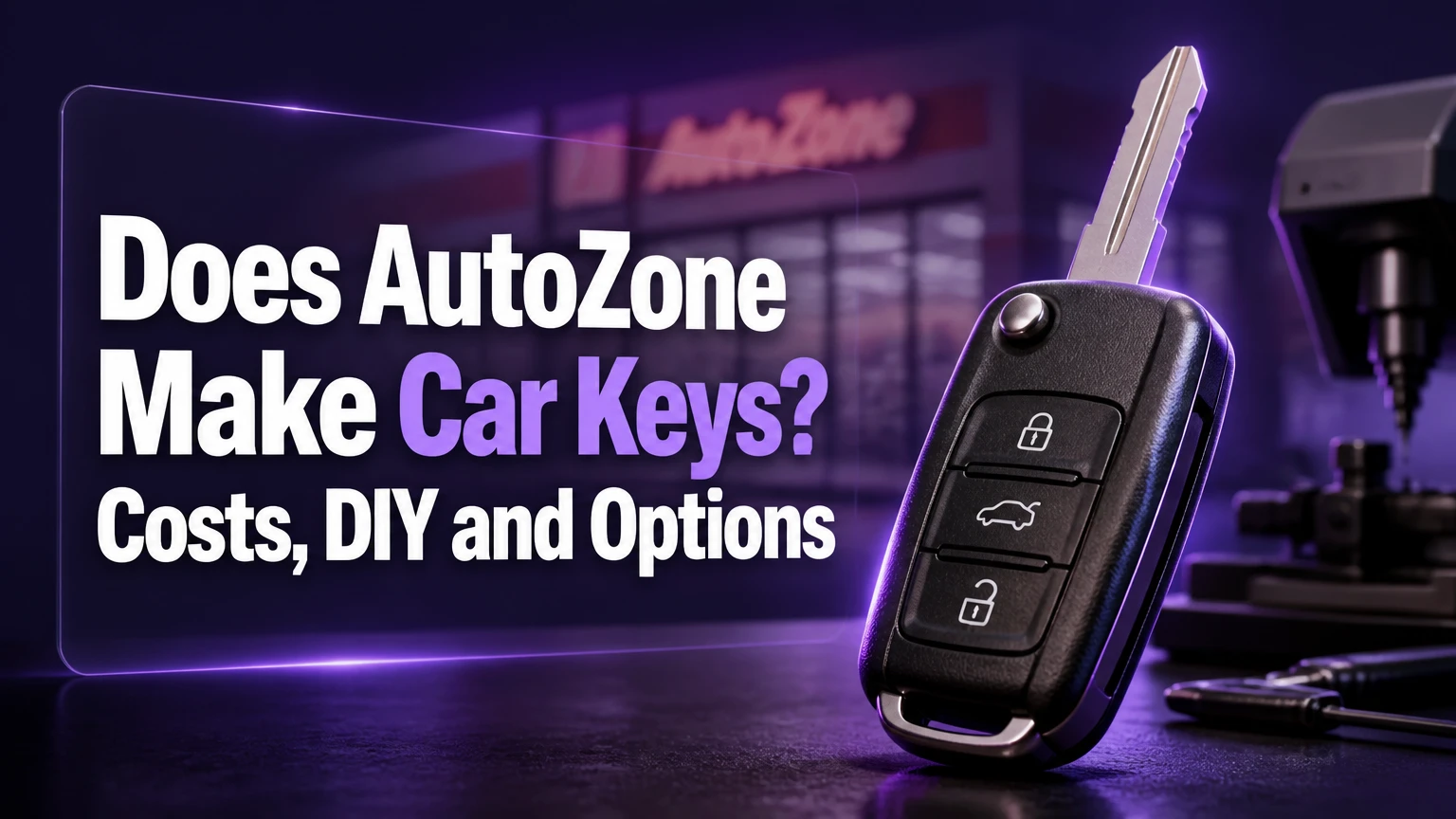
AutoZone usually does not cut and program complete car keys at standard locations. AutoZone primarily sells blank metal keys, transponder keys, remote fobs, and Car Keys Express Simple Key kits, which may require cutting at a hardware store and programming by a locksmith, dealership, or the vehicle owner. Select locations may provide broader Car Keys Express service.
Key Facts at a Glance
- Most AutoZone stores sell replacement key hardware but do not provide complete key cutting and immobilizer programming.
- A Car Keys Express kiosk or participating service can change the answer at some locations, so call the specific store before buying.
- A metal key can often be cut at a hardware store, but a transponder chip still needs vehicle-specific programming.
- AutoZone’s Simple Key kits can support DIY programming only for listed makes, models, years, and key systems.
- A mobile automotive locksmith is usually the most practical option when every key is lost or the vehicle uses a modern smart key.
- The FCC ID, blade profile, chip system, vehicle year, and programming method must match before purchase.
Does AutoZone Make Car Keys?
AutoZone does not generally manufacture a finished, ready-to-use car key at ordinary stores. The retailer commonly supplies the physical key, remote shell, transponder, or programming kit, while another service completes blade cutting and electronic pairing.
A car key has separate functions that consumers often treat as one service. The blade must match the ignition or door lock, the remote must communicate with the vehicle’s body-control system, and an immobilizer transponder must be recognized before the engine starts. A push-button vehicle may use a proximity credential with no exposed blade at all.
AutoZone’s own DIY guidance separates key cutting from electronic programming. That distinction explains why a store may sell a compatible key without being able to finish the replacement. Store capability also changes by market, equipment, staffing, and participation in Car Keys Express programs.
What Does AutoZone Actually Sell?
AutoZone sells several replacement-key categories, but inventory and vehicle coverage vary. Search the vehicle by year, make, and model, then verify the part number and compatibility details before ordering.
| Product category | Physical component | Electronic function | Usual completion point |
|---|---|---|---|
| Basic blank key | Cuttable metal blade | No immobilizer chip | AutoZone or hardware-store cutting |
| Transponder key | Metal blade and plastic head | Engine immobilizer authentication | Locksmith or compatible DIY process |
| Remote-head key | Blade integrated with remote housing | Lock, unlock, panic, and sometimes transponder functions | Cutting plus remote or chip programming |
| Keyless-entry fob | Buttons and circuit board | Door-lock communication | Vehicle-specific pairing or locksmith programming |
| Smart key | Proximity fob and emergency blade | Push-button start and proximity detection | Locksmith, dealer, or approved programming kit |
AutoZone may also sell Car Keys Express products under names such as Simple Key. Those products are not universal. A kit designed for one vehicle family may use a different transponder frequency, blade profile, or programming procedure from a visually similar kit.
Can an AutoZone Location Cut and Program a Key?
A participating AutoZone location with a Car Keys Express kiosk or related service may cut and program some supported keys on-site. Most locations do not offer that full service, so service availability must be confirmed with the exact store rather than assumed from the AutoZone brand.
Before traveling, ask four specific questions:
- Does this location cut automotive keys?
- Does the service program transponder keys or only copy metal blades?
- Does the service support the exact vehicle year, make, model, and trim?
- Must the vehicle, current key, title, registration, or identification be present?
A product page or national website listing does not prove that a nearby store has a functioning kiosk. Call the store, provide the vehicle identification details, and ask whether the service is operating that day. Some programs may cover common vehicles while excluding proximity keys, European models, encrypted systems, or vehicles with no remaining key.
A location that cuts a blade is not necessarily a location that programs the immobilizer. Those are separate capabilities.
Which Type of Replacement Key Do You Need?
The correct replacement depends on whether the vehicle has a plain mechanical key, a transponder, a remote, or a proximity system. The easiest diagnostic is to compare the original key’s shape and vehicle behavior, but the owner’s manual, VIN lookup, or locksmith database provides stronger confirmation.
| Key type | Typical vehicle feature | What happens if incompatible | Typical replacement hardware |
|---|---|---|---|
| Mechanical key | Older vehicle with no immobilizer | Blade will not turn or may unlock doors only | $2-$10 |
| Transponder key | Engine starts only when chip is recognized | Starter may crank without ignition authorization, or engine starts and stalls | $20-$80 |
| Remote-head key | Flip or fixed blade with lock buttons | Door buttons fail, or engine will not start | $40-$120 |
| Keyless-entry remote | Separate metal ignition key | Locks do not respond even when engine key works | $30-$100 |
| Smart or proximity key | Push-button start | Vehicle may display “Key Not Detected” | $100-$300+ |
| Emergency blade | Hidden blade inside smart fob | Opens the door but does not replace electronic authorization | $5-$30 |
A key fob that locks the doors is not automatically programmed to start the engine. Remote locking and immobilizer authentication commonly use separate functions, and one can work while the other remains unpaired.
How Much Does an AutoZone Car Key Cost?
An AutoZone replacement key commonly costs about $2-$300 for hardware, depending on whether the vehicle uses a mechanical blade, transponder, remote-head key, or smart fob. The final price can increase by $2-$10 for cutting and $50-$250 for professional programming.
Prices change by vehicle, brand, inventory, and whether the part is aftermarket or original equipment. The following ranges are typical retail and service figures, not a guaranteed quote.
| Replacement path | Hardware range | Cutting range | Programming range | Typical total |
|---|---|---|---|---|
| Plain metal spare | $2-$10 | $2-$10 | $0 | $4-$20 |
| AutoZone transponder plus locksmith | $20-$80 | Included or $5-$20 | $50-$150 | $70-$250 |
| Remote-head key plus locksmith | $40-$120 | $5-$20 | $50-$150 | $95-$290 |
| Simple Key DIY kit | $90-$160 | $2-$10 | $0 if successful | $92-$170 |
| Smart-key fob plus locksmith | $100-$300 | $0-$20 for emergency blade | $100-$250 | $200-$570 |
| Dealer-supplied smart key | $150-$500+ | Usually included | Usually included | $150-$600+ |
A dealership may charge more because the invoice can include an OEM key, security-code access, cutting, programming, and labor. A mobile locksmith often provides a lower combined price, but the estimate should state whether the quote includes a new fob, blade cutting, programming, service-call charges, and tax.
Why Is the Cheapest Key Not Always the Cheapest Replacement?
A $30 blank can become a $150 replacement if programming fails or a second trip is required. Some dealers refuse to program aftermarket keys, and a cut key may be nonreturnable because the blade has been altered.
The lowest-risk purchase sequence is to confirm compatibility first, identify the programming provider second, and cut the blade last. That order protects the buyer from owning an unusable key with no practical return option.
Can You Program an AutoZone Simple Key Yourself?
You can program a Car Keys Express Simple Key yourself only when the exact vehicle is listed as supported and the included EZ Installer process applies. The kit generally uses the vehicle’s OBD-II connection and a prescribed sequence, but compatibility and existing-key requirements differ by model.
DIY Programming Process
- Verify the vehicle application. Match the year, make, model, trim, key type, and kit number. Do not rely on appearance alone.
- Confirm the required working key. Some vehicles permit onboard addition with one working key; others require a professional procedure when no key remains.
- Buy the complete kit. Confirm that the kit includes the correct blade, transponder, remote functions, and EZ Installer device.
- Cut the blade after compatibility is confirmed. A hardware store may cut the metal blade, but cutting does not program the chip.
- Charge the vehicle battery. Low voltage can interrupt programming and create misleading error symptoms.
- Connect the installer to the OBD-II port. The port is normally under the dashboard near the steering column.
- Follow the vehicle-specific instructions. Keep doors closed, use the specified ignition position, and avoid pressing unrelated controls.
- Test every function. Check door operation, engine starting, trunk release, panic function, and remote range.
The process commonly takes 10-20 minutes when the vehicle is supported and the battery is healthy. A successful result means the engine starts consistently and every intended button responds, not merely that the installer displays a completion message.
Simple Key is a useful budget option for a compatible spare. It is a poor choice for an all-keys-lost emergency, an unsupported vehicle, or a modern smart-key system with restricted security access.
Should You Use AutoZone, a Locksmith, or a Dealership?
AutoZone is usually best for buying lower-cost key hardware when a qualified programmer is already available. A mobile automotive locksmith is usually best for speed, all-keys-lost situations, and on-site programming, while a dealership is the safest compatibility choice for restricted OEM systems.
| Decision factor | AutoZone parts or DIY | Mobile automotive locksmith | Dealership |
|---|---|---|---|
| Typical appointment time | Same day for stocked parts | 30-120 minutes, market-dependent | 1-7 days, market-dependent |
| Typical transponder total | $70-$250 with outside programming | $120-$300 | $180-$450 |
| Typical smart-key total | $200-$570 if supported | $250-$600 | $300-$700+ |
| All-keys-lost capability | Usually limited | Common service | Common service |
| Vehicle location | Customer must transport vehicle or key | Locksmith travels to vehicle | Vehicle usually visits dealer |
| Aftermarket acceptance | Product-specific | Often available, verify first | Varies, often prefers OEM |
| Main risk | Compatibility and split-service responsibility | Variable technician quality | Higher price and scheduling delay |
Prices vary substantially by vehicle security system and region. A quote for a 2012 Ford Focus cannot be applied to a 2023 Toyota RAV4 Prime, because the key architecture, programming access, and fob cost differ.
When Is a Locksmith the Better Choice?
Choose a mobile locksmith when all keys are lost, the vehicle is immobilized, the key must be cut by code, or the car uses a smart key. A qualified locksmith can verify ownership, retrieve the correct key data, cut the blade, erase missing credentials when supported, and program the replacement at the vehicle.
Ask for the company’s automotive license or registration where required by local law, a written total price, and confirmation that the technician supports the exact vehicle. A low phone estimate can exclude the service call, emergency surcharge, VAT or sales tax, or a second programming attempt.
When Is the Dealership Worth the Extra Cost?
A dealership is worth considering when the vehicle has a newer encrypted key system, no aftermarket equivalent exists, or the owner wants an OEM part with a manufacturer-backed parts record. The trade-off is commonly higher cost, transportation requirements, and longer scheduling.
Dealership staff may also require proof of ownership, the VIN, government identification, and all available keys. Requirements differ by manufacturer and jurisdiction.
How Do You Verify a Replacement Key Before Buying?
Verify the replacement by matching the vehicle application, blade profile, FCC ID, part number, transponder family, frequency, and required programming method. A similar-looking fob can still fail because its circuit board, immobilizer chip, or radio frequency does not match the vehicle.
Use this checklist:
- Record the vehicle year, make, model, trim, and engine.
- Compare the original remote’s FCC ID and part number.
- Check the blade profile and number of cuts.
- Confirm whether the key starts the engine or only operates locks.
- Determine whether the vehicle uses a transponder or proximity system.
- Confirm whether one working key is required.
- Ask who will program the key before cutting it.
- Retain the receipt and packaging until every function is tested.
The FCC ID identifies a radio device’s certification identity, but it does not by itself guarantee immobilizer compatibility. VIN-based catalog matching is useful, yet a locksmith or dealer may still need to confirm the vehicle’s security platform.
What Happens When All Car Keys Are Lost?
When all keys are lost, AutoZone normally cannot complete the replacement by simply selling a blank or Simple Key kit. A mobile locksmith or dealership must usually create a new credential, cut a blade by code or decode the lock, and program the vehicle’s immobilizer system.
No-key situations are harder because many DIY procedures assume that one authorized key is already present. Some vehicles allow a limited number of user-programmed keys, while others require diagnostic equipment, security credentials, or an erase-and-add procedure.
Prepare these items before calling:
- Government-issued identification.
- Vehicle registration or title.
- VIN, usually visible through the windshield or on vehicle documents.
- Vehicle location and whether it is locked.
- Make, model, year, trim, and push-button or keyed ignition type.
- Any damaged fob, valet key, or emergency blade still available.
Do not order a generic key online before confirming the system. The wrong part can delay the repair, and some security systems may need missing keys removed from memory to prevent unauthorized starting.
Why Do Replacement Keys Fail to Program?
Replacement keys fail because of incompatible chip data, an incorrect FCC ID, insufficient battery voltage, an unsupported DIY procedure, or an interrupted programming sequence. A key can also be cut correctly yet fail because cutting affects the mechanical lock while programming affects the vehicle’s electronic authorization.
Use this recovery sequence:
| Symptom | Likely cause | First corrective action | Escalation point |
|---|---|---|---|
| Buttons do nothing | Wrong frequency, dead coin cell, unpaired remote | Install the specified battery and recheck FCC ID | Locksmith if pairing still fails |
| Engine will not start | Wrong transponder or unprogrammed immobilizer | Confirm chip application and repeat approved procedure | Professional diagnostic programming |
| Installer shows an error | Low vehicle voltage or unsupported model | Charge battery and verify kit coverage | Return or replace before cutting |
| Key turns but will not unlock | Incorrect blade profile or poor cut | Compare blank and original profile | Locksmith recut or decode |
| “Key not detected” appears | Smart-fob battery, antenna, or compatibility issue | Use emergency-start position from the manual | Dealer or smart-key locksmith |
| One function works only | Remote and immobilizer systems differ | Test each function separately | Reprogram or replace correct module |
Keep the vehicle battery above normal starting condition during DIY work. If the dashboard voltage drops, stop rather than repeatedly cycling the ignition or installer.
What Are the Most Common AutoZone Key Mistakes?
The most expensive mistake is cutting a key before proving that the electronic part and programming route are correct. A cut blade can limit returns, while a compatibility error remains unresolved.
Avoid these errors:
- Assuming every AutoZone store offers key service. Call the exact location.
- Confusing remote pairing with transponder programming. Door buttons may work while the engine remains immobilized.
- Buying by appearance. Match FCC ID, part number, chip type, frequency, and vehicle application.
- Using a DIY kit after losing every key. Verify whether the procedure requires an authorized key.
- Ignoring the battery. Low vehicle voltage can interrupt programming.
- Letting a hardware store program the chip. Many hardware stores cut blades but do not provide automotive immobilizer programming.
- Accepting a verbal locksmith quote. Request a total price with parts, labor, travel, programming, and tax identified.
- Failing to test all buttons. Check lock, unlock, trunk, panic, remote start, and engine authorization before leaving.
A practitioner rule is simple: identify the key’s three separate jobs, mechanical access, remote control, and engine authorization, before selecting a replacement. Many failed purchases solve only one of those jobs.
Which Option Fits Your Situation?
The best route depends on whether you need a cheap mechanical spare, a second transponder key, or an emergency replacement with no remaining keys. AutoZone is most useful when the vehicle supports an inexpensive blank or Simple Key kit and the buyer can verify completion requirements in advance.
Choose AutoZone Parts or DIY
Choose AutoZone when you have one working key, a supported older vehicle, time to verify compatibility, and access to a cutter or approved programmer. A Simple Key kit can reduce labor cost for a known-compatible spare, but the buyer accepts the risk of an unsuccessful procedure.
Choose a Mobile Locksmith
Choose a mobile locksmith when the car cannot be driven, all keys are missing, the vehicle uses a smart key, or you need one provider to handle cutting and programming. Mobile service often reduces the number of handoffs and can diagnose compatibility at the vehicle.
Choose a Dealership
Choose a dealership when OEM compatibility, manufacturer documentation, or a restricted late-model security system matters more than price. Confirm the required documents and whether the dealer will program a customer-supplied aftermarket key before purchasing one.
Frequently Asked Questions
Can AutoZone program a key fob without the car?
AutoZone generally cannot program a vehicle-specific immobilizer key fob without access to the vehicle. Some remote controls use an owner-programming sequence, but the procedure depends on the vehicle, and a remote that locks doors may still require separate programming to start the engine.
Can Lowe’s or Ace Hardware cut an AutoZone car key?
Lowe’s, Ace Hardware, and similar stores may cut a compatible mechanical blade or transponder blank when their equipment supports that profile. Cutting usually does not program the immobilizer chip, so the completed key may still require a locksmith, dealership, or approved DIY procedure.
Is a transponder key the same as a remote key?
A transponder key and a remote key are different functions, although one housing can contain both. The transponder authorizes engine operation, while the remote sends lock, unlock, trunk, or panic commands. A replacement must support every function the original key provided.
Do you need the VIN to buy an AutoZone key?
The VIN is useful for matching the vehicle application, but the FCC ID, part number, blade profile, and key system may also be necessary. A VIN lookup can narrow the choices without proving that an aftermarket fob will program successfully.
How long does professional car-key programming take?
Professional programming commonly takes 20-60 minutes when the correct key is in stock and the vehicle is accessible. All-keys-lost jobs, smart-key systems, damaged locks, security-code delays, and unusual vehicles can extend the visit to several hours.
Can a locksmith program an AutoZone-bought key?
Many automotive locksmiths can program an AutoZone-bought key when the part is compatible and the locksmith accepts customer-supplied hardware. Ask before purchasing, because some technicians will not warranty aftermarket parts or may charge for failed programming attempts.
The Bottom Line
AutoZone usually sells the parts needed for a replacement car key rather than making and programming the finished key at a standard store. Select Car Keys Express locations may provide full service, and compatible Simple Key kits can support DIY programming, but the exact vehicle and location determine the result.
For a cheap mechanical spare, AutoZone or a hardware store may be sufficient. For a transponder or remote-head key, verify compatibility and arrange programming before cutting. For a push-button vehicle or an all-keys-lost emergency, a qualified mobile locksmith or dealership is usually the more reliable path. That is the practical answer to “does autozone make car keys”: sometimes through specific services, but usually as a parts supplier rather than a complete key-making provider.