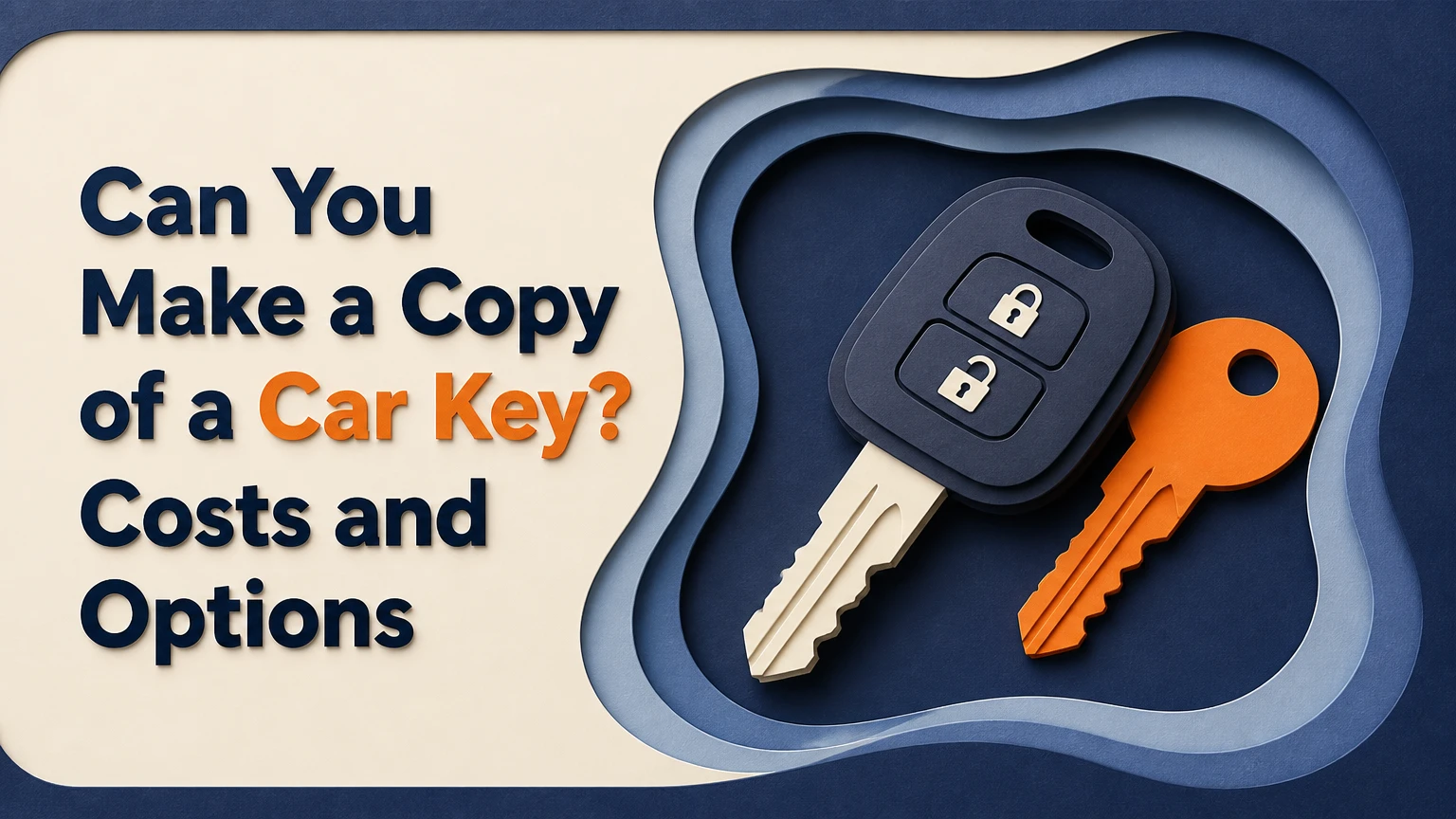
Yes, you can make a copy of a car key, but the required method depends on whether the vehicle uses a mechanical blade, transponder chip, remote fob, or proximity smart key. A complete duplicate may require both physical cutting and electronic programming, and a working spare usually costs about $10-$600 depending on the vehicle and provider.
Key Facts at a Glance
- A mechanical car key can usually be duplicated by cutting a matching metal blade.
- A transponder key must have a compatible immobilizer chip programmed before the engine will start.
- Remote lock buttons and engine-start authorization are separate functions in many vehicles.
- A working original key normally makes duplication cheaper, faster, and more reliable.
- Typical duplicate-key prices range from $10 for a basic blade to $600 or more for some smart keys.
- A reputable locksmith or dealer should verify the vehicle, key part number, and ownership before programming.
What Does Copying a Car Key Actually Mean?
Copying a car key means producing a second key that performs the same authorized functions as the original. Those functions may include unlocking the door, turning the ignition, starting the engine, locking the vehicle remotely, opening the trunk, and allowing passive entry.
Older vehicles may need only a metal duplicate. Most newer vehicles divide the job into separate systems: the mechanical blade operates a lock cylinder, the transponder authorizes engine operation, and the remote transmitter controls convenience features such as locking and unlocking.
The phrase “car key copy” therefore describes several different services. A hardware store may cut a blade accurately but cannot necessarily program an immobilizer. A locksmith may cut and program the key at the vehicle, while a dealer may use manufacturer-authorized software and an OEM key.
Does every copied car key need programming?
No. A key without electronic security needs only accurate cutting, while a key containing a transponder, remote circuit, or proximity system may need vehicle-specific programming. A blade that turns the ignition but lacks a recognized chip can still fail to start the engine.
The vehicle’s year, make, model, trim, market, and immobilizer generation determine the answer. Two cars with the same badge can use different keys because a mid-year production change introduced push-button starting or a revised security module.
Which Types of Car Keys Can Be Duplicated?
Car-key duplication is possible for every common key category, but the equipment, price, and programming procedure change substantially between categories. The fastest way to identify the right service is to inspect the original key and determine whether the vehicle starts with an ignition cylinder or a push button.
| Key type | Physical feature | Electronic function | Typical duplication time |
|---|---|---|---|
| Mechanical blade | Edge-cut metal blade | 0 electronic functions | 5-10 minutes |
| Laser or sidewinder key | Center groove, thicker blade | 0-1 optional chip | 10-20 minutes |
| Transponder key | Plastic head or integrated chip housing | Immobilizer authorization | 20-45 minutes |
| Remote flip key | Folding blade and button housing | Remote entry plus immobilizer | 30-60 minutes |
| Smart or proximity fob | Pocket-held fob, push-button start | Passive entry and immobilizer | 30-90 minutes |
Mechanical keys
Traditional mechanical keys use cuts along the blade edge. A key-cutting machine duplicates the groove pattern onto a compatible blank, and no electronic registration is required.
Mechanical keys are common on older cars, trucks, motorcycles, glove boxes, and some valet applications. The copy should turn smoothly in the door and ignition without force. A cheap duplicate can still damage a cylinder if the blank is poorly made or the cut is inaccurate.
Laser-cut or sidewinder keys
Laser-cut, sidewinder, and milled keys use a wider blade with a groove routed through its face. The name “laser-cut” does not always describe the actual production method, because many professional machines use milling cutters rather than lasers.
These blades require the correct profile, depth, and thickness. A basic edge-cutting machine cannot produce a proper sidewinder key. Some sidewinder keys also contain transponder chips, so the mechanical cut alone may not start the vehicle.
Transponder keys
A transponder key contains a passive chip that communicates with the vehicle’s immobilizer. The chip normally does not use the key’s replaceable button-cell battery, so replacing that battery will not program the key or repair an unrecognized chip.
The technician cuts the blade and then registers a compatible chip, or uses a supported cloning method. A transponder key can unlock the doors and still fail to start the vehicle if the immobilizer data is absent, incompatible, or not accepted by the engine-control system.
Remote flip keys
A remote flip key combines a folding blade, push buttons, a radio transmitter, and often a separate immobilizer chip. The remote buttons may lock the doors successfully even when the transponder remains unprogrammed.
Programming therefore has two possible stages. The remote must be synchronized with the vehicle’s body-control system, and the immobilizer portion must be accepted by the starting system. Some vehicles combine those procedures, while others require separate sequences.
Smart keys and proximity fobs
Smart keys allow passive entry or push-button starting without inserting a blade into an ignition switch. Many use low-frequency vehicle-to-fob detection and a higher-frequency response, while security protocols and frequencies vary by manufacturer and market.
The fob battery powers much of the proximity and button operation, but the exact emergency-start behavior differs. Some vehicles can start with a weak fob battery when the fob touches a marked backup location; others require a specific placement procedure in the owner’s manual.
How Is a Car Key Copied?
A professional duplicate usually follows four stages: identify the vehicle, select a compatible blank, cut the mechanical portion, and test or program the electronic functions. With one working key available, the process commonly takes 15-60 minutes, although luxury vehicles and all-keys-lost jobs can take longer.
Step 1: Identify the vehicle and existing key
Provide the technician with the vehicle identification number, year, make, model, trim, and registration location. Bring every existing key, because the technician may need to test which keys are currently stored in the vehicle.
The technician may inspect the blade profile, key markings, FCC ID, manufacturer part number, chip type, button layout, and frequency. FCC ID markings help identify some remote transmitters in the United States, but the marking alone does not guarantee compatibility.
Step 2: Verify ownership and key availability
Dealers and reputable locksmiths generally request identification plus registration, title, insurance, or another ownership document. Requirements vary by jurisdiction and provider, but the security check protects against unauthorized key creation.
A working original is valuable because it can reveal the cut, allow electronic testing, and reduce the need to decode a lock or retrieve restricted key information. Do not mail an irreplaceable key to an unknown seller unless the return and data-handling terms are clear.
Step 3: Cut the blade
The technician can trace a usable original or cut a new blade from a manufacturer key code. Code cutting is preferable when the original is visibly worn, because tracing reproduces the wear rather than the vehicle’s intended factory dimensions.
A key should operate the door and ignition smoothly, without rocking, scraping, or requiring extra pressure. A successful door test does not prove that the ignition cylinder or immobilizer will work.
Step 4: Program and test electronic functions
The technician may register the new key through an onboard procedure, a diagnostic connection, manufacturer software, or an approved locksmith tool. Some vehicles require all existing keys to be present because entering programming mode can erase keys that are not reintroduced during the session.
Test every relevant function before leaving: door operation, ignition rotation, engine starting, remote lock and unlock, trunk release, panic button, passive entry, and low-battery emergency starting. A remote that locks the doors but does not start the engine is only partially programmed.
Can You Copy a Car Key Without the Original?
Yes, a locksmith or dealer can often create a car key without the original, but the job is more expensive and may require vehicle access, ownership verification, key-code retrieval, lock decoding, or immobilizer programming. The exact result depends on the vehicle’s security architecture and whether all keys were lost.
A professional may retrieve a mechanical key code through authorized databases, decode a lock, or generate a cut from vehicle information. Electronic programming can require a diagnostic connection, a security PIN, manufacturer authorization, or a module-specific procedure.
All-keys-lost work is different from spare-key duplication. The vehicle may need to be placed into a secure programming mode, and lost or stolen keys should be removed from the authorized-key list where the vehicle supports that function.
| Situation | Typical provider time | Typical U.S. price | Main complication |
|---|---|---|---|
| Working mechanical key available | 5-15 minutes | $10-$50 | Worn original or wrong blank |
| Working transponder key available | 20-45 minutes | $90-$250 | Chip programming compatibility |
| Working smart fob available | 30-90 minutes | $200-$600+ | Security access and fob registration |
| No working key, vehicle accessible | 45-120 minutes | $150-$600+ | Code retrieval and programming |
| Stolen key, replacement required | 60-180 minutes | $200-$800+ | Deleting the old key from memory |
How Much Does a Duplicate Car Key Cost?
A duplicate car key typically costs $10-$50 for a mechanical key, $90-$250 for a transponder key, $150-$400 for a remote key, and $200-$600 or more for a smart fob. Prices vary with OEM hardware, vehicle security, labor, location, and whether the technician must program one or several systems.
These are typical U.S. consumer ranges, not guaranteed quotes. European luxury vehicles, newer encrypted systems, unusual sidewinder profiles, and keys purchased through a dealer can exceed the upper ranges.
| Key category | Hardware range | Programming or cutting labor | Typical total |
|---|---|---|---|
| Basic mechanical key | $3-$20 | $7-$30 | $10-$50 |
| Sidewinder blade | $20-$70 | $25-$80 | $45-$150 |
| Transponder key | $30-$120 | $60-$160 | $90-$280 |
| Remote flip key | $60-$180 | $90-$220 | $150-$400 |
| Smart proximity fob | $100-$350 | $100-$350 | $200-$700+ |
An advertised low price may cover only the shell or uncut blade. Ask whether the quote includes the key, cutting, immobilizer programming, remote synchronization, replacement battery, sales tax, and a working test.
Where Should You Get a Car Key Copy?
The best provider depends on the key technology and whether a working original exists. A hardware store is usually suitable for a plain mechanical blade, an automotive locksmith is often the most practical choice for mobile cutting and programming, and a dealer is the safest route for restricted or high-security systems.
| Provider | Mechanical key | Transponder key | Smart fob | Typical total price |
|---|---|---|---|---|
| Hardware store | 5-10 minutes | Select models only | 0 supported functions | $3-$120 |
| Automotive locksmith | 5-90 minutes | 20-60 minutes | 30-120 minutes | $10-$500 |
| Dealership | 30-180 minutes | 30-180 minutes | 60-240 minutes | $50-$800+ |
| Online seller | 3-10 days delivery | Programming excluded | Programming often excluded | $20-$350 |
Hardware store or key kiosk
Choose a hardware store for an older vehicle with a plainly cut, non-chip blade. Confirm the key works in the door and ignition before driving away, because some stores cannot correct vehicle-side faults or program immobilizers.
A kiosk may identify a compatible profile, but availability differs by location and model year. A copied blade is not a complete solution when the original key contains a transponder.
Automotive locksmith
An automotive locksmith is often the best value when the vehicle needs cutting and programming at the same location. A mobile technician can work at home, work, or a roadside location and may avoid a tow.
Ask for the technician’s business license where required, insurance, written total price, programming capability for the exact model, and warranty terms. Confirm whether the proposed key will be registered separately or cloned from the original.
Dealership
A dealership is appropriate when the manufacturer requires proprietary software, online security authorization, a coded smart fob, or a replacement module. Dealers commonly provide OEM hardware, but appointment delays, programming charges, and towing can increase the final bill.
A dealer is not automatically necessary for every push-button vehicle. An experienced locksmith may support the model, but verification must happen before purchasing a nonrefundable key.
Should You Buy an OEM or Aftermarket Key?
OEM keys offer the strongest part-number certainty, while reputable aftermarket keys can reduce hardware cost when the supplier guarantees compatibility and programming support. The correct choice depends on the exact part number, FCC ID where applicable, chip type, blade profile, frequency, and the provider’s willingness to program it.
Check the following before buying online:
- Match the full vehicle year, make, model, trim, and market.
- Compare the original FCC ID, part number, button layout, and blade style.
- Confirm whether the fob is new, refurbished, locked, or previously paired.
- Ask who will program it if the local provider rejects the part.
- Verify the return policy, because cut or programmed keys are often nonreturnable.
- Confirm that the package includes the immobilizer chip, not only an empty shell.
A replacement shell is useful when the circuit board and transponder still work. A shell cannot repair a failed chip, replace missing programming data, or create compatibility that the circuit board does not possess.
What Problems Can Happen After Duplication?
The most common duplication failures are inaccurate cutting, incompatible electronics, incomplete programming, and a worn original that was used as a faulty pattern. Diagnosis should separate physical operation, remote entry, and engine authorization instead of treating “the key” as one system.
The key turns, but the engine does not start
The blade is probably cut correctly, but the immobilizer does not recognize the transponder. Look for a flashing key, padlock, or immobilizer indicator, then have the technician verify chip type and stored-key status.
A dead remote battery usually does not explain a failed transponder start, because many immobilizer chips are passive. The vehicle manual identifies exceptions and emergency-start locations.
The key unlocks the doors but will not start the car
Remote entry and engine authorization may use separate circuits and programming procedures. The technician synchronized the radio transmitter, but the immobilizer chip may remain unregistered or incompatible.
Return to the provider and request a complete function test. Replacing the coin-cell battery will not program the chip.
The key works in the door but sticks in the ignition
A worn ignition cylinder or an inaccurate duplicate can cause this pattern. If the original key is heavily worn, ask for a code-cut replacement rather than a direct trace.
Never force a stiff key. A broken blade can leave metal inside the ignition and turn a cutting problem into a lock repair.
The new fob is not detected
Check the battery orientation, battery voltage, fob model, and emergency detection procedure in the owner’s manual. If passive entry works inconsistently, radio interference, a weak battery, or an incorrect regional frequency may be involved.
Some fobs are locked to a previous vehicle. A seller’s claim that a fob “looks identical” does not establish that the fob can be registered.
What Mistakes Should You Avoid?
Avoid treating a cheap uncut blade, a replacement shell, a remote transmitter, and a fully programmed car key as interchangeable products. Each item solves a different failure point, and buying the wrong component can create a nonreturnable expense.
Copying a worn original
A worn key no longer represents the factory cut precisely. Direct duplication may reproduce excessive wear, causing rough operation or premature cylinder damage.
Confusing cloning with separate programming
Cloning copies the existing transponder identity onto a compatible cloneable chip. Separate programming registers a new key identity, which may allow the vehicle owner to delete that key later without deleting the remaining original.
Ask the technician which method will be used and whether the new key appears as its own authorized entry.
Waiting until every key disappears
A spare made while one key still works generally costs less than an all-keys-lost replacement. Keep a backup away from the vehicle, not inside the center console or the same key ring.
Buying by appearance alone
Two visually identical fobs can use different chips, frequencies, part numbers, or security generations. Match identifiers, not only the vehicle badge and button arrangement.
Ignoring stolen keys
If a key was stolen, request deletion or reprogramming of the old key where the vehicle supports that function. Mechanical door locks, remote access, immobilizer authorization, and passive entry may each require separate attention.
What Is the Safest Practical Process?
The safest process is to identify the exact key system first, obtain a written all-in price, use a provider that verifies ownership, and test every function before accepting the duplicate. The cheapest blade is not the cheapest solution if it requires a second programming visit or damages a worn ignition.
Use this decision sequence:
- Inspect the original for buttons, a folding blade, or a smart-fob design.
- Check whether the car has a conventional ignition or push-button start.
- Count working keys and identify whether any key is lost or stolen.
- Photograph the key markings, part number, and FCC ID without exposing sensitive vehicle documents online.
- Call an automotive locksmith or dealer with the VIN and vehicle details.
- Request separate prices for hardware, cutting, programming, taxes, and travel.
- Ask whether programming creates a unique key entry or a clone.
- Test starting, locking, unlocking, trunk release, passive entry, and emergency operation.
A locksmith cannot guarantee a successful job from the phrase “2018 sedan” alone. The trim, market, immobilizer version, and existing key status can change the required part and procedure.
Frequently Asked Questions
Can AutoZone or another parts store copy a car key?
Some parts retailers sell compatible blanks, batteries, replacement shells, or selected programmable keys, but capability varies by store and vehicle. A parts counter may not cut a sidewinder blade or program a smart fob. Call with the exact year, make, model, and key type before visiting.
Can a copied car key be used for valet service?
Yes, if the copied key is cut and programmed for the intended functions. A valet key may intentionally omit trunk, glove-box, remote, or full-access functions, so a normal duplicate and a valet key are not equivalent. Confirm the desired restrictions before ordering.
Will a dead key-fob battery stop the car from starting?
Usually, a dead fob battery stops remote buttons or passive detection, but many vehicles provide a backup starting method for a weak fob. The procedure varies, such as placing the fob against a marked sensor or inside a designated console pocket. Follow the vehicle manual.
How many spare car keys should you have?
Two working keys are a practical minimum for most vehicles, and three can be sensible for shared or family vehicles. Some models require two recognized keys for owner-programming procedures, while a single remaining key can make future replacement more expensive.
Can a locksmith program a used key fob?
Sometimes, but many used fobs are locked, previously paired, damaged, or incompatible with the vehicle’s security generation. A locksmith can determine whether the fob supports erasure and re-registration, but a new OEM fob may be required for restricted systems.
Does insurance cover a duplicate car key?
Standard auto insurance often excludes routine spare-key duplication, while comprehensive coverage, roadside assistance, manufacturer plans, or key-replacement add-ons may cover certain lost or stolen keys. Check the policy’s deductible and exclusions before filing a claim for a low-cost duplicate.
The Bottom Line
You can make a copy of a car key, but the correct service depends on the key’s mechanical profile and electronic security. A plain blade may cost $10-$50, while a transponder, remote, or smart key can cost $90-$700 or more after cutting and programming.
Make the spare before the last key is lost. For a basic blade, use a reputable hardware store; for a programmed key, compare an automotive locksmith with the dealership; and for a stolen or high-security key, request authorized deletion of the old key as part of the replacement. A complete can you make a copy of a car key answer is therefore yes, provided the physical and electronic parts are both matched, programmed, and tested.