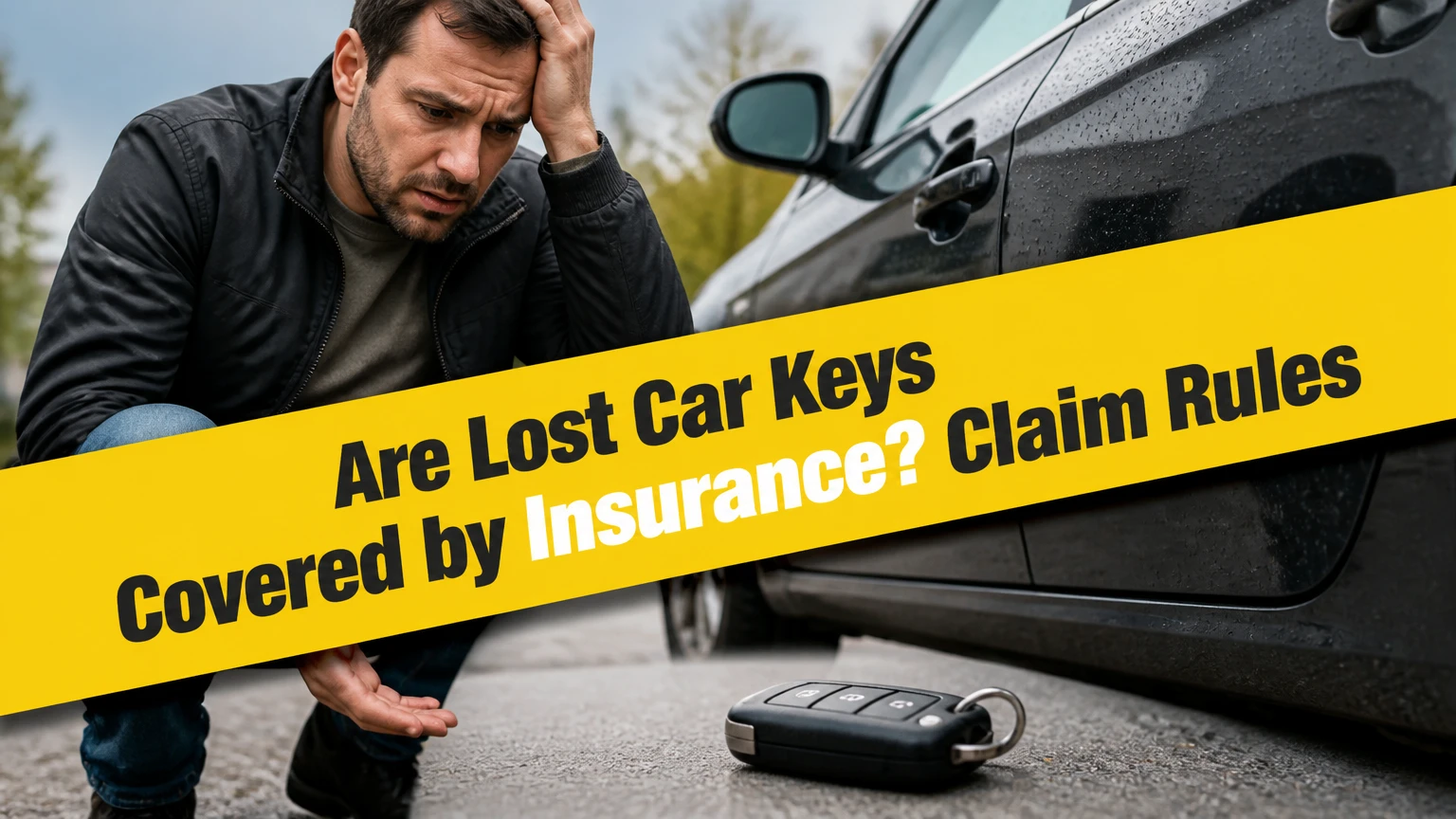
Are lost car keys covered by insurance? Usually, ordinary car insurance does not pay when you simply misplace a key or key fob. Coverage may apply through a key replacement endorsement, a premium policy benefit, roadside assistance for lockout labor, or comprehensive coverage when the key loss is connected to a covered theft or other insured event.
Key Facts at a Glance
- Standard comprehensive and collision coverage usually exclude a key that is simply lost.
- A key replacement endorsement may cover lost, stolen, or damaged keys, including cutting and electronic programming.
- Roadside assistance commonly pays for lockout service, not the cost of a replacement fob.
- A claim makes financial sense only when the expected reimbursement exceeds the deductible and any claim-related cost.
- Typical replacement prices range from $10-$50 for a mechanical key to more than $1,000 for some luxury smart-key systems.
- Stolen keys create a vehicle-security issue because anyone holding the key may be able to access or start the car.
What Does Car Key Insurance Actually Mean?
Car key insurance is usually an endorsement, packaged benefit, or separate key-care product rather than a standard coverage category. The policy wording determines whether the benefit covers accidental loss, theft, breakage, emergency transportation, key cutting, remote controls, immobilizer programming, or only a limited reimbursement.
The phrase “comprehensive insurance” causes much of the confusion. Comprehensive coverage generally responds to specified non-collision damage to the vehicle, such as theft, fire, vandalism, hail, or falling objects. A loose key that disappears from a pocket is not normally physical damage to the insured vehicle.
Key replacement products work differently. They are designed around the key as the insured item and may provide a separate limit, a lower deductible, or a service referral. UK providers often market similar products as key cover or Keycare, while policies in the United States and Canada may describe the benefit as a key replacement endorsement or vehicle protection add-on.
The legal and insurance position depends on jurisdiction. The overview of common practice is broadly similar across the United States, Canada, the United Kingdom, Australia, and other markets, but exclusions, consumer protections, taxes, policy limits, and claim consequences differ.
Which Coverage Type Pays?
The following distinctions identify the most likely payer before you call an insurer. Policy documents control the final result.
| Coverage or service | Misplaced key | Stolen key | Lockout labor | Cutting and programming |
|---|---|---|---|---|
| Standard comprehensive | Usually $0 | Sometimes, if tied to covered theft | Usually $0 | Usually $0 |
| Key replacement endorsement | Often covered | Often covered | Often covered | Often covered |
| Roadside assistance | Usually $0 | Usually $0 | Often covered | Usually $0 |
| Homeowners or renters policy | Usually excluded | Sometimes, subject to limits | $0 | Usually excluded |
| Manufacturer warranty | Usually excluded | Usually excluded | Sometimes included | Sometimes included |
| Motor club membership | Limited benefit | Limited benefit | Often covered | Partial credit in some plans |
Does Comprehensive Insurance Cover a Misplaced Key?
Standard comprehensive insurance usually does not cover a car key that the policyholder simply loses. Comprehensive coverage may become relevant when the key disappears as part of a covered vehicle theft, fire, or vandalism claim, but the exact treatment of the replacement key and personal belongings depends on the policy.
For example, a stolen vehicle may trigger comprehensive coverage for the vehicle itself, while the replacement key is handled as part of the recovery or security process. Some insurers pay for locks or reprogramming when a stolen key creates a reasonable risk of unauthorized access. Others pay only for damage to the vehicle and exclude the key.
A key lost inside a stolen handbag creates a different question. The handbag and its contents may fall under a homeowners or renters policy, subject to the personal-property limit and deductible, while the vehicle key may receive a separate exclusion. The same loss can therefore involve two policies with different definitions and deductibles.
Collision coverage almost never pays for a lost key. Collision responds to damage caused by impact with another vehicle or object, not to misplaced personal property or electronic accessories.
Does Collision Coverage Pay for a Key Fob?
Collision coverage does not normally reimburse a lost or damaged key fob unless the fob damage forms part of an insured collision loss under the policy’s vehicle-damage terms. A fob dropped on a driveway, crushed in a bag, or damaged by water generally requires a key benefit, warranty, service plan, or personal payment.
When Is a Key Replacement Endorsement Worthwhile?
A key replacement endorsement is most valuable when a vehicle uses expensive smart keys, the benefit has a low or zero deductible, and the annual premium remains below the likely replacement cost. The endorsement is less attractive for an older vehicle with a $20 mechanical key or a $100 transponder replacement.
Read five terms before purchasing or claiming:
- Covered cause: Confirm that “lost” appears alongside stolen, damaged, broken, or locked inside the vehicle.
- Per-key limit: A $500 annual limit may not cover a $900 encrypted fob.
- Programming: Verify that immobilizer pairing, remote programming, emergency blades, and labor are included.
- Deductible: A $0 endorsement deductible differs substantially from a $500 comprehensive deductible.
- Eligibility period: Some products exclude keys lost before enrollment or impose a waiting period.
Insurance Market and similar insurance guides describe key-loss coverage as an optional benefit in many markets. The product may be sold by the motor insurer, a broker, a dealer, or a separate provider, so the cancellation and claim rules may not match the main motor policy.
Can a Key Rider Cover Every Replacement Cost?
A key rider may cover the replacement key, programming, locksmith labor, towing, car hire, or transportation, but no benefit should be assumed without checking the schedule. Some policies exclude dealer markups, aftermarket keys, second replacement claims, lost spare keys, or vehicles older than a specified age.
A practical rule is to ask the insurer for the maximum payable amount in writing. Request separate figures for the key, programming, labor, call-out fee, towing, taxes, and any required security reconfiguration.
Does Roadside Assistance Replace the Key?
Roadside assistance usually pays for the service needed to unlock a vehicle, not for the physical replacement key. A roadside technician may gain entry, retrieve a locked-in key, or tow the vehicle to a dealer, while the owner pays for cutting and programming unless a separate key benefit applies.
The distinction matters at the scene. If the key is locked inside the car, unlocking may solve the problem without a replacement. If the key is genuinely missing and no spare exists, roadside assistance may only transport the car or arrange a locksmith.
Check the service limit as well. Many plans limit the number of calls per policy period, impose a mileage limit on towing, or exclude assistance at an unsafe location. A roadside plan that covers a $100 lockout call does not necessarily cover a $600 smart fob.
What Should You Do Immediately?
The first priority after losing a car key is to establish whether the key is misplaced, stolen, or locked inside the vehicle. The correct classification affects police reporting, security action, insurance eligibility, and the choice between unlocking, deactivation, and full replacement.
Follow this sequence:
- Search systematically. Check the last vehicle location, clothing, bags, workplace, parking office, lost-property desk, and any tracking tag.
- Use the spare key if available. Avoid moving the car until you know whether the missing key can be recovered.
- Treat suspected theft as a security event. Move the vehicle to a secure location, notify the police where appropriate, and tell the insurer.
- Locate the VIN. The VIN appears on the dashboard, registration document, title, or insurance records.
- Call the insurer before authorizing expensive work. Confirm coverage, approval requirements, provider restrictions, and the claim number.
- Obtain a written estimate. Require separate prices for the key, cutting, programming, emergency blade, labor, towing, and taxes.
- Bring every remaining key. Some vehicles require all authorized keys to be present during programming.
A police report does not create coverage. It documents suspected theft and may satisfy a policy condition, especially when the insurer needs evidence that the key was taken rather than misplaced.
How Do You Claim Reimbursement?
To claim reimbursement, verify the endorsement, document the loss, obtain an approved estimate, authorize the repair through the required provider, and submit itemized receipts. The claim process normally takes longer when the policyholder uses an unapproved locksmith or cannot prove ownership of the vehicle.
Prepare these documents:
| Claim item | Typical evidence | Why the insurer requests it | Common delay |
|---|---|---|---|
| Vehicle identity | VIN, registration, title | Confirms the insured vehicle | VIN mismatch |
| Policy eligibility | Schedule, endorsement number | Confirms key benefit | Rider purchased after loss |
| Loss circumstances | Written statement, police file | Tests loss versus theft classification | Inconsistent timeline |
| Replacement cost | Itemized written estimate | Separates covered services | One-line invoice |
| Ownership and payment | Receipt, driver identification | Confirms reimbursement recipient | Cash payment without receipt |
| Existing keys | Photos or technician report | Assesses reprogramming need | Missing spare information |
Ask whether the insurer requires prior authorization. Some carriers reimburse only a network locksmith or dealership, while others allow the owner to choose a provider and submit the invoice afterward.
Can a Lost-Key Claim Raise Insurance Costs?
A lost-key claim can affect renewal pricing, claim-free discounts, or underwriting decisions, but the effect depends on the insurer, jurisdiction, claim type, claim amount, and the policyholder’s history. A small endorsement claim may be treated differently from a comprehensive vehicle-theft claim.
Do not assume that asking a question creates a claim, but ask the representative to distinguish a coverage inquiry from a reported loss. Record the representative’s name, date, and instructions.
Use this calculation:
Estimated insurer payment = covered expense minus applicable deductible, subject to the policy limit.
Example: a $700 replacement fob with a $500 comprehensive deductible produces a maximum theoretical payment of $200 before exclusions. A $700 key rider with a $0 deductible may produce a much larger payment, but only if programming and the chosen provider qualify.
Filing a $200 claim against a $500 deductible generally has no payment value. A claim can still create administrative history, so compare the potential reimbursement with the premium, deductible, and any claim-free discount at risk.
How Much Does a Replacement Car Key Cost?
A typical replacement costs $10-$50 for a basic mechanical key, $100-$300 for many transponder keys, and $200-$600 or more for a smart key fob. Luxury vehicles, encrypted systems, immobilizer resets, emergency call-outs, and all-keys-lost situations can push the total above $1,000.
Prices vary by make, model, year, geographic area, key frequency, provider, and whether the vehicle must be towed. The following ranges are practical consumer estimates, not guaranteed quotes.
| Key type | Typical key price | Typical total with programming | Typical turnaround |
|---|---|---|---|
| Mechanical metal key | $10-$50 | $20-$100 | 15-60 minutes |
| Remote-head key | $75-$200 | $125-$300 | 30-120 minutes |
| Transponder key | $50-$180 | $100-$300 | 30-180 minutes |
| Smart key or proximity fob | $150-$600 | $250-$800 | 1-4 hours |
| Luxury encrypted fob | $400-$900 | $600-$1,500+ | 1-7 days |
Dealer quotes often include an OEM key, VIN verification, programming, and a security process. Mobile automotive locksmiths may offer lower prices and faster service, although some newer vehicles require manufacturer software or online authorization unavailable to an independent technician.
Should You Use a Locksmith or Dealership?
An automotive locksmith is usually the faster and less expensive choice for standard transponder keys, remote-head keys, and many mainstream vehicles. A dealership is usually the safer route for newer encrypted systems, luxury brands, unusual immobilizers, or cases where every key has been lost.
| Decision factor | Mobile locksmith | Dealership |
|---|---|---|
| Typical labor model | $75-$250 call-out and labor | $100-$300 labor, often plus towing |
| Common total | $100-$500 | $250-$1,500+ |
| Location | Comes to the vehicle | Usually requires vehicle delivery |
| Key source | OEM or aftermarket | OEM manufacturer key |
| Typical timing | 30 minutes-4 hours | Same day-7 days |
| Best fit | Mainstream vehicles and urgent access | Encrypted or luxury systems |
| Main risk | Incompatible equipment or poor key quality | Higher price and slower scheduling |
A locksmith should verify the vehicle identification, ownership, key frequency, and programming method before starting. Avoid providers who quote only a low blank-key price and add undisclosed programming, travel, or diagnostic charges at the vehicle.
A dealership is not automatically better for every car. A reputable locksmith with current manufacturer-level equipment may program a mainstream vehicle correctly at half the dealer price. The honest limitation is that no provider can guarantee same-day service when the vehicle requires a proprietary key ordered by VIN.
Can Homeowners or Renters Insurance Pay?
Homeowners or renters insurance may cover a stolen key as personal property when the theft occurred during a covered event, but the policy may exclude vehicle accessories, impose a personal-property deductible, or pay less than the motor policy’s key benefit. A merely misplaced key is usually excluded.
Consider a $1,000 homeowners deductible. A stolen $300 fob creates no practical reimbursement even if the policy technically covers it. A $50 renters deductible could produce payment, but only after the insurer applies the policy’s limits and exclusions.
Report the loss to the insurer that best matches the event. Do not submit the same expense to two insurers or describe a misplaced key as stolen. Insurance fraud concerns arise when the cause, location, or timing is deliberately misstated.
What Happens When the Only Key Is Gone?
When the only car key is lost, replacement may require a mobile locksmith, vehicle recovery, dealer programming, and removal of the missing key from the vehicle’s authorized-key memory. The process often costs more because the technician cannot use an existing key to prove operation or simplify programming.
The owner should ask whether the missing key can be electronically deactivated. Deactivation reduces the risk that someone who finds the old key can unlock or start the vehicle, although it may not prevent physical entry or every remote function.
Typical complications include:
- The vehicle must be towed because programming requires a powered diagnostic connection.
- A replacement key must be ordered from the manufacturer using the VIN.
- Security PINs or online authorization may be required.
- All remaining keys may need to be re-registered.
- A lost key may require lock-cylinder replacement if the vehicle is at high theft risk.
The cheapest quote is not always the lowest total cost. A $250 mobile service that cannot program the vehicle may lead to a $200 call-out followed by a dealer tow and a second programming charge.
Which Alternatives Can Reduce the Bill?
Warranty roadside benefits, motor clubs, manufacturer service plans, credit-card benefits, and vehicle subscription programs can reduce the cost, but eligibility usually depends on enrollment before the loss and on the exact service terms. A new-car roadside plan may cover lockout labor without paying for a replacement fob.
Check these sources in order:
| Alternative | Possible benefit | Typical limitation | Verification point |
|---|---|---|---|
| New-car warranty | Lockout or towing | Often excludes replacement keys | Warranty booklet and expiration |
| AAA or motor club | Lockout service, limited key credit | Membership tier and call limits | Benefit schedule |
| Credit-card benefit | Roadside dispatch or lockout | Card use, country, and service limits | Guide to benefits |
| Dealer service plan | Key replacement or programming | Vehicle age and named dealer | Contract wording |
| Vehicle lease program | Replacement assistance | May require return of all keys | Lease agreement |
| Bluetooth tracker | Helps locate a misplaced key | Does not replace or insure it | Battery and app status |
Do not buy a membership after losing the key and expect immediate coverage. Many programs impose activation delays or exclude pre-existing incidents.
What Common Mistakes Increase the Cost?
The most expensive errors involve treating a lockout as a replacement problem, authorizing work before checking coverage, and failing to secure the vehicle after suspected theft. Correct classification at the start prevents unnecessary towing, duplicate programming, and rejected claims.
Practitioner rules of thumb include:
- Ask for an all-in quote. A blank key price alone is not a replacement price.
- Compare the total with the deductible. A claim below the deductible has no reimbursement value.
- Bring every remaining key. Programming may erase previously stored keys or require simultaneous registration.
- Do not test unknown aftermarket fobs on a high-value vehicle. Incorrect programming attempts can consume security sessions or create additional diagnostic charges.
- Ask for the old key’s status. Stolen keys should be deleted from the immobilizer memory where the vehicle supports that function.
- Protect the spare immediately. Keeping one key at home does not help if the vehicle is stranded far away, and storing both keys together defeats the purpose of a spare.
A key-replacement rider is also not a substitute for theft prevention. It may pay for a new fob while leaving the owner responsible for a stolen vehicle, policy deductible, or security upgrade.
What Should You Do in Different Situations?
The best response depends on whether the key is locked inside, misplaced nearby, stolen, damaged, or lost with no spare. Each situation has a different first action and likely cost.
| Situation | First action | Likely service | Typical cost before coverage |
|---|---|---|---|
| Key locked inside car | Call roadside assistance | Vehicle entry | $0-$150 |
| Key misplaced, spare available | Search, then obtain quote | Duplicate key | $20-$800 |
| Key stolen from a bag | Secure vehicle and report theft | Reprogram or replace | $150-$1,500+ |
| Key damaged but still recognized | Test spare and inspect battery | Shell, battery, or fob | $10-$400 |
| Only key lost | Call qualified locksmith or dealer | Full all-keys-lost replacement | $150-$1,500+ |
| Key lost while traveling | Contact insurer or motor club | Mobile service or towing | $100-$1,000+ |
For a new vehicle, start with the manufacturer warranty and dealer before paying privately. For an older mainstream vehicle, obtain a locksmith quote before accepting a dealer estimate. For a luxury vehicle with no spare, prioritize security and manufacturer-compatible programming over the lowest advertised price.
Frequently Asked Questions
Does insurance cover a key locked inside the car?
Standard car insurance usually does not pay for the key itself when the key is locked inside the vehicle. Roadside assistance may cover the locksmith’s entry service, subject to a call-out or mileage limit. If the key is damaged during entry, coverage depends on the roadside contract and the technician’s responsibility.
Are spare car keys covered by insurance?
A spare key may be covered by a key replacement endorsement if the endorsement covers lost or stolen keys and the replacement remains within its per-claim limit. Standard comprehensive coverage generally does not pay for a spare that the owner misplaces. Ask whether the policy covers one key per incident or multiple keys.
Does insurance cover a key fob battery?
Most standard motor policies do not cover routine key-fob battery replacement because batteries are maintenance items. A key endorsement may cover a complete replacement fob when the battery failure causes qualifying damage, but it normally will not pay for an ordinary depleted battery costing about $5-$20.
Can I claim a replacement key without the original?
A qualified locksmith or dealership can often create and program a key without the original, using the VIN and vehicle security system. The process may require proof of ownership, a security code, towing, and deletion of the missing key. Insurance reimbursement still depends on the policy’s approval and documentation rules.
Will an aftermarket key void my car warranty?
An aftermarket key does not automatically void an entire vehicle warranty, but a manufacturer may deny a repair that it can reasonably link to an incompatible key or programming attempt. Keep the invoice, confirm compatibility, and use an authorized technician when the vehicle has a complex immobilizer or active service contract.
Are lost car keys covered by insurance in every country?
No. Lost car key coverage varies by country, insurer, policy wording, deductible, and product type. UK Keycare products, North American auto endorsements, Australian roadside plans, and other regional products use different limits and exclusions. Read the policy schedule and claims section rather than relying on the label “comprehensive.”
The Bottom Line
Are lost car keys covered by insurance? Standard car insurance usually does not pay for a key that is simply misplaced, while a key replacement endorsement may cover the fob, cutting, programming, and related labor. Roadside assistance generally handles lockout service only.
Check the policy before authorizing work, compare the replacement quote with the deductible, and report suspected theft promptly. Use a mobile locksmith for many mainstream vehicles, choose a dealership for proprietary or encrypted systems, and ask for deactivation when a stolen key could still access the vehicle.