Leaving a key fob inside or close to a vehicle can contribute to 12-volt car-battery drain, especially when the car repeatedly detects the fob and fails to enter a low-power state. The effect is not universal or always continuous: vehicle design, fob motion sensing, battery condition, temperature, and ignition status determine whether the fob is a meaningful cause.
Key Facts at a Glance
- A passive keyless-entry vehicle may consume more power when a recognized key fob remains in or near the cabin.
- A healthy vehicle in sleep mode typically draws about 20-50 milliamps, while an awake vehicle can draw several hundred milliamps.
- A weak 12-volt battery may fail after 24-48 hours of elevated draw; a healthy battery may last longer.
- A stationary motion-sensing fob may stop responding after a short period, reducing risk on supported vehicles.
- A dead key-fob battery usually does not mean the vehicle’s 12-volt battery is dead.
- A multimeter sleep-current test is more reliable than blaming the key fob from timing alone.
Does Leaving Key Fob in Car Drain Battery?
Yes, leaving a key fob in a car can drain the vehicle’s 12-volt battery, but the result depends on the vehicle’s keyless-entry architecture. The key fob can cause repeated detection activity or delay body-control modules from sleeping, yet many newer systems suspend the fob and allow the vehicle to sleep after the car is locked and stationary.
The strongest risk occurs when a vehicle is left unlocked, the fob is repeatedly moving, or the car’s interior antenna keeps detecting the key. A fob stored beside the vehicle can also matter when radio signals pass through a garage wall or window, although distance and antenna sensitivity vary substantially by make and model.
A key fob is rarely the only possible explanation for a dead battery. An open hatch, dashcam, aftermarket alarm, telematics module, interior light, aging battery, or charging fault can produce the same symptom. Treat proximity as a testable hypothesis, not a diagnosis.
What part of the battery is affected?
The vehicle battery affected is normally the low-voltage 12-volt battery, not the high-voltage traction battery in a hybrid or electric vehicle. The 12-volt battery powers the body-control module, locks, alarms, network gateways, interior electronics, and starting controls while the vehicle is parked.
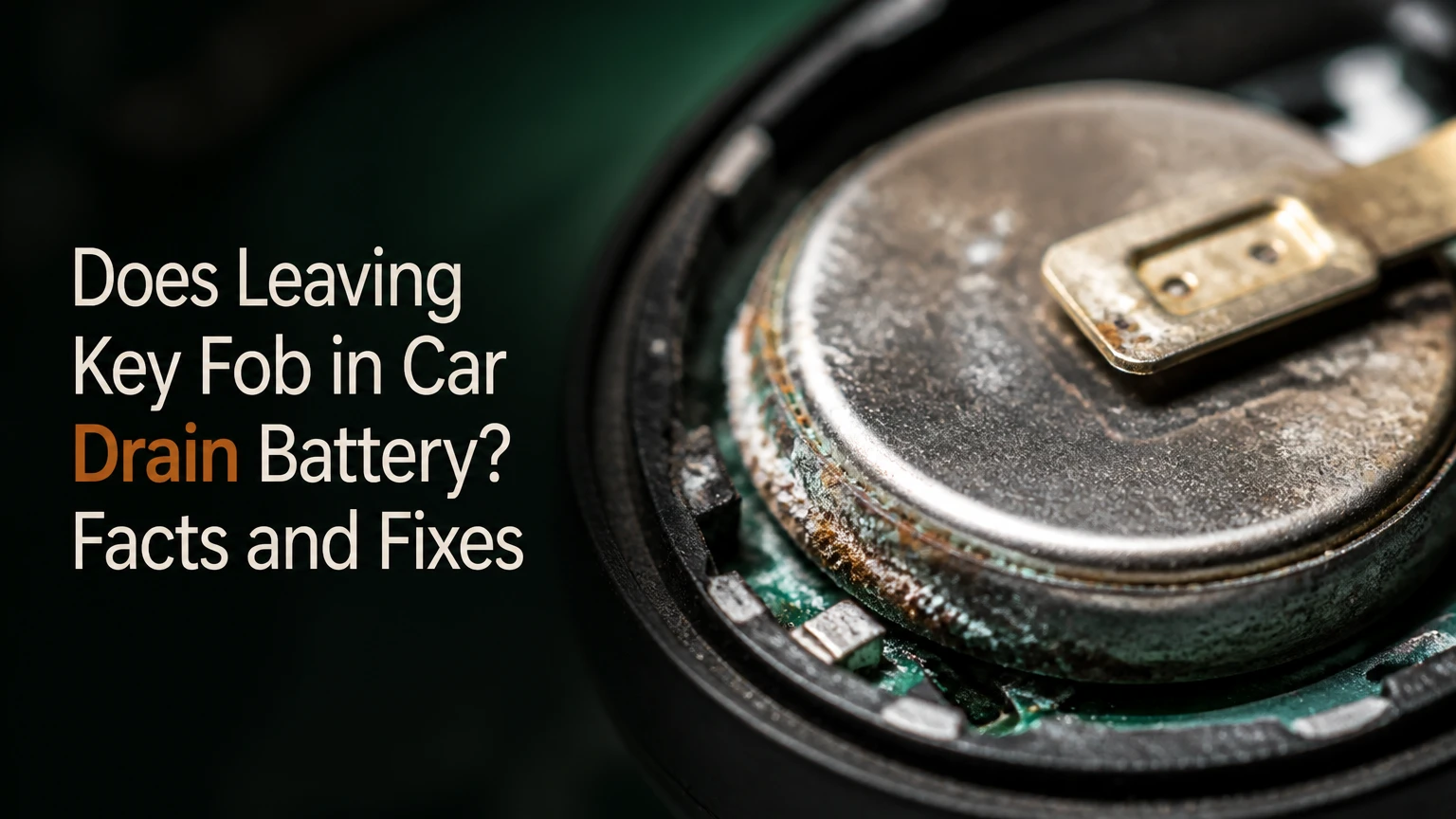
The key fob has its own small coin-cell battery, commonly a CR2032 or CR2025. Key-fob activity can shorten that cell’s life, but a depleted fob cell generally affects remote locking or key detection rather than directly discharging the vehicle battery.
How Does a Smart Key System Work?
A smart key system uses vehicle antennas, a key-fob transceiver, an immobilizer or keyless-control module, and a body-control module to determine whether an authorized key is nearby. The vehicle usually sends a low-frequency challenge, commonly around 125 kHz, and the fob returns a radio-frequency response, often near 315 MHz or 433 MHz depending on market and system design.
The vehicle may place antennas in door handles, bumpers, the center console, trunk areas, and cabin zones. Interior antennas help determine whether the key is inside the car, while exterior antennas support hands-free unlocking when the key is near a door.
A typical sequence is:
- The vehicle wakes an antenna or control module.
- The antenna searches for an authorized key.
- The fob responds if it receives the correct challenge.
- The vehicle validates the credential.
- The system returns to a low-power state when conditions permit.
That sequence is not necessarily a continuous ping-pong conversation. Sleep timers, motion sensors, lock status, network gateways, and software calibration control how often the system repeats it.
Why can proximity increase electrical draw?
Proximity increases electrical draw when the vehicle repeatedly wakes its keyless-entry electronics or keeps a networked control module active. A recognized fob inside the cabin can prevent some systems from treating the vehicle as fully unoccupied, especially if the car remains unlocked or another module continues requesting key status.
The exact current depends on the vehicle. A conventional sleeping modern vehicle often draws approximately 20-50 mA after its modules time out. A vehicle that remains partly awake may draw 100-500 mA, and an active accessory or failed module can draw more.
These are typical diagnostic ranges, not universal specifications. Manufacturer sleep-current limits may differ, and a technician must wait for timed modules to shut down before judging the result.
How Long Can a Key Fob Drain a Car Battery?
A key fob-related load can make a weak car battery fail in 24-48 hours, while a healthy battery may tolerate several days or longer. No universal deadline exists because usable capacity changes with battery age, temperature, state of charge, reserve capacity, and the vehicle’s actual current draw.
A rough calculation illustrates the problem. A 60-amp-hour battery exposed to a 300-milliamp load would theoretically lose 7.2 amp-hours per day, but a starter battery should not be discharged to its rated capacity. Voltage falls under starting load well before the battery is chemically empty.
| Parking condition | Typical parked draw | Likely consequence |
|---|---|---|
| Healthy sleep mode | 20-50 mA | Several weeks may be possible |
| Delayed sleep or repeated key detection | 100-300 mA | Failure may occur in 2-7 days |
| Awake modules or accessory load | 300-500 mA | Failure may occur in 1-3 days |
| Weak battery at 50% charge | 100-300 mA | No-start may occur in 24-48 hours |
| Interior lamp or major accessory | 1-5 A | Battery can become unusable overnight |
Cold temperatures reduce available battery capacity and increase engine cranking demand. A battery that starts normally in mild weather may fail after one night of elevated draw in freezing conditions.
Can the key fob drain its own battery?
Yes, a key fob can lose its coin-cell battery faster when it repeatedly responds to a nearby vehicle, but many fobs limit this behavior with sleep logic or motion sensing. A normal fob battery often lasts roughly 1-4 years, although usage frequency, temperature, button faults, and radio activity change that range.
A fob that needs button presses from a shorter distance, produces intermittent locking, or displays a low-key warning may have a weak cell. Replace the cell with the size and polarity specified in the owner’s manual. Some fobs lose remote-control synchronization or require a manual initialization sequence after battery replacement, so the manual takes priority over generic instructions.
Which Key Systems Are Most Likely to Cause Drain?
Older immobilizer transponder keys create little or no parked-battery risk because the passive chip has no continuously powered transmitter. Standard proximity fobs create more opportunity for drain, while motion-sensing fobs usually reduce the risk after the fob remains still.
| Key system | Parked communication | Car-battery risk | Fob-battery behavior |
|---|---|---|---|
| Mechanical key with passive chip | No active search after shutdown | Very low | No coin cell required for starting |
| Remote-lock fob | Receives button input only | Very low | Cell powers occasional transmissions |
| Passive smart fob | Vehicle searches for nearby key | Low to moderate | Cell responds during detection |
| Motion-sensing smart fob | Response pauses when stationary | Low on supported systems | Cell use falls after inactivity |
| Phone key using BLE or UWB | Phone maintains digital-key service | Vehicle-dependent | Phone manages its own power state |
Vehicle software matters more than the label on the key. Two vehicles sold in the same year can use different antenna layouts, sleep timers, and fob revisions. A dealer or locksmith can identify the exact system through the vehicle identification number and replacement-part number.
Is a motion-sensing fob always safe?
No. A motion-sensing fob reduces unnecessary transmissions, but it does not eliminate every source of vehicle battery drain. Movement in a bag, a person carrying the key near the car, a second key, an unlocked vehicle, or a separate module fault can keep the system active.
Motion sensors also do not change what happens when the ignition remains in accessory mode. If the dashboard, infotainment system, or climate fan is powered, the resulting load comes from the vehicle’s operating state rather than from key proximity alone.
How Far Away Should the Key Fob Be?
Store the key fob several metres away from the vehicle, preferably outside the garage or behind a tested signal-blocking container. A fixed distance such as 10 or 15 feet is not reliable because walls, windows, vehicle antennas, and fob orientation alter the effective detection range.
A practical storage test is simple:
- Lock the vehicle with the fob.
- Place the fob at the intended storage location.
- Wait until the vehicle’s interior and exterior lights switch off.
- Try the door handle without pressing the unlock button.
- Confirm that passive unlocking does not occur.
If the vehicle unlocks or repeatedly wakes when the key is stored inside the home, increase the distance. A Faraday pouch or metal-lined box can block the signal, but poorly made pouches may leak RF energy around seams or openings.
A signal-blocking case is not a substitute for checking the vehicle. It cannot repair an aging battery, stuck relay, open hatch switch, or malfunctioning control module.
How Can You Prove the Fob Is Involved?
You can test the key fob’s involvement by comparing the vehicle’s stabilized sleep current with and without the fob nearby. A current measurement taken immediately after locking is misleading because many vehicles remain awake for several minutes while alarms, telematics, and network modules time out.
A qualified technician typically:
- Fully charges the 12-volt battery.
- Closes or latches every door, hood, and hatch.
- Locks the vehicle and keeps all keys several metres away.
- Waits for the manufacturer’s sleep period, often 20-60 minutes.
- Measures current in series with a suitable meter or uses a current clamp.
- Repeats the test with the suspected fob inside or near the vehicle.
- Compares the stabilized readings and checks module activity.
Do not connect a standard multimeter across the battery while set to current mode. That creates a short circuit through the meter fuse and can damage vehicle electronics. Some vehicles also lose memory settings or trigger alarms when the battery circuit is interrupted, so professional testing is safer.
| Test result | More likely explanation | Next action |
|---|---|---|
| Current falls below 50 mA without fob | Fob detection or keyless module activity | Test fob distance and software |
| Current stays above 100 mA without fob | Another parasitic load | Inspect lights, accessories, and modules |
| Current changes only when fob moves | Motion or proximity response | Replace or isolate the fob |
| Current is normal but battery fails | Weak or damaged 12-volt battery | Load-test and replace if necessary |
| Current spikes after locking | Normal timed shutdown or fault | Wait for the specified sleep interval |
What Should You Do If the Car Will Not Start?
First determine whether the vehicle’s 12-volt battery is discharged or whether the key fob battery has failed. A completely dark instrument panel, rapid clicking, slow cranking, or a failed central-locking system points toward low vehicle voltage; a normal dashboard with a key-not-detected message points more toward the fob or its detection system.
Use this recovery sequence:
- Check the vehicle voltage. A fully charged 12-volt battery is typically near 12.6 volts at rest, while readings near 12.0 volts indicate substantial discharge.
- Use the emergency key blade. Many fobs contain a mechanical blade for the driver’s door.
- Try the backup start position. Hold the fob against the start button, marked backup pocket, steering-column area, or other location specified in the owner’s manual.
- Jump-start the vehicle correctly. Follow the manufacturer’s cable order and use an approved chassis ground where the manual specifies one.
- Do not treat a short drive as a full recharge. A 30-minute drive may restore some charge, but a deeply discharged battery normally needs a controlled charger and a subsequent battery test.
- Investigate the cause. Remove the fob from the cabin, check for lights or accessories, and test sleep current if the problem returns.
A hybrid or electric vehicle can still have a dead 12-volt battery even when its high-voltage battery shows charge. Use only the jump points and procedures specified by the manufacturer.
Does a dead fob battery prevent starting?
A dead fob battery does not always prevent starting because many smart keys contain a passive immobilizer backup. The backup location differs by vehicle, and some systems require the fob to touch the start button while the brake pedal is pressed.
A dead fob cell can still prevent remote unlocking, so use the mechanical key blade if necessary. Do not assume the backup procedure is universal. The owner’s manual may specify a slot in the center console, a marked pocket, or direct contact with the start switch.
What Does the Fix Usually Cost?
The cost ranges from a few dollars for a coin cell to several hundred dollars for a replacement vehicle battery, diagnostic labor, or keyless-control repair. Battery registration may add a charge on vehicles that monitor battery type, capacity, and replacement history.
| Repair or test | Typical US price | Typical time |
|---|---|---|
| CR2032 or CR2025 replacement | $2-$10 | 2-5 minutes |
| 12-volt battery load test | $0-$40 | 10-20 minutes |
| Parasitic-draw diagnosis | $80-$200 | 1-3 hours |
| Standard lead-acid battery | $120-$250 | 20-45 minutes |
| AGM battery replacement | $180-$350 | 30-60 minutes |
| Battery registration or coding | $50-$150 | 15-45 minutes |
| Replacement smart key | $100-$600 | 30 minutes to several hours |
Prices vary by region, vehicle access, battery chemistry, and whether a dealership, independent repair shop, or automotive locksmith performs the work. A key replacement is often more expensive than a battery diagnosis, so confirm the no-start cause before ordering a new fob.
What Other Problems Can Look Like Key-Fob Drain?
A dead battery after parking does not prove the key fob caused the discharge. The most common competing causes include an illuminated cargo lamp, glove-box switch, aftermarket dashcam, GPS tracker, remote starter, alarm system, stuck relay, failed alternator diode, or a battery that has reached the end of its service life.
Common misdiagnoses
- The car was left in ACC mode: The fob may be present, but the infotainment system is the actual load.
- A hatch is not fully latched: The vehicle may keep body modules awake even when the interior light appears off.
- A second fob is nearby: Testing one key while another remains in the garage produces a false conclusion.
- The fob is moving: A key in a jacket pocket or handbag may repeatedly defeat motion-based sleep.
- The battery is sulfated: A battery can show acceptable voltage yet collapse under starter load.
- The alternator has a diode fault: Reverse current can drain the battery while the vehicle is parked.
An experienced technician checks the battery’s state of health before replacing electronic modules. A new battery can temporarily mask a parasitic draw, while a new fob cannot repair a failed alternator or illuminated cargo compartment.
How Should You Prevent Key-Related Drain?
Remove the key fob from the vehicle every time, lock the car completely, and store the fob away from the vehicle’s detected range. If the fob must remain close to a garage, verify passive unlocking at that location or use a tested Faraday pouch.
Use these prevention rules:
- Keep all vehicle keys away from the car, not only the key used most recently.
- Confirm that the vehicle is fully off rather than in ACC or ignition-on mode.
- Do not leave a moving fob in the center console, cupholder, or seat.
- Replace a weak coin cell before remote range becomes intermittent.
- Use a battery maintainer for vehicles parked for weeks, following its safety instructions.
- Ask the manufacturer whether the fob has motion-sensing sleep and whether a software update changes keyless behavior.
- Test the storage location after adding a metal box, because signal blocking is only effective when the enclosure closes completely.
A Faraday pouch is useful for relay-attack reduction and proximity isolation, but it is not suitable for emergency access if the owner forgets where the mechanical key is stored. Keep a spare fob in a separate location, not beside the primary fob and vehicle.
Do Hybrids and Electric Vehicles Differ?
Hybrids and electric vehicles can experience the same keyless-entry drain on their 12-volt systems, even though propulsion energy comes from a high-voltage battery. The traction battery does not automatically protect the low-voltage battery from a sleeping-control-module fault.
Some electric vehicles periodically wake for charging management, connectivity, thermal conditioning, or software updates. Those normal events complicate sleep-current testing, so the manufacturer’s service procedure matters more than a generic 20-50 mA target.
Phone-as-a-key systems also vary. Bluetooth Low Energy and Ultra-Wideband can reduce fob-cell dependence, but the phone, vehicle, and cloud-connected services may introduce different standby loads. A phone key is not automatically more reliable during a low-phone-battery, disabled-Bluetooth, or software-permission problem.
The Bottom Line
Does leaving key fob in car drain battery? It can, particularly when a passive keyless-entry system repeatedly detects the fob or prevents the vehicle from reaching sleep mode. The claim is not universal: many modern fobs suspend activity, and other electrical faults often cause the actual discharge.
Remove the fob, fully shut down the vehicle, and store keys away from the car. If the 12-volt battery dies again, measure stabilized parasitic draw after the vehicle sleeps instead of replacing parts based only on timing.
FAQ
Can leaving a key fob in the car drain the battery overnight?
Leaving a key fob in the car can drain the 12-volt battery overnight when the vehicle remains awake, the battery is weak, or an accessory is also operating. A healthy vehicle with effective sleep controls may not fail overnight. Rapid clicking or a dark dashboard confirms low vehicle voltage more reliably than fob proximity alone.
Does locking the car stop key-fob battery drain?
Locking the car usually reduces keyless-system activity, but it does not guarantee that every module immediately sleeps. A vehicle may continue timed alarm, telematics, or key-detection processes after locking. Wait 20-60 minutes, then compare behavior with the fob moved several metres away to determine whether locking changes the draw.
Can a Faraday box prevent the car battery from draining?
A properly closed, tested Faraday box can prevent radio communication between a key fob and nearby vehicle, reducing proximity-related activity. The box cannot prevent drain caused by an open hatch, accessory, control-module fault, or weak battery. Test the box by attempting passive unlocking while the fob remains inside.
Why does my key fob battery keep dying?
A key fob battery may keep dying because of frequent button use, moisture damage, a stuck button, a damaged casing, repeated proximity responses, or an incorrect replacement cell. If a new CR2032 or CR2025 lasts only weeks, inspect the buttons and have the fob tested rather than repeatedly installing batteries.
Will a car start if the smart-key battery is dead?
Many vehicles will start with a dead smart-key battery because the fob contains a passive backup transponder. The driver usually must place the fob against a specified start-button area or emergency pocket while pressing the brake. The exact procedure differs by manufacturer, so use the vehicle’s owner’s manual.
Should I disconnect the car battery when storing the vehicle?
Disconnecting the car battery can reduce parked drain during long storage, but it may erase settings, disable alarms, affect electronic locks, and require battery registration on some vehicles. A compatible battery maintainer is often better for storage, provided the vehicle manufacturer permits its use and the charger is correctly rated.