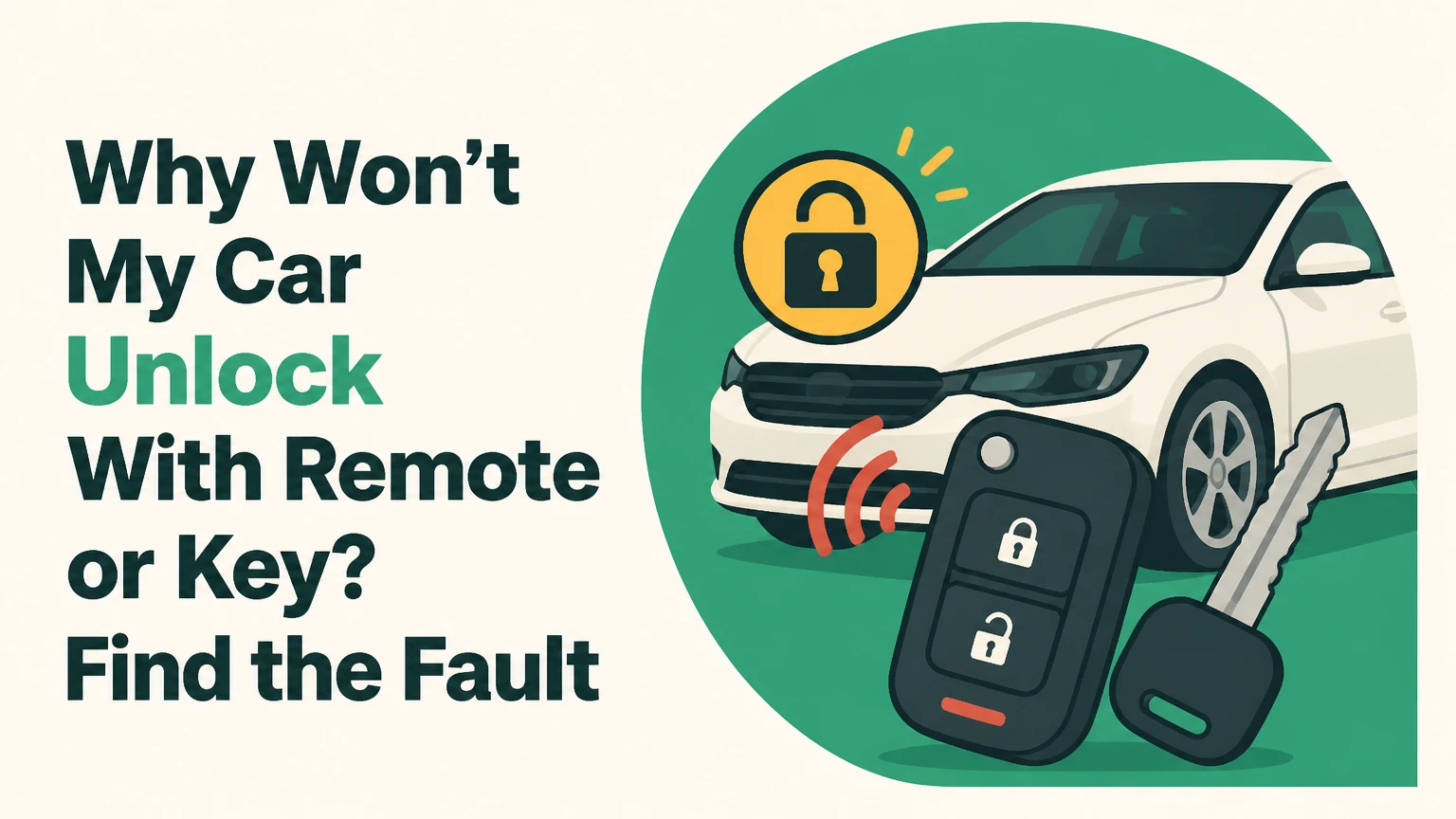
A car that will not unlock with either the remote or the physical key usually has either a dead vehicle battery, a failed key fob, a seized door lock cylinder, or a broken lock linkage. Test the vehicle’s electrical response and the key’s mechanical movement separately; those two observations usually identify whether the fault is electronic, mechanical, or a combination of both.
Key Facts at a Glance
- A dead key-fob battery normally affects remote unlocking, while a dead car battery can disable the receiver, actuators, alarm, and interior power at once.
- A physical key that turns freely without unlocking the door often indicates a disconnected cylinder-to-latch linkage.
- A key that will not turn may indicate ice, corrosion, a worn key, a damaged cylinder, or tension on the lock mechanism.
- A flashing fob LED proves only that the fob has some electrical activity; it does not prove correct programming, RF transmission, or vehicle reception.
- Many modern vehicles hide a mechanical keyhole beneath a removable cap on the driver’s exterior handle.
- Typical diagnosis costs range from $5-$15 for a coin-cell battery to $100-$250 for a vehicle battery and $100-$300 for an automotive locksmith visit.
Why Do Both the Remote and Key Fail Together?
Both unlocking methods fail together when the vehicle has lost its 12-volt power, when the mechanical lock has failed while the fob has also failed, or when a vehicle design routes the physical key through an electronic release. The failure is not automatically evidence of one common component.
A remote key fob transmits an encrypted command to a receiver or Body Control Module (BCM). The BCM then controls the door-lock actuators, which are small electric motors or geared mechanisms inside the doors. A physical key usually moves a lock cylinder and linkage without requiring battery power, but some newer designs use the key cylinder to request an electronic release rather than provide a fully independent mechanical path.
A dead car battery is especially likely when the remote produces no visible response, the vehicle has no interior lights, and the horn or hazard lights do not react. A separate fob problem and a seized cylinder are more likely when the car has normal electrical power but the remote and key show different mechanical symptoms.
How the Remote and Physical Key Differ
The remote controls the vehicle wirelessly, while the blade key acts through the door cylinder. The remote depends on the fob cell, receiver, BCM, vehicle battery, antenna, programming, and actuators. The blade depends on the correct key profile, a clear cylinder, intact internal wafers, connecting rod, clips, and latch.
The transponder chip used to authorize engine starting is often separate from the buttons used for locking. A car can therefore recognize a key for starting while its remote buttons fail. Conversely, a replacement fob may lock doors correctly while its immobilizer transponder remains unprogrammed.
What Should You Check First?
Check whether the car has electrical power, whether the fob produces a response, and whether the key turns normally. These three observations provide more diagnostic value than repeatedly pressing the unlock button or forcing the blade.
Use this sequence:
- Press the remote once while watching for hazard flashes, a horn chirp, mirror movement, or an audible lock actuator.
- Check another door, the trunk, or the passenger-side lock if the vehicle has them.
- Switch on a nearby light or use the vehicle’s connected app, if available, to look for signs of battery power.
- Remove the emergency blade from the fob and insert it fully into the designated cylinder.
- Turn the key gently in both directions while applying light pressure toward the door.
- Try the spare key or spare fob, if available.
- Stop before using pliers, a screwdriver, a coat hanger, or an improvised electrical connection.
Symptom-Based Diagnostic Table
| Remote response | Key behavior | Most likely fault | First action |
|---|---|---|---|
| No lights, horn, or actuator sound | Key turns normally but door stays locked | Dead vehicle battery or electronic release fault | Confirm 12-volt power and locate jump terminals |
| Fob LED flashes | Key will not enter fully | Debris, ice, damaged blade, or blocked cylinder | Warm and clean the cylinder without forcing it |
| Hazard lights flash | Key turns freely with no resistance | Detached rod, broken clip, or failed cylinder linkage | Use another entry point or call a locksmith |
| Hazard lights flash, no lock movement | Key feels normal | Door actuator, fuse, wiring, or latch fault | Diagnose the affected door circuit |
| Primary fob fails | Spare fob works | Dead battery, damaged primary fob, or programming fault | Replace the cell and inspect the case |
| Remote and key both fail after freezing rain | Key is stiff or immovable | Frozen cylinder or latch | Use lock de-icer and gentle heat, not an open flame |
Is the Vehicle Battery Dead?
A dead or severely discharged 12-volt battery is the leading single cause of a remote that suddenly becomes completely unresponsive, especially when the car also has no interior lights, no alarm response, and no visible dashboard activity. A healthy resting automotive battery commonly measures about 12.6-12.8 volts after sitting, while readings near 12.0 volts indicate substantial discharge.
Voltage alone does not prove battery health. A battery can show an acceptable resting voltage and still collapse under load because of a failed cell or internal resistance. The most reliable confirmation comes from a multimeter test followed by a load test or conductance test at a parts store, repair shop, or roadside service provider.
Check the owner’s manual for dedicated positive and negative jump points. Some vehicles place the battery in the trunk but provide under-hood terminals, while others require a mechanical hood-release procedure. Electric vehicles and hybrids still have a conventional low-voltage battery that powers locks and control modules, even though the traction battery is large.
What Battery Symptoms Mean
| Observation | Typical interpretation | Useful test | Likely remedy |
|---|---|---|---|
| Interior lights completely dark | 12-volt battery disconnected or discharged | Measure resting voltage | Charge, jump-start, or replace battery |
| Lights work but fade rapidly | Weak battery or poor terminal connection | Measure voltage while activating load | Clean terminals and load-test battery |
| Remote works intermittently | Low vehicle voltage, RF interference, or receiver fault | Try spare fob near the car | Test battery and inspect connections |
| Battery is less than 3 years old | Battery may still have a drain or charging problem | Parasitic-draw and charging tests | Diagnose alternator, drain, or wiring |
| Battery is 5-7 years old | Capacity loss becomes increasingly plausible | Professional battery test | Replace if test fails |
Do not raise the vehicle and connect a charger to a starter terminal as a general lockout solution. Working beneath a vehicle introduces crushing, short-circuit, fire, and airbag risks, and many modern cars have protected electrical architectures that can be damaged by an incorrect connection. Roadside technicians have safer access procedures for the model.
Is the Key Fob Battery or Programming at Fault?
A key fob with a dead coin cell cannot transmit the lock command, but replacing the cell usually does not erase the fob’s programming. Common cells include CR2032 and CR2025, although the correct number, polarity, and physical thickness must match the vehicle manufacturer’s specification.
The LED on a fob is only a basic indication. Some fobs have no LED, some LEDs remain dim with a weak cell, and a lit LED cannot confirm that the radio section, buttons, rolling-code data, or vehicle receiver works.
Replace the battery with the correct type, avoid bending the contacts, and check that the rubber button membrane is seated. Test the fob close to the driver’s door. If the car responds only at very short range, the fob battery, antenna, or receiver may be weak.
Does a New Fob Need Programming?
A new fob may need programming, but an existing fob that stopped working usually needs a battery, button, case, or vehicle-side diagnosis first. Programming procedures vary by make, model, year, and market; some older vehicles permit an owner sequence, while many newer vehicles require an immobilizer-capable scan tool and proof of ownership.
| Fob situation | Programming expectation | Typical cost | Best next step |
|---|---|---|---|
| Original fob, new CR2032 | Usually no reprogramming | $5-$15 | Install correctly and retest |
| Spare original fob also fails | Vehicle-side fault more likely | $0-$150 diagnosis | Check vehicle battery and fuses |
| Replacement aftermarket shell | Transponder may be reusable | $10-$40 shell | Transfer compatible electronics |
| New aftermarket electronic fob | Compatibility varies by model | $30-$150 part | Verify frequency and part number |
| Dealer-supplied smart key | Often requires registration | $150-$600 typical | Compare dealer and locksmith quotes |
Repeatedly pressing buttons outside the vehicle does not reliably “use up” a rolling code, and battery replacement does not automatically cause desynchronization. Rolling-code resynchronization is possible on some systems, but the correct procedure must come from the owner’s manual or a qualified technician.
Why Won’t the Physical Key Turn?
A key that will not turn is usually blocked by ice, corrosion, a damaged or worn key, seized wafers, or pressure on the lock mechanism. The key should enter fully and rotate with controlled, moderate force; resistance that increases sharply is a reason to stop, not to add leverage.
First, verify that the blade belongs to the vehicle and that the cuts are not visibly rounded. Insert it fully, gently wiggle it within a narrow range, and pull or push the door slightly while applying light turning pressure. Door seals can place tension on the latch, particularly when the vehicle is parked against an obstruction or on an incline.
For ice, use an automotive lock de-icer or gentle warm air. Do not pour boiling water into the cylinder, because refreezing can worsen the blockage. A manufacturer-compatible dry-film or lock lubricant is preferable to a heavy oil that traps grit.
What Does Key Movement Tell You?
| Key movement | Mechanical meaning | Common cause | Appropriate response |
|---|---|---|---|
| Will not enter fully | Cylinder path is obstructed | Ice, dirt, bent blade | Clean, de-ice, inspect blade |
| Enters but will not rotate | Wafers or mechanism are seized | Corrosion, worn key, frozen cylinder | Lubricate correctly and stop if rigid |
| Turns a small amount, then stops | Lock is binding | Latch tension or damaged wafers | Relieve door pressure, avoid force |
| Turns 360 degrees freely | Cylinder is not engaging linkage | Detached rod or broken retaining clip | Call locksmith or access another door |
| Turns normally, no unlock | Linkage, latch, or electronic release failed | Rod, actuator, latch, BCM | Diagnose door mechanism |
The common claim that “90% of mechanical key failures” result from poor lubrication is not supported by a universal automotive failure database. Actual causes vary by climate, cylinder design, key wear, corrosion, and frequency of use.
What If the Key Turns but the Door Stays Locked?
A key that rotates freely without moving the lock usually indicates a broken or detached linkage between the cylinder and latch. A failed retaining clip can disconnect the rod, while previous forced-entry damage can bend the rod or damage the door carrier.
If the remote causes hazard flashes but no lock movement, the vehicle may be receiving the command while the actuator, wiring, fuse, or latch is failing. If the key also spins without resistance, the cylinder linkage becomes more likely than a dead fob.
Do not pry the door frame or insert tools through the weather seal. Airbags, wiring, paint, glass, and weather barriers can be damaged, and a temporary opening can create a permanent water leak. An automotive locksmith can often open the door without damage and repair the linkage after removing the interior trim.
Which Entry Method Is Safest?
The safest entry method is the manufacturer’s emergency mechanical key, followed by an alternate factory lock cylinder or roadside locksmith service. The best choice depends on whether the vehicle has a hidden keyhole, a dead battery, damaged locks, or a person or animal inside.
Check the owner’s manual for:
- The emergency blade release inside the smart key.
- The removable cap on the driver’s handle.
- The approved jump terminals.
- The mechanical hood-release route.
- The procedure for a dead smart-key battery.
- The location of passenger-door or trunk cylinders.
A locked vehicle with a child, vulnerable adult, or animal inside is an emergency. Contact local emergency services immediately rather than experimenting with wedges, wires, or glass-breaking methods.
Locksmith, Dealer, or Roadside Service?
| Provider | Best use | Typical time | Typical cost |
|---|---|---|---|
| Roadside assistance | Non-destructive entry and jump-start | 20-60 minutes | $0-$150, membership dependent |
| Automotive locksmith | Cylinder, linkage, lockout, fob work | 30-120 minutes | $75-$300 |
| Independent repair shop | Actuator, wiring, latch, battery repair | 1-3 hours | $100-$180 per labor hour |
| Dealership | Proprietary programming and module faults | 1-4 hours | $150-$600 for key work |
| Emergency services | Occupant or animal safety | Immediate dispatch | Local policy dependent |
Prices are typical North American ranges, not guaranteed quotes. Location, vehicle security system, key type, after-hours service, and required parts can change the final amount substantially.
How Do You Prevent a Repeat Lockout?
Use the physical key cylinder every few months, replace fob batteries before failure, and test the spare key while the primary key still works. Preventive checks matter because a rarely used cylinder can seize unnoticed for years.
Keep the emergency blade separate from a bulky key ring only if you can identify it quickly, and record the vehicle’s approved jump points in the owner’s manual or phone. Do not store a loose coin cell where children can access it; button batteries present a serious ingestion hazard.
Practitioner Rules That Avoid Expensive Damage
- Never force a stationary key with pliers. A snapped blade inside the cylinder can require extraction, cylinder replacement, and key reprogramming.
- Do not diagnose from the fob LED alone. Test a spare fob and look for vehicle-side responses before buying a replacement transmitter.
- Use a lock lubricant designed for automotive cylinders. Standard penetrating oils can leave residue, while graphite can be unsuitable for some cylinder designs; follow the lubricant and vehicle manufacturer’s guidance.
- A dead battery and seized cylinder can coexist. Fixing the fob will not help if the car has no 12-volt power, and charging the car will not free a corroded lock.
- A starting key is not necessarily a working remote. Immobilizer recognition, remote locking, and passive-entry authorization can use different circuits and credentials.
How Much Does the Repair Usually Cost?
The repair commonly costs $5-$15 for a fob battery, $100-$250 for a vehicle battery, $100-$400 for a cylinder, or $150-$500 for an actuator or latch repair. Programming a smart key can add $100-$600, depending on whether a compatible locksmith or dealership equipment is available.
| Fault | Parts range | Labor or service time | Typical total |
|---|---|---|---|
| Fob coin cell | $5-$15 | 5-10 minutes | $5-$30 |
| Vehicle 12-volt battery | $100-$250 | 15-45 minutes | $120-$350 |
| Lock cylinder cleaning | $5-$25 | 15-45 minutes | $50-$150 |
| Lock cylinder replacement | $50-$200 | 1-3 hours | $150-$500 |
| Linkage clip or rod | $5-$75 | 1-3 hours | $150-$450 |
| Door actuator or latch | $75-$300 | 1-4 hours | $250-$800 |
| Smart-key programming | $50-$400 key | 15-90 minutes | $150-$600 |
A locksmith is often the most efficient first call when the key turns freely, the vehicle is locked, and no occupant is at risk. A dealership becomes more useful when the vehicle requires proprietary key registration, security-module access, or a replacement smart key with no compatible aftermarket option.
FAQ
Can a dead key fob battery prevent the physical key from working?
A dead key-fob battery normally cannot stop a genuinely mechanical blade key from turning the lock. The physical cylinder may still be seized, damaged, or disconnected, however, so the two failures can appear together when the fob battery dies first and exposes an unused mechanical lock.
Why does my car unlock from the inside but not from the outside?
A car that unlocks from the inside but not from the outside usually has an exterior cylinder, linkage, handle, actuator, or wiring fault. If the remote unlocks other doors, the affected door’s actuator or latch is more likely than the BCM. A locksmith can isolate the door without damaging the frame.
Why does my remote lock the car but not unlock it?
A remote that locks but does not unlock may have a worn unlock button, damaged circuit board, incorrect programming, or a vehicle-side unlock relay or actuator fault. Test the spare fob and check whether the hazard lights respond to unlock. A single failed button is common on older fobs.
Can cold weather make both car locks stop working?
Cold weather can freeze the door cylinder, latch, seals, and actuator, while low temperatures also reduce 12-volt battery output. Warm the cylinder with approved de-icer or gentle air, clear ice from the handle, and avoid boiling water or an open flame. Persistent recurrence indicates moisture intrusion or a weak battery.
Should I replace the car battery before testing the key fob?
Test for basic vehicle power first, but do not replace the vehicle battery solely because the remote failed. A fob coin cell costs far less and is a common isolated cause. Replace the car battery only after voltage, terminal condition, and battery age support that diagnosis.
When should I stop troubleshooting and call a locksmith?
Call an automotive locksmith when the key will not turn after safe de-icing, turns freely without unlocking, is broken in the cylinder, or no alternate factory entry method works. Call emergency services first if a child, animal, or vulnerable person is locked inside.
The Bottom Line
A car that will not unlock with remote or key needs separate electronic and mechanical tests. Confirm vehicle 12-volt power, test the fob battery and spare remote, then observe whether the physical key enters and turns normally. A dead battery, seized cylinder, failed linkage, actuator fault, and programming problem require different repairs, so avoid forcing the key or prying the door. The fastest safe answer to “why won’t my car unlock with remote or key” comes from the symptom pattern, not repeated button presses.