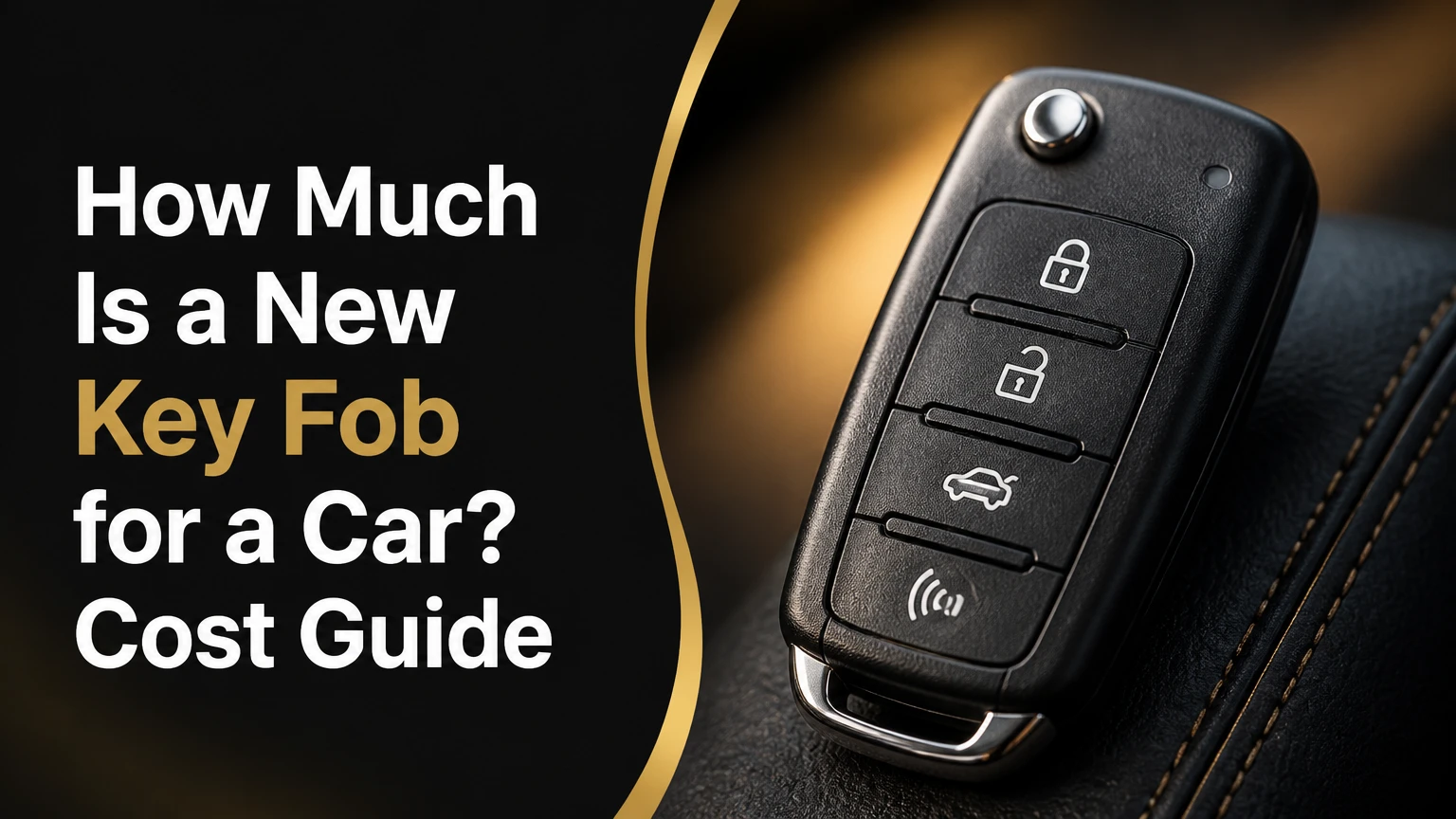
A new car key fob typically costs $50-$400 when purchased and programmed, while complex proximity keys, luxury vehicles, and dealer-only systems can raise the total to $800 or more. Parts-only replacements may cost $20-$600, but programming, key cutting, mobile service, taxes, and towing determine the final bill.
Key Facts
A complete programmed key-fob replacement usually costs $120-$320 through an automotive locksmith.
A dealership replacement commonly costs $250-$800 or more for late-model, luxury, and proximity systems.
A replacement battery usually costs $2-$8 and can solve a dead-button problem without replacing the fob.
An aftermarket remote may cost $20-$120, but compatibility and programming determine whether it works.
Losing every working key costs more because the vehicle may require immobilizer resets, towing, or special security access.
A used smart key can remain permanently paired to another vehicle and may be impossible to reuse.
How Much Is a New Key Fob for a Car?
A new car key fob costs $50-$100 for a basic remote, $120-$250 for a transponder key, $150-$300 for a switchblade key, and $250-$800 or more for a proximity smart key. Those are typical United States replacement totals, including programming but excluding unusual towing or emergency charges.
The vehicle’s year, make, model, key design, and number of working keys matter more than the word “fob.” A remote that only locks doors is inexpensive; a push-to-start smart key may contain a proximity transmitter, immobilizer transponder, emergency blade, and encrypted vehicle authentication.
Published consumer guidance supports the broad spread. Kelley Blue Book and Consumer Reports both explain that vehicle technology, replacement source, and whether programming is required drive the final price. Local labor rates also vary substantially, so a written quote should identify the fob, programming, blade cutting, service call, and tax separately.
Typical Cost by Key-Fob Type
| Key-fob type | Parts-only price | Programmed replacement | Typical use |
|---|---|---|---|
| Separate keyless remote | $20-$50 | $50-$100 | 1990s-2000s vehicles with a separate ignition key |
| Transponder key | $35-$100 | $120-$250 | Standard metal key with an immobilizer chip |
| Switchblade or flip key | $75-$150 | $150-$300 | Folding metal blade inside a remote housing |
| Proximity smart key | $50-$600+ | $250-$800+ | Push-button ignition and passive entry |
| Luxury encrypted smart key | $200-$600+ | $400-$1,200+ | Select Mercedes-Benz, BMW, Audi, and high-trim vehicles |
A parts-only price is not a complete replacement price. A blank fob can still require cutting, immobilizer enrollment, remote synchronization, and a technician with current software access.
What Determines the Replacement Price?
The key’s security functions determine most of the price, while labor and vehicle access determine the rest. A basic remote sends lock commands, but a proximity key must authenticate the driver and authorize starting through several vehicle modules.
Key Functions and Their Cost Impact
A remote transmitter usually controls door locks, trunk release, panic alarms, and sometimes remote start. A transponder chip authorizes engine operation, even when the buttons work separately. A proximity system detects a nearby key and allows push-button starting without inserting a blade.
Modern remotes commonly use changing or rolling authentication codes, which prevent a previously captured button signal from unlocking the vehicle later. The precise radio architecture varies by manufacturer: some systems use low-frequency wake-up signals, higher-frequency radio communication, passive RFID, or multiple antennas around the cabin.
A dead coin-cell battery does not always mean the electronic key is ruined. Many smart keys contain a passive backup transponder that can start the car when held against a specified location, such as the start button, steering-column reader, or emergency key slot.
Vehicle and Service Variables
| Price variable | Typical effect | Common added amount or condition |
|---|---|---|
| Programming labor | Adds diagnostic enrollment time | $50-$150 |
| Mobile locksmith visit | Avoids towing but includes travel | $20-$100 |
| After-hours emergency call | Applies nights, weekends, and holidays | $50-$150 |
| Mechanical blade cutting | Required for integrated backup keys | $10-$40 |
| Dealer security access | Required on some newer vehicles | Included or billed at $100-$250 labor |
| Towing to dealer | Needed when the vehicle cannot be serviced roadside | $75-$200 |
| All keys lost | May require resets and extra diagnostics | $100-$300 above ordinary service |
| Extra spare programmed at the same visit | Shares some labor with the first key | $80-$250, model dependent |
A quote that says “$99 key replacement” may cover only a shell or remote body. Ask whether the price includes an original or aftermarket transmitter, programming, cutting, travel, tax, and testing.
Which Replacement Option Costs Less?
An automotive locksmith is usually the best value for a conventional car, while a dealership is the safer choice when the manufacturer restricts software access or the vehicle uses a complex encrypted smart key. DIY is cheapest only when the exact fob is compatible and onboard programming is permitted.
| Replacement source | Typical total | Typical time | Best fit | Main limitation |
|---|---|---|---|---|
| Automotive locksmith | $120-$320 | 30-90 minutes | Toyota, Honda, Ford, Chevrolet, Hyundai, and many Nissan models | Some late-model systems require manufacturer access |
| Authorized dealership | $250-$800+ | 1-5 business days | OEM-only, luxury, EV, and restricted programming systems | Higher parts, labor, and towing costs |
| Online aftermarket fob | $20-$120 before labor | 3-7 days shipping | Affordable spare when compatibility is confirmed | Wrong FCC ID or frequency can make it unusable |
| Online OEM fob plus locksmith | $100-$400 total | 1-7 days | Owners who verify the part and arrange local programming | Seller returns and pre-owned-key status create risk |
| Self-programmed replacement | $20-$120 | 15-45 minutes | Older vehicles with documented onboard pairing | Many vehicles require an existing working key |
When Is a Locksmith the Better Choice?
A mobile automotive locksmith generally provides the lowest complete cost for mainstream vehicles when the technician supports the exact year and immobilizer system. The locksmith can bring a compatible fob, cut an emergency blade, connect to the vehicle, and test door functions and engine authorization at the vehicle’s location.
The locksmith must still have legitimate programming equipment and vehicle-specific knowledge. Ask for the technician’s business identity, an itemized quote, proof-of-ownership requirements, and a confirmation that the quoted price includes all required keys and programming.
A locksmith is a poor choice when the provider cannot identify the vehicle’s FCC ID, refuses to explain whether the part is new or refurbished, or advertises a universal fob. Universal compatibility claims are usually incomplete because radio frequency, immobilizer generation, button layout, and software authorization differ.
When Does a Dealership Make Sense?
A dealership makes sense when the vehicle uses proprietary security access, a manufacturer-controlled online programming system, or a smart key that independent equipment cannot legally or technically enroll. Some newer luxury vehicles and electric vehicles have these restrictions, but the answer depends on model year and region rather than the badge alone.
Dealers can verify the VIN, order the correct OEM key, retrieve factory programming information, and remove missing keys from the vehicle’s authorized-key list. The trade-off is a higher bill and, in many cases, a required appointment or tow.
Before approving dealer work, request separate prices for the key, programming labor, cutting, security access, and towing. A dealer’s OEM part is not automatically the only safe option, but it is often the least uncertain option for a restricted system.
What Information Do You Need Before Buying a Fob?
You need the vehicle identification number, exact model year and trim, existing key details, and the fob’s part number or FCC ID before ordering. The VIN confirms the vehicle, but the VIN alone does not guarantee that every online key with the same button layout will work.
Collect these details:
- Year, make, model, and trim: A 2018 Ford Escape and a 2018 Ford Fusion can use different transmitters.
- Ignition type: Determine whether the car uses a metal key, flip key, or push-button start.
- Existing fob markings: Record the FCC ID, part number, frequency, and button count.
- Blade profile: Photograph the emergency blade or compare the keyway with a locksmith’s catalog.
- Working-key count: Tell the provider whether one, two, or zero programmed keys remain.
- Vehicle location: A mobile technician needs access to the car, not merely the key.
- Ownership documents: Bring a driver’s license, registration, title, or other accepted proof.
The FCC ID identifies the radio transmitter in many North American fobs, but it is only one compatibility check. A matching shell or button layout does not prove that the immobilizer chip, frequency, transponder type, or programming procedure matches the vehicle.
How Is a New Key Fob Programmed?
A technician programs a replacement fob by identifying the vehicle, connecting approved diagnostic equipment or using an onboard sequence, enrolling the remote and immobilizer data, and testing every function. The process usually takes 15-60 minutes when the correct part and at least one working key are available.
A typical professional process is:
- Verify ownership and vehicle identity. The technician checks documents and confirms the VIN.
- Inspect the replacement. The technician confirms part number, FCC ID, frequency, button layout, blade, and transponder type.
- Cut the emergency blade. A code cutter or duplicator matches the vehicle’s mechanical key profile.
- Connect programming equipment. A diagnostic tool typically accesses the vehicle through the OBD-II port, although some systems use a dedicated procedure.
- Enroll the key. The vehicle stores the new remote and immobilizer credentials.
- Manage missing keys. When supported, the technician deletes lost keys from the authorized list.
- Test operation. Locking, unlocking, trunk release, panic, remote start, passive entry, emergency start, and engine authorization receive separate checks.
Some older vehicles allow onboard remote programming, but many require two previously programmed keys or a security password. A button sequence can synchronize remote buttons without programming the engine immobilizer, so a fob may lock doors yet still fail to start the vehicle.
Can You Program a Car Fob Yourself?
You can program some older remotes yourself, but most modern transponder and proximity keys require specialized equipment, security credentials, or an already authorized key. DIY programming is a practical option for a documented vehicle procedure, not a universal method.
Check the owner’s manual for terms such as “remote transmitter programming,” “additional key,” or “integrated keyhead transmitter.” The manual may distinguish between:
- Remote button synchronization
- Immobilizer or transponder enrollment
- Smart-key registration
- Remote-start activation
- Erasing all previous keys
Self-programming usually fails when the vehicle needs a security PIN, internet-connected manufacturer access, two existing keys, or a diagnostic tool. It can also erase previously enrolled keys if the wrong procedure is followed.
The lowest-risk DIY route is often buying a confirmed fob and paying a qualified locksmith only for programming. The arrangement saves parts markup while preserving a professional compatibility check.
Should You Buy an OEM, Aftermarket, or Used Fob?
Choose a new OEM fob for restricted, high-value, or poorly documented vehicles; choose a reputable aftermarket fob for a confirmed mainstream application; and treat used smart keys as high-risk unless the seller proves that the key can be reset. Price alone does not reveal whether a fob is programmable.
| Fob source | Typical price | Compatibility evidence | Risk level | Best use |
|---|---|---|---|---|
| New OEM dealer part | $150-$600+ | VIN and manufacturer catalog | Low | Luxury, EV, restricted systems |
| New OEM online part | $80-$400 | Part number and FCC ID match | Medium-low | Confirmed part with return protection |
| Reputable aftermarket | $20-$120 | Vehicle list, frequency, FCC ID | Medium | Mainstream cars and spare keys |
| Refurbished OEM | $50-$250 | Reset status and tested electronics | Medium-high | Older vehicles with available resellers |
| Used locked smart key | $20-$150 | Often no reset proof | High | Generally avoid |
An aftermarket key can work well when its transmitter and transponder match the vehicle and the seller provides a meaningful return policy. Poor-quality cases, weak buttons, incorrect batteries, and unreliable circuit boards are common reasons a cheap fob becomes expensive.
Used proximity keys are especially problematic. Some manufacturers pair a key permanently with a vehicle identification number, while others permit special reset procedures. “Looks identical” is not evidence of reusability.
What Should You Check Before Replacing the Fob?
Check the battery, battery contacts, physical buttons, vehicle receiver, and emergency-start procedure before buying a complete replacement. A new CR2032 or CR2025 battery typically costs $2-$8, and battery replacement can restore a functioning circuit board within minutes.
Use this diagnosis:
- One button fails: Inspect the rubber button pad and circuit-board contact for dirt or wear.
- All buttons fail: Install the correct battery with the positive side oriented correctly, then inspect corrosion.
- The car starts but buttons fail: The immobilizer still works, so the fault may involve the remote transmitter, battery, or receiver.
- Buttons work but the engine will not start: The transponder may be unprogrammed, damaged, or incompatible.
- The fob works close to the car only: A weak battery, damaged antenna, or radio interference may be involved.
- A second known-good fob also fails: Diagnose the vehicle receiver, fuse, antenna, or body-control module.
Do not assume that a new battery fixes every dead smart key. Water intrusion, cracked solder joints, crushed antenna coils, and failed microswitches require repair or replacement.
How Do You Start a Car With a Dead Smart Key?
A dead smart key can often start the vehicle when held against the designated backup reader or push-button start switch. The exact location varies by manufacturer, so the owner’s manual remains authoritative.
Common designs place the backup reader inside the start button, beneath a marked tray, inside a center-console pocket, or near the steering column. The emergency metal blade may unlock the driver’s door, but it usually cannot authorize engine operation by itself.
If the car still reports “key not detected” after the battery change and backup procedure, the problem may be a failed fob, vehicle antenna, or unregistered key. A second working key is the fastest comparison test.
What Happens If You Lose Every Working Key?
Losing every working key usually costs $250-$1,000 or more, because the technician must create an initial authorized key and may need to reset the immobilizer. Towing, dealer-only security access, and high-end smart keys can push the total above that range.
A technician may need to:
- Confirm ownership more rigorously
- Obtain a manufacturer security code or online authorization
- Program a new immobilizer key from an all-keys-lost state
- Erase the missing fob from vehicle memory
- Cut a mechanical emergency blade
- Replace a damaged or locked module in unusual cases
A vehicle with one working key is cheaper and easier to service because the technician may use that key to authorize additional-key programming. The exact procedure differs by manufacturer, model year, and immobilizer generation.
After losing a key, ask whether the provider will delete it from the vehicle’s authorized list. Door-lock buttons may stop working after deletion, but some systems require a separate security reset to prevent all functions from remaining active.
Does Insurance or a Warranty Pay for Replacement?
Comprehensive auto insurance, roadside-assistance plans, manufacturer service contracts, and premium vehicle-protection programs may cover some key replacement costs, but ordinary bumper-to-bumper warranties often exclude lost keys as maintenance or owner responsibility.
Check the policy for:
- Key replacement or key-care coverage
- A per-claim limit, commonly $250-$1,000
- Deductible requirements
- Locksmith or dealer restrictions
- Lost-key versus stolen-key treatment
- Rental-car or towing benefits
- Required police reports for theft claims
Insurance may reimburse a qualifying replacement rather than pay the technician directly. Photograph the damaged fob, keep the itemized invoice, and confirm authorization before ordering an expensive smart key.
How Can You Avoid Paying Too Much?
Compare two or three itemized quotes, verify the exact fob identifier, and ask whether the quoted price includes programming and testing. The cheapest advertised part is not the cheapest completed replacement if it cannot be enrolled or must be returned after a failed compatibility check.
Use this purchasing checklist:
- Call a mobile automotive locksmith and the dealer for the same VIN-specific job.
- Request separate parts, labor, programming, cutting, travel, tax, and towing prices.
- Confirm whether the part is OEM, aftermarket, new, refurbished, or used.
- Match the FCC ID, part number, frequency, button layout, blade, and transponder.
- Ask whether one working key remains and whether all keys can be tested.
- Confirm the provider’s warranty and failed-programming policy.
- Keep a spare once the replacement works.
A practitioner rule of thumb is to replace a lost final key before an emergency occurs. The second key often costs less during the same visit because vehicle access and diagnostic labor are already covered.
Frequently Asked Questions
Can a locksmith make a key fob without the original?
A qualified automotive locksmith can often create and program a replacement without the original, but the vehicle must support an all-keys-lost procedure. The technician will usually require proof of ownership, the VIN, and access to the vehicle. The service costs more when immobilizer resets, security codes, or towing are necessary.
How long does a car key-fob replacement take?
A basic remote replacement usually takes 15-30 minutes, while a transponder or smart-key replacement commonly takes 30-90 minutes. Dealer ordering can add one to five business days. All-keys-lost situations, unavailable parts, software authorization, and vehicle-module faults can extend the appointment.
Is replacing a key-fob battery the same as replacing the fob?
Replacing a battery is not the same as replacing a key fob. A battery change restores power to an otherwise functional transmitter, while complete replacement addresses damaged electronics, missing keys, failed immobilizer chips, or incompatible hardware. Battery service normally costs $2-$8; a programmed replacement commonly costs $120-$800.
Can I use a different car’s key fob?
A different vehicle’s key fob works only when its frequency, FCC ID, part number, transponder system, and programming architecture are compatible. Identical button layouts do not establish compatibility. Used smart keys may remain locked to the original vehicle, so a reset-capable part and a return policy are important.
How many car key fobs should I have?
Most owners should keep two programmed keys, with one stored securely away from the vehicle. A second key reduces the cost and delay of future replacement because additional-key programming is often simpler than an all-keys-lost procedure. Fleet operators may need three or more keys for shared vehicles.
Is a dealership always required for a push-button-start car?
A dealership is not always required for a push-button-start vehicle. Many automotive locksmiths can program proximity keys for mainstream Toyota, Honda, Ford, Chevrolet, Hyundai, Kia, and Nissan models. Dealer service is more likely when the manufacturer restricts software access, the model is high-end, or no independent provider supports that immobilizer system.
The Bottom Line
A new car key fob costs about $50-$400 in ordinary cases, with basic remotes at the low end and proximity smart keys, luxury models, and all-keys-lost situations reaching $800 or more. Start with a battery and compatibility check, then compare an itemized automotive-locksmith quote with the dealer’s price. The exact vehicle year, make, model, key type, and number of working keys determine the final answer to how much is a new key fob for a car.