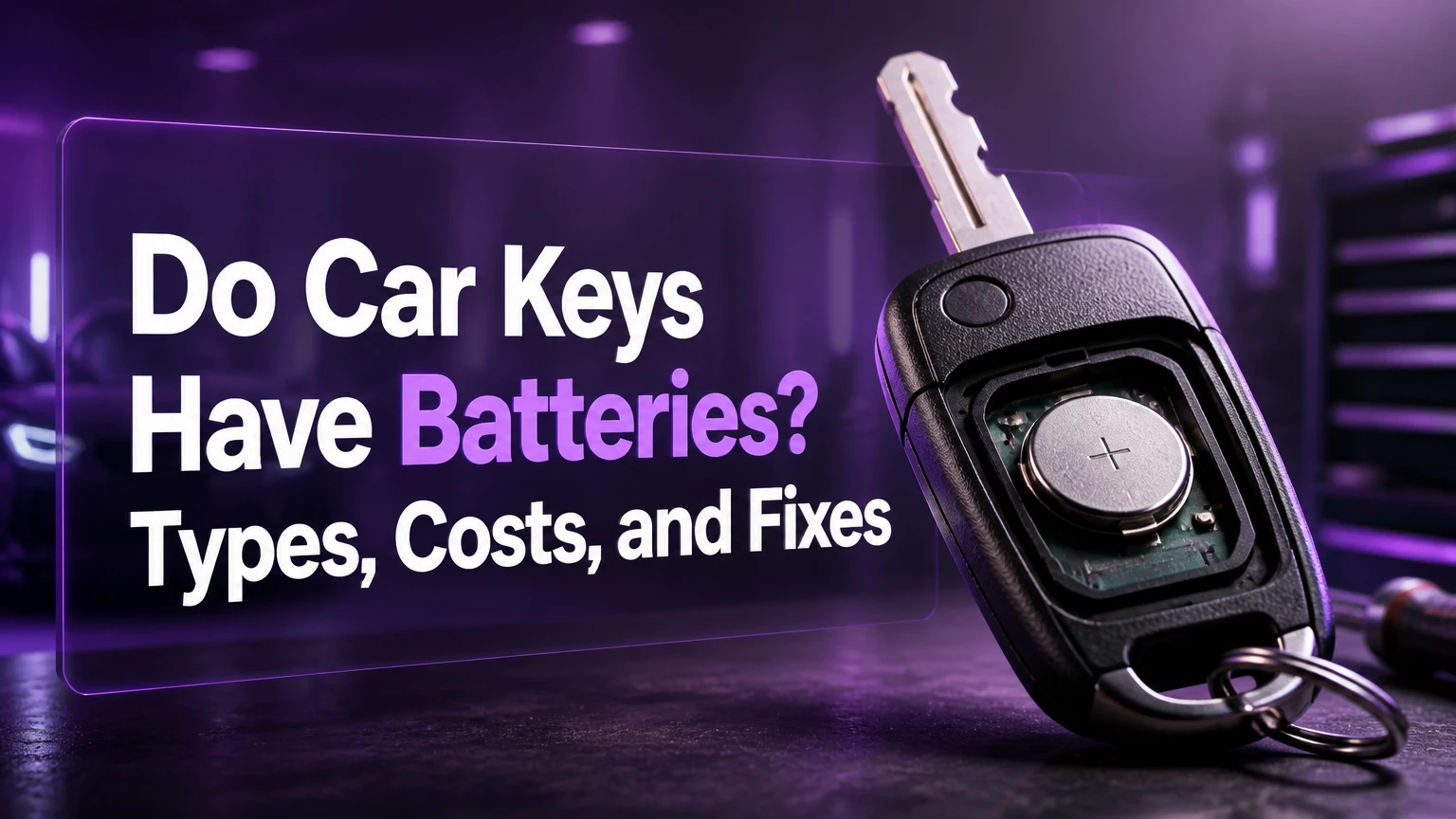
Yes, most modern car keys have batteries, but a traditional metal key does not. A remote key fob uses a replaceable coin-cell battery to operate buttons and transmit commands, while a smart key uses battery power for proximity functions. A passive transponder chip can often authorize starting without the fob battery.
Key Facts at a Glance
- A traditional metal car key has no battery because it mechanically turns the lock and ignition.
- Most remote fobs use a 3-volt lithium coin cell, commonly a CR2032 or CR2025.
- A dead fob battery usually stops remote locking first, but it does not always prevent engine starting.
- Smart-key vehicles normally include a hidden mechanical blade and a backup starting procedure.
- A replacement battery typically costs $2-$7 and takes 5-10 minutes for a standard fob.
- The exact battery number and emergency-starting method depend on the vehicle, key design, and model year.
Do Car Keys Have Batteries?
Most car keys have batteries when they include remote buttons, passive entry, a display, or a phone-connected electronic system. A plain metal key has no electrical component, and some transponder keys contain a passive immobilizer chip that receives energy from the vehicle rather than a replaceable battery.
The important distinction is between the key’s mechanical or immobilizer function and its remote-control function. Pressing Lock or Unlock requires electrical power inside the fob. Turning a physical blade in a lock does not. Starting an older vehicle with a passive transponder may also work after the remote battery has failed because the ignition antenna energizes the chip briefly.
A battery warning therefore does not always mean the key is unusable. It usually means the remote signal has weakened or the proximity range has declined. The vehicle owner’s manual remains the authority for the exact battery number, emergency entry point, and backup-starting position.
What does a car key battery power?
A car key battery powers the electronic functions that require the fob to send or process signals. Those functions commonly include remote locking, unlocking, trunk release, panic alarms, passive-entry detection, and key-fob status displays.
The battery does not directly power the vehicle starter motor. It also does not replace the immobilizer’s coded authorization. In many systems, the fob contains a separate passive transponder that the car can read through a short-range electromagnetic field when the fob is near the ignition switch or start button.
How Does a Car Key Fob Work?
A remote car key fob converts a button press into an encrypted radio-frequency command that the vehicle receives and validates. A smart key adds two-way proximity communication, allowing the car to detect an authorized fob nearby before unlocking doors or permitting a start request.
The basic sequence is:
- The driver presses a button or approaches the vehicle.
- The fob’s battery powers its microcontroller and transmitter.
- The fob sends an identification code and command.
- The vehicle receiver checks the message against stored credentials.
- The body-control module operates the lock, trunk, alarm, or starting system.
Modern remote-entry systems commonly use rolling or changing codes rather than one permanently repeated code. Frequency varies by market and vehicle, with 315 MHz common in North America and 433.92 MHz common in many European applications, although regional standards and model-specific designs differ.
Does the battery power the transponder chip?
The battery usually does not power the immobilizer transponder in a conventional key. The vehicle’s antenna creates an electromagnetic field that supplies enough energy for the passive chip to return its identification code.
That arrangement explains a common driver experience: the Lock and Unlock buttons stop working, yet the vehicle still starts when the physical key is inserted. Smart-key systems use a similar backup principle, but the correct placement varies. Some vehicles require the fob to touch the Start/Stop button; others specify a pocket, center console slot, steering-column area, or dedicated reader.
Which Types of Car Keys Need Batteries?
Remote fobs, flip keys, smart proximity fobs, and display keys need batteries, while plain mechanical keys do not. A transponder key may contain an electronic chip without a replaceable battery, so the presence of security electronics alone does not prove that a coin cell is installed.
| Key type | Replaceable battery | Main powered function | What often still works when battery dies |
|---|---|---|---|
| Metal mechanical key | No | Lock and ignition movement | Door lock and engine operation |
| Transponder-blade key | Usually no | None for passive chip | Mechanical start authorization |
| Remote flip key | Yes, usually 3 V | Lock, Unlock, trunk, alarm | Blade entry and often starting |
| Smart proximity fob | Yes, usually 3 V | Passive entry and remote commands | Emergency entry and backup start |
| Display key | Rechargeable lithium-ion | Screen, remote commands, vehicle data | Mechanical backup, if supplied |
How do remote flip keys use their batteries?
A remote flip key uses its coin cell for button-operated functions, while the folding or fixed metal blade handles physical access and may operate the ignition. If the battery is exhausted, the driver can usually unfold the blade, unlock the door manually, and start the car through the transponder system.
A remote key may still fail to start the vehicle if its separate immobilizer chip is damaged, missing, or not programmed. Some older designs contain a loose transponder capsule inside the plastic shell, so opening a two-piece key requires care.
How do smart keys differ?
A smart key uses a battery for passive entry, remote commands, and communication with the vehicle while the fob remains nearby. Push-to-start vehicles often monitor whether an authorized fob is inside the cabin before enabling ignition.
A low battery can produce reduced detection distance before complete failure. The vehicle may display messages such as “Key Battery Low,” “No Key Detected,” or “Key Not Found,” but wording differs by manufacturer.
Smart keys are not completely dependent on a healthy coin cell. Manufacturers normally provide an emergency blade and a passive backup reader, although the procedure is not universal. Do not assume that holding every fob against the start button will work in the same way.
Are digital car keys battery-powered?
A digital car key stored on a smartphone depends on the phone’s rechargeable battery, operating system, vehicle application, and wireless communication hardware. A dedicated display key usually contains a rechargeable lithium-ion battery rather than a disposable CR2032.
Digital keys can offer phone-based unlocking, sharing, and starting, but they are not a perfect replacement for a physical fob. A dead phone, disabled Bluetooth, expired app authorization, incompatible phone model, or vehicle-network issue can prevent access. Keep the physical key or an approved backup credential available.
Which Battery Does a Car Key Fob Use?
The correct car-key battery is the number printed on the old cell or specified in the vehicle owner’s manual. Most ordinary fobs use a 3-volt lithium coin cell, but CR2032, CR2025, CR2016, CR1632, and CR1620 cells are different sizes and should not be substituted solely because they look similar.
The numbers describe approximate dimensions. In a CR2032, “20” indicates a diameter of about 20 millimeters and “32” indicates a thickness of about 3.2 millimeters. A CR2025 has the same diameter but is approximately 2.5 millimeters thick.
| Battery | Voltage | Approximate size | Replacement concern |
|---|---|---|---|
| CR2032 | 3.0 V | 20 mm × 3.2 mm | Common standard; thicker than CR2025 |
| CR2025 | 3.0 V | 20 mm × 2.5 mm | May fit loosely where CR2032 is required |
| CR2016 | 3.0 V | 20 mm × 1.6 mm | Some designs stack two cells, but only if specified |
| CR1632 | 3.0 V | 16 mm × 3.2 mm | Smaller diameter; common in selected Toyota and Lexus fobs |
| CR1620 | 3.0 V | 16 mm × 2.0 mm | Must match the holder’s thickness and contacts |
Panasonic’s battery guidance identifies the first two digits of coin-cell designations as diameter and the final two digits as nominal thickness in tenths of a millimeter. That sizing convention is useful for identification, but the vehicle’s holder and contact pressure determine the correct fit.
Do not stack two thinner batteries to imitate a thicker battery unless the manufacturer designed the fob for that arrangement. A poor fit can create intermittent contact, damage the cover, or place incorrect pressure on the circuit board.
Can a CR2025 replace a CR2032?
A CR2025 should not automatically replace a CR2032. Both cells provide approximately 3 volts and share a 20-millimeter diameter, but the CR2025 is 0.7 millimeters thinner, which can leave the contacts under tension or cause intermittent operation.
Some fobs tolerate the substitution temporarily, but the correct battery is the one listed by the manufacturer. A thinner cell may also have lower capacity, so apparent compatibility does not guarantee equivalent service life.
How Long Does a Car Key Battery Last?
A standard remote fob battery typically lasts 2-5 years, while a smart proximity fob commonly lasts 1-3 years. Actual life depends on button frequency, passive-entry design, temperature, battery age, water exposure, and whether the fob is stored close to the vehicle.
A smart fob can consume more energy because it periodically listens for vehicle wake-up signals. A remote-only fob generally spends most of its time in a low-power state and uses energy mainly during button presses.
| Fob situation | Typical battery life | Common warning sign | Recommended response |
|---|---|---|---|
| Remote-only fob, moderate use | 3-5 years | Shorter lock range | Replace within 30 days |
| Smart proximity fob, daily use | 1-3 years | “Key battery low” message | Replace promptly |
| Spare fob stored unused | 4-7 years | No warning until needed | Test twice yearly |
| Cold-weather operation | 1-3 years | Temporary range loss | Warm fob and replace if recurring |
| Display key | 1-3 weeks per charge | Low-battery icon | Recharge using approved charger |
These are typical practitioner ranges, not guarantees. Lithium coin cells lose available output in cold conditions, and a battery that works indoors may fail to provide reliable range outside during winter.
What are the signs of a weak key-fob battery?
The clearest signs include reduced remote range, delayed response, repeated button presses, a dashboard warning, and a “key not detected” message. A vehicle that responds only when the fob is very close often indicates low battery power, although damaged buttons or radio interference can create similar symptoms.
A weak battery can also cause selective failure. Lock may work while trunk release does not because different commands require different signal timing or button condition. Test the spare fob before buying parts; if both fobs fail simultaneously, inspect the vehicle receiver, 12-volt battery, or local radio interference.
How Much Does Car Key Battery Replacement Cost?
Replacing a car key battery typically costs $2-$7 as a do-it-yourself job, $10-$25 from a locksmith, or $15-$50 through a dealership. The price rises when the service includes a damaged housing, testing, programming, an emergency blade, or a complete replacement fob.
| Replacement option | Typical price | Typical time | Best use |
|---|---|---|---|
| DIY coin cell | $2-$7 | 5-10 minutes | Intact standard fob |
| Automotive locksmith | $10-$25 | 5-15 minutes | Unfamiliar shell or mobile service |
| Dealership counter | $15-$50 | 10-30 minutes | Premium or sealed fob |
| Complete replacement fob | $100-$600+ | 30 minutes to several hours | Lost, damaged, or unprogrammed key |
A battery replacement normally does not require programming because the fob’s stored credentials remain in memory. Programming becomes relevant when the entire fob is replaced, the circuit board is damaged, or a particular model requires a resynchronization sequence after power loss.
The higher dealership price can be reasonable for an expensive sealed display key or a vehicle still under a service plan. It is harder to justify for a simple CR2032 swap when the owner can open the housing without damaging clips or seals.
How Do You Replace a Car Key Battery?
Most standard car key batteries can be replaced in 5-10 minutes with the correct coin cell and a plastic pry tool or small flat screwdriver. Success depends primarily on identifying the correct cell, preserving the housing clips, and installing the positive and negative sides in the original orientation.
Before You Start
- Battery: One manufacturer-specified 3-volt lithium coin cell.
- Tools: Plastic pry tool or a small flat screwdriver.
- Time: 5-10 minutes for an accessible fob.
- Cost: Approximately $2-$7 for a reputable battery.
- Preparation: Photograph the old battery orientation before removal.
- Safety: Keep coin cells away from children and pets; swallowed lithium cells require immediate emergency medical attention.
Step 1: Remove the emergency blade
Press the release button or slide the retaining latch, then pull out the hidden mechanical blade. Many fobs expose the opening seam only after the blade is removed.
You will know this step worked when the blade separates without force and a pry notch becomes visible. Do not twist the blade sideways because excessive leverage can crack the plastic carrier.
Step 2: Open the fob housing
Insert the plastic tool or screwdriver into the designated notch and rotate gently to separate the two shell halves. Work around the seam rather than forcing one corner until the clips release.
You will know the housing is opening correctly when the halves separate gradually and the rubber button membrane remains seated. A sharp tool pushed deep into the case can scratch the circuit board, tear a gasket, or dislodge a loose transponder.
Step 3: Identify the old battery
Read the code printed on the old cell and note which side faces upward. The positive side is commonly marked with a plus sign, but the holder design determines orientation.
You will know the identification is reliable when the replacement number matches both the old cell and the vehicle manual. Do not rely on a generic online listing that groups several visually similar batteries together.
Step 4: Remove and install the new cell
Lift the old battery from the retaining tab with a plastic tool, then insert the new cell without bending the contacts. Match the original polarity exactly, and avoid pressing directly on delicate circuit-board components.
You will know the cell is seated when it lies flat under the retainer and cannot rattle inside the holder. Finger oils are unlikely to destroy a coin cell immediately, but clean handling helps prevent contamination on the contacts.
Step 5: Close and test the fob
Align the shell halves, press them together until every clip engages, reinstall the emergency blade, and test Lock, Unlock, trunk release, and panic functions near the vehicle. Test the mechanical blade separately if the fob has one.
You will know the replacement succeeded when the vehicle responds consistently from a normal distance and no key-battery warning remains after the vehicle is restarted. If the buttons work only intermittently, reopen the housing and inspect contact pressure.
What Should You Do if the Key Fob Battery Dies?
A dead key-fob battery usually requires manual door unlocking followed by the vehicle’s emergency start procedure. Remove the hidden mechanical blade for entry, then place the fob at the manufacturer-specified backup reader or directly against the Start/Stop button before pressing the brake and starting.
The exact sequence differs substantially:
- Remove the emergency key from the fob.
- Find the covered mechanical lock, often behind a door-handle cap.
- Unlock the driver’s door manually.
- Enter the vehicle and expect the alarm to sound on some models.
- Hold the fob against the Start/Stop button, place it in the backup slot, or use the marked reader.
- Press the brake or clutch and operate the ignition.
- Replace the coin cell before relying on remote functions again.
The passive transponder can often communicate even when the coin cell is empty. However, a damaged fob, incorrect replacement shell, missing chip, or vehicle 12-volt battery failure can prevent starting regardless of the coin cell.
Can a car start with a dead key battery?
Many vehicles can start with a dead key battery because the immobilizer transponder has a passive backup path. The driver must use the specific emergency position described by the manufacturer, which may be the start button, center console, steering column, or a dedicated slot.
A dead battery is therefore different from an unrecognized key. If the dashboard says “No Key Detected” after the emergency procedure, move other electronic keys and phones away from the reader, try the spare fob, and check the vehicle battery before assuming the fob needs programming.
Why Does a Key Fob Still Not Work After Battery Replacement?
A key fob can remain inoperative after a new battery because of reversed polarity, weak contact pressure, an incorrect cell, broken buttons, water damage, radio interference, or a lost synchronization sequence. Replacing the battery fixes only a power problem; it cannot repair a damaged circuit board or failed transmitter.
| Symptom after replacement | Likely cause | First diagnostic action | Likely remedy |
|---|---|---|---|
| No buttons work | Reversed cell or poor contact | Check polarity and retainer | Reinstall or clean contacts |
| Range remains very short | Weak cell or interference | Test a second reputable cell | Replace cell or change location |
| One button fails | Worn rubber or switch | Compare other buttons | Repair membrane or fob |
| Car starts but remote fails | Remote circuit fault | Test spare fob | Repair or replace fob |
| Remote works but car will not start | Immobilizer issue | Use spare and inspect chip | Locksmith or dealer diagnosis |
| Both fobs fail | Vehicle receiver or 12 V battery | Check vehicle electrical system | Vehicle-level diagnosis |
A synchronization procedure may be required on selected models, especially older vehicles that lose rolling-code alignment. The procedure can involve turning the ignition, pressing a sequence of buttons, or using diagnostic equipment. Use the vehicle manual rather than a generic sequence because an incorrect procedure can waste time without repairing a hardware fault.
Does touching the battery reduce its life?
Normal handling does not usually reduce a coin cell’s life enough to explain immediate failure. The more important risks are installing an old or counterfeit cell, contaminating contacts, bending the retainer, or fitting the wrong thickness.
A reputable battery with a clear expiration date is preferable to an unidentified multipack. Store spare cells in their original packaging at room temperature, away from loose metal objects that could short the terminals.
Which Replacement Method Is Best?
DIY replacement is the lowest-cost option for an intact, accessible fob, while a locksmith is useful for uncertain housing designs and mobile service. A dealership is the safest choice when the key is sealed, unusually expensive, still under coverage, or already showing immobilizer faults.
| Driver situation | Recommended method | Typical cost | Main reason |
|---|---|---|---|
| Simple CR2032 fob | DIY | $2-$7 | Low risk and minimal expense |
| Broken clips or water-resistant seal | Locksmith | $10-$25 | Better shell-handling technique |
| BMW display key or sealed unit | Dealership | $15-$50 for service | Model-specific charging or casing |
| Remote works inconsistently | Locksmith or dealer | $10-$50 diagnosis | Battery may not be the root cause |
| Complete key is lost | Automotive locksmith first | $100-$400 typical | Replacement and programming options |
| Fleet with many vehicles | Scheduled technician service | $2-$25 per fob | Consistent records and reduced downtime |
The cheapest choice is not always the lowest total cost. Breaking a $300 smart fob while saving a $20 service fee reverses the calculation, particularly when the shell contains a loose transponder or a water-resistant gasket.
What Are the Most Common Car-Key Battery Mistakes?
The most expensive mistakes involve treating every key like a simple remote. A reversed battery is easy to correct, but a lost transponder, damaged housing, or incorrect emergency procedure can leave the vehicle inaccessible or unable to start.
- Choosing by appearance: CR2025 and CR2032 cells share a 20-millimeter diameter but have different thicknesses.
- Forcing the shell: Locate the seam and release notch before applying leverage.
- Discarding internal parts: Keep the transponder, rubber membrane, and contact clips in their original positions.
- Assuming replacement means programming: A coin-cell swap usually preserves programming, while a new fob may need registration.
- Ignoring the vehicle battery: A weak 12-volt battery can mimic a key-detection failure.
- Leaving a spare unused: Test the spare twice yearly and replace its cell before a long trip.
- Using the emergency blade without preparation: Practice removing the blade and identify the concealed door lock before the primary battery fails.
One practitioner rule is especially useful: if a fob works only when held against the vehicle, replace the battery soon, but if a fresh battery changes nothing, stop buying cells and investigate the contacts, transmitter, receiver, or vehicle power supply.
What Are the Alternatives to a Physical Fob?
Approved alternatives include a mechanical key, a second programmed fob, a manufacturer-supported smartphone key, and an external emergency key stored separately. Each alternative solves a different failure scenario, so no single option replaces the redundancy of both a physical key and a functioning electronic credential.
| Alternative | Access method | Power dependency | Main limitation |
|---|---|---|---|
| Mechanical emergency blade | Door cylinder | None | Usually cannot operate remote locks |
| Spare programmed fob | Radio or proximity | Coin cell | Must remain charged and available |
| Smartphone digital key | Bluetooth, NFC, or app | Phone battery | Phone compatibility and authorization |
| Key card, where supplied | NFC or RFID | Often passive | Limited range and model availability |
| Roadside locksmith | Professional entry and key service | Service vehicle equipment | Cost and waiting time |
Phone-based keys are convenient for routine use but are a poor sole backup when traveling. Keep a mechanical key and at least one independently stored credential where the vehicle manufacturer permits it.
How Should You Dispose of a Key-Fob Battery?
Used lithium coin cells should go to a battery-recycling point or household hazardous-waste program, not loose into ordinary trash. Tape the positive and negative faces or return the cell in its packaging so the battery cannot contact metal and short-circuit.
The U.S. Environmental Protection Agency recommends recycling batteries through appropriate collection programs, while local rules determine which facilities accept lithium coin cells. Do not burn, crush, puncture, or recharge a disposable CR2032, CR2025, or CR2016.
Frequently Asked Questions
Do all car keys use the same battery?
No, car keys do not use one universal battery. CR2032 is common, but CR2025, CR2016, CR1632, and CR1620 also appear in manufacturer-specific fobs. The owner’s manual and the number printed on the existing cell are more reliable than the vehicle brand alone because different model years can use different holders.
Will a dead key-fob battery set off the car alarm?
A dead key-fob battery can trigger an alarm when the driver unlocks the vehicle manually, depending on the security system. Insert the key into the ignition or use the emergency start method to authenticate the fob. If the alarm continues after authentication, the vehicle manual will specify the reset procedure.
How often should a spare car-key battery be replaced?
Replace a spare car-key battery about every 3-5 years for a remote-only fob, or sooner if the cell approaches its expiration date. Test the spare twice a year by checking lock range and trunk operation. Storage does not stop chemical aging, even when the buttons are never pressed.
Can a key fob drain when it is near the car?
A smart key can drain faster when stored very close to the vehicle because proximity systems may repeatedly detect and communicate with the fob. Keep a spare several feet away from the car, especially overnight, and avoid placing it beside the vehicle’s door or center console when parked at home.
Can water damage cause battery symptoms?
Yes, water damage can produce the same reduced range or intermittent response as a weak battery. Remove the cell, inspect for corrosion, and allow the housing to dry completely, but do not apply heat directly to the circuit board. Corroded contacts or damaged switches generally require fob repair or replacement.
Should you replace both key-fob batteries at once?
Replace both batteries together only when both fobs are the same age or show reduced performance. Separate fobs can use different battery types, particularly when one is a primary smart key and the other is a simpler remote. Confirm each cell number individually before opening either housing.
The Bottom Line
Most modern car keys have batteries because remote buttons, passive entry, and smart-key communication require electrical power. Traditional metal keys do not, and passive transponder chips may still authorize starting after a fob battery dies.
For a normal replacement, match the exact coin-cell number, preserve polarity, open the housing gently, and test every function. A DIY swap usually costs $2-$7 and takes 5-10 minutes, but a locksmith or dealership is safer for sealed, damaged, display, or immobilizer-equipped keys. Knowing the emergency blade and backup-start procedure before failure prevents a low-cost battery problem from becoming a lockout.