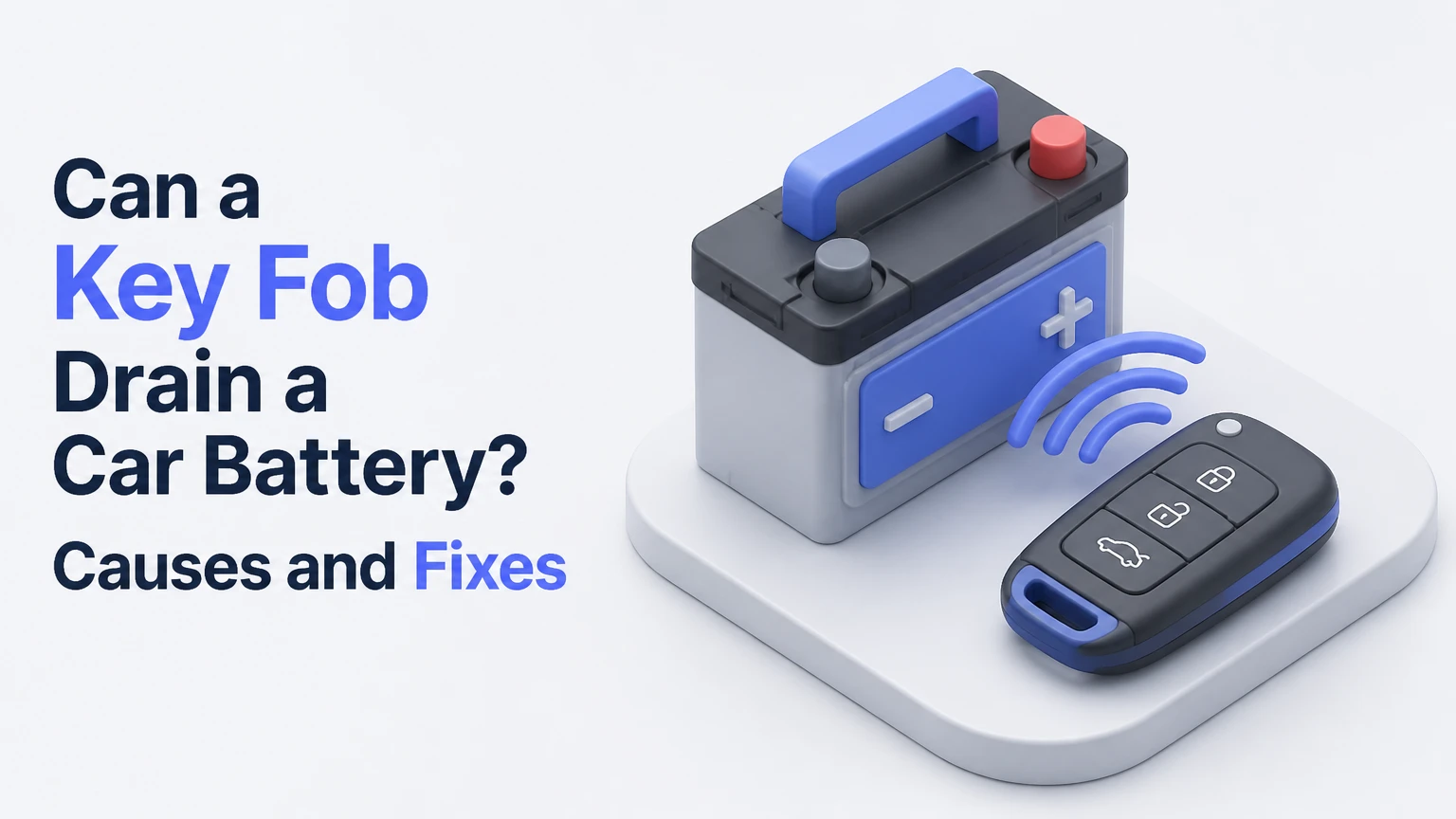
Yes, a key fob can drain a car battery, but usually only when a smart-key system repeatedly wakes the vehicle, a button is stuck, or a vehicle-side component fails. The key fob’s coin-cell battery and the car’s 12-volt battery are separate; the fob normally does not power the vehicle, but its presence or repeated signal can prevent the body control module from entering sleep mode.
Key Facts at a Glance
- A passive smart key stored close to a parked vehicle can increase the vehicle’s standby current on some models.
- A normal parked-car draw is commonly about 20-50 milliamps after every module has gone to sleep.
- A stuck remote button can transmit repeatedly and drain the fob’s CR2032 or CR2025 battery without necessarily draining the vehicle battery.
- A healthy 60 amp-hour battery exposed to a 250-milliamp draw may become unreliable in several days, especially in cold weather.
- Moving every key at least 20-30 feet away is a useful first test, but it does not prove the fob caused the fault.
- A failed door-handle sensor, latch, alarm, telematics unit, or aftermarket accessory can mimic a key-fob problem.
Can a Key Fob Drain a Car Battery?
A key fob can drain a car battery when the vehicle’s keyless-entry system keeps control modules awake or repeatedly initiates wake-up cycles. The risk is highest with passive proximity systems that detect a nearby fob, while conventional button-operated remotes normally transmit only after a button press.
The common scenario is a car parked in an attached garage with the smart key on a wall hook near the interior door. The exact distance varies by antenna design, building materials, key position, and vehicle software, so a universal “15-foot rule” is unreliable. Some cars tolerate nearby keys without abnormal current, while others repeatedly poll for a fob or keep a related module active.
The key fob itself has a small coin cell, commonly a CR2032 or CR2025. That cell powers the fob’s transmitter and receiver. The vehicle battery powers the BCM, alarm, locks, telematics, immobilizer, and other systems that may remain active after ignition shutdown.
What the key fob does not do
A key fob does not directly transfer its coin-cell energy into the car battery. A weak fob battery usually causes shorter operating range, intermittent unlocking, or a “key not detected” warning rather than a dead vehicle battery.
A vehicle battery that dies overnight should not automatically be blamed on the fob. A 12-volt battery with a shorted cell, an aging alternator diode, a glovebox lamp, or an aftermarket tracker can create the same symptom.
How Does a Smart Key Communicate With a Parked Car?
A smart-key vehicle usually sends a low-frequency request from antennas around the cabin and door handles, and the fob responds over a higher-frequency radio link after it detects a valid challenge. The body control module then verifies the response before authorizing unlocking, starting, or another access function.
The system is not normally a simple continuous radio conversation. Modern vehicles use timed polling, encrypted authentication, sleep timers, and zone-specific antennas. A vehicle may wake briefly without developing a damaging drain, because a short wake-up event is different from a module that never reaches sleep.
Toyota’s technical documentation describes the electronic-key system as using an “entry function” when the key is within the vehicle’s detection area. That manufacturer wording matters because detection range and behavior are model-specific, not universal across all cars.
| System component | Typical signal or function | Battery involved | Failure symptom |
|---|---|---|---|
| CR2032 or CR2025 cell | Powers fob electronics | Key-fob battery | Reduced range or no button response |
| LF antenna, roughly 125 kHz | Detects proximity zones | Vehicle 12V system | Repeated wake requests |
| UHF transmitter, commonly 315 or 433.92 MHz | Sends authenticated response | Key-fob battery | Intermittent locking |
| Bluetooth Low Energy | Phone-as-key communication | Phone and vehicle battery | App connection or background polling |
| UWB module | Measures distance and direction | Phone, fob, and vehicle systems | Inaccurate passive authorization |
Exact frequencies differ by market and manufacturer. A North American vehicle may use a different radio allocation from an equivalent European model.
What Current Draw Is Normal After Shutdown?
A typical modern vehicle should settle near 20-50 milliamps after its modules shut down, although manufacturer specifications can be lower or higher. The meaningful measurement is the stabilized draw after the car has been locked, all doors are recognized as closed, and the specified sleep period has elapsed.
Some vehicles need 10-45 minutes to enter low-power mode. Others wake periodically for telematics, remote services, battery monitoring, or emissions-related functions. A brief reading of 200 milliamps immediately after locking is therefore not enough to diagnose a fault.
| Stabilized draw at the battery | Practical interpretation | Approximate daily consumption | Recommended response |
|---|---|---|---|
| 15-50 mA | Typical sleep range for many vehicles | 0.36-1.20 Ah | No action if the battery is healthy |
| 50-100 mA | Borderline on many vehicles | 1.20-2.40 Ah | Check the vehicle specification |
| 100-250 mA | Abnormally high for long periods | 2.40-6.00 Ah | Diagnose accessories and modules |
| 250-1,000 mA | Severe parasitic draw | 6.00-24.00 Ah | Repair promptly |
| More than 1 A | Major awake circuit or short | More than 24 Ah | Stop repeated battery replacement and test immediately |
The arithmetic uses current multiplied by time. A 250-milliamp draw consumes about 6 amp-hours per day, but a car battery should not be discharged to its printed capacity before starting becomes impossible. Cold temperatures, battery age, reserve capacity, and repeated cranking reduce usable starting power.
How Quickly Can the Battery Go Flat?
A 12-volt car battery can become unable to start the engine within 24-72 hours when an abnormal draw remains active, but the actual time depends on current, battery condition, temperature, and starting requirements. A healthy battery and a 1-amp draw may fail much sooner than a weak battery and a 150-milliamp draw.
For example, a nominal 60 amp-hour battery exposed to 500 milliamps loses about 12 amp-hours in 24 hours. That calculation does not mean the battery has 48 hours of guaranteed starting capacity, because voltage falls under load and cold weather increases the engine’s cranking demand.
| Continuous draw | Energy used in 24 hours | Likely practical result on a healthy 60-Ah battery | Main variable |
|---|---|---|---|
| 50 mA | 1.2 Ah | Usually starts after several days | Battery age |
| 150 mA | 3.6 Ah | May start after a week, but risk rises | Temperature |
| 500 mA | 12 Ah | Starting problems often appear in 2-4 days | Battery state of charge |
| 1,000 mA | 24 Ah | A flat battery may occur in 1-3 days | Reserve capacity |
The AI Overview’s 24-48-hour estimate is plausible for a substantial draw, but it should not be treated as a universal key-fob timetable.
Which Key Systems Carry the Greatest Risk?
Passive proximity keys carry more risk than traditional button remotes because the vehicle actively searches for a nearby authorized key. A conventional remote usually sends a signal only when a button is pressed, so its normal presence several feet away is unlikely to keep the car awake.
| Key system | Normal transmission behavior | Vehicle-drain risk | Typical fob-cell life | Common failure |
|---|---|---|---|---|
| Metal key with passive transponder | Responds only during immobilizer interrogation | Very low | 5-10 years or no replaceable cell | Damaged transponder |
| Button-operated remote | Transmits after button press | Low | 2-5 years | Stuck button |
| Passive smart key | Responds to vehicle proximity polling | Low to moderate, model-dependent | 1-3 years | Nearby key or failed sensor |
| Phone-as-a-key system | Uses BLE, UWB, or NFC | Low to moderate | Phone-dependent | App, Bluetooth, or telematics fault |
A passive smart key can still be harmless when stored nearby if the manufacturer designed the vehicle to enter sleep mode correctly. Conversely, a traditional remote with a jammed button can create repeated lock, unlock, or panic commands and drain its own coin cell quickly.
Where Should You Store a Smart Key?
Store a smart key at least 20-30 feet from the vehicle, preferably behind several walls, when the car is parked in a garage. A location near the front door, garage wall, or window can remain within the vehicle’s detection zone even when the key is inside the house.
Do not leave the fob inside a parked vehicle unless the owner’s manual specifically supports that use. The cabin contains interior antennas designed to detect the key, and the car may keep authorization and security modules active.
A Faraday pouch provides a stronger test than distance alone. Place the key inside the pouch, lock the car normally, and confirm that passive unlocking no longer works while the fob remains enclosed. Replace the pouch if the vehicle still detects the key.
Does a Faraday Pouch Solve the Problem?
A correctly functioning Faraday pouch can stop radio communication between a smart key and the car, reducing proximity-related wake-ups and limiting relay attacks. It cannot repair a failed door-handle antenna, alarm module, telematics unit, alternator diode, or aftermarket accessory.
Test the pouch before relying on it. With the key sealed inside, attempt passive door unlocking and keyless starting according to the manufacturer’s procedure. A pouch that blocks one frequency but leaks another may appear to work intermittently.
Faraday storage also has limitations. The pouch must remain closed, the key must not be placed beside a spare fob outside the pouch, and phone-as-key systems may continue communicating through the owner’s smartphone unless Bluetooth or the relevant app permissions are managed.
How Can You Confirm the Fob Is Involved?
Confirm suspected key-fob involvement by isolating the keys, allowing the vehicle to sleep, and measuring current draw under controlled conditions. Moving all fobs away for several nights is a useful screening test, but a digital multimeter or professional current clamp provides stronger evidence.
Use this sequence:
- Fully charge the vehicle battery and confirm that it can hold approximately 12.6 volts at rest after charging.
- Move every physical fob at least 20-30 feet away, including spare keys and keys belonging to another household member.
- Disable or remove phone-as-key access temporarily, if the vehicle supports it.
- Lock the vehicle with the mechanical key or remote, close the hood and doors, and wait the manufacturer’s sleep period.
- Record the stabilized current rather than the initial post-locking reading.
- Repeat the test with one fob brought close, then move it away and observe whether the reading changes.
A series multimeter connection can be dangerous if the meter’s current fuse is exceeded. Never start the engine, operate high-current accessories, or open doors while the meter is connected in series unless the test procedure specifically allows it.
What If the Key Fob Is Not the Real Cause?
A failed vehicle component is more likely than a healthy fob when the battery dies with all keys stored far away. Door-latch switches, touch-sensitive handles, alarm systems, infotainment units, remote-start modules, GPS trackers, and charging ports can all prevent sleep.
The most useful diagnostic method is voltage-drop testing across fuses after the vehicle has stabilized. A technician can also remove fuses one at a time, use a current clamp, or monitor the vehicle network to identify the circuit that remains awake.
| Possible cause | Typical draw pattern | Useful clue | First diagnostic action |
|---|---|---|---|
| Nearby passive key | Draw rises when key approaches | Problem improves with distant storage | Repeat the distance test |
| Stuck fob button | Fob battery dies quickly | Lock or panic button feels soft | Remove cell and inspect button |
| Door-handle sensor | Intermittent wake cycles | Touch entry behaves erratically | Scan body-control faults |
| Aftermarket tracker | Constant draw, often 20-150 mA | Accessory wiring is non-factory | Isolate accessory fuse |
| Alternator diode leak | Draw remains after module sleep | Battery may discharge while parked | Perform alternator ripple and isolation tests |
| Interior or trunk lamp | Draw changes when doors move | Visible light or warm lamp housing | Inspect switches and latch signals |
The key diagnostic distinction is causation. A nearby fob may expose weak sleep logic, but the vehicle’s receiver, antenna, or software can be the component that actually consumes the 12-volt power.
Can a Dead Key Fob Battery Drain the Car Battery?
A dead key-fob battery normally cannot drain the vehicle battery because the two batteries are electrically separate. A depleted CR2032 can prevent remote locking, reduce passive-entry range, or require the emergency start procedure described in the owner’s manual.
A fob with a damaged circuit, moisture contamination, or a stuck button can behave differently. The damaged fob may transmit repeatedly until its own coin cell is exhausted, and repeated vehicle wake events may add to the car’s standby load.
Replace the coin cell with the exact type specified by the manufacturer. Installing a CR2025 where a CR2032 is required can create poor contact, reduced capacity, or case damage, even though both cells have similar diameters.
Can a Phone-as-Key System Cause the Same Issue?
A phone-as-key system can contribute to wake-ups through Bluetooth Low Energy, UWB, or connected-vehicle services, but the phone itself usually does not continuously power the car. The more common problems are a vehicle telematics module, an app connection loop, or software that repeatedly requests vehicle status.
For diagnosis, temporarily disable phone-as-key permissions, Bluetooth, and remote-vehicle services while keeping the physical fob away. If the drain stops, restore each feature separately to identify the trigger.
Phone-as-key systems also create a separate battery concern: the smartphone may lose charge faster when Bluetooth, location services, UWB, and the manufacturer’s app remain active. That phone drain does not prove the vehicle battery is being drained.
How Should You Protect a Car During Long Storage?
For storage longer than two weeks, use a vehicle-approved battery maintainer connected according to the battery manufacturer’s instructions, rather than relying on repeated jump-starts. A maintainer keeps the 12-volt battery charged while allowing the vehicle’s normal standby systems to operate.
Before storage, charge the battery fully, clean corrosion from the terminals, move every smart key away from the car, and confirm that the trunk and interior lamps switch off. A maintainer must match the battery chemistry, especially for AGM, EFB, lithium auxiliary, or hybrid-vehicle batteries.
| Storage condition | Key action | Typical equipment cost | Check interval |
|---|---|---|---|
| 2-7 days | Store fob 20-30 feet away | $0 | At return |
| 2-4 weeks | Use an automatic maintainer | $30-$100 | Weekly visual check |
| 1-3 months | Maintainer plus battery test | $50-$150 | Every 2-4 weeks |
| Outdoor winter storage | Weather-rated maintainer and covered connection | $60-$180 | Weekly |
Disconnecting a battery can erase learned settings, disable alarms, or create problems for vehicles with battery-management systems. Follow the service manual before disconnecting either terminal.
What Does Diagnosis and Repair Usually Cost?
A replacement coin cell usually costs $3-$10, while a professional parasitic-draw diagnosis commonly costs $100-$250 depending on labor rates and access. A replacement smart fob may cost $150-$600 after cutting, programming, and immobilizer authorization.
Costs vary sharply by manufacturer. Luxury vehicles, proximity keys, encrypted immobilizers, and vehicles requiring online dealer authorization sit near the upper end. A battery replacement alone will not solve a recurring drain.
| Repair or test | Typical price range | Typical time | When it is appropriate |
|---|---|---|---|
| CR2032 or CR2025 replacement | $3-$10 | 5-15 minutes | Weak fob range |
| 12V battery replacement | $120-$300 | 20-60 minutes | Failed battery test |
| Parasitic-draw diagnosis | $100-$250 | 1-3 hours | Battery repeatedly goes flat |
| Door-handle or latch repair | $150-$700 | 1-4 hours | Vehicle-side wake fault |
| Smart-fob replacement and programming | $150-$600 | 30-120 minutes | Lost or damaged fob |
| Automatic battery maintainer | $30-$150 | 5-15 minutes to connect | Long-term parking |
A technician should test battery health before measuring parasitic draw. A weak battery can make a normal 40-milliamp standby load appear to be the primary problem.
Common Mistakes That Create False Diagnoses
Owners often replace the vehicle battery before checking whether a lamp, accessory, or module remains active. That approach can produce two dead batteries instead of one repaired fault.
Avoid these mistakes:
- Testing too soon: Measuring immediately after locking captures normal shutdown activity, not stabilized sleep current.
- Leaving a spare fob nearby: One key may be distant while a second key remains on a kitchen counter near the garage.
- Assuming distance is universal: Metal doors, walls, antenna placement, and model software change the effective detection zone.
- Using an untested Faraday pouch: Signal leakage can allow intermittent detection.
- Pulling fuses randomly: Opening doors or waking modules can reset the condition being measured.
- Ignoring aftermarket equipment: Remote starters, dash cameras, trackers, and audio amplifiers are frequent sources of standby drain.
- Jump-starting repeatedly: Deep discharge damages lead-acid batteries and can hide the original parasitic load.
A practitioner’s rule of thumb is simple: if the fob’s own coin cell dies quickly, inspect the fob; if the car battery dies while the fob is isolated, inspect the vehicle.
When Should You Call a Technician?
Call a technician when the battery loses starting power in less than two days, the stabilized draw exceeds the manufacturer’s specification, or the vehicle shows multiple body-control and keyless-entry warnings. Professional diagnosis is also appropriate when a series ammeter test could interrupt the vehicle network or deploy safety systems.
Stop testing if the battery becomes hot, swollen, leaks electrolyte, or smells strongly of sulfur. Do not place a damaged battery on a maintainer.
A technician with a scan tool can examine body-control wake history, keyless-entry faults, door-latch status, telematics activity, and battery-management data. That information can distinguish a nearby authorized key from a failed sensor that falsely reports a key request.
FAQ
Can leaving keys in the garage kill a car battery?
Leaving a smart key in a garage can contribute to battery drain when the key remains within the vehicle’s effective detection range and the car repeatedly wakes its keyless-entry modules. Store the key 20-30 feet away or inside a verified Faraday pouch, then confirm the vehicle reaches its normal sleep current.
Does locking the car with the remote prevent battery drain?
Locking the car with a remote does not guarantee that every module enters sleep mode. The vehicle may still wake for telematics, a door-handle sensor, an alarm fault, or a nearby smart key. A stabilized current measurement is more reliable than the locking method alone.
Can a car battery drain while the key is inside the vehicle?
A smart key left inside the vehicle can keep interior antennas and authorization modules active, depending on the model. Remove all keys, close every door and the trunk, lock the vehicle, and wait for the documented sleep period before judging the standby draw.
Will changing the key-fob battery fix a dead car battery?
Changing the key-fob battery will not normally fix a dead car battery because the cells power separate circuits. It may correct repeated transmissions caused by a damaged or unstable fob, but a vehicle that continues losing charge needs a battery-health and parasitic-draw test.
Can cold weather make key-fob battery drain worse?
Cold weather reduces available capacity from both coin cells and 12-volt lead-acid batteries. A marginal vehicle battery may fail after a normal overnight standby load, while a cold fob may show reduced range. Warm the key and test the vehicle battery before blaming proximity communication.
Can a jump-start damage a smart-key system?
A correctly performed jump-start usually does not damage a smart-key system, but reverse polarity, voltage spikes, and poor-quality booster equipment can damage body-control modules. Follow the owner’s manual, connect the terminals in the specified order, and investigate the drain instead of repeatedly boosting the car.
The Bottom Line
Can a key fob drain a car battery? Yes, a smart key can contribute to a flat 12-volt battery when proximity detection, repeated transmissions, or a related vehicle fault prevents sleep mode. The fob is not usually the direct electrical load. Move every key 20-30 feet away, test any Faraday pouch, allow the vehicle to sleep, and measure stabilized parasitic current before replacing parts.