The best place to buy a car key battery depends on whether you need the battery immediately, want installation help, or are optimizing price. Auto parts stores and Batteries Plus are usually best for same-day replacement, Walmart and Target often cost less for DIY installation, and online marketplaces offer the lowest per-cell price when you can verify the exact battery code and seller freshness.
Key Facts at a Glance
- Most modern key fobs use a lithium coin cell, commonly CR2032, CR2025, CR2016, CR1620, or CR1632.
- The battery code must match the fob specification exactly, because thickness affects spring pressure and electrical contact.
- A replacement usually costs $4-$10 at a general retailer and takes 5-15 minutes when the case has a serviceable seam.
- Auto parts stores may install a battery as a courtesy, but installation policies vary by store, fob design, and employee availability.
- A weak key-fob battery normally affects remote buttons first; it does not usually erase the immobilizer transponder or mechanical key function.
- If a new battery does not restore operation, inspect polarity, contacts, synchronization, fob damage, and the vehicle’s 12-volt battery before buying another cell.
Where to Buy Car Key Battery Today
Auto parts stores are the strongest all-around choice when you need a battery immediately and want a reasonable chance of installation help. Walmart, Target, Home Depot, Lowe’s, supermarkets, electronics retailers, Batteries Plus, dealerships, locksmiths, and online marketplaces all sell compatible coin cells, but they differ in service, stock accuracy, price, and return convenience.
Call the specific location before driving there. Retail inventory can be wrong, and free installation is a local service decision rather than a universal promise. Take the fob or a clear photograph of its battery compartment so the employee can verify the code without guessing.
Which retailer is best for your situation?
| Buying situation | Best retailer | Typical total cost | Typical time | Main limitation |
|---|---|---|---|---|
| Need the car working within 30 minutes | Auto parts store | $6-$12 | 10-30 minutes | Installation varies |
| Want the lowest immediate shelf price | Walmart or Target | $4-$8 | 10-20 minutes | Usually self-service |
| Need careful handling of a fragile fob | Batteries Plus or locksmith | $10-$25 | 15-45 minutes | Fewer locations or higher labor |
| Need several cells for multiple devices | Amazon or eBay | $0.60-$2 per cell | 1-3 days | Seller freshness varies |
| Need guaranteed vehicle-specific confirmation | Dealership | $10-$30 | 20-90 minutes | Highest likely price |
| Need a replacement outside normal hours | Supermarket or convenience retailer | $6-$15 | 10-30 minutes | Limited codes and pack sizes |
Auto parts stores
AutoZone, O’Reilly Auto Parts, Advance Auto Parts, and NAPA commonly stock CR2032 and other popular coin cells near the electrical accessories or checkout area. These stores are appropriate when the vehicle is needed immediately and the fob has a conventional two-piece plastic shell.
The battery itself often costs about $6-$10 for a single or two-pack. Some locations replace the cell without charging labor, while others decline if the case is difficult, the fob is a sealed unit, or damage could create a liability dispute. Ask two questions before purchase: “Do you have this exact code?” and “Will someone install it on this fob?”
Auto parts staff should not be expected to program a replacement key. Battery replacement and key programming are separate services.
Big-box stores and supermarkets
Walmart, Target, Home Depot, Lowe’s, Kroger, and other large retailers can provide inexpensive same-day cells, usually in two-packs or multipacks. The battery section may be near electronics, automotive accessories, photographic supplies, or checkout displays rather than beside car keys.
These stores suit a driver who can open the fob and identify polarity. They are less suitable when the fob contains a loose circuit board, a hidden screw, a rubber gasket, or a battery soldered to a tabbed holder. A low price does not compensate for a broken retaining clip.
Check that the package is sealed, the code is visible, and the cell has not been loose in a bin. Do not buy a visibly corroded, scratched, dented, or swollen coin cell.
Batteries Plus and specialty battery retailers
Batteries Plus and similar battery specialists are useful when the fob design is unfamiliar or the owner wants installation handled professionally. These retailers may carry less common codes, inspect the contacts, and offer replacement plans, although terms and prices vary by location.
A lifetime replacement plan makes financial sense only when its upfront cost is lower than the expected number of service visits. For example, a $15-$20 plan can be reasonable for a household with several remotes or for a vehicle kept longer than five years, but it is poor value for a one-time CR2032 change that takes five minutes.
Ask whether the plan covers the exact fob, the battery only, installation, and future visits. “Lifetime” may refer to the plan, the vehicle ownership period, or the retailer’s terms, not to the battery’s physical life.
Online marketplaces
Amazon and eBay typically offer the lowest cost per battery, particularly in four-, five-, or ten-cell packs. Online buying works best when the existing fob already identifies the battery code and the vehicle is still usable while delivery is pending.
Choose a manufacturer-authorized or high-turnover seller when possible. Coin cells slowly lose stored energy over time, and marketplace listings can combine old inventory with newer stock. Inspect the package for a manufacturing or best-before date, intact individual blisters, and the correct country-specific labeling.
Avoid loose cells, implausibly cheap premium-brand packs, and listings that show several different codes under one product title. A multipack is economical only when the cells remain protected from metal objects, heat, moisture, and children.
Dealerships and automotive locksmiths
A dealership is the safest route when the owner’s manual specifies an unusual battery, the fob is sealed, the vehicle is under a service agreement, or the remote includes a complicated emergency-key assembly. The parts department can identify the factory specification by vehicle identification number, but the VIN does not always identify the battery inside an aftermarket or replacement fob.
Dealership pricing commonly reaches $10-$30 for battery and service, depending on brand and labor policy. A qualified automotive locksmith may charge a similar or lower amount and can diagnose a damaged remote, replace a housing, or program a key when the problem is not simply the coin cell.
Neither option is necessary for a standard accessible CR2032 compartment unless the owner prefers professional handling.
How Much Does a Car Key Battery Cost?
A car key battery typically costs $4-$10 for a retail two-pack, $0.60-$2 per cell in a reputable online multipack, or $10-$30 when a dealership or locksmith supplies and installs it. Delivery fees, expedited shipping, installation labor, and replacement-plan charges can change the total more than the battery itself.
| Purchase method | Typical pack or service | Battery price | Added cost | Practical total |
|---|---|---|---|---|
| Online multipack | 4-10 cells | $4-$15 | $0-$6 delivery | $4-$21 |
| Walmart or Target | 2 cells | $4-$8 | $0 installation | $4-$8 |
| Auto parts store | 1-2 cells | $6-$10 | $0-$5 service | $6-$15 |
| Specialty retailer | 1 cell with fitting | $8-$15 | $0-$10 service | $8-$25 |
| Locksmith | 1 cell and diagnosis | $5-$12 | $10-$30 labor | $15-$42 |
| Dealership | 1 cell and fitting | $8-$20 | $0-$15 labor | $8-$35 |
Prices are typical United States retail ranges, not fixed national prices. Luxury-brand fobs, sealed housings, mobile locksmith callouts, and after-hours service can exceed the table.
A premium brand is not automatically fresher than a less famous brand. Packaging date, authorized distribution, intact seals, and correct storage are stronger purchasing signals than a logo alone. Energizer’s published guidance for lithium coin cells emphasizes keeping batteries in their original packaging and away from metal objects, because a short circuit can cause heating or leakage.
What Battery Does a Key Fob Use?
The correct key-fob battery is the code printed on the old cell, listed in the owner’s manual, or specified by the fob manufacturer. The most common codes are CR2032, CR2025, and CR2016, which all have a 20-millimeter diameter but different thicknesses.
| Battery code | Diameter | Thickness | Nominal voltage | Common fit |
|---|---|---|---|---|
| CR2032 | 20 mm | 3.2 mm | 3 V | Many modern Toyota, Honda, Nissan, Chevrolet, Ford, and Subaru fobs |
| CR2025 | 20 mm | 2.5 mm | 3 V | Slim remotes and selected Mazda, Volkswagen, and other fobs |
| CR2016 | 20 mm | 1.6 mm | 3 V | Thin or older remotes, some two-cell designs |
| CR1620 | 16 mm | 2.0 mm | 3 V | Selected compact Japanese and European fobs |
| CR1632 | 16 mm | 3.2 mm | 3 V | Selected Subaru, Lexus, and other remote designs |
The first two digits generally indicate diameter in millimeters, and the last two indicate thickness in tenths of a millimeter. The code is a physical specification, not a vehicle-brand guarantee.
Can you replace a CR2032 with a CR2025?
A CR2025 should not replace a CR2032 unless the fob manufacturer explicitly permits it. Both cells provide approximately 3 volts, but the CR2025 is 0.7 millimeters thinner, which can leave the battery loose and interrupt contact when the remote moves.
A CR2016 is thinner still. Two CR2016 cells may appear in series in a particular remote, but owners should never stack cells in a compartment designed for one battery. Stacking changes voltage, increases pressure, and can damage contacts or the circuit board.
A thicker cell can also be unsafe if the compartment lacks clearance. The exact code is the correct answer.
How Do You Know the Battery Is Weak?
A weak key-fob battery usually causes shorter operating range, delayed response, repeated button presses, or a low-key-battery message before the remote stops responding. Push-button vehicles may also display a warning while the engine still starts, because the immobilizer system can detect the transponder separately from the remote transmitter.
| Symptom | Likely cause | First check | Appropriate next action |
|---|---|---|---|
| Remote works only nearby | Weak coin cell or interference | Test with a fresh exact-code cell | Replace cell and test outdoors |
| Dashboard says key battery low | Low fob-cell voltage | Inspect battery code and date | Replace cell |
| LED is dark after replacement | Wrong polarity or no contact | Confirm plus side and retaining tabs | Reinstall and inspect contacts |
| Remote buttons work, car does not start | Immobilizer or vehicle issue | Use emergency-start procedure | Consult owner’s manual |
| One button fails | Worn switch or damaged membrane | Test every button | Repair housing or fob |
| Both fobs fail suddenly | Vehicle 12-volt battery or receiver issue | Check vehicle battery and central locking | Diagnose vehicle system |
A key-fob cell commonly lasts about two to four years, but frequent button use, passive-entry polling, extreme temperatures, and accidental button presses can shorten that period. A remote stored beside the vehicle may communicate more often than one kept farther away, depending on the car’s passive-entry design.
How Do You Replace the Battery?
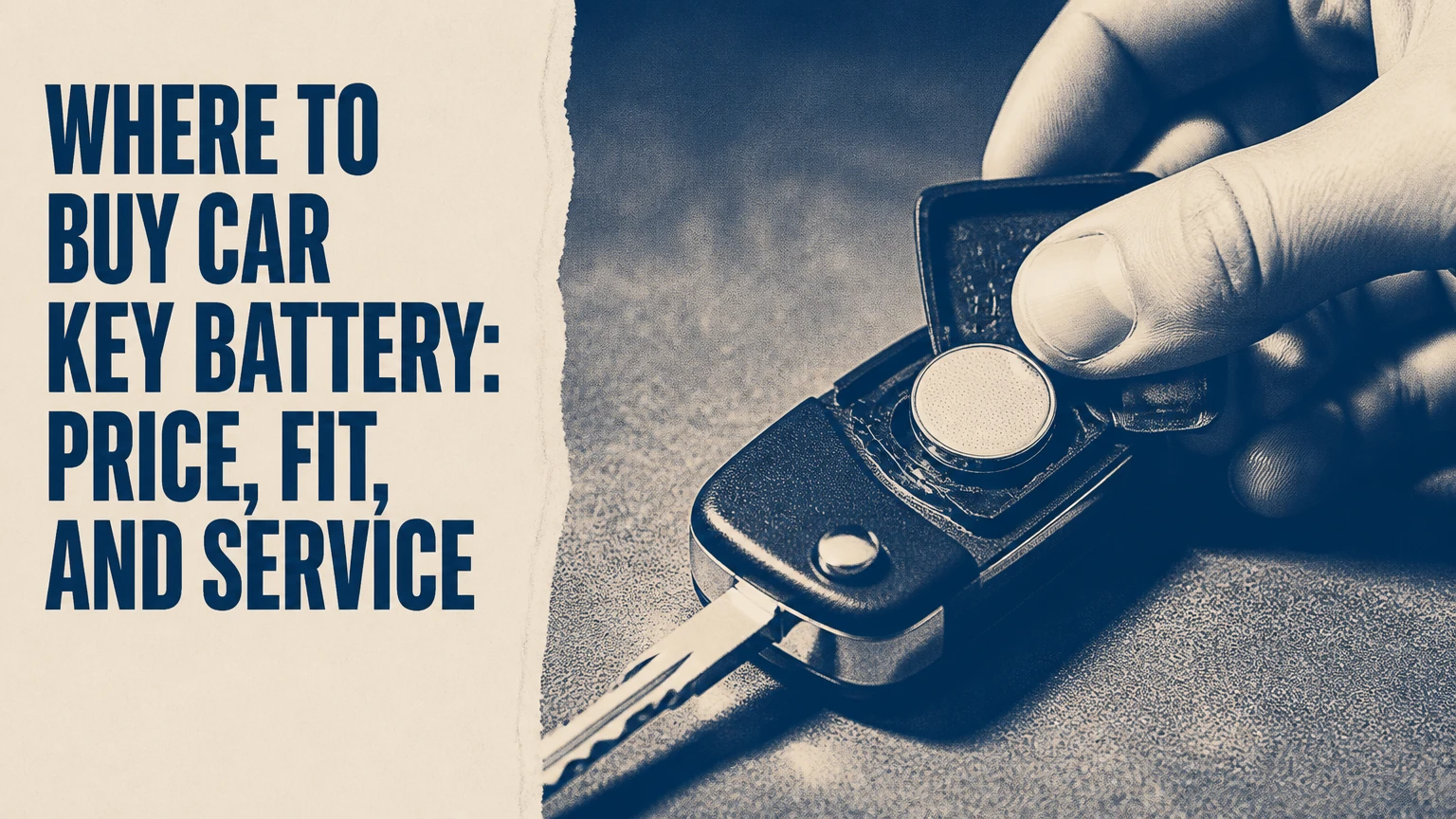
Most serviceable key fobs can be opened, the coin cell exchanged, and the buttons tested in 5-15 minutes. The determining factor is the housing design, not the battery brand, because a removable emergency key and a marked pry notch make replacement simpler.
Before you start
| Requirement | Typical value |
|---|---|
| Time | 5-15 minutes |
| Difficulty | Low for a marked service seam; moderate for hidden screws |
| Materials | 1 exact-code 3-volt coin cell |
| Tools | Emergency key blade, plastic pick, or small flat screwdriver |
| Preparation | Photograph the old battery orientation |
| Safety | Keep the removed cell away from children and pets |
Step 1: Identify the exact cell
Read the code on the old battery before discarding it. Compare the code with the owner’s manual and, if necessary, the vehicle manufacturer’s parts information.
Do not rely solely on a search result for the vehicle year and model. A single model can use different fobs across trim levels, markets, and replacement-key suppliers. You will know this step worked when the code on the replacement matches the old cell or the authoritative manual specification.
The common mistake is buying a CR2032 because it is widely stocked. Popular does not mean universal.
Step 2: Remove the emergency key or cover
Slide the release latch and pull out the metal emergency blade if the fob has one. Many housings use the empty blade channel as the leverage point for separating the two plastic halves.
If no blade exists, look for a small screw, a molded arrow, or a notch at the seam. Use a plastic pick when possible because metal tools can mark the housing or bridge circuit contacts. You will know the step worked when the case separates slightly without bending the shell.
Do not twist forcefully at a random corner. Internal clips can break even when the case eventually opens.
Step 3: Open the housing carefully
Work around the designated seam with light, controlled pressure. Keep the buttons, rubber membrane, transponder component, and circuit board in their original positions.
Some fobs contain a loose circuit board that can fall out as soon as the cover separates. Place the pieces on a clean, dry surface and photograph the arrangement if the design is unfamiliar. The checkpoint is a fully visible battery holder with no displaced spring or clip.
The common mistake is prying directly against a circuit board. Leverage belongs at the molded seam, not against electronics.
Step 4: Install the new cell
Note which side faces upward before removing the old battery. In many fobs, the positive side marked with a plus sign faces the cover, but the correct orientation is the one shown by the holder or manual.
Hold the cell by its edges and slide it beneath the retaining clip rather than forcing it vertically. Remove any packaging film from the battery itself, but do not scrape the cell. You will know the installation worked when the battery sits flat and the retaining tab holds it firmly.
The common mistake is confusing a protective package seal with a removable film on the cell. Never install a battery still inside its retail blister or with insulating material covering its contacts.
Step 5: Reassemble and test
Align the housing halves, press around the perimeter, reinstall the emergency key, and tighten any screw without overtightening the plastic. Test lock, unlock, trunk, panic, and passive-entry functions while standing close to the vehicle.
A successful replacement produces a visible fob LED response, a vehicle lock response, or both. Test the remote from several meters away after the close-range test. If the vehicle starts but remote buttons do not work, the immobilizer and remote transmitter are not proving the same thing.
What if the fob is sealed?
A sealed fob, rechargeable smart key, or soldered battery requires professional service. Do not cut a welded housing or solder near a lithium coin cell without the correct replacement component and electronics tools.
A locksmith, dealership, or specialist battery retailer can identify whether the housing is serviceable and whether the battery is soldered, tabbed, or rechargeable. Opening a sealed unit may destroy its water resistance and can make a replacement housing necessary.
Which Buying Option Has the Best Value?
Auto parts stores provide the best value for a single urgent replacement when installation is free or inexpensive. Online multipacks provide the lowest unit cost, while specialty retailers provide the best value when a fragile fob, unusual code, or diagnostic uncertainty makes breakage more expensive than the battery.
| Priority | Recommended option | Why it wins | When it loses |
|---|---|---|---|
| Immediate operation | Auto parts store | Same-day stock and possible fitting | Store lacks the code or declines service |
| Lowest unit price | Online multipack | $0.60-$2 per cell is typical | Delivery delay or stale inventory |
| Lowest mistake risk | Specialty retailer | Staff can inspect fit and contacts | Higher total cost |
| Factory assurance | Dealership | Vehicle-brand parts support | Labor and convenience fees |
| Complex key problem | Automotive locksmith | Battery, housing, and programming diagnosis | Mobile-callout pricing |
| One spare for home | Big-box retailer | Immediate, inexpensive two-pack | DIY handling required |
The cheapest purchase is not always the cheapest outcome. A $5 cell is expensive if incorrect thickness breaks a $200-$500 smart key housing or leaves the driver stranded during a trip.
What Should You Check Before Buying Online?
Online buyers should confirm the exact code, chemistry, voltage, pack count, seller identity, package date, and delivery time before ordering. A listing that groups CR2016, CR2025, and CR2032 under one headline is not enough evidence that the cells are interchangeable.
Use this checklist:
- Match the full code, including the letters and numbers.
- Confirm a 3-volt lithium coin cell when the fob specifies a CR cell.
- Choose sealed individual packaging rather than loose batteries.
- Check the seller’s recent reviews for old or counterfeit stock.
- Compare the delivered price per cell, not the headline pack price.
- Avoid buying a ten-pack if one battery will sit in a hot vehicle for years.
- Confirm the return policy before opening the package.
Online marketplaces are also a poor emergency choice when the current battery is already failing. A nearby retailer costs more but removes the two-day delay and provides a faster path to diagnosis.
Common Mistakes and How to Fix Them
Installing the right diameter with the wrong thickness
A CR2025 can fit physically where a CR2032 belongs, yet fail intermittently because the thinner cell does not maintain spring pressure. Replace it with the specified code instead of bending the holder to compensate.
Reversing the polarity
Most holders mark the positive side, but the plus side does not face upward in every design. Remove the cell, inspect the molded symbol, and reinstall it according to the holder rather than habit.
Leaving insulating material on the cell
Some batteries have a removable protective film, while others do not. A battery installed with insulation over a contact will show no electrical response. Inspect both faces and follow the package instructions.
The often-repeated claim that every new coin cell has a bitter safety sticker is incorrect. Child-safety warnings and coatings vary by manufacturer, so inspect the actual product instead of assuming a sticker exists.
Flattening or breaking the contact tabs
Excessive prying and forcing can flatten spring contacts or snap plastic retainers. If the cell is loose, a technician should restore the contact geometry; improvised foil or folded paper can create unreliable pressure and short-circuit risk.
Assuming a new battery repairs a damaged remote
Water intrusion, a worn microswitch, cracked solder joint, damaged antenna, and failed circuit board can mimic a dead battery. If the fob LED never lights with a verified cell, the remote needs inspection rather than another multipack.
Expecting programming after a battery swap
Battery replacement normally does not program a key. If the remote loses synchronization, the vehicle-specific owner’s manual procedure may restore it, but many modern systems resynchronize automatically. Key programming requires immobilizer access and is a separate locksmith or dealership service.
Why Does the Key Still Not Work After Replacement?
A key fob that remains inoperative after a fresh battery usually has a polarity, contact, synchronization, fob-damage, interference, or vehicle-power problem. Diagnose those causes in order, because buying another battery cannot correct a broken switch or a discharged vehicle battery.
- Recheck the code and orientation. Confirm the exact battery number and positive-side position.
- Test the battery outside the fob. A retailer with a coin-cell tester can verify voltage, although open-circuit voltage alone does not prove performance under load.
- Inspect the holder. Look for bent tabs, corrosion, dirt, or a cell that moves inside the compartment.
- Try the spare fob. If both remotes fail, inspect the vehicle’s 12-volt battery, receiver, and central-locking system.
- Use the emergency-start location. Push-button vehicles often specify a backup position near the start button, steering column, or center console.
- Follow the vehicle’s resynchronization procedure. Procedures differ by manufacturer and model year, so use the manual rather than a generic sequence.
- Seek a locksmith or dealer. Escalate when the LED stays dark, the housing has water damage, or the key requires programming.
Radio interference can also reduce apparent range near strong transmitters or dense electronic equipment. Test the fob beside the vehicle in a different location before treating a borderline range problem as battery failure.
How Should Spare Car Key Batteries Be Stored?
Store spare coin cells in their original blister packaging at room temperature, away from keys, coins, tools, children, pets, and direct sunlight. Do not tape a loose cell to the inside of a glovebox, because tape can fail and metal objects can bridge the positive and negative surfaces.
A vehicle glovebox is convenient but can reach temperatures that accelerate battery aging. A cool household drawer is usually better for long-term storage. Keep one correctly labeled spare with the emergency key supplies, but replace stock that has exceeded the manufacturer’s recommended shelf life.
Recycle used lithium coin cells through a household battery program or a retailer that accepts them. Cover exposed terminals with nonconductive tape according to the recycling program’s instructions, and never place loose lithium coin cells in a fire, incinerator, or mixed recycling bin.
When Should You Use a Locksmith Instead?
Use an automotive locksmith when the replacement cell does not restore operation, the fob housing is broken, the key is aftermarket, the vehicle needs programming, or you need service at the vehicle’s location. A locksmith can separate a battery problem from a transmitter, transponder, housing, or programming fault.
A dealership is preferable when the key is covered by a warranty, the vehicle uses a proprietary sealed smart key, or the owner needs factory documentation. A battery retailer is usually sufficient for a conventional replaceable coin cell.
Bring every existing key to diagnostic service. A technician can compare the working and failed remotes, which often reveals whether the fault is inside one fob or in the vehicle receiver.
FAQ
Can I buy a key-fob battery at a gas station?
Some gas stations and convenience stores sell CR2032 or CR2025 cells, but selection and freshness are inconsistent. Use a convenience retailer only when the code is clearly printed and the package is sealed. For an unusual CR1620 or CR1632, an auto parts store, battery specialist, locksmith, or online seller is more reliable.
Do car key batteries have to be the same brand?
No. The replacement must match the specified code, voltage, physical dimensions, and chemistry; the brand can differ. Energizer, Duracell, Panasonic, Sony, Maxell, and reputable private-label cells can all work when genuine and fresh. Manufacturer quality control and storage history matter more than choosing the original logo.
Will a dead key-fob battery prevent the car from starting?
Usually, a dead remote battery does not erase the immobilizer transponder, so the vehicle may still start with the emergency key or backup detection procedure. Push-button vehicles commonly provide a designated location for a weak fob. Follow the owner’s manual because the location and procedure vary by model.
How long can a new key-fob battery sit unused?
A properly packaged lithium coin cell can remain usable for several years, but the manufacturer’s date guidance controls. Heat, humidity, damaged packaging, and contact with metal shorten storage life. Buy the smallest sensible pack for one vehicle, and store unused cells in original packaging rather than loose in a drawer.
Can I open every key fob myself?
No. Many conventional remotes have a pry seam, but sealed smart keys, rechargeable units, and tabbed or soldered batteries need specialist service. Stop if the housing will not separate with light pressure, if a circuit board begins to lift, or if the manual says the key is non-serviceable.
Where should I buy a battery for an urgent trip?
Buy from a nearby auto parts store or battery specialist, then ask the staff to verify the code and test the remote before leaving. A dealership is appropriate for a sealed or luxury-brand key, while online ordering is unsuitable when delivery delay could leave you without reliable access or starting capability.
The Bottom Line
For most drivers, the best place to buy a car key battery is a nearby auto parts store or Batteries Plus because the exact cell can be verified and installation may be available immediately. Choose Walmart or Target for inexpensive DIY service, an online multipack for the lowest unit price, and a locksmith or dealership for sealed, damaged, or programmable keys.
Check the old battery code before purchasing, especially when comparing CR2032, CR2025, and CR2016 cells. Replace the battery carefully, test every function, and seek diagnosis if the remote still fails. The correct answer to where to buy car key battery is the retailer that combines the right specification with the service level your fob requires.