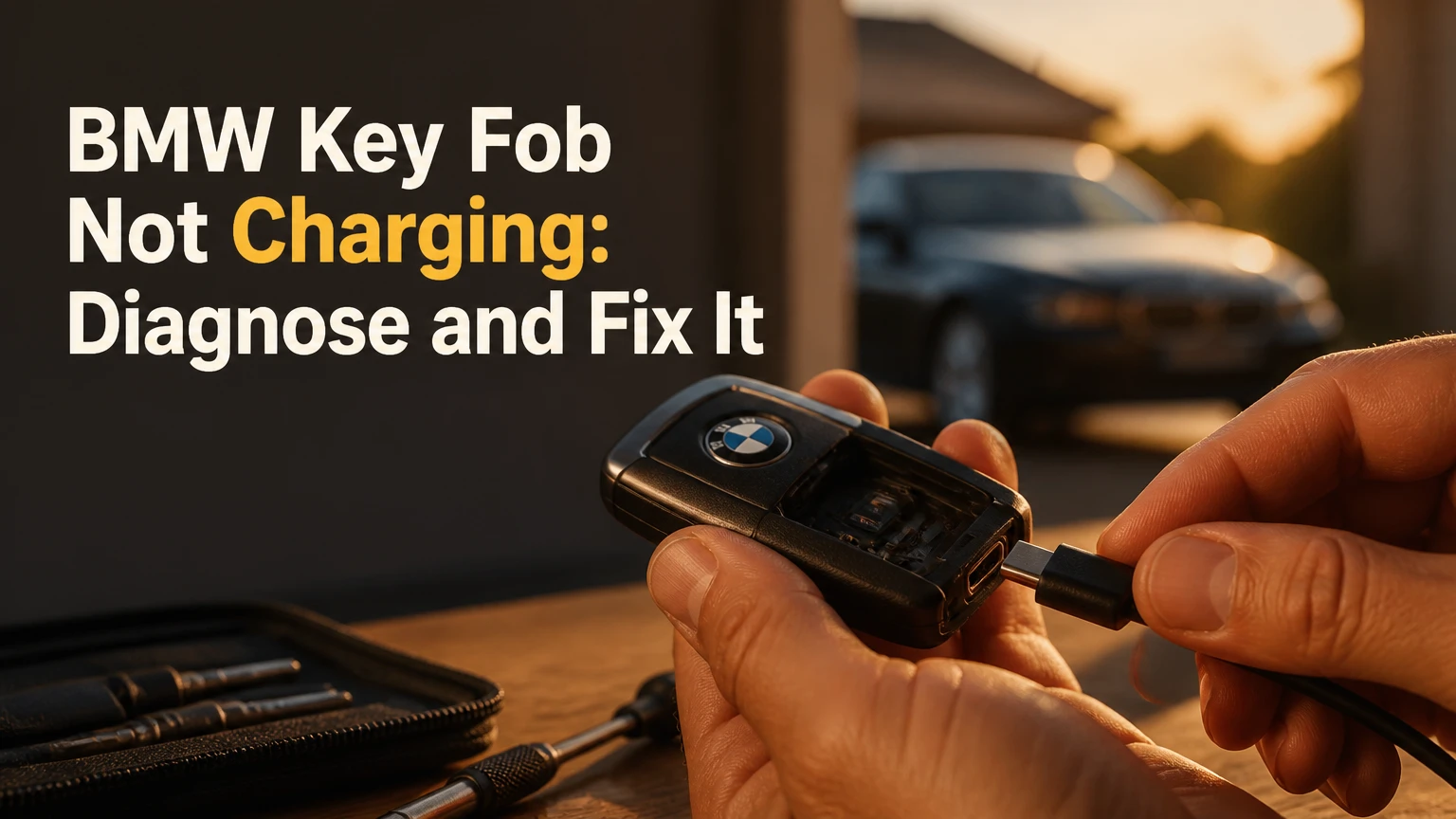
A BMW key fob not charging usually has a dead replaceable coin cell, not a charging fault. Older sealed BMW keys use an inductively charged VL2020 battery, while Comfort Access and many modern blade-style keys use non-rechargeable CR2032 or CR2450 cells that must be replaced. Display Keys charge separately through USB or a wireless tray.
Key Facts at a Glance
- A BMW key with a removable battery cover normally uses a replaceable CR2032 or CR2450 cell.
- A sealed older diamond or rectangular slot key may use an inductively charged VL2020 battery.
- A CR2032 or CR2450 battery must never be recharged in an ignition slot or charging tray.
- A rechargeable VL2020 key may need several hours of driving before its charge becomes reliable.
- A dead remote battery does not always prevent the transponder from starting the BMW.
- If every key fails after a battery replacement, investigate the vehicle, antenna, fuse, or radio interference.
Identify Your BMW Key Type Before Charging
The key shape provides a useful starting point, but the battery compartment and vehicle equipment determine the answer. BMW changed key designs across generations, and similar-looking keys can use different batteries depending on Comfort Access, production year, and market.
Remove the physical blade or inspect the rear housing without forcing the shell. A visible battery hatch indicates a replaceable cell. A sealed case with no hatch generally indicates an older rechargeable design, although the exact battery should be confirmed from the key housing, service documentation, or a replacement-key specialist.
| BMW key style | Typical vehicles or generation | Battery | Charging method |
|---|---|---|---|
| Diamond-shaped sealed key | E39, E46, some early BMW generations | VL2020 | Induction through ignition |
| Rectangular sealed slot key | E60, E90, E70 and related generations | VL2020 | Induction through key slot |
| Rectangular key with hatch | Late E-series and Comfort Access variants | CR2032 | No charging |
| Modern black, silver, or shield-style key | Many F-series and G-series vehicles | CR2032 or CR2450 | No charging |
| BMW Display Key with screen | Selected G-series vehicles | Internal lithium-polymer pack | USB or wireless tray |
Does Comfort Access mean the key should charge?
Comfort Access generally points to a replaceable battery, not an inductively charged key. The system lets the BMW detect a key in your pocket, but passive entry does not mean the vehicle recharges that key.
Check the rear of the fob rather than relying on the vehicle feature. BMW manuals for different model years specify different key procedures, so the vehicle’s owner documentation takes priority over a generic shape guide.
Which battery does a BMW key use?
The battery number printed on the existing cell is the correct replacement specification. CR2032 is 20 mm wide and 3.2 mm thick, while CR2450 is 24 mm wide and 5.0 mm thick; substituting one for the other can damage contacts or prevent the cover from closing.
| Battery | Nominal voltage | Typical BMW use | Rechargeable? | Typical retail price |
|---|---|---|---|---|
| VL2020 | 3 volts | Sealed older rechargeable key | Yes, rechargeable type | $8-$20 |
| CR2032 | 3 volts | Many Comfort Access keys | No | $3-$10 |
| CR2450 | 3 volts | Some larger modern fobs | No | $4-$12 |
| Internal Li-polymer pack | About 3.7 volts | Display Key | Yes, built-in pack | $40-$150 repair range |
Battery dimensions and use cases are typical, not a universal BMW parts catalog. Confirm the number printed on the battery before purchasing.
How Does an Older BMW Key Charge?
An older rechargeable BMW key charges by inductive coupling when the key sits in the vehicle’s ignition system. A coil in the ignition switch or key slot creates an alternating magnetic field, and a matching coil inside the key transfers energy to the VL2020 cell.
The car normally needs the ignition switched on, not merely unlocked or connected to a battery charger. A short start-and-stop trip may provide too little charging time, especially when the battery has been nearly empty for months.
Step 1: Confirm the charging system
Insert the sealed key fully into its slot or ignition position. Start the engine and leave the key in the normal operating position while driving. Do not judge the result from a single 10-minute trip.
Step 2: Drive continuously
A typical recovery attempt requires 3-4 hours of uninterrupted driving. A severely depleted but healthy VL2020 may need substantially longer, and some older BMW owners report up to 20-30 hours of cumulative driving before the key reaches a stable charge.
Step 3: Test the key after resting
Park the BMW, remove the key, and wait at least 30 minutes before testing the lock and unlock buttons. A key that works only immediately after driving has a weak battery or poor internal charging circuit.
You will know the test succeeded when the remote works repeatedly after the key has sat overnight. The common mistake is counting ignition-on time while the car is stationary, because some BMW systems charge only under operating conditions and may reduce electrical output at idle.
Can an Apple Watch or toothbrush charger charge a BMW key?
An Apple Watch or electric toothbrush charging base may transfer energy to some inductive BMW keys, but the method is inconsistent and should not be treated as a repair. Alignment, charger frequency, coil spacing, and the key’s internal charging circuit must all be compatible.
Place the sealed key flat against the center of the charging base only if the charger manufacturer permits contact with other objects. Stop if the key becomes noticeably warm. Never use this approach with a CR2032, CR2450, damaged battery, wet key, or Display Key unless BMW specifies that charger.
The safer diagnostic is the vehicle’s own ignition charging system. A community workaround cannot confirm correct charging voltage, battery temperature, or cell condition.
Why Will a Rechargeable BMW Key Not Hold a Charge?
A rechargeable BMW key that works after a long drive but dies overnight usually has a chemically aged VL2020 cell. The battery may accept a temporary charge while losing capacity rapidly, especially in E39 and E46 keys that are now more than 15 years old.
Other causes include cracked solder joints, damaged induction coils, corrosion from water exposure, a defective ignition-slot charger, and a key shell that no longer keeps the contacts aligned. The remote transmitter can also fail independently of the battery.
Use the symptom to isolate the fault
| Symptom | Most likely cause | First test | Practical repair |
|---|---|---|---|
| Key works after driving, then dies overnight | Aged VL2020 | Test after 12 hours parked | Replace VL2020 or key |
| Key never responds, second key works | Failed key battery or circuit | Compare both keys | Repair or replace failed key |
| Both keys fail, radio reception is normal | Vehicle receiver, fuse, or coding issue | Test interior central locking | Scan vehicle and inspect fuse |
| Both keys fail, radio reception is poor | Diversity antenna or amplifier | Compare AM/FM reception | Diagnose antenna module |
| Key buttons work near car only | Weak battery or antenna loss | Test at 1 meter and 10 meters | Replace cell, then inspect receiver |
| Key became unreliable after rain | Water or corrosion damage | Open only if serviceable | Dry, clean, or replace key |
A BMW key that starts the engine but cannot lock the doors often has a remote-control problem rather than an immobilizer problem. That distinction prevents an unnecessary replacement key order.
When should you replace the VL2020?
Replace the VL2020 when a fully charged key loses remote function within hours, when the key is more than a decade old, or when measured voltage collapses under load. Voltage alone is not sufficient because a weak rechargeable cell can show near-normal voltage without delivering transmitter current.
Sealed BMW keys require careful shell opening and soldering. The replacement cell must have the correct tabs and chemistry. Installing an ordinary CR2020 or a tabless coin cell without appropriate electrical work can create poor connections, reverse-polarity damage, or a shell that no longer closes securely.
How Do You Replace a BMW Key Battery?
Replacing a BMW key battery takes about 5-15 minutes when the fob has a removable cover, and the BMW 5 Series battery procedure identifies the key design and matching CR2450 or CR2032 cell. The job requires the correct CR2032 or CR2450 cell, a plastic pry tool or the emergency blade, and careful attention to the positive and negative markings.
Before You Start
| Requirement | Typical specification |
|---|---|
| Time | 5-15 minutes |
| Difficulty | Easy for a removable-cover key |
| Battery cost | $3-$12 |
| Tools | Emergency blade, plastic trim tool, lint-free cloth |
| Prerequisite | Confirm battery number and polarity |
| Avoid | Metal shorting across the coin-cell contacts |
Step 1: Remove the emergency blade
Press the release button on the side or rear of the BMW key and pull out the metal blade. The blade may expose a slot or provide the leverage point for the battery cover.
You will know the blade is fully removed when the battery-cover release or pry notch becomes visible. Do not twist the blade sideways, because excessive leverage can crack the plastic housing.
Step 2: Open the battery cover
Insert the blade tip or a plastic tool into the designated notch and lift the cover gradually around its edge. Modern shield-style fobs often use snap clips, while rectangular Comfort Access keys may have a separate hatch.
A cover that resists moderate pressure may be retained by a hidden clip or screw. Do not force a sealed rechargeable key through a battery-hatch procedure.
Step 3: Install the new cell
Remove the old coin cell and install the new one with the same polarity orientation. In most BMW fobs, the positive side faces outward, but the molded plus sign inside the compartment is the final authority.
Press the cell under the retaining tab before lowering the opposite edge. You will know the installation is correct when the battery sits flat, the contacts do not bend, and the cover closes without pressure.
Step 4: Test every function
Press lock, unlock, trunk, and panic where fitted, then test the vehicle from several distances. Check passive entry and passive starting separately if the BMW has Comfort Access.
A new battery should not require remote reprogramming in most BMW models. If the car starts but the remote buttons fail, perform synchronization only after confirming battery fit and polarity.
Does a New BMW Key Battery Need Programming?
A normal coin-cell replacement does not erase the BMW key’s identity, so programming is usually unnecessary. Remote synchronization can sometimes be required after a battery has been completely disconnected, but synchronization is different from ordering and coding a new key.
For many older BMW procedures, the first key is turned to the accessory position briefly, removed, and then the lock and unlock buttons are operated in a defined sequence. The exact sequence varies by generation, so use the BMW owner’s manual or model-specific service procedure rather than applying an E46 sequence to a G-series vehicle.
A newly purchased BMW key is different. The immobilizer transponder and vehicle security system may require dealer or qualified locksmith programming, proof of ownership, and a compatible key ordered for the vehicle identification number.
Can You Start a BMW With a Dead Key Fob?
A BMW can often start with a dead remote battery because the immobilizer transponder may remain readable at close range. The emergency-start position differs by generation, but it is commonly near the steering column, ignition slot, or marked key symbol.
For a slot-equipped BMW, insert the key into the slot and press the start button or operate the ignition normally. For some Comfort Access vehicles, hold the fob directly against the marked area on the steering column while pressing the brake and start button.
A dead remote battery does not prove that the key is unrecognized. If the dashboard displays a key-not-detected message after the close-range procedure, try the spare key and inspect the vehicle battery voltage before ordering a fob.
What If the BMW Key Works Only Near the Car?
A BMW key that operates only within a few inches of the vehicle has a weak battery, reduced transmitter output, receiver interference, or a failing diversity antenna system. Replace the coin cell first, then test the same key at 1 meter, 5 meters, and 10 meters in an open area.
Disconnect aftermarket dashcams, USB chargers, LED light adapters, and inexpensive phone chargers before retesting. Poorly filtered electronics can emit radio-frequency noise that masks the key-fob signal near the vehicle.
If the spare key has the same short range and the radio has poor reception, investigate the diversity antenna amplifier and coaxial connections. If only one key has short range, the key itself remains the stronger suspect.
Why Do None of the BMW Keys Work?
When multiple BMW keys fail simultaneously, the vehicle is more likely at fault than every key battery. Check the car’s 12-volt battery, central-locking fuses, receiver module, antenna connections, and radio reception before opening both fobs.
| Vehicle-side check | Result | Interpretation | Next action |
|---|---|---|---|
| Interior lock switch | Does not work | Central locking power fault | Check battery and fuses |
| Interior lock switch | Works normally | Remote receiver issue possible | Test keys and antenna |
| Radio reception | Poor with both keys failing | Diversity antenna suspicion | Inspect amplifier and coax |
| Radio reception | Normal | Key receiver or interference | Remove accessories and scan |
| Spare key | Works normally | Primary fob fault | Replace or repair primary key |
| Spare key | Also fails | Vehicle-side fault more likely | Diagnose receiver system |
Fuse locations vary by BMW generation, commonly behind the glovebox, in the luggage compartment, or under the hood. Use the fuse chart for the exact vehicle rather than replacing a fuse with a higher-rated part.
Which Repair Option Makes Sense?
The best repair depends on key construction, not only price. A replaceable-cell fob favors a DIY battery change, while a sealed VL2020 key requires soldering skill or a specialist; Display Key repairs involve lithium battery and screen components that are poor candidates for improvised charging.
| Option | Typical cost | Typical time | Best fit | Main limitation |
|---|---|---|---|---|
| DIY CR2032 or CR2450 replacement | $3-$12 | 5-15 minutes | Removable-cover key | Incorrect cell can damage contacts |
| Specialist VL2020 repair | $50-$150 | 1-3 days | Sealed rechargeable key | Shell may show opening marks |
| Automotive locksmith | $150-$300 | 1-2 hours to several days | Lost or failed complete key | Quality and programming ability vary |
| BMW dealer replacement | $300-$600 | 2-10 business days | OEM replacement with ownership proof | Highest typical cost |
| Used key refurbishment | $40-$150 | 1-7 days | Some older models | Immobilizer pairing may prevent reuse |
Prices are typical United States ranges and vary by model, region, key availability, and whether programming is included. A locksmith who only cuts mechanical blades may not be able to pair a BMW immobilizer key.
Expert rule: do not cut open a working sealed key first
If the spare key works, keep it intact while diagnosing the failed key. Sealed housings can split, circuit boards can lift, and an attempted VL2020 repair can leave you without a dependable backup.
Expert rule: battery warnings are not charging instructions
A dashboard low-battery warning on a Comfort Access BMW normally means replace the coin cell. Leaving that key in the ignition slot will not recharge a CR2032 or CR2450, because those cells are designed for one-way discharge.
Expert rule: starting and locking use different evidence
A BMW key may start the engine through its passive transponder while its radio transmitter is too weak to operate the locks. Test remote buttons, passive entry, and engine authorization as separate functions.
What Are the Common Mistakes?
The most common BMW key mistake is buying a rechargeable VL2020 for a key designed for a CR2032, or attempting to charge a non-rechargeable coin cell. The second common mistake is blaming the key when both fobs and the vehicle radio show the same failure.
- Forcing open a sealed key: Stop when no battery hatch exists. Use a repair specialist or replacement-key service.
- Installing the wrong thickness: A CR2450 in a CR2032 compartment can crush contacts or prevent the cover from locking.
- Ignoring polarity: Photograph the old cell before removal and match the molded plus sign.
- Testing beside a USB charger: Remove aftermarket electronics before judging operating range.
- Replacing both keys immediately: Test the spare first; simultaneous failure points toward the BMW.
- Using a high-rated fuse: Install only the specified amperage and investigate why the original failed.
- Assuming synchronization fixes hardware: Programming cannot restore a cracked circuit board, dead battery, or failed antenna.
How Long Should a BMW Key Battery Last?
A replaceable BMW key battery commonly lasts 1-3 years, depending on button use, passive-entry polling, temperature, and battery quality. A Display Key may require more frequent charging because its screen and wireless functions consume substantially more energy than a conventional transmitter.
A sealed VL2020 battery has a much longer calendar history but eventually loses chemical capacity. For an older E39 or E46 key, age is a stronger predictor than recent driving distance because the original cell may have spent years in a degraded state.
Cold weather can temporarily reduce coin-cell output. If a key fails only below freezing and recovers indoors, replace the battery before diagnosing the receiver.
FAQ
Will leaving my BMW key in the ignition charge it?
A sealed inductive BMW key may charge while installed in the correct ignition or key slot with the ignition operating. A replaceable CR2032 or CR2450 key will not charge there. Identify the battery design first, because inserting a modern key into a slot does not change its battery type.
Can I use a rechargeable CR2032 in a BMW key?
Do not substitute a rechargeable CR2032 unless the key manufacturer specifically approves that chemistry and charging circuit. Older BMW keys designed for VL2020 use a different rechargeable cell and internal charging arrangement. A standard rechargeable coin cell can have different voltage behavior, dimensions, and safety requirements.
Why does my BMW say the key battery is low after replacement?
A low-battery warning after replacement usually indicates an incorrect cell, poor contact pressure, reversed polarity, or a battery that was old before installation. Check the printed battery number, clean the contacts, and test a fresh cell from a reputable manufacturer before investigating the vehicle.
Does a dead BMW key fob drain the car battery?
A failing key fob normally does not drain the BMW’s vehicle battery. A key left close to the car can keep Comfort Access systems active on some models, while aftermarket accessories or a weak vehicle battery are more common causes of parked-car battery drain.
Can water damage stop a BMW key from charging?
Water can corrode the circuit board, induction coil, battery contacts, or transmitter components inside a BMW key. Remove the battery if the design allows it, avoid heat guns and rice, and have a water-damaged sealed key inspected before applying power or attempting external charging.
The Bottom Line
A BMW key fob not charging is usually a battery-type identification problem. Replace a CR2032 or CR2450 in a key with a removable cover, charge and test a sealed VL2020 key through the correct ignition system, and treat a Display Key as a separate USB or wireless-charging device. If both keys fail, diagnose the BMW’s battery, fuse, antenna, receiver, and radio interference before buying another fob.