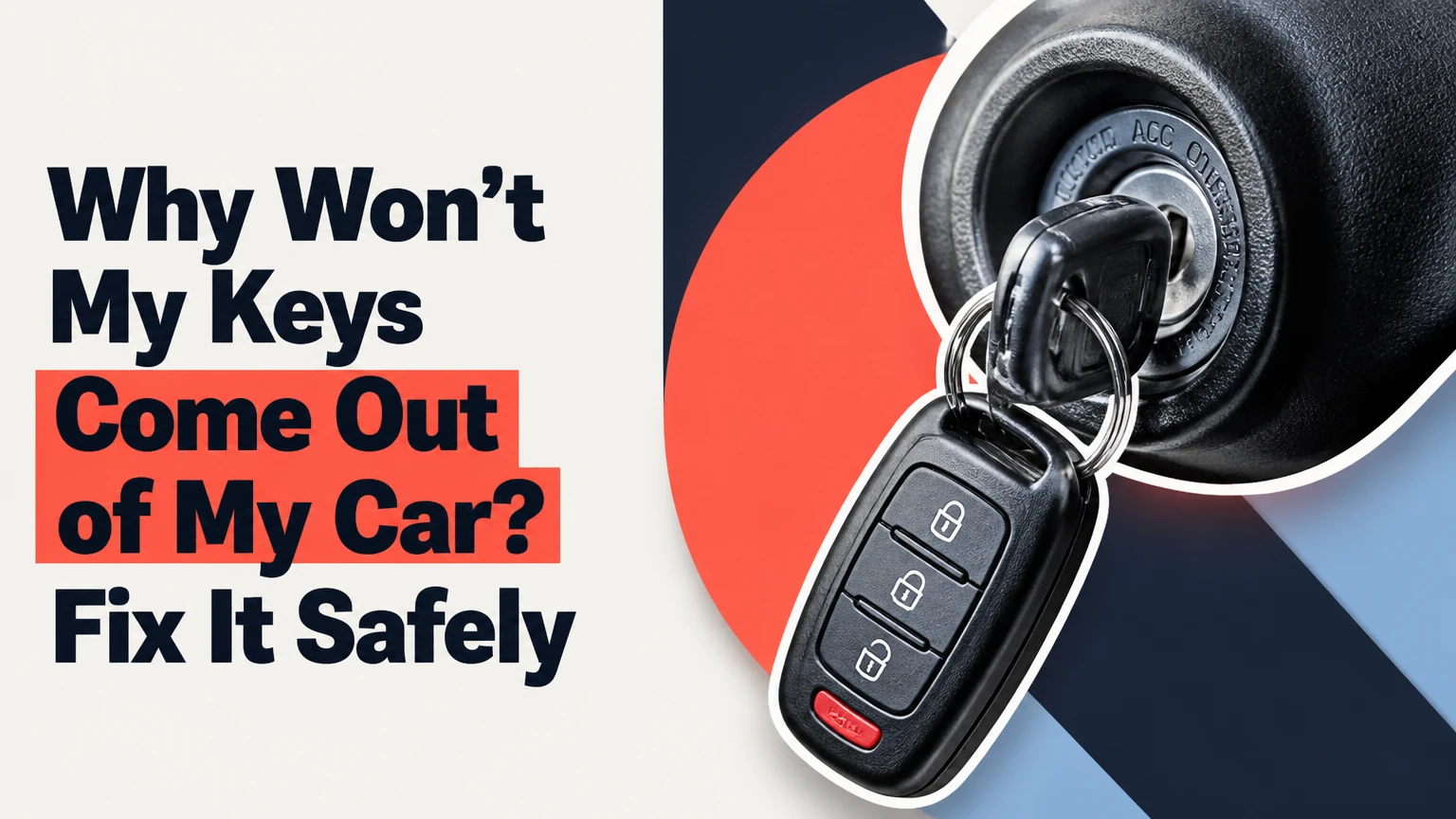
A car key usually will not come out because the ignition interlock has not detected the required safe condition, most often the transmission fully in Park, the ignition in the LOCK or OFF position, or sufficient electrical power. Steering-wheel pressure, a worn key, a damaged ignition cylinder, shifter linkage, brake switch, or electronic selector can also prevent removal.
Key Facts at a Glance
An automatic vehicle normally releases its ignition key only when the ignition reaches LOCK and the transmission position is confirmed as Park.
A key that turns but will not withdraw usually indicates an interlock or final-position problem, not a completely seized lock cylinder.
A key that will not turn at all more often points to steering-lock tension, a worn key, damaged tumblers, or a failed ignition cylinder.
A dead battery can disable an electronic key-release solenoid on some vehicles, but a jump-start will not repair a broken shifter cable or lock cylinder.
Never twist the key with pliers or force the steering wheel; a snapped key usually requires extraction and may require cylinder replacement.
Typical professional repair costs range from $100-$250 for mobile locksmith attendance to $200-$450 for an ignition lock-cylinder replacement.
Why Won’t My Keys Come Out of My Car?
The most common reason keys remain trapped is that the vehicle has not completed its park-and-lock sequence. Automatic transmissions use a mechanical cable, electrical range sensor, shift-lock solenoid, or a combination of these components to confirm Park before the ignition cylinder reaches the removable-key position.
The exact design varies by make, model, and year. Older vehicles commonly use a cable between the shifter and ignition lock, while newer vehicles may use a transmission range sensor, body control module, and column or ignition solenoid. A fault anywhere in that chain can leave the key in ACC or ON even though the engine has stopped.
The key position matters. If the key is in ACC, the radio and accessories may remain powered; if it is in ON, warning lamps and control modules may drain the battery. A key that is physically stuck in the cylinder has a different diagnosis from a key that turns normally but stops before LOCK.
What must happen before a key can be removed?
The ignition must generally be in LOCK or OFF, the automatic transmission must be recognized as Park, and the steering-lock mechanism must be aligned. Some vehicles also require a functioning battery, brake-pedal signal, or ignition solenoid.
A manual-transmission vehicle usually does not use the same Park interlock because it has no Park position. The driver should select neutral, apply the parking brake, switch the ignition fully to LOCK, and follow the vehicle handbook. Do not assume a manual vehicle requires the clutch pedal for key removal.
How Does the Car-Key Interlock Work?
A car-key interlock links the ignition cylinder to the transmission selector so the key cannot be removed while the vehicle could roll. Mechanical systems use a cable or lever; electronic systems use sensors and solenoids; many vehicles combine both arrangements.
When the shifter reaches Park, a detent mechanism or range sensor reports the position. The control system then permits the ignition lock to rotate to LOCK. In a column-mounted cylinder, a locking pin may also engage the steering shaft after the key is removed.
The system is designed around prevention, not convenience. A loose shifter, misadjusted cable, failed range sensor, or weak solenoid can therefore produce a trapped key even when the engine and transmission operate normally.
Which component is most likely to be responsible?
The symptom provides the first useful separation between mechanical and electrical causes.
| Symptom | Likely component | Useful check | Typical next action |
|---|---|---|---|
| Shifter does not firmly select Park | Shift cable, bushing, or selector assembly | Gear lever feels loose or display disagrees | Mechanic diagnosis |
| Dashboard does not show P | Transmission range sensor or wiring | Compare lever position with instrument display | Scan and inspect sensor |
| Brake lights do not illuminate | Brake-light switch or fuse | Press pedal with ignition on | Test switch and fuse |
| Key will not turn from ACC | Steering lock, worn key, or cylinder tumblers | Move wheel while applying light key pressure | Locksmith or cylinder diagnosis |
| Key turns to OFF but remains trapped | Park interlock, solenoid, or lock-cylinder release | Push shifter firmly into Park | Inspect interlock |
| Battery is completely dead | Battery, terminal, fuse, or solenoid power supply | Test voltage and electrical operation | Jump-start or electrical diagnosis |
How Do You Get a Stuck Key Out Safely?
You can often release a stuck key in 2-5 minutes without tools by completing the Park check, relieving steering pressure, and returning the ignition to LOCK. The factor that most determines success is whether the key is being held by an interlock condition or by damaged metal inside the ignition cylinder.
Before you start
| Item | Typical requirement | Safety limit |
|---|---|---|
| Time | 2-5 minutes for basic checks | Stop after 10 minutes of unsuccessful gentle attempts |
| Difficulty | Low for checks, moderate for an override | Do not remove trim without the service procedure |
| Cost | $0 for inspection; $10 or less for approved lubricant | Professional help may cost $100-$450 |
| Tools | Flashlight, spare key, booster pack, vehicle manual | No pliers, drill, or heavy lubricant |
| Prerequisite | Vehicle secured on level ground | Apply the parking brake before further testing |
Step 1: Confirm Park and apply the parking brake
Push the automatic shifter firmly forward into Park while holding the brake pedal. Keep light pressure on the key and try to rotate it toward LOCK, then withdraw it without twisting force.
Check the instrument cluster. The display should show P, and the vehicle should not roll when the brake is released briefly under controlled conditions. Do not test rolling on a slope or near traffic.
You will know the step worked when the key rotates fully to LOCK and slides out with two fingers. A shifter that feels unusually loose, stops short of Park, or shows a different gear on the display suggests linkage or range-sensor trouble.
Common mistake: Pulling the shifter backward and forward aggressively can move the vehicle out of Park. Use the brake pedal and parking brake throughout.
Step 2: Relieve steering-wheel tension
Hold the key with light turning pressure toward LOCK. At the same time, pull the steering wheel firmly left, then firmly right, using the direction that allows the wheel to move slightly.
A parked vehicle can load the steering-lock pin, especially when a front tire rests against a curb. The ignition cylinder may then refuse to rotate even though the key itself is correct.
You will know the step worked when the key turns past the tight point without scraping or binding. If the wheel remains locked and the key does not respond, stop applying force because the cylinder may be worn.
Common mistake: Holding the wheel at its maximum stop while twisting the key harder can damage the key blade or cylinder wafers.
Step 3: Check battery power and terminal condition
Switch on the interior light, headlights, or dashboard. Dim lamps, rapid clicking, no display, or a clock that has reset indicate low voltage, although electrical symptoms alone do not prove the battery caused the trapped key.
A fully charged 12-volt automotive battery normally measures about 12.6 volts at rest. Around 12.2 volts indicates a substantially discharged battery, while a reading below 12.0 volts requires charging or testing rather than repeated starting attempts.
Use a booster pack or jump-start procedure specified by the vehicle manufacturer. Keep the transmission in Park, connect the leads in the stated order, and allow the vehicle’s systems time to wake up before trying the key.
You will know the battery was relevant when the gear display, warning lamps, and key-release function return after power is restored. If the key remains trapped with normal electrical operation, the battery was not the complete fault.
Common mistake: Assuming a jump-start repairs the interlock. It only restores power; it cannot reconnect a broken shifter cable or replace a failed solenoid.
Step 4: Try the spare key
Insert the spare key only if it is the correct cut and profile for the vehicle. Compare the working spare with the trapped key for rounded cuts, bent edges, cracks, or a visibly worn shoulder.
A key blade wears against the cylinder over time. The original key may still start the vehicle but fail to align the internal wafers cleanly enough for removal, particularly when the cylinder is also worn.
You will know the key was the problem when the spare rotates and withdraws normally. Replace or duplicate the key from the best available original, not from a badly worn copy.
Common mistake: Repeatedly testing several poorly cut duplicates can accelerate damage to the lock cylinder.
Step 5: Use only approved lock-cylinder lubricant
If the key feels gritty, dry, or intermittently sticky, use a very small amount of dry graphite or a manufacturer-approved lock lubricant. Follow the product label, insert the key fully, and move it gently several times.
Avoid flooding the cylinder. Conventional oily sprays can leave residue that collects dust and changes the movement of internal wafers, while some electronic cleaners may damage plastics or finishes if applied incorrectly.
You will know lubrication helped when the key movement becomes smoother immediately. Temporary improvement does not prove the cylinder is healthy; worn wafers or a damaged key still require repair.
Common mistake: Using WD-40 as a routine cure. A penetrant may help in limited situations, but it is not a universal ignition-cylinder lubricant and can create contamination problems.
Step 6: Find the model-specific manual release
Many automatic vehicles include a shift-lock override near the selector, beneath a small labeled cover, or near the steering column. The override may release the shifter, the ignition key, or both, so read the owner’s manual before inserting a tool.
A typical procedure involves switching the ignition to the stated position, applying the parking brake, removing a small cap, and pressing the release with a screwdriver or similar blunt tool. The location and sequence differ substantially between manufacturers.
Use the override only to move the vehicle or release the key as the manual permits. Do not pry the center console, probe electrical connectors, or bypass an immobilizer. An override is an emergency release, not a repair.
Common mistake: Assuming every slot labeled “Shift Lock” releases the ignition key. Some slots only permit the selector to move from Park when the battery or brake circuit has failed.
What If the Key Turns but Still Will Not Come Out?
A key that turns but will not withdraw usually has an unresolved final-position interlock. Confirm that the ignition reaches LOCK, push the shifter into Park, and check whether the dashboard displays P before investigating the cylinder itself.
Some ignition switches have several positions, including ACC, ON, START, and LOCK. The key may feel almost removed while remaining one detent short of LOCK. On certain vehicles, the key must be pushed inward before turning fully counterclockwise.
If the engine stopped with the selector between positions, or the range sensor reports an invalid signal, the release solenoid may remain energized. A brake-light fault or blown interlock fuse can create a similar result on electronically controlled systems.
A mechanic can test the Park signal, solenoid voltage, wiring continuity, and cylinder release mechanism. Do not keep cycling the key for hours because an intermittent release often becomes a complete lockout.
What If the Key Will Not Turn at All?
A key that will not turn at all points more strongly to steering-lock load, a worn or incorrect key, seized cylinder wafers, or a damaged ignition lock cylinder. Press the key inward gently, move the steering wheel in both directions, and try the spare key once.
Do not use pliers. The thin blade can twist or snap inside the cylinder, turning a diagnostic problem into a key-extraction procedure.
Cold weather can thicken contamination inside a lock cylinder or freeze moisture near the keyway. Warm the key and cylinder safely with the vehicle manufacturer’s recommended method; never use an open flame or pour boiling water into the lock.
If the key is bent, cracked, or difficult to insert, stop testing it. An automotive locksmith can often extract a damaged key and determine whether the cylinder or blade failed.
Can a Dead Battery Trap the Key?
A dead battery can trap a key when the vehicle uses an electrically controlled ignition release or shift interlock, but battery failure is not a universal explanation. Mechanical cable systems can still release the key with no battery power if the shifter and cylinder are correctly aligned.
Battery-related clues include no instrument display, no interior lighting, absent brake lights, a failed central locking system, and a selector that will not move from Park. These clues become more meaningful when the key was removable before the battery went flat.
| Electrical clue | What it suggests | First test | Repair boundary |
|---|---|---|---|
| No dash or dome light | Discharged battery or disconnected terminal | Measure battery voltage | Charge, replace, or inspect terminals |
| Dash works but no brake lights | Brake switch or fuse | Press pedal and inspect lamps | Electrical repair |
| P appears as another gear | Range sensor, cable, or wiring | Compare lever and cluster | Transmission-control diagnosis |
| Jump-start restores functions | Low-voltage interlock condition | Retry normal removal | Test battery and charging system |
| Jump-start changes nothing | Mechanical or circuit fault | Inspect fuses and release signal | Mechanic or locksmith |
Is the Key, Ignition Cylinder, or Shifter at Fault?
The key is the least expensive component to test, while a lock cylinder or shifter mechanism requires specialized diagnosis. A symptom comparison prevents unnecessary parts replacement.
| Suspected fault | Distinguishing symptom | Typical part or service cost | Typical labor or arrival time |
|---|---|---|---|
| Worn key blade | Spare key works normally | $10-$80 | 15-30 minutes |
| Ignition lock cylinder | Both keys bind or fail to turn | $200-$450 | 1-2 hours |
| Shift cable or bushing | Loose selector, incorrect gear display | $150-$400 | 1-3 hours |
| Range sensor or neutral-safety switch | Park is not recognized | $150-$500 | 1-3 hours |
| Interlock solenoid or wiring | Key release fails despite correct Park | $150-$500 | 1-3 hours |
| Battery or terminal fault | Vehicle has widespread low-voltage symptoms | $120-$300 | 30-90 minutes |
Prices are typical US independent-shop ranges, not guaranteed quotes. Vehicle access, immobilizer programming, regional labor rates, and OEM parts can change the total substantially.
Why does a worn key cause intermittent problems?
A worn key has shallower or rounded cuts that may no longer position the cylinder wafers consistently. The key can start the vehicle one day and bind the next because temperature, steering pressure, and the exact cylinder position alter the alignment.
A spare key is a valuable low-cost diagnostic. If the spare behaves identically, the cylinder, steering lock, or interlock deserves attention instead of another duplicate key.
Where Is the Manual Override on a Car?
The manual override location depends on the manufacturer and vehicle generation. Common locations include a small cover beside the automatic selector, a recessed opening near the column, or an access point identified in the owner’s manual as shift-lock release or ignition-key release.
The override often moves the selector out of Park rather than releasing the key. That distinction matters because moving a vehicle without a functioning Park signal can create a rollaway hazard.
Use the parking brake and wheel chocks if the vehicle must be moved. If the manual does not describe the release, roadside assistance or a qualified technician is safer than guessing beneath the dashboard.
Should You Call a Locksmith, Mechanic, or Dealer?
Call a mobile automotive locksmith when the key will not turn, the blade is damaged, the cylinder is suspected, or the key needs extraction or programming. Call an independent mechanic when the shifter, transmission range sensor, brake circuit, fuse, or wiring appears responsible.
A dealership is most useful when the vehicle has a complex electronic ignition, a body-control-module fault, active immobilizer programming, or a warranty requirement. The dealer is not automatically the best first call for a physically worn key cylinder.
| Service option | Best diagnosis | Typical cost | Main limitation |
|---|---|---|---|
| Mobile automotive locksmith | Key extraction, cylinder, key cutting | $100-$250 attendance; $150-$600 repair | Usually cannot repair transmission wiring |
| Independent mechanic | Cable, sensor, fuse, solenoid, BCM diagnosis | $100-$180 diagnostic fee; $150-$500 repair | May require towing or key-programming support |
| Dealership service center | OEM electronic and immobilizer faults | $150-$250 diagnostic fee; $300-$900 repair | Highest labor and programming costs |
| Roadside assistance | Jump-start, towing, basic release | $0 under some plans; $75-$120 typical | Does not provide full diagnosis |
An honest limitation matters: a locksmith is not a substitute for transmission-control diagnosis, and a dealer is not always necessary for a simple worn blade. Choose the provider based on the failed subsystem.
Can You Drive With the Key Stuck?
Do not drive the vehicle if the ignition key cannot reach the normal OFF or LOCK position, the shifter does not reliably indicate Park, or the engine remains powered after the key is removed; a hot key with a burning smell or flickering instruments also needs prompt inspection. Those conditions can cause battery drain, unintended movement, steering-lock complications, or loss of reliable shutdown.
A vehicle may be movable after a documented manual override, but that does not make it roadworthy. If the key only comes out after repeated jiggling, arrange repair before the next trip because intermittent interlock failures commonly become total failures at an inconvenient time.
Secure the vehicle with the parking brake, keep it in Park or neutral as appropriate, and do not leave it unattended with the key accessible. If the vehicle is in traffic, on a slope, or blocking a travel lane, request roadside assistance rather than continuing DIY work.
What Common Mistakes Make the Problem Worse?
The most expensive mistakes are force, incorrect lubricant, and misdiagnosis. Each can damage a component that was still recoverable.
- Forcing the key with pliers: A twisted or broken blade may require extraction, cylinder removal, and a programmed replacement.
- Spraying large quantities into the keyway: Residue can contaminate wafers and complicate later locksmith work.
- Ignoring the gear display: A shifter in Park does not guarantee that the range sensor reports Park.
- Disconnecting the battery immediately: Power loss can erase useful fault clues and may lock some electronic systems until they are reinitialized.
- Bypassing the interlock permanently: Defeating a safety system can permit key removal while the vehicle is not safely secured.
- Leaving the car unlocked: A trapped key may leave the vehicle in an accessible state, especially if the ignition remains in ACC.
The practitioner rule is simple: use light rotational pressure, one controlled variable at a time, and stop when the symptom changes from resistance to grinding, scraping, or key flex.
How Much Does a Stuck-Key Repair Cost?
A simple key replacement may cost $10-$80, while professional diagnosis and repair commonly range from $150-$500. Mobile locksmith attendance often costs $100-$250, and dealership electronic or immobilizer work can exceed $900 on some vehicles.
| Repair situation | Typical US total | Typical time | Most suitable provider |
|---|---|---|---|
| Spare key or duplicate blade | $10-$80 | 15-30 minutes | Locksmith or key service |
| Jump-start and battery test | $0-$120 | 15-30 minutes | Roadside provider |
| Shift cable or selector bushing | $150-$400 | 1-3 hours | Independent mechanic |
| Ignition cylinder replacement | $200-$450 | 1-2 hours | Locksmith or mechanic |
| Range sensor or interlock circuit | $150-$500 | 1-3 hours | Independent mechanic |
| Dealer immobilizer or BCM repair | $300-$900+ | 2-6 hours or longer | Dealership |
The quoted price should identify diagnosis, parts, labor, key programming, extraction, and towing separately. A low mobile fee may exclude the replacement cylinder or a transponder key.
What Changes for Special Situations?
What if the car uses a push-button start?
A push-button vehicle may not have a removable ignition key at all. If a mechanical emergency key or key fob is trapped in the vehicle, the issue may involve a fob slot, steering lock, electronic selector, or a dead fob battery rather than a conventional ignition cylinder.
Replace the fob battery with the specified type and use the manufacturer’s backup start location. Do not assume the small metal emergency key can start the engine; it often only operates the door lock.
What if the vehicle has a manual transmission?
A manual vehicle generally releases its key after the ignition reaches LOCK, regardless of whether first gear or reverse is selected. Apply the parking brake, select neutral before working around the vehicle, and consult the manual if the key remains trapped.
A manual car can still have a worn ignition cylinder, steering-lock problem, immobilizer fault, or damaged key. The absence of Park makes a shifter interlock diagnosis less likely, not impossible for an aftermarket system.
What if the key broke inside?
Stop turning the remaining piece and do not push it deeper. A locksmith can use extraction tools without drilling the cylinder, although a severely damaged cylinder may still need replacement.
If the broken key contains a transponder chip in its plastic head, retain every piece. The vehicle may need the original chip or a newly programmed replacement after extraction.
What if the problem happens only in freezing weather?
Freezing-weather recurrence points to moisture, contamination, battery weakness, or lubricant unsuitable for low temperatures. Warm the lock safely, inspect the key, and test battery voltage rather than forcing the cylinder.
Repeated freezing means the underlying moisture or wear remains. A locksmith can clean and inspect the cylinder, while a mechanic can test low-voltage behavior and charging performance.
When Should You Stop Troubleshooting?
Stop DIY troubleshooting when the key bends, the cylinder grinds, the vehicle cannot confirm Park, the override procedure is unclear, or the key remains trapped after the spare-key and steering checks. A damaged immobilizer, range sensor, or cylinder needs test equipment and model-specific repair information.
Request a locksmith for key and cylinder symptoms. Request a mechanic for gear-position, brake-light, fuse, wiring, or selector symptoms. Request a tow when the vehicle cannot be secured in Park, remains powered, or sits in an unsafe location.
Frequently Asked Questions
Can a bad brake-light switch keep the key in the ignition?
Yes, some vehicles use the brake-pedal signal as part of the shift-lock and ignition-release logic. Check whether the brake lights illuminate when the pedal is pressed. If they do not, inspect the brake-light fuse and switch, but do not assume the brake switch is responsible on every model.
Will disconnecting the battery release a stuck car key?
Usually no, and disconnecting the battery can remove diagnostic clues or trigger electronic reinitialization requirements. A dead battery may prevent an electronic release solenoid from operating, so restoring power is safer than disconnecting it. Follow the vehicle manual before removing either battery terminal.
Can a locksmith remove a key stuck in the ignition?
An automotive locksmith can usually extract a broken key, test the key blade, cut a replacement, and repair or replace many ignition cylinders. The locksmith may not diagnose a transmission range sensor, shifter cable, BCM, or damaged wiring, which requires a mechanic or dealer.
Is a stuck key always caused by the ignition cylinder?
No. Park recognition, steering-wheel tension, low voltage, a brake switch, a worn key, and a shift cable can all prevent removal. A cylinder becomes more likely when both keys bind, the key will not turn in either direction, or the keyway feels gritty and mechanically damaged.
How long can I leave the key stuck?
Leave the key stuck only long enough to secure the vehicle and arrange help. If the ignition remains in ACC or ON, the battery may discharge within hours, although the exact time depends on the vehicle and electrical load. Lock the vehicle safely and avoid leaving it unattended.
The Bottom Line
Why won’t my keys come out of my car? The vehicle usually has not confirmed Park, the ignition has not reached LOCK, or an interlock component has failed. Try the Park check, steering-wheel release, battery inspection, and spare key in that order, using only gentle pressure.
If those checks fail, do not force the key or permanently bypass the safety mechanism. A locksmith is usually the right first call for a key or ignition-cylinder problem, while a mechanic is better for shifter, sensor, brake-circuit, fuse, and wiring faults.