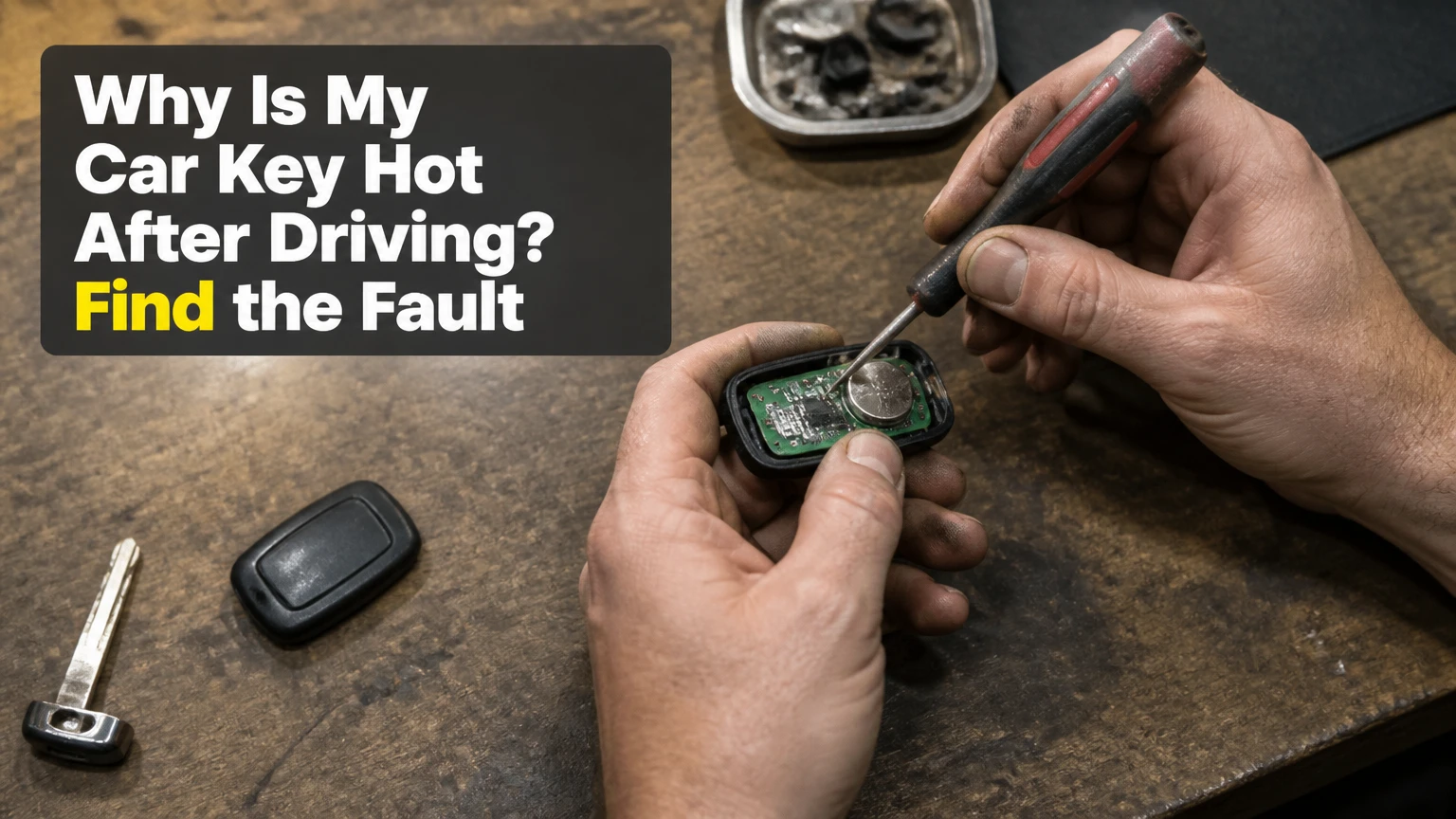
A car key that becomes hot after driving is usually receiving heat from the ignition lock area, and the most concerning source is an overheated ignition switch, terminal, or wire caused by resistance or excess current. Mild warmth can also come from the steering column, heater ducts, sunlight, or a vehicle-specific interlock, but a key that is painful, smells burnt, or accompanies flickering or stalling needs prompt inspection.
Key Facts at a Glance
- A hot car key is a symptom, not a diagnosis; the ignition switch, wiring, lock cylinder, and nearby cabin components can all be involved.
- Corroded or loose electrical contacts create heat because electrical power dissipates as (P=I^2R), so heat rises rapidly when current and resistance increase.
- A faint burning-plastic smell, melted trim, smoke, flickering instruments, radio resets, or engine stalling makes continued driving unsafe.
- A new metal key may correct mechanical binding, but it cannot repair an overheated ignition switch or damaged wiring.
- The key interlock mechanism does not behave identically across vehicles; mild warmth is not automatically a factory characteristic.
- Do not increase fuse size, spray oily lubricant into the lock, or probe steering-column wiring without the vehicle’s wiring diagram and appropriate safety procedures.
Why Does a Car Key Get Hot After Driving?
The ignition switch is the leading electrical suspect when heat is localized around the keyhole and increases during a drive. The mechanical lock cylinder turns the key, while a separate electrical switch behind it routes battery power to ignition, engine-management, instrument, accessory, and starter circuits. A loose contact or overheated terminal can transfer heat through the lock housing to the key.
The key itself normally carries no meaningful operating current in a conventional keyed ignition. That distinction matters. The metal blade can conduct heat from the lock cylinder, but it is not generally acting as a direct electrical heat sink from every high-current circuit behind the steering column.
Heat can also travel from a warm dashboard, defroster duct, steering-column structure, or sunlight-heated interior. Compare the key with the surrounding trim after the same drive. If the key is much hotter than its immediate surroundings, an ignition assembly or local wiring fault becomes more likely.
How Does Ignition-Switch Resistance Create Heat?
An ignition-switch contact produces heat when current crosses a damaged, dirty, loose, or undersized electrical connection. Joule heating follows (P=I^2R), meaning a circuit carrying 20 amperes through 0.05 ohms dissipates about 20 watts at that connection, while the same current through 0.2 ohms dissipates about 80 watts.
That calculation is an illustration, not a universal vehicle specification. Actual ignition loads differ, and modern vehicles distribute power through relays and multiple circuits. A technician should measure voltage drop and current against the manufacturer’s service information rather than rely on a generic resistance threshold.
Repeated arcing pits switch contacts and oxidizes their surfaces. Heat then weakens spring tension, increases contact resistance, and creates a feedback loop that can discolor plastic, loosen terminals, and eventually interrupt power to engine-control or fuel-system components.
Is a Warm Car Key Normal?
A slightly warm key can be normal when the steering column or cabin is warm and the key remains comfortable to hold. A key that is painful to touch, leaves a hot-metal smell, discolors surrounding plastic, or becomes progressively hotter during each trip is not normal enough to ignore.
No universal temperature limit separates safe from unsafe warmth because the key’s starting temperature, cabin temperature, metal composition, drive duration, and vehicle design all affect perception. A useful practical comparison is whether the key feels merely warmer than room temperature or hot enough to withdraw immediately.
Normal Warmth Versus a Fault
| Observation | More consistent with normal heat | More consistent with a fault |
|---|---|---|
| Key temperature | Comfortable after 30-60 minutes | Painful or difficult to hold |
| Nearby trim | Similar warmth across column | Heat concentrated at key barrel |
| Odor | No odor | Plastic, ozone, rubber, or electrical smell |
| Electrical behavior | Stable radio and instruments | Flicker, resets, warning lights |
| Engine operation | No stumble or stall | Hesitation, shutdown, difficult restart |
| Progression | Same mild warmth each trip | Increasing heat over days or weeks |
A vehicle-specific design can produce some warmth near the lock cylinder, but the claim that a key interlock solenoid routinely makes every key hot is too broad. The interlock’s location, duty cycle, and power arrangement vary by manufacturer and model year. Service documentation is the correct authority for a model-specific “normal” condition.
Can a Hot Key Cause a Fire or Engine Stall?
A severely hot key can indicate a connection hot enough to melt insulation or plastic, and an ignition-switch fault can interrupt power while the vehicle is moving. The immediate risks are electrical fire, loss of engine power, disabled accessories, and a steering-column repair that becomes more extensive after continued overheating.
Stop driving and switch the engine off as soon as practical if you notice smoke, melting, a burning smell, visible discoloration, sparks, repeated stalling, or a key too hot to hold. Park outside away from structures when possible, keep a safe distance if smoke continues, and use roadside assistance rather than repeatedly restarting the vehicle.
A hot key alone does not prove that a fire is imminent. Heat without odor or electrical symptoms may come from the cabin environment, but the cause still deserves inspection because intermittent ignition faults can worsen under vibration and load.
When Is Towing the Safer Choice?
| Symptom during or after driving | Recommended action | Reason |
|---|---|---|
| Mild warmth, no odor, stable operation | Book a shop inspection soon | Possible heat transfer or early wear |
| Key too hot to hold | Stop extended driving | Localized overheating may be progressing |
| Burning odor or melted trim | Shut down and tow | Insulation and housing may be damaged |
| Dashboard flicker or radio resets | Avoid highway driving and arrange diagnosis | Ignition power may be intermittent |
| Engine stalls or cuts out | Tow rather than continue | Loss of propulsion can recur in traffic |
| Smoke or visible arcing | Move away and request emergency assistance | Fire risk cannot be assessed safely roadside |
Which Components Can Make the Key Hot?
The ignition switch, switch connector, mechanical lock cylinder, key interlock, damaged wiring, and nearby HVAC or dashboard parts can all explain a warm key. Location, associated symptoms, and whether the heat follows electrical load help separate those possibilities more effectively than replacing the key immediately.
Electrical Ignition Switch or Connector
The electrical switch sits behind the lock cylinder and may contain contacts for accessory, run, and start positions. A worn switch can overheat internally, while a loose connector terminal can become the hottest point even when the switch itself is serviceable.
A connector fault deserves special attention because replacing only the switch may leave a heat-damaged terminal in place. Brown plastic, softened insulation, green corrosion, or a terminal that fits loosely confirms the need for wiring repair or connector replacement.
Mechanical Lock Cylinder and Key
A worn key blade, damaged wafer, contamination, or a heavy key ring can make the lock cylinder bind. Mechanical friction can create some warmth, but severe heat usually requires an additional electrical or environmental source.
A duplicate key cut from the original may test the mechanical theory. If the spare key turns more smoothly but both keys become hot, the cylinder may be worn while the heat source remains electrical or environmental. Key smoothness alone does not clear the switch.
Key Interlock Mechanism
A shift-lock or key-retention interlock prevents key removal unless the transmission is in Park, depending on vehicle design. The mechanism may include a solenoid near the steering lock, but its electrical duty and physical proximity differ substantially among vehicles.
Do not assume a particular Honda, Toyota, Ford, General Motors, or Volkswagen model has the same arrangement as another model. A factory wiring diagram and technical service information can identify whether the interlock is energized while driving and whether it shares the affected housing.
Heat From HVAC, Sunlight, or the Dashboard
Cabin heat can warm the steering column and key without an electrical ignition failure. Defroster use, a blocked duct, prolonged windshield sunlight, or a hot dashboard becomes more plausible when the surrounding trim is equally warm and no electrical symptoms occur.
This explanation is less persuasive when the key becomes dramatically hotter than the column or when heat is concentrated at the lock barrel. Compare the key after driving with the heater off and again with the same route and climate settings, but do not treat that experiment as a substitute for a safety inspection.
How Should You Check the Problem Safely?
A safe home check records the pattern without opening the steering column or disturbing live wiring. Compare cold and hot conditions, inspect for odor and discoloration, test a spare key if available, and stop immediately when electrical symptoms or smoke appear.
Step 1: Record the Temperature Pattern
Before starting a cold vehicle, note whether the key and column are at the same temperature. After a normal drive, switch off the engine, remove the key carefully, and compare the key, lock bezel, column trim, and lower dashboard.
You will know the observation is useful when the heat location is clear. A hot key with cool surrounding trim points toward the lock assembly; uniformly warm trim points more strongly toward cabin or column heat.
Step 2: Check Electrical Symptoms
Write down any flickering instrument illumination, radio reboot, accessory interruption, warning-light activity, difficult starting, or engine stumble. Notice whether symptoms appear when the blower motor, headlights, rear defogger, or aftermarket equipment is operating.
Do not wiggle the key while driving. If a technician performs a gentle stationary movement check, the vehicle should be in Park with the parking brake applied, and the engine should be stopped if movement could affect key position.
Step 3: Inspect Without Removing Trim
With the engine off and the key removed, look for melted plastic, brown connector areas, smoke residue, or an electrical odor around accessible trim. Do not insert tools, spray cleaner into unknown electrical openings, or remove airbag-related steering-column components without the correct procedure.
You will know the inspection has found a priority issue when plastic is soft, discolored, or visibly deformed. That condition calls for diagnosis before further driving.
Step 4: Ask for a Voltage-Drop Test
A technician can measure voltage drop across the ignition-switch contacts and connector while the relevant circuits are loaded. The acceptable value depends on the vehicle’s service specification, circuit design, and test points, so a generic 0.2-volt rule cannot confirm every switch failure.
The test should include the main feed, ignition outputs, connector terminals, grounds, and accessory circuits where appropriate. Measuring resistance with the vehicle off may miss a fault that appears only under operating current.
What Should a Technician Test?
A complete diagnosis identifies the hottest component under load, verifies circuit current, checks voltage drop, and inspects heat-damaged terminals. The technician should also confirm whether an accessory installation, interlock circuit, or HVAC source explains the temperature before recommending parts.
Useful diagnostic questions include:
- Is heat concentrated in the switch, connector, lock cylinder, or surrounding trim?
- Does the problem occur with headlights, blower, rear defogger, or accessories switched on?
- Has an amplifier, remote starter, dash camera, heated seat, or auxiliary light been added?
- Are ignition-feed fuses correctly rated and securely seated?
- Does the engine lose power or do instruments reset?
- Does the vehicle have a recall or technical bulletin involving the ignition switch?
- Is the key difficult to turn, remove, or return from the Start position?
- Does the connector show corrosion, looseness, melted insulation, or heat discoloration?
A circuit can overheat without immediately blowing its fuse. A fuse protects wiring against excessive current over time; it does not guarantee that every switch contact or poorly made splice remains cool under its intended load.
Can Aftermarket Accessories Overheat the Ignition Circuit?
Aftermarket accessories can overheat an ignition circuit when installers draw high current through an ignition-switched wire instead of using that wire only as a relay trigger. Amplifiers, heated seats, auxiliary lamps, remote starters, inverters, and poorly installed dash cameras are common areas to investigate.
The correct architecture uses a fused battery feed sized for the accessory, an appropriately rated relay, and an ignition signal that carries only the relay’s control current. The accessory fuse must protect the new wire, while the factory ignition fuse must remain at its specified rating.
| Accessory or modification | Typical electrical concern | Correct diagnostic direction |
|---|---|---|
| Audio amplifier | 20-100+ amp battery feed incorrectly tapped | Inspect dedicated fused cable and relay |
| Heated seat kit | 8-15 amp circuit per seat, model-dependent | Verify separate fused supply |
| Auxiliary lighting | 5-20 amp load, poor switch wiring | Check relay, grounds, and wire gauge |
| Remote starter | Multiple ignition outputs and bypass module | Inspect harness splices and programming |
| Dash camera | Usually under 1 amp, bad hardwire tap possible | Check fuse tap position and insulation |
| Power inverter | 10-40+ amp load depending on wattage | Verify direct fused supply, not switch output |
Never install a larger fuse to stop repeated fuse failures. The higher fuse can allow the wire, terminal, or switch to overheat before protection operates.
Does a New Key Fix a Hot Ignition?
A new key fixes a hot-key problem only when a worn or damaged blade causes lock-cylinder binding and the heat is mechanical. A replacement key cannot cool a high-resistance ignition switch, repair a melted connector, or correct an accessory that overloads the ignition feed.
A locksmith can compare the original key with the lock cylinder, decode the factory cut, and determine whether the blade is excessively worn. Transponder programming may still be required for the engine immobilizer, even when the mechanical blade is cut correctly.
Avoid oil-based sprays such as general-purpose water-displacing lubricant in the cylinder. Use only a product specified for automotive lock cylinders, and ask a locksmith before applying graphite or dry-film lubricant because some modern cylinders and manufacturer procedures call for different materials.
Which Repair Is Usually Required?
The required repair depends on the hottest location: an electrical switch may need replacement, a connector may need terminal repair, a lock cylinder may need service, and an accessory installation may need complete rewiring. Replacing the entire ignition lock assembly is not automatically necessary.
| Diagnosed fault | Typical US parts cost | Typical labor time | Common total range |
|---|---|---|---|
| Electrical ignition switch | $30-$180 | 1-3 hours | $150-$500 |
| Heat-damaged switch connector | $20-$120 | 1-3 hours | $150-$450 |
| Mechanical lock-cylinder service | $80-$250 | 1-3 hours | $180-$600 |
| New coded key or transponder key | $40-$250 | 15-60 minutes | $60-$350 |
| Accessory wiring correction | $50-$300 | 1-4 hours | $150-$700 |
| Dealer module and key programming | $150-$800+ | 2-5 hours | $300-$1,300+ |
These are typical planning ranges for the United States, not quotes. Luxury vehicles, immobilizer integration, seized lock cylinders, damaged steering-column trim, and dealership-only programming can increase the bill.
Electrical Switch Versus Lock Cylinder
| Feature | Electrical switch fault | Lock-cylinder fault |
|---|---|---|
| Key turning effort | Often normal initially | Stiff, sticky, or inconsistent |
| Electrical symptoms | Flicker, resets, stalling | Usually absent |
| Heat location | Switch or connector behind barrel | Barrel and key blade |
| New key result | Usually no change | May improve operation |
| Typical repair | Switch or terminal replacement | Cylinder repair or replacement |
| Immobilizer effect | Model-dependent | Key coding may be required |
A skilled technician may replace only the electrical switch module and preserve the original lock cylinder and keys. That approach reduces coding work, but it is appropriate only when testing proves the mechanical cylinder is sound and no heat damage extends into the housing.
What Mistakes Make the Problem Worse?
The most damaging responses are continued highway driving, oversized fuses, heavy keychains, and unverified lubricants. Each action can hide symptoms, increase mechanical wear, or allow a small electrical fault to damage a larger harness.
- Driving until the key becomes unbearable: Heat can progress from intermittent resistance to melted insulation. Arrange diagnosis before long trips.
- Installing a larger fuse: The fuse no longer protects the original circuit design. Restore the specified rating and investigate the underlying overload.
- Hanging a heavy keychain: Constant downward force accelerates wear in the cylinder and can worsen key alignment. Use a lightweight ring.
- Spraying general-purpose oil into the lock: Oil can collect grit and interfere with wafers. Follow the lock manufacturer’s lubrication procedure.
- Replacing the key first without testing: A new blade addresses wear, not electrical resistance. Compare key operation while investigating the switch and connector.
- Removing steering-column trim casually: Airbag wiring and immobilizer components may be nearby. Use the service manual or leave access work to a qualified technician.
One practitioner rule is especially useful: if a connector is hot enough to discolor its plastic, replacing only the switch is incomplete until the terminal tension and wire insulation are checked.
What If the Car Uses Push-Button Start?
A push-button vehicle can develop a similar heat problem even without a metal ignition key, but the likely components change. Investigate the start-button module, smart-key receiver, steering-lock actuator, ignition relays, wiring, and nearby HVAC heat rather than assuming a conventional lock-cylinder failure.
A warm key fob after driving may result from sunlight, a heated console, a continuously active button, repeated communication attempts, or a failing internal battery. Key-fob warmth is not equivalent to a hot metal ignition key and should be evaluated by location and electrical symptoms.
Do not place a key fob on a hot dashboard or near a wireless charging pad while diagnosing temperature. Compare the fob with a spare and check whether the vehicle reports a low-battery or key-detection warning.
How Can You Prepare for a Repair Visit?
Bring the make, model, year, engine, key type, accessory list, and a written symptom pattern to the repair shop. The most useful details are drive duration, outside temperature, heater settings, electrical loads switched on, maximum perceived heat, odor, and any dashboard or engine symptoms.
Photographs of melted trim or discoloration taken after the vehicle cools can preserve evidence that disappears when the area is cleaned. Do not deliberately recreate smoke or overload the circuit to make the fault easier to find.
Ask the technician to identify the heat source before authorizing parts. Request the measured voltage drop, the affected circuit, connector condition, and whether the original fuse rating and accessory wiring match manufacturer requirements.
Frequently Asked Questions
Can cold weather make a car key feel hot after driving?
Cold weather does not normally generate ignition-switch heat, but it increases contrast between a warm key and cold fingers. Cabin heating, defroster airflow, and sunlight can also warm the steering column. If the key is painful, smells electrical, or is much hotter than nearby trim, arrange an inspection regardless of outside temperature.
Can a loose battery terminal heat the ignition key?
A loose battery terminal usually causes starting problems, flickering, or charging faults rather than directly heating the key. High resistance at the battery, ground, or ignition feed can create heat elsewhere in the circuit, however. A technician should inspect battery connections and grounds when voltage-drop testing the ignition system.
How long can I drive with a warm ignition key?
There is no reliable safe mileage for a warm ignition key because temperature does not identify the failing component. Mild warmth with no odor or electrical symptoms warrants prompt scheduling, while painful heat, melting, flicker, or stalling warrants stopping and towing. Avoid highway travel until the cause is known.
Can a heavy keychain cause the ignition switch to fail?
A heavy keychain can accelerate mechanical wear in the lock cylinder and place leverage on the key, especially over years of vibration. It usually does not create high electrical current by itself. Removing the weight is sensible preventive maintenance, but it will not reverse heat damage already present in the switch or connector.
Should I disconnect the battery before inspecting the ignition?
Disconnecting the battery can reduce electrical risk during authorized switch or wiring work, but modern vehicles may require radio codes, memory retention, or airbag precautions afterward. Follow the vehicle service manual. Do not disconnect or probe steering-column wiring casually, particularly where yellow airbag connectors or immobilizer modules are present.
Is a hot key covered by a vehicle recall?
Some vehicles have had ignition-switch or wiring recalls, but coverage depends on the exact make, model, year, market, and vehicle identification number. Check the manufacturer’s recall database or the National Highway Traffic Safety Administration database in the United States. A recall check does not replace an immediate safety response to smoke or stalling.
The Bottom Line
Why is my car key hot after driving? The answer is usually heat transferred from the ignition area, with an overheated switch, connector, or overloaded circuit requiring the most urgent attention. Mild warmth can come from cabin heat or a vehicle-specific mechanism, but painful heat, burning odor, melted trim, flickering electronics, or stalling means stop driving and arrange a tow. A technician should locate the heat source, perform a load-based voltage-drop test, inspect terminals and wiring, and verify aftermarket equipment before replacing the key or lock cylinder.