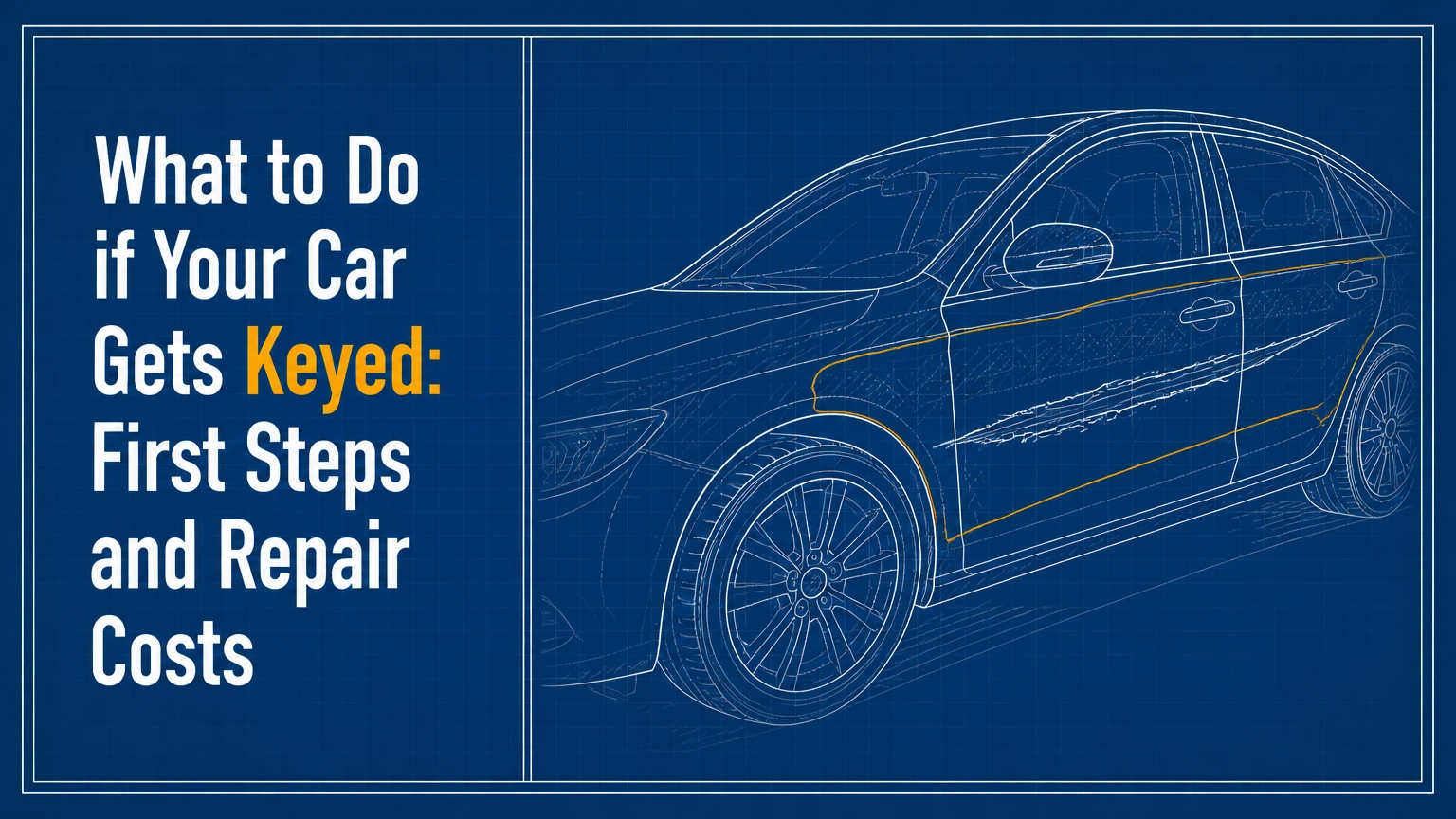
If your car gets keyed, document the damage before cleaning it, report suspected vandalism, preserve nearby camera footage, and contact your insurer before authorizing repairs. A clear-coat mark may need polishing, while a scratch through the color coat, primer, or metal requires touch-up protection or professional refinishing. The scratch depth determines urgency, cost, and repair method.
Key Facts at a Glance
- A keyed-car scratch is intentional paint or body damage caused by a sharp object such as a key, coin, or knife.
- A fingernail catching in the groove suggests the scratch may extend beyond the clear coat, but the test cannot identify the exact layer.
- Comprehensive insurance commonly covers vandalism in the United States, subject to the policy’s deductible and exclusions.
- Raw steel should receive prompt temporary protection, but ordinary household wax is not a substitute for proper corrosion control.
- Typical repair prices range from $20-$50 for light DIY polishing to $500-$1,500 for professional repainting of one damaged panel.
- Do not wet-sand, polish, or apply touch-up paint until photographs, video evidence, and insurance decisions are complete.
What Does It Mean When a Car Gets Keyed?
A keyed car has deliberate linear damage made with a hard, sharp object. The mark can cut through the clear coat, colored base coat, primer, and, in severe cases, the steel or aluminum body panel.
Modern automotive paint is a layered system. The clear coat provides gloss and ultraviolet protection; the base coat supplies color; primer promotes adhesion and corrosion resistance; and the body panel provides the substrate. A scratch that removes only clear coat is cosmetic and often repairable by machine polishing. A scratch exposing primer or metal needs material replacement, not polishing alone.
Not every long mark is keying. A parking-bay scrape can leave paint transfer, while a branch can create irregular surface damage. Parallel, narrow lines at a consistent height are more consistent with an intentional object, but photographs cannot prove who caused the damage.
How Deep Is the Scratch?
Scratch depth determines whether the correct treatment is polishing, touch-up, spot repair, or panel repainting. Inspect the mark in daylight after photographing it, then wash only the surrounding surface with automotive shampoo if dirt prevents a reliable view.
Use three checks:
- Run a clean fingernail lightly across the groove. No catch often indicates clear-coat damage, although a deep groove with rounded edges can still fool the test.
- Inspect the color inside the line. A body-color line may be a clear-coat scratch; white, gray, beige, or dark primer indicates deeper penetration.
- Identify the panel material. Bare steel can corrode. Aluminum resists ordinary red rust but can oxidize and lose paint adhesion. Plastic bumper covers cannot rust, though exposed plastic still needs sealing.
Do not scrape the groove with a blade or abrasive tool to “confirm” the depth. That converts an inspection problem into additional damage.
| Visible condition | Likely affected layer | Immediate response | Typical repair |
|---|---|---|---|
| Gloss reduced, no fingernail catch | Clear coat | Photograph and keep dry | Polishing or paint correction |
| Fingernail catches, body color remains | Clear coat, possibly base coat | Avoid aggressive compound | Professional correction or spot repair |
| Gray, white, or dark primer visible | Base coat and primer | Seal temporarily if exposed | Primer, color coat, and clear coat |
| Shiny silver or orange-brown steel visible | Bare metal, possibly corrosion | Keep dry and protect promptly | Corrosion treatment and repainting |
| Black plastic visible on bumper | Paint removed from plastic | Protect from contamination | Plastic preparation and refinishing |
The fingernail test is a screening method, not a thickness measurement. Factory clear-coat thickness varies by vehicle, panel, repair history, and paint system, so a professional paint-thickness gauge gives better evidence when resale value matters.
What Should You Do First if Your Car Gets Keyed?
The first priority is preserving evidence, not making the scratch look better. Complete the documentation and reporting steps before washing, polishing, touching up, or moving loose objects near the vehicle.
Step 1: Document the Damage and Scene
Take wide photographs showing the vehicle, parking position, nearby signs, adjacent cars, and the surrounding property. Then take close images of each scratch with a ruler or coin for scale, plus angled photographs that show depth and reflected light.
Record the date, approximate discovery time, exact location, and whether the vehicle was locked. Photograph unrelated damage, broken items, fingerprints, or debris without touching them. Keep the original files because editing or compressing images can remove metadata useful to an insurer or investigator.
You will know documentation is adequate when a person who was not present can identify the vehicle, location, number of damaged panels, and approximate severity from the files alone. A common mistake is taking only close-ups. Close-ups show the mark but not the scene.
Step 2: Report Suspected Vandalism
Call the local police or sheriff’s department through its non-emergency channel unless the vandal is present, the incident is unfolding, or anyone faces an immediate threat. Request the incident or report number and ask how to submit photographs or additional evidence.
Give the responding agency the location, discovery time, estimated damage, suspected sequence of events, and names of possible witnesses. Do not accuse a neighbor, former partner, or another driver without evidence. An unsupported accusation can create a separate dispute and does not strengthen an insurance claim.
Police reports are not always required for coverage. Many insurers accept a claim without one, while some policies, lenders, or local procedures may require documentation for vandalism. The report creates a contemporaneous record, but it does not guarantee an investigation or payment.
Step 3: Preserve Video and Witness Evidence
Look for cameras facing the parking space, building entrance, fuel pumps, driveways, and road approaches. Ask the property owner to preserve footage rather than demanding an immediate copy, because many systems overwrite recordings after several days.
Download footage from a personal dashcam, Tesla Sentry Mode, garage camera, or home security system in its original format. Save a second copy with the vehicle’s location and date in the filename. Do not crop the only copy or post faces and license plates publicly before law enforcement advises you.
Ask witnesses for their name and preferred contact method. Write down what each person personally observed, separating direct observations from assumptions.
Step 4: Check Comprehensive Insurance Before Repairing
Vandalism is commonly handled under comprehensive coverage in U.S. auto policies, not collision coverage, but the policy language and jurisdiction control. Comprehensive coverage may pay for intentional damage after the deductible; liability-only insurance generally does not pay to repair the policyholder’s own vehicle.
Ask your insurer four questions:
- Is vandalism covered under my current policy?
- What comprehensive deductible applies to this incident?
- Will a claim affect my premium or claim history in this state?
- Does the insurer require an inspection or approved repair facility?
A claim usually makes more financial sense when the repair estimate substantially exceeds the deductible and the policy consequences are acceptable. A $900 repair with a $500 deductible has a theoretical $400 benefit before any policy effects, while a $300 repair produces no payment under that deductible.
Do not assume every damaged item belongs in the same claim. Stolen contents, broken glass, or damage to personal property may follow different coverage rules. Ask the adjuster to separate vehicle damage from belongings.
Step 5: Keep Exposed Metal Dry and Temporarily Protected
Bare steel needs prompt attention because water and oxygen can begin corrosion, but no universal “4-48 hour” rust deadline applies. Humidity, salt, temperature, contamination, steel condition, and whether the panel is galvanized all change the timeline.
For a short delay, gently clean and dry the area, then use a temporary automotive paint-protection product that is compatible with the surface. Follow the product label. Avoid sealing active rust, dirt, or trapped moisture under wax, tape, or a coating.
If the scratch exposes metal and repair cannot occur within a short period, ask a body shop or insurer-approved facility what temporary protection they recommend. A temporary coating reduces exposure; it does not restore primer, color, corrosion resistance, or factory appearance.
Step 6: Get a Written Estimate Before Choosing a Fix
Obtain at least one written estimate for minor damage and two estimates for a large or multi-panel repair. Ask whether the price includes preparation, primer, color blending, clear coat, corrosion treatment, trim removal, shop materials, taxes, and calibration.
A modern vehicle may contain parking sensors, cameras, radar, molded body cladding, or adjacent panels that affect the estimate. A repair that appears to involve one door can require blending into the fender or quarter panel for a credible color transition.
Which Repair Option Fits the Damage?
Clear-coat scratches are candidates for polishing, while scratches through the color layer usually need paint application. The best choice also depends on the vehicle’s age, paint condition, lease requirements, deductible, and tolerance for a visible repair.
| Repair method | Suitable damage | Typical U.S. cost | Typical shop or DIY time |
|---|---|---|---|
| Hand polish or scratch compound | Clear coat only, under 1 panel | $10-$35 materials | 30-90 minutes |
| Dual-action paint correction | Clear coat damage across 1-3 panels | $150-$600 | 4-8 hours |
| OEM touch-up system | Small primer or metal marks | $20-$75 materials | 1-3 days with curing |
| Mobile spot repair | Localized base-coat damage | $150-$500 | 2-5 hours |
| Full panel repaint | Deep damage across one panel | $500-$1,500 | 2-5 business days |
| Multi-panel refinish | Long damage across doors and fenders | $1,200-$4,000+ | 3-10 business days |
These are typical ranges, not quotations. Metropolitan labor rates, luxury paint systems, pearl colors, hidden corrosion, and required sensor procedures can increase the final amount.
When Is DIY Polishing Appropriate?
DIY polishing is appropriate when the scratch does not catch a fingernail, no primer or metal is visible, and the surrounding clear coat is not cracked. Use a clean microfiber towel, automotive wash solution, and a product labeled for clear-coat paint. Test a small inconspicuous area first.
Polishing removes or levels a small amount of surrounding clear coat. It cannot replace missing paint. Stop if the gloss becomes hazy, the panel heats significantly, or the mark remains unchanged after a conservative pass.
A practitioner rule of thumb is simple: if the scratch still looks sharply white or gray after cleaning, compound is unlikely to restore it. More abrasion will usually enlarge the dull area rather than recreate the missing base coat.
When Does Touch-Up Paint Make Sense?
Touch-up paint makes sense for a narrow, isolated scratch that reaches primer or metal when preventing further exposure matters more than achieving an invisible finish. Match the manufacturer’s paint code, not the vehicle’s marketing color name. The code may appear on the driver-door jamb, body label, trunk area, or service documentation.
Apply only to a clean, dry surface, and follow the paint manufacturer’s instructions for primer, color, clear coat, and curing. Use several thin applications rather than one heavy bead. Touch-up paint protects the substrate but commonly leaves a raised edge or visible color difference.
Touch-up is a poor choice for a long scratch across several panels, a pearl or tri-coat finish, or a leased vehicle approaching inspection. A professional can blend color and flatten the repair more effectively.
When Is Professional Repainting Necessary?
Professional refinishing is usually necessary when bare metal, corrosion, peeling paint, multiple body lines, or a long multi-panel scratch is present. The shop may remove trim, feather the damaged edges, treat corrosion, prime the substrate, apply color, blend adjacent areas, and clear-coat the repaired section.
Paint correction preserves original paint but cannot rebuild missing layers. Panel repainting costs more, yet a proper repair can prevent recurring edge failure and reduce visible contrast on metallic or pearl finishes.
Paintless dent repair is not a substitute for paint repair. PDR can restore a dent when the paint remains intact, but it cannot replace a keyed groove or missing coating.
What Are the Main Repair Trade-Offs?
Professional spot repair is usually the lowest-cost route for localized deep damage, DIY touch-up is the lowest-cash option, and full panel refinishing offers the most consistent appearance. No option is universally best because cosmetic quality, corrosion control, time, and vehicle value point in different directions.
| Option | Appearance potential | Rust protection | Best financial condition | Main limitation |
|---|---|---|---|---|
| DIY polish | High for clear coat only | No protection for missing paint | Repair under $100 | Cannot replace paint |
| DIY touch-up | Low to moderate | Moderate after correct preparation | Low-value vehicle | Visible edge or color mismatch |
| Mobile spot repair | Moderate to high | High when substrate is prepared | Localized damage under $500 | Blend may be visible in harsh light |
| Full panel repaint | High with skilled color match | High | Valuable, leased, or newer vehicle | Highest cost and shop time |
How Does Insurance Deductible Math Affect the Decision?
Deductible math provides the first financial filter, but it is not the only one. Compare the written repair estimate with the deductible, possible premium effects, prior claims, and whether a future buyer or lease inspector will value a documented professional repair.
| Repair estimate | $250 deductible | $500 deductible | $1,000 deductible |
|---|---|---|---|
| $300 | $50 theoretical benefit | $0 | $0 |
| $750 | $500 theoretical benefit | $250 | $0 |
| $1,500 | $1,250 theoretical benefit | $1,000 | $500 |
| $3,000 | $2,750 theoretical benefit | $2,500 | $2,000 |
Coverage limits, depreciation rules, taxes, and policy conditions can change these figures. Never authorize a repair on the assumption that an insurer will reimburse a specific amount before the claim is evaluated.
What Mistakes Make a Keyed Car Worse?
Household products and aggressive sanding create many failed DIY repairs. The safest approach is to preserve evidence, identify the substrate, and stop before a cosmetic experiment removes sound factory paint.
- Using toothpaste or household polish: These products have uncontrolled abrasives and may contain additives that complicate refinishing.
- Applying nail polish or household spray paint: The resin, color, and solvent system may be incompatible with automotive coatings.
- Painting over rust or dirt: Coating contamination traps defects and allows corrosion to continue beneath the repair.
- Guessing the paint color: A vehicle’s color name may cover several formulas, and faded factory paint may not match new touch-up paint.
- Wet-sanding the surrounding panel: Removing too much clear coat creates a larger dull area and can expose the base coat.
- Washing before documenting: Water can remove debris, transfer evidence, or alter the scene photographs.
- Claiming before asking about coverage: A low-value claim can create an unfavorable financial outcome when the estimate is near the deductible.
The clearest stopping rule is professional: stop DIY work when primer or metal is exposed across a body line, when rust is visible, or when the first conservative correction pass produces haze.
Which Repair Strategy Fits Your Situation?
A leased vehicle, newer luxury vehicle, daily driver, and rental car require different decisions because inspection standards, resale value, and contractual duties differ.
Leased Vehicle
Use a reputable repair facility when the scratch reaches primer or metal, especially before a turn-in inspection. Keep the invoice, paint code information, photographs, and insurer correspondence. A casual touch-up may prevent corrosion but still fail a lease-company cosmetic inspection.
Older Daily Driver
A correctly matched touch-up system may be financially sensible when the vehicle’s market value is low and the damage is localized. Protect the substrate first, accept that the repair may remain visible, and avoid spending more than the vehicle’s likely value benefit.
Luxury, Collector, or New Vehicle
Obtain a specialist estimate and ask whether blending, paint thickness, ceramic coatings, protective film, or manufacturer-approved materials affect the repair. Preserve original paint where possible, but do not accept a visibly poor spot repair merely because it costs less.
Rental or Company Vehicle
Notify the rental company or fleet manager immediately and follow the contract’s incident procedure. Photograph the vehicle, location, and existing condition before authorizing work. Personal insurance, rental-company damage waivers, and commercial policies can allocate responsibility differently.
Repeat Vandalism
After documenting the incident, improve lighting, park under visible cameras, vary parking locations, and ask property management to preserve footage. A camera aimed at the vehicle’s approach path can be more useful than one pointed only at the parking space.
Can a Keyed Scratch Rust?
A keyed scratch can rust when it exposes ferrous steel, but rust does not begin on a fixed schedule in every vehicle or climate. Saltwater residue, high humidity, damaged galvanizing, and trapped moisture accelerate corrosion; aluminum panels and plastic bumpers behave differently.
Orange-brown discoloration indicates corrosion, not merely missing paint. Do not apply touch-up paint over active rust. A body shop should remove corrosion, assess the metal, apply compatible corrosion protection, and rebuild the paint system.
A small exposed steel mark may remain stable for a short dry period, while a salted panel in a wet climate can deteriorate quickly. The correct response is prompt inspection, not reliance on an exact hour count.
The Bottom Line
If you are deciding what to do if your car gets keyed, photograph the scene first, report suspected vandalism, preserve video, check comprehensive coverage, and keep exposed metal dry. Then choose polishing for clear-coat damage, touch-up for small deep marks, or professional refinishing for metal exposure, corrosion, long scratches, leases, and high-value vehicles.
Do not polish away evidence or sand before the insurer and repairer have assessed the damage. A written estimate compared with your deductible gives the fastest practical decision point.
Frequently Asked Questions
Will a keyed-car claim raise my insurance rates?
A vandalism claim can affect premiums, renewal decisions, or claim history, but the result depends on the insurer, state, policy, claim frequency, and loss amount, while understanding how keying is classified under state law can clarify the separate legal issue. Ask the carrier for a coverage explanation and potential rating impact before filing when the repair estimate is close to the deductible.
Can I remove a keyed scratch with WD-40?
WD-40 may temporarily mask certain surface marks or loosen contamination, but it does not restore a scratch through automotive paint. Clean the panel with automotive shampoo instead, document the damage, and use a paint-correction product only after confirming that the clear coat remains intact.
Should I wash the car after someone keys it?
Do not wash the damaged area until you have photographed the scene and checked for transferable evidence. After documentation, a gentle hand wash can remove dirt for inspection, but avoid pressure washing directly into a deep groove or using a brush that adds new scratches.
Does a keyed car need a police report for insurance?
A police report is not universally required for a vandalism claim. Some insurers request one, while others accept photographs and a recorded claim statement. Filing a non-emergency report still creates a useful contemporaneous record and may help connect the incident with nearby reports or footage.
How long can I drive with a deep paint scratch?
A vehicle can usually be driven mechanically with cosmetic paint damage, but exposed steel should be inspected and protected promptly. Driving through rain, road salt, or automatic car washes increases contamination and moisture exposure, so schedule an assessment sooner when primer or metal is visible.
Is a professional repair reported to the vehicle history?
A repair may appear in a vehicle-history report if an insurer claim, collision database entry, auction record, or service provider submits it. Paying privately does not guarantee privacy, and a paint repair alone may never be reported. Keep accurate invoices and disclose material repairs when required.