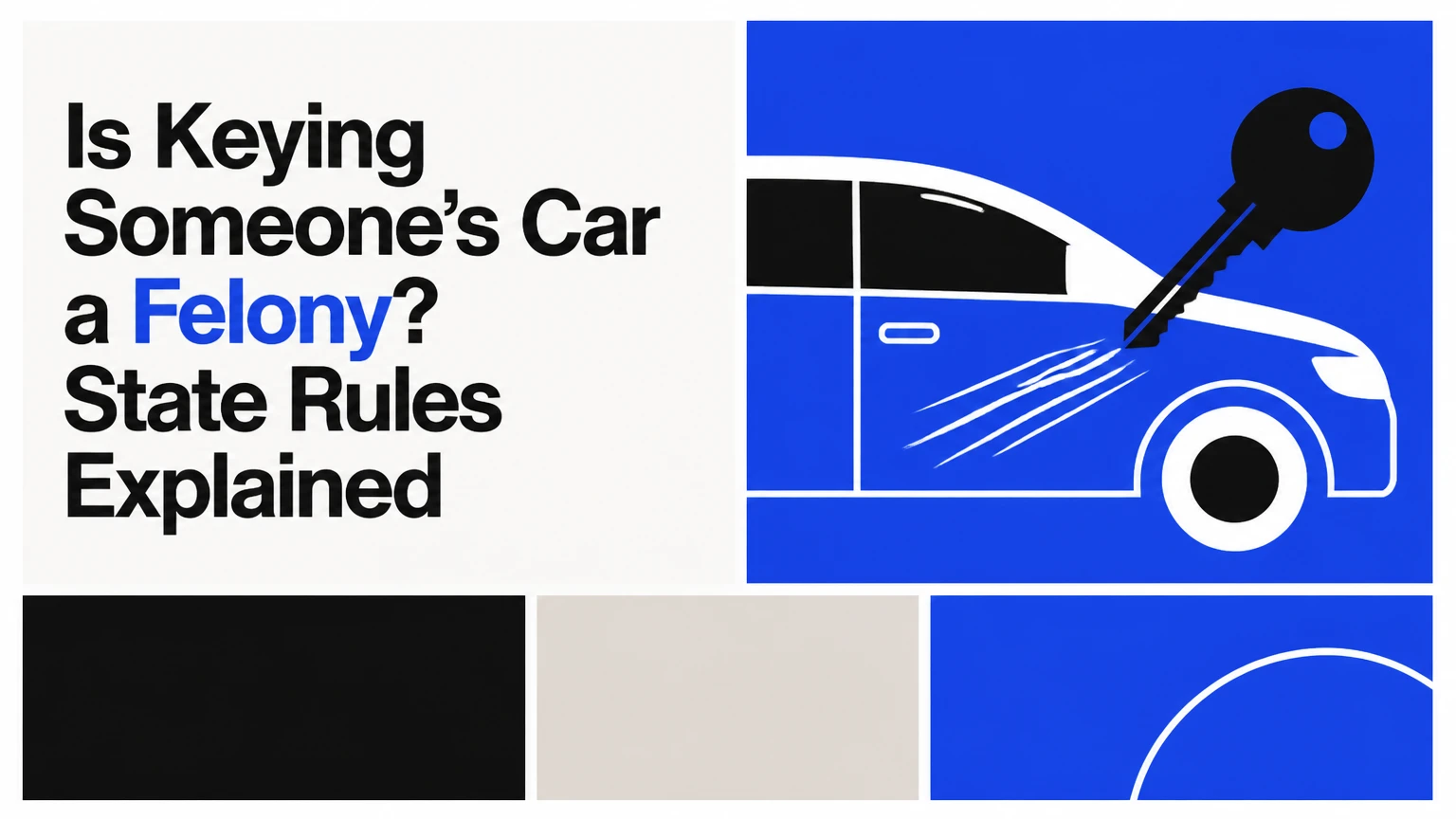
Keying someone’s car can be a felony, but the classification depends on the state, the proven repair cost, the defendant’s intent, and sometimes prior convictions or aggravating circumstances. A scratch is commonly charged as vandalism, criminal mischief, malicious mischief, or criminal damage, and a low-cost offense may remain a misdemeanor.
Key Facts
Keying a vehicle is usually prosecuted as intentional property damage, not as a standalone “keying” offense.
A felony threshold is determined by the law of the state where the vehicle was damaged.
Repair estimates, invoices, photographs, surveillance footage, and proof of intent can affect the charge.
Comprehensive auto insurance commonly covers vandalism, subject to the policy deductible and exclusions.
Paying restitution can reduce financial exposure, but payment does not automatically dismiss criminal charges.
An accidental scratch generally lacks the willful or malicious intent required for a typical vandalism conviction.
Is Keying Someone’s Car a Felony?
Keying someone’s car is potentially a felony when the legally recognized damage exceeds the applicable state threshold or when another aggravating factor raises the offense level. The same conduct may be a misdemeanor in one state and a felony in another, while borderline cases can turn on competing repair estimates.
The term “keying” describes the method, not the legal offense. Prosecutors may file criminal mischief in New York, criminal damage to property in Texas, vandalism under California law, or criminal mischief in Florida. New Jersey generally uses criminal mischief provisions for intentional property damage.
The charge usually concerns the cost of restoring the vehicle, not the emotional distress caused by the incident or the car’s full market value. A $900 scratch to one door and a $4,000 scratch requiring blending across four panels may therefore produce different classifications.
What legal elements must prosecutors prove?
A typical property-damage prosecution requires proof that the accused intentionally damaged property belonging to another person and caused legally measurable loss. California Penal Code § 594, for example, describes vandalism using the words “maliciously commits any act,” then addresses damage, defacement, and the value of the resulting loss.
The precise elements vary by jurisdiction, but prosecutors commonly need to establish:
- Property of another: The vehicle was owned, possessed, or controlled by someone other than the accused.
- Physical damage or defacement: The scratch changed the vehicle’s condition or required restoration.
- Causation: The accused’s act caused the claimed damage rather than pre-existing wear.
- Required mental state: The act was intentional, knowing, willful, reckless, or malicious, depending on the statute.
- Applicable value: The legally relevant repair or loss amount reached the statutory grading threshold.
A mistaken accusation can fail at any element. For example, a photograph showing a scratch does not identify who made it, and a repair invoice does not prove that every listed panel was damaged during the alleged incident.
How do states determine whether damage becomes a felony?
States generally classify vehicle vandalism by statutory damage bands, but the bands use different wording, exceptions, and penalty structures. The table below gives representative rules and should be checked against the current statute and charging practice in the relevant county.
| State | Representative felony trigger | Lower-level treatment | Important qualification |
|---|---|---|---|
| California | $400 or more under Penal Code § 594 | Under $400 is generally a misdemeanor | Vandalism is often a wobbler, and prior convictions can affect sentencing |
| Florida | $1,000 or more under Statutes § 806.13 | $200-$999 is generally a first-degree misdemeanor; under $200 is generally a second-degree misdemeanor | Penalties and grading can change with prior convictions or circumstances |
| New York | More than $250 under Penal Law § 145.05 | $250 or less is generally fourth-degree criminal mischief | Third-degree criminal mischief is a class E felony |
| Texas | $2,500 or more under Penal Code § 28.03 | Lower bands range from a Class C misdemeanor to a state jail felony | Damage to certain property or interruption of public services can create special rules |
| New Jersey | $500 or more under Statutes § 2C:17-3 | Under $500 is generally a disorderly persons offense | Higher damage bands can produce third- or fourth-degree charges |
The thresholds are not interchangeable. New York’s rule is commonly described as damage exceeding $250, while California uses $400 or more for its principal vandalism distinction. Florida’s statute also separates damage below $200, damage from $200 to below $1,000, and damage at or above $1,000.
Does the repair bill alone decide the charge?
The repair bill is important, but it does not automatically decide the charge. Prosecutors and defense lawyers may dispute whether the estimate includes unrelated damage, unnecessary replacement, a full repaint instead of localized repair, or improvements beyond the vehicle’s pre-loss condition.
Courts may consider reasonable restoration cost, diminution in value, or another measure specified by state law. A shop estimate prepared before disassembly may differ from a final invoice because hidden damage, paint blending, calibration, trim removal, or corrosion becomes visible later.
The strongest valuation evidence usually identifies each damaged panel, the repair method, labor hours, materials, paint system, taxes, and whether the work is necessary to return the car to its prior condition.
How much does repairing a keyed car typically cost?
A professionally repaired keyed vehicle commonly costs about $500-$1,500 for one damaged panel and $2,500-$6,000 or more when the scratch crosses several panels. Exact cost depends on paint depth, panel shape, blending requirements, vehicle construction, regional labor rates, and whether sensors or trim must be removed.
A superficial mark confined to the clear coat may qualify for wet sanding and machine polishing. A scratch through the clear coat and color layer generally requires sanding, primer or sealer, basecoat, clearcoat, curing, and blending into adjacent panels.
| Damage pattern | Typical professional cost | Typical shop time | Main cost driver |
|---|---|---|---|
| Clear-coat scuff on one panel | $150-$400 | 1-2 days | Polishing and localized refinishing |
| Deep scratch on one steel door | $500-$1,500 | 2-4 business days | Sanding, paint matching, and clearcoat |
| Scratch across two or three panels | $1,500-$3,500 | 3-6 business days | Blending and removal of trim |
| Long scratch across four or more panels | $2,500-$6,000+ | 4-10 business days | Multiple refinish operations and labor |
| Matte, tri-coat, or specialty finish | $1,500-$8,000+ | 4-12 business days | Difficult color matching and broader blending |
These figures are typical market ranges, not legal valuations or guaranteed quotations. A premium vehicle, aluminum panel, carbon-fiber component, or paint-protection film can increase the estimate substantially.
Can a victim choose any repair estimate?
A victim can obtain estimates from selected shops, but a criminal case still requires a credible connection between the claimed amount and the alleged damage. Three written estimates can expose outliers, while photographs taken before repair preserve evidence that an insurer or court can evaluate.
The victim should avoid polishing, touching up, washing aggressively, or repainting the vehicle before photographing it. A paint pen can alter the original evidence and make it harder for an adjuster to determine whether the scratch reached the primer or metal.
A prosecutor may use the lowest reasonable estimate, a typical estimate, or expert testimony, depending on local law and the disputed facts. The victim’s preferred shop does not have unlimited authority to convert every cosmetic imperfection into felony-level damage.
What evidence proves who keyed a vehicle?
Evidence linking a person to the act usually matters more than the existence of the scratch. Useful evidence includes continuous surveillance, a witness who saw the object contact the vehicle, admissions, texts describing the plan, location data, distinctive clothing, possession of a matching tool, and a reliable timeline.
Digital evidence has limits. A camera showing someone near a vehicle may establish opportunity without proving contact, and a license-plate image may identify a car without identifying the person who exited it.
Preserve original files with metadata rather than sending only compressed social-media copies. Ask nearby businesses, apartment managers, and neighbors to preserve recordings quickly because many systems overwrite footage after 7-30 days.
| Evidence type | What it can establish | Common limitation |
|---|---|---|
| Doorbell or security video | Presence, movement, possible contact | Poor angle, night glare, overwritten footage |
| Vehicle parking camera | Proximity, timing, sometimes clear conduct | Motion activation may miss the side panel |
| Text messages or posts | Motive, threat, admission, timing | Context, authentication, sarcasm, deleted content |
| Witness statement | Observation of the act or immediate aftermath | Distance, lighting, memory, bias |
| Repair documentation | Scope and cost of damage | Does not identify the perpetrator |
| Phone or location records | Possible presence at the scene | General location may not prove exact conduct |
An expert rule of thumb is to separate identity evidence, intent evidence, and damage evidence. A case may have strong photographs but weak identity proof, or strong motive but no reliable proof that the accused caused the particular scratch.
What happens after someone reports a keyed car?
After a report, law enforcement may document the scene, collect video and witness information, contact a suspect, and send the file to a prosecutor. The prosecutor then decides whether the evidence supports a citation, summons, arrest warrant, misdemeanor complaint, felony information, or no charge.
The process commonly follows this sequence:
- Incident report: The officer records the vehicle’s condition, location, ownership, and available evidence.
- Investigation: Detectives or officers obtain recordings, interview witnesses, and compare timelines.
- Damage valuation: The victim supplies estimates, invoices, photographs, and insurance information.
- Charging decision: A prosecutor applies the state’s elements and grading threshold.
- First court appearance: The accused receives release conditions, a summons, or a bail decision.
- Pretrial litigation: Lawyers challenge identity, intent, causation, valuation, and admissibility.
- Resolution: The case may end through dismissal, diversion, plea, restitution, or trial.
A felony allegation does not prove that a felony occurred. The charge can be reduced if the evidence supports a lower damage amount, accidental contact, lack of intent, unreliable identification, or pre-existing damage.
What penalties can follow a conviction?
Penalties can include incarceration, probation, fines, restitution, community service, counseling, a no-contact order, and a civil judgment. Felony exposure may also affect employment screening, professional licenses, housing applications, immigration status, and firearm rights under federal or state law.
The maximum sentence is not the expected sentence. Courts consider criminal history, damage amount, victim impact, cooperation, restitution, threats, weapons, probation status, and whether the defendant accepted responsibility.
| Consequence | Victim-side impact | Accused-side exposure |
|---|---|---|
| Insurance claim | Deductible may apply | Insurer may seek reimbursement |
| Restitution | Court-ordered payment for proven loss | Payment obligation survives sentencing |
| Criminal record | May support a protection request | Misdemeanor or felony record may affect work |
| Civil lawsuit | Additional recovery may be available | Attorney fees, judgment, and collection risk |
| Vehicle downtime | Rental or transportation expense | May become part of a lawful damage claim |
Restitution usually covers documented economic loss. It may not cover every claimed inconvenience, emotional injury, or speculative resale reduction unless a statute or civil claim permits that category.
Does insurance cover vandalism to a keyed car?
Comprehensive auto insurance commonly covers vandalism, including intentional scratching by an unknown person, subject to the policy deductible, coverage limits, exclusions, and claim procedures. Collision coverage generally addresses impact with another vehicle or object, not deliberate paint damage while the car is parked.
The Insurance Information Institute identifies vandalism as a typical comprehensive-coverage risk, but each policy controls. A $1,000 deductible can make a $900 repair claim economically pointless, while a $250 deductible may justify immediate filing.
The victim should photograph the damage, obtain a police report number, ask the insurer whether inspection must occur before repairs, and retain every estimate and receipt. The insurer may pay the shop directly, reimburse the policyholder, or pursue subrogation against an identified wrongdoer.
A reported cosmetic repair does not automatically create a structural-history entry. Resale effects depend on the reporting system, the repair record, the vehicle’s age, and whether the damage involved paint only or structural components.
What if the scratch was accidental or the vehicle had prior damage?
An accidental scratch may not satisfy a statute requiring willful or malicious conduct, although reckless-damage statutes or civil negligence claims can apply in some situations. Prior damage can also defeat or reduce the claimed amount if photographs, inspection records, or witnesses show that the mark existed earlier.
Common examples include a bag zipper brushing a door, a bicycle handle striking a quarter panel, or a key ring making contact while someone reaches into a pocket. Those facts differ from dragging a key deliberately along a parked vehicle after a dispute.
The defense should preserve messages, photographs, location records, and witness statements before memories change. The victim should preserve dated photographs, prior inspection reports, dealership records, and proof of the vehicle’s condition before the incident.
Consent also matters. A person who had permission to handle or move the vehicle may still be liable for damage, but permission can undermine an inference that the conduct was unauthorized or malicious.
Can paying for the damage end a vandalism case?
Paying repair costs can support restitution, diversion, or a negotiated reduction, but a private payment does not automatically end a criminal case. Criminal charges belong to the state, and a prosecutor or court may continue the case even after the victim receives money.
Civil compromise rules differ sharply by jurisdiction. A written agreement should identify the exact payment, repair scope, release terms, insurance rights, and whether the victim must appear or provide information. The parties should not use threats, pressure, or misleading statements to influence testimony.
A payment can create new evidence. Messages such as “I will pay if you do not report me” may be interpreted as consciousness of guilt or witness pressure, depending on context. Anyone accused of the offense should discuss communication and restitution with a defense lawyer before contacting the victim.
What should a victim do after discovering a keyed car?
A victim should preserve the scene, secure evidence, report the damage, obtain itemized estimates, and notify the insurer. The first hour matters because nearby cameras may overwrite footage and because moving or cleaning the vehicle can destroy useful detail.
- Photograph the vehicle: Capture wide views, each panel, the scratch’s endpoints, paint transfer, debris, and the surrounding location.
- Record the timeline: Write when the car was last seen undamaged, where it was parked, and who had access.
- Preserve video: Request original files from businesses, neighbors, apartment managers, and vehicle systems.
- File a police report: Use the emergency line only for immediate danger; otherwise use the non-emergency process.
- Obtain itemized estimates: Ask two or three qualified body shops to identify panel count, labor, materials, and taxes.
- Contact the insurer: Confirm comprehensive coverage, deductible, inspection rules, rental coverage, and repair authorization.
Do not confront a suspected neighbor, former partner, employee, or acquaintance alone. A property dispute can become a harassment, assault, stalking, or restraining-order matter if communications escalate.
What should an accused person do after an allegation?
An accused person should avoid discussing the facts with the victim, posting about the incident, or giving a detailed statement to police before obtaining legal advice. The person should preserve exculpatory evidence, comply with any lawful summons, and avoid deleting messages or location records.
A practical response includes:
- Save texts, emails, photographs, work records, receipts, and calendar data.
- Write a private timeline while memories remain fresh.
- Do not contact witnesses to coordinate accounts.
- Do not alter, discard, or hide clothing, tools, or devices identified in the allegation.
- Ask a criminal-defense lawyer about the charge, evidence, release conditions, and restitution.
- Follow every no-contact, stay-away, or court scheduling order.
Silence is not an admission of guilt. A lawyer can assess whether the disputed issue is identity, intent, causation, valuation, or an evidentiary defect.
Which facts create the hardest edge cases?
The hardest cases involve multiple damaged panels, unclear timing, leased or rented vehicles, competing estimates, and a suspect who had a plausible reason to be nearby. These cases require separate analysis of ownership, causation, intent, and the legally accepted valuation method.
| Edge case | Legal question | Evidence that usually matters |
|---|---|---|
| Rental vehicle | Who may claim loss and downtime? | Rental agreement, fleet records, repair invoice |
| Leased vehicle | Does the driver own the damaged interest? | Lease terms, lessor notice, inspection report |
| Pre-existing scratch | Which damage occurred during the incident? | Prior photos, delivery inspection, paint depth |
| Multiple panels | Does the entire estimate reflect the act? | Video, panel photographs, repair methodology |
| Specialty paint | Is the higher cost reasonably necessary? | Factory finish specification, shop explanation |
| False accusation | Can motive replace proof? | Alibi, access records, camera gaps, messages |
A rental company may claim administrative fees, loss of use, towing, diminished value, or contractual charges beyond the paint invoice. Whether those amounts count toward a criminal threshold depends on the statute and the court’s valuation rules.
The Bottom Line
Is keying someone’s car a felony? Yes, potentially, but no nationwide rule makes every keyed car a felony. The decisive questions are where the damage occurred, what the applicable statute requires, whether the prosecution can prove intentional conduct, and what reasonable repair or loss amount the evidence establishes.
For a victim, preserve the vehicle and digital evidence before repairing it, file a report, and coordinate with the insurer. For an accused person, avoid direct confrontation and substantive statements, preserve favorable evidence, and obtain jurisdiction-specific legal advice quickly. A local criminal-defense or property-damage lawyer can apply the current statute to the actual estimate and facts.
Frequently Asked Questions
Is keying a car considered vandalism everywhere?
Keying a car is commonly treated as vandalism or criminal mischief, but statutory labels differ. California uses vandalism, New York uses criminal mischief, Texas uses criminal mischief or criminal-damage provisions, and Florida uses criminal mischief. The label matters less than the elements, grading threshold, and required mental state in the charging jurisdiction.
Can a person be charged if the car owner never saw the damage happen?
Yes. Direct eyewitness testimony is not required if other admissible evidence establishes identity and causation. Surveillance footage, admissions, digital messages, forensic paint evidence, witness observations before and after the event, and a reliable timeline can collectively support a charge, although proximity alone may be insufficient.
Does a police report guarantee an arrest?
No. A police report documents the allegation and may begin an investigation, but officers and prosecutors still assess probable cause, evidence quality, jurisdiction, and available resources. A case may result in an interview, citation, summons, arrest warrant, referral for prosecution, diversion, or no charge.
Can a victim recover a deductible from the person who caused the damage?
A victim may be able to seek the deductible as part of restitution or a civil claim when the defendant is identified and legally responsible. The victim should keep the declarations page, payment record, repair invoice, and insurer correspondence because recovery depends on state law and the final economic loss.
Does keying a car create a criminal record even if the charge is reduced?
A reduced charge can still create a record, although diversion, dismissal, expungement, sealing, or deferred adjudication may change what appears in different background checks. The result depends on the jurisdiction, disposition, eligibility rules, and whether the person completed court conditions.
What if the repair estimate crosses the felony threshold but the final bill is lower?
The result depends on the state’s valuation rule and the stage of the case. An estimate may support an initial charge, while a final invoice, expert testimony, or competing estimate may affect plea negotiations, sentencing, or proof at trial. The defense can challenge unrelated or unnecessary work.