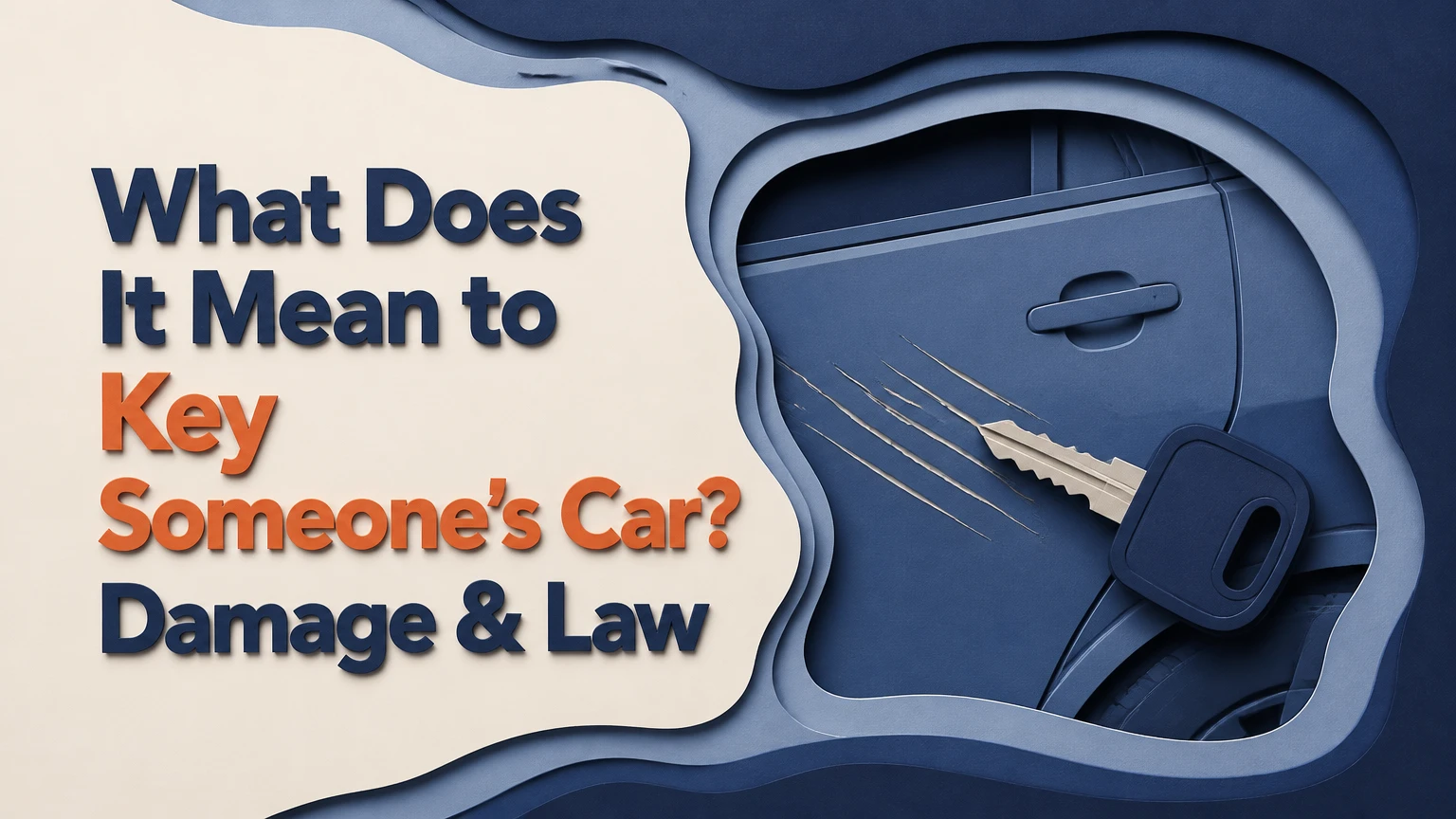
Keying someone’s car means intentionally scratching the vehicle with a key or another hard, sharp object, usually by dragging it across painted body panels. The act is generally treated as deliberate property damage or vandalism, although the exact criminal charge, civil liability, and penalty depend on the jurisdiction, repair cost, and available evidence.
Key Facts at a Glance
- Car keying is intentional damage, not an ordinary accidental scratch.
- A keyed scratch may cut through the clear coat, colored base coat, primer, and sometimes the metal panel.
- The legal label may be vandalism, criminal mischief, malicious mischief, or property damage.
- A fingernail test can indicate depth, but it cannot reliably identify the object or perpetrator.
- A typical professional repair ranges from about $150 for a minor spot repair to more than $4,000 for damage across several panels.
- Comprehensive auto insurance often covers vandalism, subject to the policy’s deductible and exclusions.
What Does It Mean to Key Someone’s Car?
To key someone’s car means to deliberately score or gouge the exterior paint with a key, key-like object, knife, jewelry, or similarly hard item. The scratch commonly appears as a long, narrow line on a door, fender, hood, quarter panel, or several connected panels.
The phrase describes both the physical act and the intent behind it. A branch scraping a door in a parking lot may create similar marks, but it is not normally called keying unless evidence indicates a person intentionally caused the damage. Keying is therefore different from an accidental scrape, road debris, or a shopping-cart impact.
The target is the vehicle, but the legal harm usually belongs to the vehicle owner or insurer. The damage can reduce appearance, expose corrosion-prone material, lower resale appeal, and require refinishing rather than simple polishing.
Why Do People Key Cars?
People may key cars because of retaliation, jealousy, an argument, parking resentment, road rage, a personal dispute, or general vandalism. The visible mark does not prove a particular motive, and investigators should treat motive as a hypothesis rather than a fact.
A deliberate symbol, insult, or name may suggest a personal grievance. A straight line across multiple panels may indicate an opportunistic act or an attempt to maximize repair cost, but the mark itself cannot establish who caused it. Camera footage, witnesses, messages, admissions, and location history provide stronger evidence.
How Does Keying Damage Automotive Paint?
Keying damages automotive paint when a hard, narrow edge concentrates force over a small contact area and moves across the coating. The object may remove material by cutting, plowing, or fracturing the finish, with the final depth determined by pressure, object shape, paint hardness, panel curvature, and the direction of movement.
Most factory-painted steel panels contain several functional layers. Modern paint systems vary, but a simplified cross-section usually includes:
- E-coat or corrosion-resistant coating: Applied over metal during manufacturing to improve corrosion protection.
- Primer or surfacer: Helps adhesion, fills minor surface irregularities, and supports the color layer.
- Base coat: Provides the vehicle’s color, metallic effect, or pearlescent appearance.
- Clear coat: Transparent topcoat that supplies gloss and resistance to ultraviolet light, chemicals, weather, and light abrasion.
A shallow mark may remain in the clear coat. A deeper gouge can expose the base coat, primer, e-coat, or bare substrate. The AI Overview’s three-stage explanation is useful for consumers, but actual factory systems can contain additional coatings and different layer combinations.
Does a Keyed Scratch Always Reach Bare Metal?
No. Many keyed scratches damage only the clear coat or colored paint, particularly when the object is dull, the pressure is low, or the person stops quickly. A sharp key corner pressed firmly against the panel can reach the substrate, but depth must be inspected rather than assumed.
Bare steel can corrode when moisture and oxygen reach the exposed surface, especially in humid or salty environments. Aluminum panels do not form iron rust, although exposed aluminum can oxidize and still requires proper refinishing. Plastic bumpers cannot rust, but deep scratches can expose dark substrate, weaken appearance, and require plastic-compatible repair materials.
What Does Keying Damage Look Like?
Keying damage usually appears as a narrow linear gouge with a relatively consistent direction, often extending across a door or continuing over adjacent panels. Paint transfer, irregular edges, a dent, or a broad scuff may indicate a different event, although multiple damage types can occur together.
| Visible finding | Likely depth or event | Practical implication |
|---|---|---|
| Glossy line visible only in angled light | Clear-coat abrasion | Polishing may improve or remove it |
| White, gray, or dark line on a colored car | Base coat, primer, or substrate exposure | Touch-up or refinishing may be needed |
| Silver steel visible on a steel panel | Paint system cut to metal | Seal promptly and obtain a repair estimate |
| Broad gray smear with no sharp groove | Paint transfer or rubber scuff | Solvent-safe cleaning may work before polishing |
| Deep line beside a dent or crease | Impact plus paint damage | Panel repair may cost more than scratch repair |
| Repeated words, symbols, or initials | Graphic vandalism | Photograph the entire pattern for evidence |
A line that disappears when wet may still have damaged the clear coat. Water temporarily fills microscopic surface irregularities and changes light reflection, so the wet test indicates appearance rather than proving that no material was removed.
Can You Tell Whether a Scratch Came From a Key?
You usually cannot prove the object from the scratch alone. A key often creates a narrow groove, but a screw, ring, buckle, tool, branch, fence, or sharp plastic edge can produce a similar result.
Investigators look at pattern, height, direction, paint transfer, surrounding dents, surveillance footage, and access to the vehicle. A scrape at bumper height with colored transfer may fit a parking collision, while a continuous shoulder-height line across doors may raise suspicion of deliberate vandalism. These are clues, not conclusive identification.
How Deep Is the Scratch?
The scratch is shallow when a fingernail glides across it with little resistance and the line changes substantially when polished. The scratch is deeper when a fingernail catches, a contrasting underlayer is visible, or the groove has raised edges and irregular flaking.
| Inspection result | Probable coating condition | Suitable next action |
|---|---|---|
| Not visible after washing | Dirt or removable surface contamination | Wash with automotive shampoo |
| Visible, smooth to touch, no nail catch | Clear-coat marking | Test a small area with compound |
| Nail catches lightly, no substrate visible | Deep clear coat or base coat | Obtain a detailer or body-shop assessment |
| Contrasting color exposed | Base coat, primer, or e-coat damage | Use matched touch-up or panel refinishing |
| Bare steel or aluminum visible | Substrate exposed | Clean, seal, and schedule professional repair |
| Scratch includes denting or broken trim | Collision-related damage | Use a body shop rather than a polishing service |
The fingernail test is only a screening tool. Perform it gently after washing, because dragging grit across the surface can create additional marks. A paint-depth gauge can measure coating thickness, but it cannot by itself reveal the full shape or cause of the gouge.
What Should You Do Immediately?
Photograph the vehicle before washing or touching the damage, then preserve evidence, report suspected vandalism, and protect any exposed substrate from moisture. Immediate documentation matters because cleaning, driving, rain, or attempted repair can alter paint transfer and the appearance of the mark.
Use this sequence:
- Photograph every panel, the entire vehicle, close-ups, nearby ground, and surrounding cameras.
- Record the date, time discovered, location, weather, and last confirmed undamaged condition.
- Ask property managers, businesses, neighbors, or transit operators whether video exists.
- Avoid polishing, sanding, or applying touch-up paint before documenting the damage.
- Contact local police or the relevant reporting authority if deliberate vandalism is suspected.
- Notify the insurer only after checking the comprehensive deductible and policy conditions.
- Place temporary paint-protection tape over a small exposed steel area only if rain is imminent and professional advice is unavailable.
Do not confront a suspected person. A confrontation can create a safety problem and may compromise a later investigation.
Is Keying a Car Illegal?
Keying a car is generally illegal because intentionally damaging another person’s vehicle can constitute vandalism, criminal mischief, malicious mischief, or property damage. The specific charge depends on local law, the monetary value of damage, the defendant’s intent, prior record, protected status of the property, and whether threats or other offenses occurred.
The legal outcome varies substantially by jurisdiction. Some regions classify lower-value damage as a misdemeanor and higher-value damage as a felony, while others use different offense names or thresholds. A civil claim may separately seek repair costs, diminished value, towing, rental transportation, or an insurance deductible.
A 2015 explanation from attorney Corey Cohen describes car keying as potentially falling under criminal mischief or a felony depending on the jurisdiction and damage amount. That point should be read as a jurisdiction-specific legal explanation, not universal legal advice. Police reports, repair estimates, video, witness statements, and admissions can affect charging and restitution.
What Evidence Helps Prove Vandalism?
The strongest evidence connects a person to the vehicle, the time of the event, and the intentional act. No single photograph proves all three elements.
Useful evidence includes:
- High-resolution surveillance or parking-mode dashcam video.
- Witness names, contact details, and contemporaneous statements.
- Text messages, social posts, threats, or admissions showing motive.
- Photographs showing consistent marks across several panels.
- Paint transfer, object fragments, fingerprints, or other physical evidence.
- A repair estimate that separates paint, labor, parts, blending, and taxes.
- A timeline showing where the vehicle was parked and who had access.
Save original video files instead of sending only compressed social-media copies. Record file dates and avoid editing footage, because investigators may need metadata and an unaltered sequence.
How Much Does It Cost to Repair a Keyed Car?
A typical keyed-car repair costs about $150-$600 for a localized professional repair, $500-$1,200 for one full-panel refinish, and $1,500-$4,000 or more when several panels require paint and blending. Labor rates, vehicle color, panel material, scratch depth, location, and regional pricing create major variation.
These are typical North American consumer ranges, not guaranteed quotes. Luxury finishes, tri-coat pearl paint, matte paint, body creases, rust, and difficult color matching can increase the bill.
| Damage scope | Typical professional cost | Typical shop time | Common repair method |
|---|---|---|---|
| Clear-coat mark, one small area | $75-$250 | 1-4 hours | Compound, polish, and protection |
| Localized deep scratch | $150-$600 | 0.5-1 day | Spot repair and color blending |
| One conventional door or fender | $500-$1,200 | 1-3 days | Sand, prime, refinish, and clear coat |
| Two or three connected panels | $1,000-$2,500 | 2-5 days | Panel preparation and paint blending |
| Whole side, four or more panels | $2,000-$5,000+ | 4-10 days | Extensive refinishing and curing |
| Rusted or dented panel | $800-$2,500+ per panel | 2-7 days | Corrosion removal, bodywork, and paint |
A quote that says “paint over the scratch” may omit feathering, primer, clear coat, blending, calibration, or corrosion treatment. Ask whether the shop will repair the whole panel, blend adjacent panels, replace trim, and warranty color matching.
Can You Fix a Keyed Car Yourself?
DIY repair is reasonable for a clear-coat scratch or a small deep mark on an older daily driver when appearance does not need to be flawless. DIY touch-up paint can slow corrosion and improve appearance, but it rarely matches the level surface and spray-blended finish of a professional refinish.
A basic touch-up process uses automotive shampoo, lint-free microfiber towels, isopropyl alcohol or a manufacturer-approved cleaner, factory paint-code touch-up paint, a fine applicator, and compatible clear coat. Apply several thin layers rather than one thick blob, and follow the product’s drying intervals.
Do not wet-sand or compound a scratch that has exposed metal unless you understand paint repair. Aggressive sanding can enlarge the defect, remove surrounding factory clear coat, and create a visible dull patch. Matte finishes, tri-coat colors, carbon fiber, and high-value vehicles warrant professional assessment.
Should You Claim Keying Damage on Insurance?
A comprehensive claim may cover intentional vandalism, while collision coverage normally addresses impact damage rather than deliberate scratching. The policy deductible, claim history, exclusions, insurer rules, and local regulations determine whether filing is financially sensible.
Compare the estimated repair cost with the deductible before opening a claim. For example, a $450 repair against a $500 deductible usually produces little or no payment, whereas a $2,500 repair with a $250 deductible may justify a claim after considering possible premium effects.
| Scenario | Repair estimate | Deductible | Initial claim economics |
|---|---|---|---|
| Clear-coat polish | $150 | $500 | Usually self-pay |
| One deep door scratch | $900 | $500 | Potential $400 covered amount |
| Three-panel vandalism | $2,400 | $500 | Potential $1,900 covered amount |
| Whole-side damage | $4,500 | $1,000 | Potential $3,500 covered amount |
| Vehicle has no comprehensive coverage | $900 | Not applicable | Seek responsible party or self-pay |
Do not delay reporting if the insurer requires prompt notice. Preserve photographs and the police report, and ask whether the insurer needs an inspection before repairs begin. A deductible is not the only consideration, because claim frequency and local underwriting practices can affect future premiums.
How Is Keying Different From Other Car Scratches?
Keying is defined by intentional conduct, while ordinary scratches describe physical appearance without proving intent. A comparison can guide inspection, but only video, witnesses, admissions, or forensic evidence can establish what happened.
| Damage type | Typical pattern | Common location or height | Usual first response |
|---|---|---|---|
| Deliberate keying | Long, narrow, continuous groove | Door or fender side | Photograph and report suspected vandalism |
| Shopping-cart impact | Short scrape with dent | Bumper, corner, or door edge | Check for dent and paint transfer |
| Parking collision | Broad scrape, dent, transferred paint | Bumper or quarter panel | Photograph both damage and debris |
| Branch or hedge scrape | Multiple fine lines, irregular direction | Hood, roof, or side | Wash, inspect, and test polishing |
| Road debris | Chips and clustered pitting | Hood, bumper, windshield area | Inspect for impact pattern |
| Pet or buckle scratch | Short arcs or isolated marks | Lower door or trunk | Clean and evaluate clear-coat depth |
A keying claim becomes less persuasive when the mark aligns with a parking barrier, includes matching foreign paint, or appears only on a protruding corner. Conversely, a repeated straight line across several accessible panels may support a vandalism theory, especially when surveillance confirms a person’s movement.
What Mistakes Make Keyed-Car Damage Worse?
The most expensive mistakes are polishing through the remaining clear coat, sealing dirt into a deep groove, and delaying exposed steel repairs until corrosion spreads. Vehicle owners often improve a superficial mark while accidentally converting a localized repair into a larger refinishing job.
Avoid these failure modes:
- Using household cleaner or abrasive powder: Strong solvents and gritty products can stain trim or add scratches. Use automotive-safe products.
- Guessing the paint color: Metallic and pearl colors change with angle. Use the factory paint code, usually found on a door-jamb label or manufacturer database.
- Applying thick touch-up paint: A raised ridge attracts dirt and remains visible. Build thin layers and level only with product-approved methods.
- Sanding before measuring the defect: Sanding removes sound coating around the scratch. Test polishing on a small area first.
- Washing before taking evidence photographs: Water can remove paint transfer and alter the original appearance.
- Ignoring adjacent panels: Professional blending may be needed when color, pearl, or metallic orientation changes across a repair boundary.
A useful practitioner rule is to stop DIY work when the scratch catches firmly, exposes substrate, includes a dent, or crosses a body crease. Those conditions raise the chance that a shop can save time and material by controlling the repair from the beginning.
How Can You Prevent Someone From Keying Your Car?
Prevention reduces opportunity rather than guaranteeing protection. Parking in a well-lit, monitored area, leaving clearance from pedestrian traffic, and using a parking-mode camera can improve deterrence and evidence quality.
A front-and-rear dashcam may miss a person walking beside a door, so a 360-degree system or side-facing camera provides broader coverage. Parking mode requires a suitable hardwire kit or battery pack, correct low-voltage cutoff settings, adequate storage, and local compliance with recording and privacy rules.
Useful measures include:
- Park away from tight spaces, cart returns, blind corners, and crowded pedestrian routes.
- Use lighting and visible security cameras where available.
- Keep personal disputes away from the vehicle and document threats.
- Enable impact and motion recording with a date-synchronized camera.
- Check recordings promptly after discovering damage.
- Do not publish an accusation based solely on a blurry clip.
Cameras are less useful when the lens is dirty, the vehicle battery is weak, the side panel is outside the field of view, or recordings overwrite before retrieval. A camera is evidence support, not a substitute for safe parking or police investigation.
When Should You Use a Body Shop?
Use a body shop when bare metal is exposed, rust has started, the scratch crosses multiple panels, the vehicle has a complex finish, or the damage includes dents and broken trim. Professional refinishing is also appropriate when resale appearance, lease return standards, or color uniformity matters.
A detailing specialist may handle clear-coat correction, but a collision or automotive refinishing shop is better suited to primer exposure, substrate damage, panel straightening, and paint blending. Ask for a written estimate that identifies the damaged panels and explains whether the repair is spot-based or panel-based.
The lowest quote is not always the lowest total cost. A cheap repair that leaves a visible halo, solvent mark, mismatched pearl, or returning corrosion may require a second refinish.
Frequently Asked Questions
Does keying a car count as a hate crime?
Keying a car is not automatically a hate crime. The classification may apply only when evidence shows that the damage was motivated by bias against a protected characteristic under the applicable law, and the exact categories differ by jurisdiction. Slurs, symbols, threats, or targeted messages can make motive and sentencing more significant.
Can a car wash remove key marks?
A car wash can remove dirt and loose contamination, but it cannot restore paint removed by a key. Automated brushes may add fine swirls, so hand washing with automotive shampoo is safer when documenting suspected vandalism. Clear-coat marks may respond to polishing, while deep grooves require paint repair.
Does ceramic coating stop someone from keying a car?
Ceramic coating does not reliably stop deliberate keying. The coating can improve resistance to chemicals, water, and light surface abrasion, but a hard object pressed with enough force can cut through it and the factory clear coat. Paint-protection film offers greater physical protection in covered areas, though it also has limits.
How long can a keyed car stay unrepaired?
A shallow clear-coat scratch can usually wait while you arrange a repair, but exposed steel should be protected and assessed promptly, especially before rain, snow, road salt, or high humidity. Aluminum and plastic do not develop iron rust, yet deep damage can still spread under lifted paint or become harder to match.
Can police identify a person from a keyed scratch?
Police generally cannot identify a person from the scratch alone. Identification usually depends on surveillance footage, witnesses, admissions, digital messages, physical evidence, or a reliable timeline. Photographs and repair estimates establish damage and cost, but they rarely identify the object or perpetrator without supporting evidence.
Is keying a car a felony everywhere?
No. Keying a car is not a felony everywhere. Local statutes may classify the conduct according to repair value, prior offenses, threats, protected property, or other circumstances, with outcomes ranging from a civil claim or misdemeanor to a felony. Consult the relevant local authority or licensed attorney for a jurisdiction-specific answer.
The Bottom Line
“What does it mean to key someone’s car” refers to deliberately scratching a vehicle with a key or another hard object, usually as vandalism or intentional property damage. The mark may affect only clear coat or may expose paint layers and metal, so photograph the vehicle first, preserve evidence, check comprehensive coverage, and obtain a professional estimate before attempting repair.