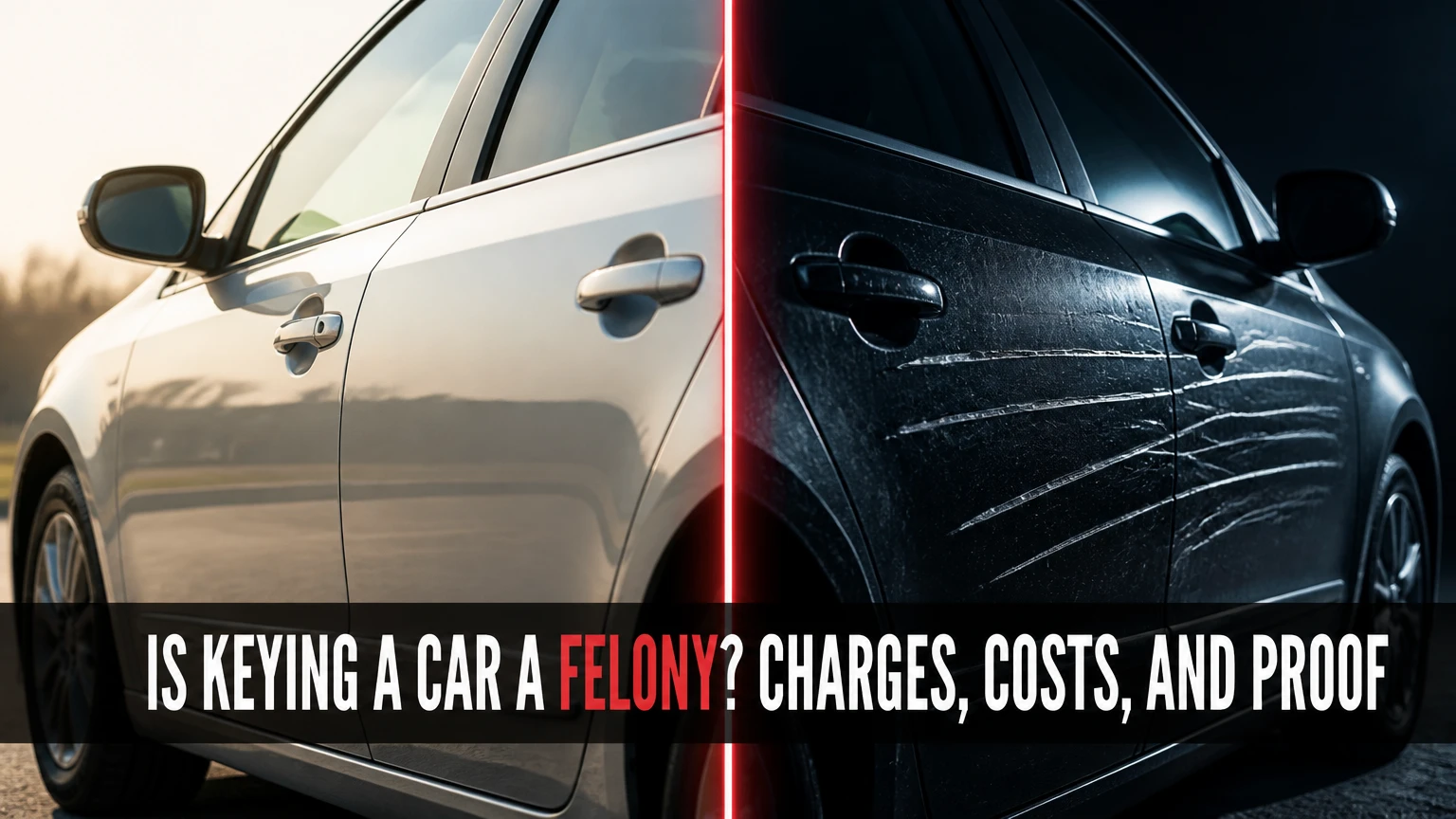
Keying a car can be a felony, but it is more often charged as a misdemeanor unless the legally recognized damage value reaches the jurisdiction’s felony threshold or aggravating factors apply. Prosecutors generally must prove intentional damage to someone else’s property, and the exact offense, dollar limit, and penalties depend on the state or country.
Key Facts at a Glance
- Keying a vehicle is commonly prosecuted as vandalism, criminal mischief, malicious mischief, or criminal damage to property.
- A felony charge usually depends on the repair or property-loss value defined by local law, not on the scratch’s appearance alone.
- A deep scratch does not automatically make the offense a felony because intent, ownership, valuation, and jurisdiction still matter.
- Typical professional repair costs range from about $150 for a shallow clear-coat mark to more than $3,500 for extensive multi-panel damage.
- Comprehensive automobile insurance commonly covers intentional vandalism, subject to the policy’s deductible and exclusions.
- Photographs, security footage, witness accounts, paint transfer, messages, and a written repair estimate can materially affect a case.
Is Keying a Car a Felony?
Keying a car is potentially a felony when the jurisdiction classifies the proven property damage above a specified value or when an aggravating circumstance raises the offense. A single-panel scratch may remain a misdemeanor, while damage across several panels can produce a felony-level estimate because painting and blending costs accumulate.
The legal answer cannot be determined from the word “keyed” or from the scratch’s depth. A prosecutor normally considers the applicable statute, the accused person’s intent, the vehicle’s ownership, the repair estimate, and whether the conduct involved threats, stalking, hate-based targeting, a protected location, or a prior criminal record.
Why the jurisdiction controls the result
United States states use different names and thresholds for property damage. Florida’s criminal-mischief statute, for example, distinguishes damage of $1,000 or more from lower-value damage, while Indiana’s criminal-mischief framework has historically used a lower threshold for certain felony classifications. Statutes change, and charge level can depend on additional facts, so an attorney or current state statute must confirm the result.
| Location example | Common offense framework | Illustrative felony trigger | Important limitation |
|---|---|---|---|
| Florida | Criminal mischief | $1,000 or more in damage under Fla. Stat. §806.13 | Degree and penalty depend on the statutory category |
| Indiana | Criminal mischief | Certain damage levels beginning around $750 under Ind. Code §35-43-4-7 | Exact classification depends on current statute and circumstances |
| Other U.S. states | Vandalism, criminal mischief, criminal damage | Frequently several hundred to several thousand dollars | Thresholds and valuation rules vary substantially |
| Canada and other countries | Mischief or property-damage offenses | No universal U.S.-style rule | Different legal tests and monetary limits apply |
The examples are not a nationwide rule. A local statute may measure repair cost, replacement value, total loss, or another legally defined amount.
What Crime Is Keying a Car?
Keying a car is usually treated as intentional property damage under a statute called vandalism, criminal mischief, malicious mischief, or criminal damage to property. The label changes by jurisdiction, but the prosecution generally must connect the defendant to a deliberate act that damaged property without the owner’s permission.
A typical case has four factual questions:
- Was the act intentional? Deliberately dragging a key across paint usually supplies stronger evidence than an accidental scrape.
- Did damage occur? A prosecutor needs evidence of a physical mark, repairable defect, or measurable loss.
- Did the defendant lack permission? A vehicle owner’s consent can defeat the property-damage theory.
- Did the defendant know the property belonged to someone else? Ownership may be established through registration, testimony, or business records.
Some statutes require malicious intent. Others require only that the defendant knowingly or intentionally damage property. The difference matters when the accused claims the contact was accidental, mistaken, or part of a legitimate attempt to remove an obstruction.
When does a scratch become a felony?
A scratch becomes felony-level property damage when the legally accepted loss exceeds the local threshold or when a separate aggravating factor applies. The scratch’s depth is evidence of possible repair cost, but depth alone does not establish a felony, identify the offender, or prove intent.
Several factors can push a case toward a higher charge:
- Damage spans doors, quarter panels, fenders, hood, or roof.
- A metallic, tri-coat, pearl, matte, or specialty finish requires wider blending.
- Bare metal requires corrosion treatment before refinishing.
- A leased or commercial vehicle requires approved repair standards.
- The incident includes threats, harassment, stalking, or targeted bias.
- The accused has prior qualifying convictions.
- The damage affects a police, government, emergency, or protected vehicle.
How Do Courts Calculate Damage?
Courts usually rely on admissible evidence of the property loss, often a professional repair estimate, paid invoice, testimony from a qualified estimator, or evidence of replacement and related expenses. The estimate is not automatically conclusive, because the defense can challenge unnecessary work, inflated pricing, pre-existing damage, or repairs unrelated to the incident.
The relevant number may differ from an insurer’s first estimate. An insurance adjuster may authorize a practical repair, while a manufacturer-certified shop may identify additional blending, calibration, corrosion protection, or finish requirements. A prosecutor may use the amount supported by the evidence and allowed by the statute, not simply the highest quote obtained by the owner.
| Damage scope | Typical repair route | Typical cost range | Typical shop time |
|---|---|---|---|
| Clear coat only, one panel | Polishing or localized correction | $150-$300 | 1-4 hours |
| Color coat damage, one panel | Sanding, touch-up, paint, clear coat | $400-$1,000 | 1-2 business days |
| Primer or bare metal, one panel | Filling, priming, respray, corrosion control | $800-$1,800 | 2-4 business days |
| Long scratch across two panels | Multi-panel preparation and blending | $1,500-$3,500 | 3-7 business days |
| Specialty finish or extensive panels | Manufacturer-compatible refinishing | $3,000-$7,000 or more | 5-10 business days |
These are typical consumer repair ranges, not legal conclusions. Region, vehicle size, labor rates, paint system, hidden damage, and shop standards can change the estimate substantially.
Can multiple scratches be added together?
Multiple areas of damage can be aggregated when they arose from the same incident and the statute permits the total loss to be considered. A long mark crossing a front door and rear door may require two panels, blending, and additional preparation, so the total estimate can exceed a threshold even when each isolated panel would not.
The prosecution still must prove that the charged conduct caused the claimed damage. Pre-existing scratches, unrelated dents, and repairs that improve the vehicle beyond its prior condition can create valuation disputes.
How Deep Is the Damage?
A keyed-car scratch generally falls into one of three paint-system categories: clear coat, color coat, or primer and substrate. The deepest layer reached helps predict repair complexity and corrosion risk, but a paint inspection and written estimate provide stronger evidence than a visual guess.
Modern automotive finishes commonly include a substrate, primer, base color, and clear coat. A scratch that disappears when wet may be limited to the clear coat, while a mark that catches a fingernail or reveals gray primer, silver metal, or black plastic usually needs more than polishing.
| Paint layer affected | Visual indicator | Suitable repair | Rust or deterioration risk |
|---|---|---|---|
| Clear coat | Mark changes or nearly disappears when wet | Polish, compound, or controlled wet sanding | Low if color coat remains sealed |
| Base coat | White, faded, or contrasting line | Color-matched touch-up or panel refinishing | Moderate if clear coat is breached |
| Primer | Gray, beige, or uniform underlayer visible | Fill, prime, paint, and clear coat | Moderate to high with moisture exposure |
| Bare steel | Bright or dark exposed metal | Corrosion treatment and professional refinish | High, especially in wet or salted climates |
| Plastic substrate | Black or textured surface visible | Repair, adhesion promoter, and refinish | No steel rust, but finish failure can spread |
Does a fingernail test prove the legal damage amount?
The fingernail test only provides a rough repair clue; it does not prove the repair cost or felony classification. If a fingernail catches, the scratch may have entered the base coat or deeper, but paint hardness, scratch width, lighting, and panel curvature can make the test unreliable.
Do not aggressively polish a deep gouge. Removing surrounding clear coat can enlarge the repair area and increase the estimate.
What Evidence Matters in a Keyed-Car Case?
The strongest evidence usually combines proof of the event, proof of identity, proof of intent, and proof of financial loss. Security video showing a person making contact with the vehicle is more persuasive when paired with timestamped photographs and a repair estimate connecting the mark to that event.
Useful evidence includes:
- Original photographs showing the full vehicle, close-ups, location, and scale.
- Security-camera or dash-camera footage exported in its original format.
- Witness names, contact details, and a contemporaneous account.
- Text messages, social-media posts, threats, or admissions.
- Photographs of a key, tool, clothing, or paint transfer, if lawfully obtained.
- Parking receipts, access logs, license-plate images, and location data.
- Registration or lease documents proving ownership or lawful possession.
- Two or more itemized repair estimates, especially for extensive damage.
- Receipts for repairs, rental transportation, towing, and temporary protection.
Avoid confronting a suspected person or entering private property to obtain evidence. Preserve original files, record when each image was taken, and give copies to law enforcement or an insurer.
How can someone prove who keyed a car?
A vehicle owner can prove identity through direct video, eyewitness testimony, admissions, motive evidence, physical evidence, or a combination of circumstantial facts. Motive alone, such as a neighbor dispute or breakup, rarely proves beyond a reasonable doubt that a particular person made the scratch.
A camera that records only the vehicle may prove timing but not identity. Investigators may compare footage from nearby businesses, apartment entrances, parking garages, or traffic cameras. The owner should report the incident promptly because many systems overwrite recordings within days.
What Should a Vehicle Owner Do First?
A vehicle owner should photograph the damage, preserve available video, avoid washing or polishing the panel, obtain a police report when appropriate, and request an itemized repair estimate. Prompt documentation protects both the criminal investigation and the insurance claim.
Use this sequence:
- Photograph every damaged panel before cleaning or touching the paint.
- Note the discovery time, last known undamaged time, and exact location.
- Ask nearby property owners or security staff to preserve recordings.
- Report intentional damage to local law enforcement and obtain the report number.
- Contact the insurer before authorizing major repairs.
- Obtain an estimate that identifies panels, labor hours, materials, blending, and calibration.
- Apply temporary protection only if bare metal is exposed and the insurer permits it.
- Keep invoices, rental-car receipts, communications, and repair photographs.
A police report does not guarantee prosecution. It creates a contemporaneous record and may help an insurer evaluate vandalism coverage.
Will Insurance Pay for a Keyed Car?
Comprehensive automobile coverage commonly pays for vandalism, including deliberate paint damage, after the policyholder pays the comprehensive deductible. Liability insurance generally does not pay to repair the policyholder’s own keyed vehicle, although liability coverage may apply when the insured caused damage to someone else’s property under the policy terms.
| Coverage or payment source | Usually covers the owner’s keyed vehicle? | Typical financial issue | Action to take |
|---|---|---|---|
| Comprehensive coverage | Often yes | Deductible may be $100-$1,000 or more | Report damage and ask about claim handling |
| Collision coverage | Usually no for standalone vandalism | Applies mainly to collision events | Check whether another event caused the damage |
| Liability coverage | No for the insured’s own car | May cover damage caused to another person | Identify the responsible driver or defendant |
| At-fault person’s payment | Potentially yes | Collection may be difficult | Preserve estimates and request restitution |
| Lease or finance contract | Repair obligation usually remains | Approved shop and documentation may be required | Notify the lessor or lender when required |
A claim may affect renewal pricing depending on the insurer, state, claim history, and underwriting rules. Ask whether a claim can be withdrawn before payment and whether the insurer requires a police report.
What Does Repair Usually Cost?
Keyed-car repair typically costs $150-$300 for clear-coat correction, $400-$1,000 for a painted panel, and $800-$3,500 or more when the scratch reaches metal or crosses multiple panels. Labor rates, paint type, blending, corrosion treatment, and required sensor procedures drive the final estimate.
A professional repair may involve washing, degreasing, sanding, feathering the edge, filling imperfections, priming, color matching, spraying, blending adjacent areas, applying clear coat, curing, and polishing. A scratch that looks narrow can therefore require refinishing most of a door or more than one panel.
A body shop may charge more than a mobile repair technician because the shop can control dust, humidity, curing, and spray-booth conditions. A mobile service may improve appearance substantially, but it may not provide a durable or invisible result for a deep gouge, a matte finish, or a large blend.
Which repair option fits the damage?
A professional body shop is the safest choice for bare metal, multi-panel damage, leased vehicles, corrosion, and specialty finishes. A qualified mobile technician can suit a shallow or moderate mark when the owner accepts some visible variation, while a DIY kit mainly provides inexpensive sealing and cosmetic improvement.
| Repair option | Typical price | Typical time | Best use | Main limitation |
|---|---|---|---|---|
| Body shop refinishing | $400-$3,500+ | 2-10 business days | Deep, broad, or specialty-finish damage | Highest cost and vehicle downtime |
| Mobile paint repair | $200-$600 | Same day to 2 days | Localized damage with accessible panels | Limited booth control and blending range |
| Paint correction detailer | $150-$500 | 2-8 hours | Clear-coat scratches and scuffs | Cannot replace missing color or metal |
| Factory touch-up kit | $30-$100 | 1-3 hours plus curing | Small exposed spots and older vehicles | Raised or visible repair line is common |
| Insurance-approved network shop | Deductible plus covered balance | 2-10 business days | Covered vandalism with documentation | Choice and procedures may be policy-limited |
A touch-up pen should seal exposed metal quickly, but it should not be represented as a factory-level restoration. Paint-code accuracy also varies by vehicle age, exposure, and manufacturer color variant.
What Is the Professional Repair Process?
Professional keyed-car repair normally follows seven stages: cleaning, damage preparation, filling or priming, color matching, base-coat application, clear-coat curing, and final polishing. The technician chooses the process according to the deepest damaged layer and the amount of panel surface that must be refinished.
- Clean the panel. Remove wax, road film, and contamination so the scratch can be measured accurately.
- Feather the damage. Sand the edges until the transition is smooth rather than leaving a sharp paint ridge.
- Fill and prime exposed substrate. Use compatible filler and primer, then allow curing according to the product specification.
- Match the color. Use the manufacturer paint code, variant cards, or spectrophotometer readings where available.
- Blend the base coat. Extend color into an adjacent area when a hard patch would be visible.
- Apply clear coat and cure. Protect the repaired color with a compatible clear system and controlled curing.
- Level and polish. Remove minor texture, dust nibs, or haze after the finish has cured.
Technician judgment matters most during color blending. A perfect paint-code match can still look different if the surrounding original paint has faded or the panel receives a different angle of light.
What If the Vehicle Is Leased or Financed?
Leased vehicles usually require repairs that meet the leasing company’s return standards, while financed vehicles remain the owner’s responsibility unless the insurance policy provides coverage. A leased vehicle may require an approved repair facility, manufacturer-compatible paint, and records showing that the work was completed correctly.
A lease inspection can identify visible scratches, paint mismatch, corrosion, or unrepaired damage. An inexpensive touch-up may prevent rust but still produce a charge at turn-in if the repair is conspicuous. Ask the lessor for written standards before choosing a cosmetic repair.
Finance companies generally do not pay for vandalism repairs merely because they hold a lien. The borrower should notify the insurer and review any contract requirement to maintain comprehensive coverage.
What If the Damage Was Accidental?
Accidental contact usually does not satisfy an intentional-vandalism statute, but the person may still owe civil damages or face a different offense if the conduct was reckless. For example, deliberately dragging an object against a vehicle differs legally from brushing against it while carrying equipment.
The facts determine the result. A person who accidentally scratches a car should identify themselves, provide insurance information, photograph the damage, and avoid making a false statement. Leaving without reporting may create separate legal or insurance consequences in some locations, particularly if the incident involved a collision.
Can the Owner Recover Money Separately?
A vehicle owner may pursue restitution in a criminal case and civil recovery through an insurance claim, demand for payment, or small-claims action, depending on local procedure. Recoverable losses can include reasonable repair costs, a rental vehicle, towing, storage, and sometimes provable diminution in value.
The owner cannot usually collect twice for the same loss. If an insurer pays the claim, the insurer may seek reimbursement from the responsible person through subrogation, while the policyholder may remain responsible for the deductible unless recovery occurs.
A civil claim requires proof connecting the defendant to the damage and evidence supporting the requested amount. Keep the estimate, paid invoice, photographs, police report, lease requirements, and deductible records together.
Common Mistakes That Increase Cost or Weaken Proof
Polishing a deep gouge
Aggressive machine polishing can remove surrounding clear coat without replacing missing color. Stop when the fingernail catches or primer and metal are visible, then obtain an estimate.
Washing away evidence
Cleaning can remove transferable material or alter the mark’s edges. Photograph first, preserve the surface, and let an investigator or insurer advise on collection.
Using one low estimate
A low mobile quote may not include blending, corrosion treatment, or manufacturer finish requirements. Request an itemized estimate that identifies all affected panels and procedures.
Waiting on bare metal
Exposed steel can oxidize, especially in humid or salted environments. A temporary compatible touch-up may reduce corrosion while the owner arranges a proper repair, but it will not establish the final loss value.
Accusing a neighbor publicly
An accusation can create defamation or harassment problems and may interfere with an investigation. Provide evidence privately to law enforcement, the insurer, or counsel.
FAQ
Can a person be arrested for keying a car?
A person can be arrested when officers have probable cause and local law permits an arrest for the suspected property-damage offense. An arrest is not a conviction, and prosecutors still must prove identity, intent, unauthorized damage, and the legally relevant loss. The accused should avoid discussing facts with investigators without legal advice.
Does keying a car count as a hate crime?
Keying a car may qualify for a hate-crime enhancement when the conduct was motivated by bias against a legally protected group and the jurisdiction’s statute covers the offense. The damage itself does not automatically become a hate crime. Threats, slurs, messages, and repeated targeting may provide relevant evidence.
How long does a keyed-car repair take?
A clear-coat correction may take several hours, a single painted panel commonly takes one to two business days, and multi-panel or specialty-finish repairs may take five to ten business days. Scheduling, paint curing, parts availability, and additional damage discovered during sanding can extend the timeline.
Can a car wash remove a key scratch?
A car wash cannot remove a scratch that penetrates the clear coat or color layer. Washing may remove dirt that makes a mark look worse, but polishing can correct only some clear-coat damage. A visible line that catches a fingernail generally needs paint repair rather than washing.
Should a vehicle owner file a police report for a small scratch?
A police report is useful when the damage appears intentional, surveillance footage may exist, insurance requires documentation, or the owner may seek restitution. For very minor damage below the deductible, the owner may choose not to claim insurance, but photographs and an incident record remain valuable.
What should someone do if accused of keying a car?
Someone accused of keying a car should preserve messages and location records, avoid contacting the accuser aggressively, and obtain legal advice before giving a detailed statement. The person should not destroy, alter, or fabricate evidence. An attorney can evaluate the statute, repair estimate, intent evidence, and available defenses.
The Bottom Line
Is keying a car a felony? It can be, but the answer depends on the jurisdiction, legally supported damage value, intent, ownership, and aggravating facts. A deep scratch may produce a high repair estimate, yet depth alone does not determine the charge. Vehicle owners should document the scene, preserve evidence, report intentional damage, and obtain an itemized estimate before repairing the vehicle. Anyone accused should avoid confrontation and seek local legal advice because statutory thresholds and defenses vary.