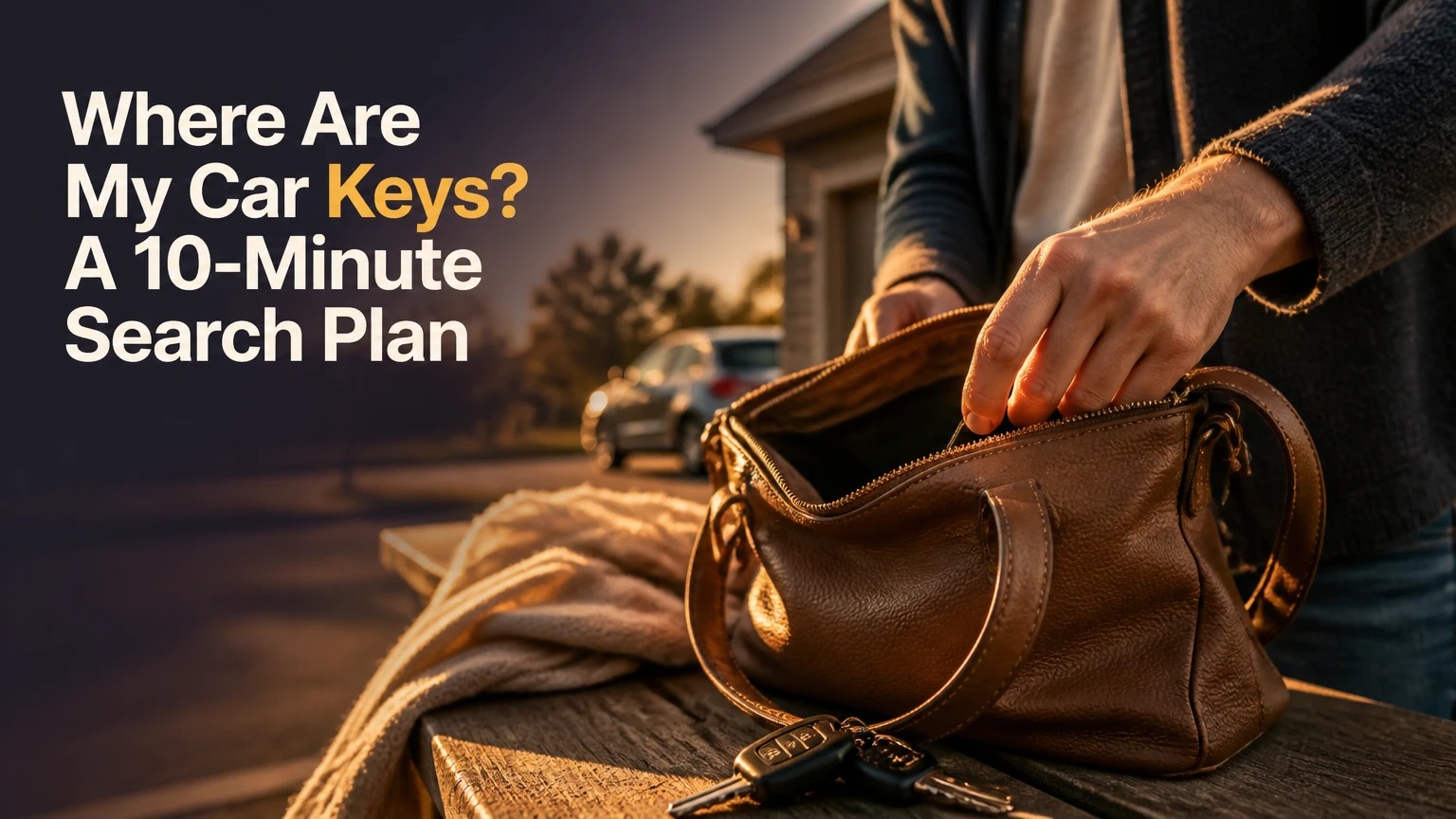
Your car keys are most likely near the last place you used them, along the route you walked afterward, or beneath an object in an ordinary drop zone. Start with the entryway, pockets, bags, counters, seating, and vehicle, then search by your last completed action instead of scanning every room randomly.
Key Facts at a Glance
- Car keys are commonly misplaced during a transition, such as arriving home, changing clothes, carrying groceries, or moving between vehicles.
- A focused 10-minute search is more effective than repeatedly checking the same visible surfaces.
- A dead key-fob battery usually prevents remote buttons from working, but many vehicles still support manual entry and emergency starting.
- Transponder keys and proximity fobs generally require electronic programming, while a basic mechanical key may only require cutting.
- Typical replacement costs range from about $10-$80 for simple keys and $100-$600 or more for programmed keys and smart fobs.
- If a lost key might have been stolen, disabling or deleting that key from the vehicle’s memory matters more than simply buying another key.
Where Are My Car Keys Most Likely to Be?
The most likely locations are the key’s normal landing place, the immediate entryway, clothing worn during the last trip, a bag you carried, or the vehicle itself. Search these locations in order because misplaced keys usually follow a routine interruption rather than a mysterious disappearance.
Search the Five-Foot Drop Zone
Stand at the door where you entered and inspect a radius of about five feet. Check the floor, shoe rack, coat pockets, mail pile, console table, charging station, and any bowl or hook intended for keys.
Use a flashlight held low to the floor. Metal catches light under furniture, while a black fob can disappear against dark upholstery. Lift mail, reusable shopping bags, jackets, hats, and delivery packaging instead of searching only around them.
Reconstruct the Last Completed Action
Ask what you did immediately after unlocking or parking the car. If you carried groceries, check the refrigerator, pantry, countertop, and reusable bags. If you changed clothes, inspect every pocket of the removed trousers, jacket, hoodie, and laundry basket.
If you returned from work, check the desk, laptop bag, bathroom counter, and charging area. If you stopped somewhere else first, call that location before assuming the keys are inside your home.
Search the Vehicle Methodically
Inspect the ignition, center console, cup holders, door pockets, under the driver’s seat, between the seat rail and console, floor mats, cargo area, and trunk opening. A key can slide under a mat or remain in the trunk after loading items.
For a push-button vehicle, check the driver’s seat, console, cup holders, coat, and bag. The car may lock or unlock while the fob remains inside, but behavior varies by manufacturer, model, and software version.
What Is the Fastest Way to Find Lost Car Keys?
The fastest method is a single-direction, event-based search that takes approximately 10 minutes. Do not restart the search from the beginning after every discovery; mark each checked location and move forward through the last-use sequence.
- Minute 0-1: Check the launchpad. Inspect the usual hook, bowl, drawer, counter, and charging surface.
- Minute 1-3: Search the entryway. Lift coats, shoes, bags, mail, packages, and floor mats.
- Minute 3-5: Search clothing and bags. Empty pockets and compartments completely onto a clear surface.
- Minute 5-7: Search the last-action zone. Check groceries, laundry, bathroom items, work equipment, and children’s belongings.
- Minute 7-9: Search furniture. Remove couch cushions, inspect seams, and use a light beneath chairs.
- Minute 9-10: Search the car. Check the ignition, console, seats, pockets, mats, cargo area, and trunk.
You will know the process is working when each location is physically cleared rather than visually glanced at. The common mistake is checking a counter three times while never emptying the bag placed beside it.
Why Searching Under Objects Works
Keys are often concealed by mail, clothing, blankets, shopping bags, and papers because people place them down before completing another task. The inverse search method changes the question from “Where can I see keys?” to “What could be covering keys?”
Use both hands. Lift cushions, shake garments over a bed, open every zipper, and move containers away from walls. If another person is helping, assign rooms or zones so two people do not create the illusion of a thorough search.
Which Key Type Needs Programming?
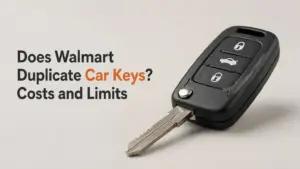
Transponder keys, remote fobs, and proximity smart keys generally need programming or synchronization with the vehicle, while a basic mechanical key usually needs only accurate cutting. A key may fit the door and still fail to start the engine because the immobilizer does not recognize its electronic identifier.
| Key type | Physical identifier | Electronic programming | Typical replacement complexity |
|---|---|---|---|
| Mechanical edge-cut key | Side notches or simple blade | No | Low, often $5-$30 |
| Transponder key | Metal blade with plastic chip head | Usually yes | Medium, often $50-$180 |
| Laser-cut or sidewinder key | Central winding groove | Often yes | Medium-high, often $100-$250 |
| Remote key-fob combo | Blade plus lock and unlock buttons | Usually yes | High, often $100-$300 |
| Proximity smart key | Push-button vehicle fob | Yes | High, often $200-$600 or more |
How Car-Key Technology Works
A mechanical key physically moves the lock cylinder or ignition tumblers. A transponder chip adds an electronic identity that the immobilizer checks before allowing the engine to run.
Remote keyless entry uses radio communication for locking and unlocking. Proximity systems detect an authorized fob near the vehicle and can permit push-button starting, but the exact sensing range, backup reader location, and battery-failure behavior differ across manufacturers.
A useful distinction is that remote entry and engine authorization are separate functions. A fob button can stop working because of a depleted coin cell, while the passive transponder remains usable. Conversely, a cut blade can unlock a door without authorizing the engine.
Can I Start My Car With a Dead Fob Battery?
Many vehicles can start with a dead fob battery, but the emergency procedure depends on the make, model, and year. Common methods include holding the fob against the start button, placing it in a marked backup pocket, or inserting an emergency blade into a conventional ignition.
For a push-button vehicle, first unlock the door with the hidden mechanical blade if the remote buttons fail. Then hold the fob directly against the start button or place it in the manufacturer-specified backup location while pressing the brake and start button.
Do not assume every vehicle uses the same reader. Check the owner’s manual for terms such as “dead key fob,” “backup starting,” or “passive key.” A replacement CR2032 or CR2025 coin cell often restores remote operation, but battery type and polarity must match the original.
| Symptom | Likely cause | Immediate action | Remaining risk |
|---|---|---|---|
| Buttons do nothing | Depleted coin cell | Replace battery | Fob may still need resynchronization |
| Car unlocks manually but will not start | Immobilizer or unrecognized key | Use backup reader procedure | Programming may be required |
| Fob works only nearby | Weak battery or interference | Replace cell and move away from electronics | Antenna or fob fault possible |
| Hidden blade will not turn | Wrong blade, damaged lock, or frozen cylinder | Verify blade and use approved lubricant | Do not force the cylinder |
| Vehicle says key not detected | Fob location or system fault | Use marked backup pocket | Dealer diagnosis may be needed |
A practical rule is to replace the coin cell before buying a new fob when the key was recently found and the vehicle still recognizes it. Buying a new fob does not fix a damaged antenna, immobilizer fault, or wrong programming procedure.
How Much Does a Replacement Car Key Cost?
A typical replacement car key costs about $10-$600 or more, depending mainly on whether the key has a chip, remote electronics, proximity functions, and manufacturer security requirements. A mobile automotive locksmith is often the fastest lower-cost option, while a dealership is more likely to handle unusual or current-model systems.
| Replacement route | Typical price | Typical time | Best fit |
|---|---|---|---|
| Hardware-store mechanical copy | $5-$30 | 5-20 minutes | Older mechanical key |
| Automotive locksmith | $80-$300 | 30-120 minutes | Mobile replacement or programming |
| Dealership | $200-$600+ | 1 hour-3 days | OEM smart key or proprietary system |
| Online replacement hardware | $20-$150 | 2-7 days shipping | Owner with a verified compatible spare |
| Roadside assistance benefit | $0-$200 covered value | 30-180 minutes | Lockout, towing, or limited key service |
Prices vary by country, vehicle, key frequency, security platform, travel distance, and whether all keys have been lost. Ask for a complete quote that separates the key, cutting, programming, service call, tax, and towing.
What Documents Are Needed for a New Key?
A locksmith or dealership typically asks for government identification, vehicle registration or title, and the vehicle identification number. The VIN is usually visible through the windshield or on the driver’s door-jamb label, but some providers also require proof that the requester controls the vehicle.
Prepare these details before calling:
- Make, model, year, trim, and engine type.
- VIN and registration or title.
- Number of working keys remaining.
- Key shape, button layout, and manufacturer markings.
- Exact location of the vehicle.
- Whether the vehicle is locked, disabled, or safely drivable.
A key code can speed mechanical cutting on some older vehicles, but it is not universally printed in the owner’s manual. A provider may retrieve cutting information from authorized databases after verifying ownership.
Should I Use a Locksmith or Dealership?
Choose a mobile automotive locksmith when speed, on-site service, and cost matter most; choose a dealership when the vehicle has a current, uncommon, or heavily integrated smart-key system and factory support is the priority. Confirm capability before dispatch because not every locksmith programs every brand.
| Decision factor | Automotive locksmith | Dealership | Online seller |
|---|---|---|---|
| On-site service | Usually available | Rarely available | No service |
| Typical total cost | $80-$300 | $200-$600+ | $20-$150 before service |
| Programming coverage | Brand-dependent | Manufacturer-specific | Usually none |
| Same-day availability | Often 30-120 minutes | Often appointment-based | Shipping required |
| Ownership verification | Usually required | Required | Seller policies vary |
| Best use | Lost key at home or roadside | New luxury or proprietary fob | Verified spare hardware |
When Is an Online Key Worth Buying?
An online key can reduce hardware cost when you have the exact part number, frequency, blade profile, FCC or regional identifier where applicable, and a known programming path. It is a poor choice when all keys are lost, the vehicle is immobilized, or compatibility is uncertain.
Visual similarity is not enough. Two fobs can share button layouts while using different frequencies, encryption generations, circuit boards, or vehicle markets. Ask the seller whether the part is new, refurbished, OEM, aftermarket, or previously locked to another vehicle.
A low purchase price also excludes cutting and programming. The final cost can exceed a locksmith quote after shipping, failed programming attempts, and a second service call.
Can a Locksmith Make a Key Without the Original?
A qualified automotive locksmith can often cut and program a replacement without the original key, provided the vehicle and ownership documents can be verified. The locksmith may decode the lock, retrieve a vehicle-specific key code, or use diagnostic equipment to register the new transponder or fob.
The job becomes harder when all keys are missing because some vehicles require security access codes, an alarm reset, a new immobilizer procedure, or deletion of the missing keys. Newer luxury vehicles may require online authorization that only an authorized dealer or approved specialist can obtain.
Ask three questions before booking:
- Does the provider support the exact make, model, and year?
- Can the provider program a vehicle when all keys are lost?
- Does the quote include cutting, programming, travel, and key deletion?
Do not provide a key service with more personal or vehicle information than necessary. Legitimate providers should verify ownership rather than treating a working lock as proof of authorization.
What Should I Do If Someone Stole My Car Keys?
Treat stolen car keys as a vehicle-security issue, not an ordinary lost-item problem. Move the vehicle to a secure location if possible, contact the manufacturer or a qualified locksmith, and ask whether the missing key can be erased from the vehicle’s authorized-key memory.
If the keys were taken with a registration document, address label, garage remote, or house key, secure the home and vehicle together. Report the theft to police when appropriate, notify your insurer, and change garage or building access codes.
A replacement key alone may leave the stolen key active. The correct service is usually “all-keys-lost” replacement or key reprogramming with the missing credential removed, although the procedure varies by model.
What If the Key Is Locked Inside the Car?
Use roadside assistance, a licensed automotive locksmith, or the vehicle manufacturer’s connected-services app when available. Do not break a window or use improvised tools, because side-curtain airbags, weather seals, wiring, and door mechanisms can suffer expensive damage.
A spare key, remote-unlock subscription, or manufacturer app may solve the lockout without cutting a replacement. If a child, pet, or medically vulnerable person is trapped inside, call emergency services immediately rather than waiting for a routine locksmith appointment.
Should I Put a Tracker on My Car Keys?
A Bluetooth tracker is useful for locating keys near a compatible phone network, while an Ultra-Wideband tracker can provide more precise nearby direction on supported devices. A tracker does not replace a spare key, prevent theft, or provide guaranteed worldwide GPS tracking.
| Tracker approach | Typical range or coverage | Battery interval | Main limitation |
|---|---|---|---|
| Bluetooth tracker | About 30-100 feet direct range | 6-24 months | Nearby range is limited |
| Crowd-network tracker | Network-dependent location updates | 6-24 months | Requires participating phones |
| Ultra-Wideband tracker | Precise nearby finding | 6-18 months | Requires compatible phone and tag |
| Dedicated GPS unit | Cellular-network coverage | Hours to weeks | Larger, costlier, recurring fees |
Attach the tracker securely, enable separation alerts, and test the sound before an emergency. Review privacy settings, especially when a vehicle is shared, leased, or used by family members.
Avoid hiding a spare transponder key under the vehicle. Anyone who finds it may start or access the car, and weather, theft, and changing vehicle locations make external magnetic boxes unreliable. Store a labeled spare with a trusted person or in a secure home location instead.
How Should I Prevent Losing Car Keys Again?
Use one fixed landing point, one spare-key plan, and one recovery tool. The most reliable prevention system is behavioral: place keys in the same container immediately after entering, then attach a tracker only as a backup rather than relying on technology.
Keep at least one tested spare key. If the vehicle supports owner programming with two working keys, making a third before losing either one can avoid a more expensive all-keys-lost procedure, but the exact self-programming rule is vehicle-specific.
Record the key’s part number, battery type, and emergency-start instructions in a secure place. Do not store the VIN, key code, or registration photograph in an unsecured public note.
Expert Rules That Save Money
- Test the spare twice a year. A spare that has never started the vehicle is an assumption, not a backup.
- Replace weak batteries early. Intermittent range often appears before complete failure, and a cheap coin cell costs less than an emergency callout.
- Buy programming before hardware. Confirm that a replacement fob can be registered to the vehicle before ordering a visually matching shell.
- Delete stolen credentials. Replacing the physical key without removing its electronic authorization leaves the core security problem unresolved.
The Bottom Line
If you are asking “where are my car keys,” search the launchpad, five-foot entry zone, clothing, bags, last-action area, furniture, and vehicle in that order. Give each location one physical inspection, then use a tracker or call the last place you visited instead of repeating the same scan.
If the keys are genuinely gone, identify the key type, gather the VIN and ownership documents, and compare a mobile locksmith with the dealership. A dead fob battery may need only a coin-cell replacement, while a stolen or unrecognized key may require programming and deletion of the old credential.
Frequently Asked Questions
Can a car run without the key inside?
A conventional ignition vehicle generally needs a correctly cut key and, if equipped, a recognized transponder. A push-button vehicle may continue running after the fob leaves the cabin, but it usually will not restart once switched off. Exact warnings and behavior depend on the manufacturer and model year.
How do I find my keys when the tracker is offline?
Search the last reported location first, then inspect the route between that location and your current position. Replace the tracker battery, check Bluetooth permissions, and look for the tag inside bags, under seats, or beneath clothing. Offline status means the tracker cannot currently communicate, not that the keys are necessarily far away.
Can a dead car battery prevent the key fob from working?
Yes. A discharged vehicle battery can disable remote locks, proximity detection, and push-button starting even when the fob battery is healthy. Use the hidden mechanical blade to enter, then follow the vehicle manual’s procedure for connecting a jump pack or external power source safely.
How long does car-key programming take?
A basic transponder or remote replacement often takes 30-120 minutes when the provider has compatible equipment and the vehicle is accessible. Dealership orders for uncommon smart keys can take one to three days. Security authorization, missing keys, parts availability, and towing usually create the longest delays.
Will insurance pay for lost car keys?
Coverage depends on the policy, deductible, roadside benefits, and whether the loss is treated as theft or accidental misplacement. Some comprehensive policies or manufacturer assistance plans cover limited locksmith costs, while others exclude replacement keys. Ask the insurer about programming, towing, rekeying, and stolen-key deletion separately.