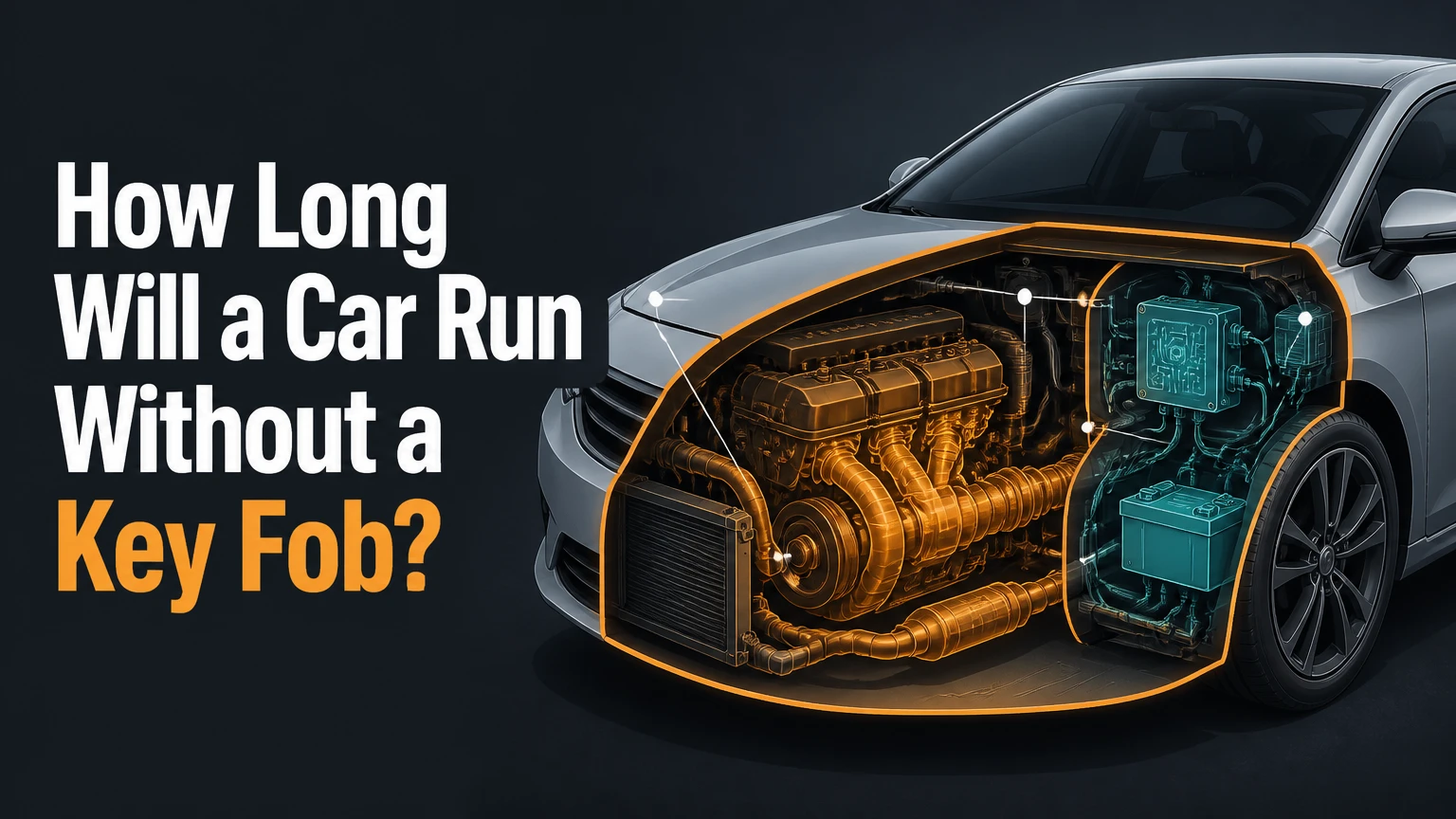
A car with a keyless ignition will usually keep running indefinitely after the engine has started, even when the key fob leaves the cabin. The practical limit is fuel exhaustion, battery depletion in an electric vehicle, stalling, or deliberate shutdown. Once switched off, most vehicles require the authorized fob or an approved backup key to restart.
Key Facts
A running gasoline or hybrid vehicle normally does not shut off merely because its key fob is removed.
A dashboard message or warning chime commonly appears after the vehicle loses contact with the fob.
The car can usually be driven until it is turned off, runs out of fuel, loses usable battery charge, or develops a mechanical fault.
Restart behavior after shutdown is manufacturer- and model-specific; there is no universal 10-30-second grace period.
A dead fob battery often has a passive backup starting location, commonly at the start button, center console, or a marked tray.
Remote-start systems, electric vehicles, smartphone keys, valet modes, and manual transmissions can behave differently.
How Long Will a Car Run Without a Key Fob?
A started keyless car will commonly run for the rest of its available fuel or charge, not for a preset number of minutes or miles. The vehicle usually verifies the fob before starting, then avoids stopping the engine when the signal disappears because an unexpected shutdown could remove propulsion assistance in traffic.
The answer applies most directly to vehicles with passive keyless entry and push-button start. A conventional ignition key, a remote-start session, a subscription-based digital key, and a vehicle with an immobilizer fault follow different rules. The owner’s manual remains the authority for a specific model.
How far can a keyless car drive without the fob?
A keyless car normally has no programmed distance limit after a valid start. A gasoline vehicle could theoretically travel hundreds of miles until its tank is empty, while an electric vehicle stops when its high-voltage battery reaches its usable reserve.
The vehicle may continue displaying Key Not Detected, No Key Found, or a similar warning. That warning confirms an authentication problem, not an immediate engine cutoff. Steering, braking, transmission operation, and speed are generally unaffected while the powertrain remains active.
Why Does the Engine Keep Running After the Fob Leaves?
The immobilizer authorizes starting, rather than continuously authorizing every second of driving. Continuous shutdown monitoring would create a dangerous failure mode if a fob battery died, radio interference blocked the signal, or the fob fell out of a driver’s pocket on a motorway.
A typical passive keyless system uses several vehicle antennas. Low-frequency signals wake or locate the fob, while a radio-frequency response carries encrypted authentication data to the body control module, immobilizer, or powertrain control system. The exact frequencies, cryptography, antenna arrangement, and control modules vary by manufacturer.
The sequence generally works as follows:
- The driver presses the brake and start button.
- Cabin antennas search for an authorized fob.
- The fob responds through its transponder or radio transmitter.
- The immobilizer validates the response.
- The vehicle permits the engine or motor to start.
- The vehicle later detects that the fob is absent and issues a warning instead of stopping.
A fob can therefore be essential for starting without being required for continued propulsion. That design improves safety but creates a predictable stranding risk.
What Happens When the Key Fob Leaves the Cabin?
The vehicle usually warns the driver within seconds or after the next authentication check, but the engine continues running. The exact warning can be an instrument-cluster message, audible chime, flashing key icon, or a combination of alerts.
The practical sequence is straightforward:
- The driver starts the car with the fob present.
- Another person removes the fob, or the driver leaves it at home.
- The car detects that the fob is outside the cabin.
- A warning appears and may repeat while a door opens or the vehicle changes state.
- The car continues driving normally.
- The driver reaches a destination and turns the vehicle off.
- Restarting may then be impossible without the fob, a backup key, or an approved digital credential.
A warning does not necessarily indicate a low fob battery. It can also result from radio interference, a fob left in a metal container, an antenna fault, or a key placed outside the interior detection zone.
Can someone drive away with the car while the fob is absent?
Yes, if the vehicle was already running and the driver or thief can operate it. The missing-fob warning generally does not function as a remote immobilization command, so the car may remain driveable until shutdown, fuel depletion, or a fault.
That does not mean the vehicle can be started freely without authorization. A thief who enters a locked, switched-off vehicle still faces the immobilizer and its authentication requirements. The security weakness is the handoff between a valid start and later operation.
Will the Car Restart After You Turn It Off?
Most vehicles will not reliably restart after shutdown without the authorized fob, although some models permit a brief restart under defined conditions. Claims of a universal 10-30-second restart window are inaccurate because manufacturers implement different timers, ignition states, and safety policies.
A short restart allowance may apply after an accidental shutdown, but it can disappear when the driver opens a door, moves the selector to Park, locks the vehicle, or allows the vehicle control modules to enter a sleep state. Some systems also reject a restart if the original start came from a remote-start feature.
| Vehicle state after fob loss | Typical result | Main limitation | Recommended action |
|---|---|---|---|
| Engine still running in Drive | Continues operating | Fuel, charge, or mechanical failure ends operation | Return for the fob or obtain a spare |
| Engine running, selector in Park | Usually remains on | Shutdown may create a no-start condition | Avoid turning it off in an unsafe location |
| Engine switched off immediately | Often no restart | Model may have no grace period | Use the spare, locksmith, roadside assistance, or dealer |
| Engine switched off for several minutes | Usually locked out | Control modules may fully reset | Follow the manual’s backup-key procedure |
| Remote-start session without fob | May shut off when brake is pressed | Remote-start authorization differs from normal start | Use the physical or digital credential |
| EV in active drive state | Usually remains movable | Low state of charge ends travel | Drive to a safe charging location |
Toyota and Lexus vehicles often require the fob again after shutdown. Ford, General Motors, BMW, and other manufacturers may provide different behavior across model years, so a brand-level assumption is unsafe. Confirm the exact procedure in the owner’s manual.
Do Different Vehicle Types Behave Differently?
Vehicle type changes the relevant limit, but the central rule remains the same: a validly authenticated drive session often continues after the credential disappears.
| Vehicle type | What normally happens after fob loss | Actual operating limit | Important exception |
|---|---|---|---|
| Gasoline vehicle | Engine continues and warning appears | Fuel exhaustion or engine fault | Remote start may terminate when the brake is pressed |
| Hybrid vehicle | Gas engine and electric system remain controlled normally | Fuel depletion, battery fault, or shutdown | Some hybrids stop the gasoline engine frequently by design |
| Battery-electric vehicle | Motor remains available while the drive session is active | Usable high-voltage charge or fault | Park or power-off can require a phone, card, or fob |
| Manual-transmission vehicle | Engine keeps running after credential loss | Fuel, stalling, or driver action | Restart after a stall usually requires authentication |
| Fleet or commercial vehicle | Software may enforce idle or restart rules | Fleet configuration and fuel or charge | Telematics can impose separate restrictions |
An automatic transmission does not make the vehicle safer to leave unattended. A running car can still be shifted, driven, or stolen if physical access is obtained.
What If the Fob Battery Is Dead?
A dead key-fob battery usually prevents remote locking and radio communication, but it does not always prevent starting. Most manufacturers include a passive transponder that can be read at a designated backup location without relying on the coin-cell battery.
Use this general procedure:
- Enter the vehicle with the mechanical emergency key if the door is locked.
- Sit in the driver’s seat and press the brake pedal.
- Hold the fob directly against the start button, if the manual identifies that method.
- If that fails, place the fob in the marked backup pocket or tray.
- Press the start button once.
- Replace the coin cell with the specified CR2032, CR2025, or other listed battery.
The backup location differs. Common positions include the center-console tray, a cup-holder recess, the steering-column cover, or a slot beneath the start button. Do not assume the same location works across Nissan, Audi, Ford, Toyota, BMW, and General Motors vehicles.
A passive start procedure is different from bypassing the immobilizer. It uses the vehicle’s intended authentication hardware and does not make an unauthorized key valid.
What Should You Do if the Car Is Running and the Fob Is Missing?
Drive directly to the fob or to a secure recovery point, provided continuing to drive is legal and safe. Avoid stopping at a destination where the vehicle must be shut off, because the car may become immobile immediately afterward.
Use this decision path:
- The fob is nearby: Return to it without unnecessary stops.
- A second authorized fob exists: Have another person bring it to the vehicle.
- The vehicle must be parked: Choose a safe, legal location before switching off.
- The vehicle is obstructing traffic: Move it to safety first, then contact roadside assistance.
- The fob is lost or stolen: Disable or replace the credential through the manufacturer, dealer, or qualified automotive locksmith.
- The vehicle is a rental or fleet car: Contact the rental company or fleet manager before authorizing a key replacement.
Do not leave a running vehicle unattended with the doors unlocked. The ability to keep driving without a fob is a propulsion behavior, not a theft-prevention feature.
Can You Lock a Keyless Car Without the Fob?
A vehicle may still be lockable without the fob, but passive-touch locking and remote locking commonly stop working. The mechanical emergency key can usually lock the driver’s door, while other doors may require an interior lock switch or a manufacturer-specific procedure.
| Locking method | Likely availability without fob | Typical condition | Practical drawback |
|---|---|---|---|
| Exterior touch sensor | Usually unavailable | Requires detected fob | Vehicle cannot authenticate the request |
| Remote-lock button | Unavailable | Fob must transmit | Dead or missing transmitter cannot send command |
| Interior central-lock switch | Often available | Vehicle remains powered | Doors may relock or alarm behavior may vary |
| Mechanical emergency key | Usually available | Key blade must match cylinder | Only the driver-door cylinder may be exposed |
| Smartphone digital key | Model-dependent | Phone must hold a valid credential | Phone battery, NFC, Bluetooth, or app state can matter |
Check the manual before locking the vehicle. A mechanical key cylinder may trigger the alarm until the car recognizes the authorized credential again; then use the authorized ignition key for safe alarm shutoff without a key fob.
What Are the Main Security and Safety Risks?
The main safety benefit is prevention of an abrupt engine shutdown at speed. The main security risk is that a person with access to an already-running car may continue driving without possessing the fob.
The risk is greatest in predictable situations:
- A driver leaves the vehicle running during a warm-up and walks indoors.
- A valet or passenger carries the fob away.
- A driver ignores repeated warning chimes.
- A spare fob is hidden inside the glove box or center console.
- A smartphone key is treated as the only credential.
- A vehicle is left running at a fuel station or outside a convenience store.
A spare fob should not be stored inside the cabin. Anyone who gains entry could potentially start and move the vehicle because the credential is already within the interior detection zone.
The warning is also not a theft alarm in the conventional sense. It tells the operator that the authorization token is absent; it does not contact the police, disable the drivetrain, or guarantee that the vehicle will stop.
How Do Remote Start and Digital Keys Change the Answer?
Remote start can impose a stricter rule than a normal push-button start. Many vehicles allow the engine to run remotely, but require a recognized fob or phone credential before the driver presses the brake and selects a gear.
Digital keys also vary widely. Apple, Google, Samsung, Tesla, Rivian, BMW, Hyundai, Kia, and other systems may use Bluetooth, NFC, ultra-wideband, or a combination of technologies. Cellular service is not always necessary, but phone battery level, device compatibility, wallet integration, and vehicle settings can determine whether the credential works.
| Credential type | Starts vehicle without physical fob? | Common technology | Failure condition |
|---|---|---|---|
| Physical proximity fob | Yes, when authorized | LF/UHF radio and passive transponder | Dead battery may require backup location |
| Mechanical key | Only on vehicles designed for it | Cut metal key and ignition cylinder | Many push-button cars have no mechanical start |
| NFC key card | Model-dependent | Near-field communication | Card must be placed at the marked reader |
| Smartphone key | Model-dependent | Bluetooth, NFC, or UWB | Phone battery, permissions, or credential expiry |
| Remote-start app | Usually not for full drive authorization alone | Cellular app command | Brake input may require separate authentication |
A phone is not automatically equivalent to a fob. Carry the manufacturer-issued backup card, physical key, or second fob when traveling outside the vehicle’s normal operating area.
What Does a Replacement Fob Cost?
A replacement key fob typically costs about $150-$600 or more after programming, while a coin-cell battery often costs $2-$5. Dealer programming, vehicle security architecture, regional labor rates, and whether an existing key remains available determine the final bill.
| Recovery option | Typical cost | Typical timeframe | Best use |
|---|---|---|---|
| CR2032 or CR2025 battery | $2-$5 | 5-15 minutes | Fob works poorly or has a low-battery warning |
| Aftermarket fob and locksmith programming | $150-$300 | 1-3 hours | Common vehicle with compatible equipment |
| OEM fob and dealer programming | $300-$700+ | Same day to 1-2 days | Premium, newer, or security-restricted vehicle |
| Emergency roadside towing | $75-$200 | 30-120 minutes | Vehicle cannot be restarted safely |
| Dealer-ordered credential | $400-$800+ in some cases | 1-5 business days | Lost all keys or model-specific ordering required |
These are typical U.S. ranges, not fixed prices. Mercedes-Benz, BMW, Audi, and newer encrypted systems can exceed the upper range, especially when every remaining credential must be erased and new keys must be registered.
Bring the vehicle identification number, registration, photo identification, and any remaining key. A locksmith or dealer may need all four before programming a replacement.
What Common Mistakes Cause a No-Fob Stranding?
The most common mistake is turning off a vehicle in an inconvenient place before confirming that the credential is present. A short warning chime during driveway warm-up can become a long tow after a commute.
Mistake 1: Ignoring the warning message
Read Key Not Detected before leaving the driveway. If the message appears, check the driver’s pocket, bag, coat, and center console immediately.
Mistake 2: Assuming a grace period exists
Do not test a claimed 10-30-second restart window in traffic. Some vehicles offer no restart window, while others apply it only under narrowly defined conditions.
Mistake 3: Keeping the spare inside the vehicle
An interior spare can defeat the intended separation between the car and its credential. Store the spare in a secure, accessible location away from the vehicle.
Mistake 4: Treating a dead battery as a lost key
Try the passive backup reader before ordering a replacement. The fob may still contain a functioning transponder even when its remote buttons do nothing.
Mistake 5: Relying on a phone at one percent charge
A digital key can fail because of a dead battery, locked device, disabled Bluetooth, expired sharing permission, or an incompatible operating-system update. Carry a physical backup.
Which Model-Specific Claims Require Verification?
Owner’s manuals, not generic brand charts, determine exact behavior. Model year, trim, market, software version, remote-start status, and immobilizer configuration can change the result even within one manufacturer.
The following broad patterns are useful but not definitive:
| Manufacturer example | Common warning behavior | Shutdown behavior | What to verify |
|---|---|---|---|
| Toyota or Lexus | Chime and multi-information display warning | Often requires fob immediately | Backup start location and lock procedure |
| Ford or Lincoln | Chime and No Key Detected message | Varies by model and start mode | Remote-start brake authorization |
| BMW or MINI | Instrument-cluster and iDrive warning | Varies by Comfort Access system | Digital Key and emergency detection location |
| General Motors | Driver Information Center message | Varies by vehicle generation | Keyless ignition and remote-start rules |
| Tesla | Screen prompt or key warning | Phone key, card, or fob rules apply | Card placement and PIN-to-Drive setting |
Tesla vehicles do not use a conventional engine, and their drive authorization can depend on a phone key, key card, fob, or PIN-to-Drive setting. A Tesla should not be assumed to follow the same post-start behavior as a gasoline vehicle with a conventional immobilizer.
What Is the Safest Recovery Procedure?
The safest procedure depends on whether the car is running. A running car should be moved to a safe legal location or returned directly for the fob, while a switched-off car should be handled through its approved backup credential process.
If the vehicle is running
Keep the vehicle occupied, avoid unnecessary stops, and drive to the fob or a secure recovery point. Do not switch off the engine merely to test whether it will restart.
If the vehicle is switched off
Try the manufacturer’s passive-start procedure if the fob is present but its battery is dead. If the fob is genuinely absent, use a spare, digital key, mobile locksmith, dealer, or roadside-assistance service.
If the vehicle is in a dangerous position
Prioritize traffic safety over key recovery. Activate hazard lights, move away from live lanes if possible, and call emergency or roadside services when the vehicle cannot be safely repositioned.
An immobilizer cannot replace ordinary precautions. Lock the vehicle, remove visible valuables, and never leave children or animals inside a running car.
Expert Rules That Prevent Most Problems
Practitioner rule 1: Check the key warning before shifting into Drive, not after the first mile. The driveway is the cheapest place to discover a missing credential.
Practitioner rule 2: Separate “can keep running” from “can restart.” These are different authorization events, and confusing them causes most preventable roadside calls.
Practitioner rule 3: Replace a fob battery at the first intermittent range or low-battery warning. A transmitter that works only beside the door may still fail to authenticate reliably inside the cabin.
Practitioner rule 4: Test the backup start location before an emergency. A driver who knows whether the fob belongs on the start button, console tray, or NFC reader can solve a dead-cell problem in minutes.
Practitioner rule 5: Treat a smartphone key as a convenience credential, not the only recovery plan. Carrying a card or second fob costs less than a tow and avoids dependence on phone power.
Frequently Asked Questions
Will a car shut off if the key fob battery dies while driving?
A car usually will not shut off solely because the key fob battery dies while driving. The engine or electric motor normally remains active after the initial authentication, although the dashboard may display a missing-key warning. The vehicle may not restart after the driver turns it off.
Can I drive to a gas station without the key fob?
You can usually drive to a gas station without the key fob if the vehicle is already running. However, switching off the engine may prevent a restart, and refueling requires the vehicle to be stopped. Drive only if the fuel range safely covers the trip back to the fob or a recovery location.
Does a keyless car need the fob inside the cabin at all times?
A keyless car generally needs the fob inside the cabin to authorize starting, not to maintain operation continuously. Interior antennas verify the credential during startup, while later absence typically triggers a warning rather than an engine shutdown. The owner’s manual controls exceptions for remote start and special drive modes.
Can I start a push-button car with the physical key blade?
A physical key blade usually unlocks the door but does not start a push-button vehicle. The blade is mechanical, while the immobilizer requires an electronic transponder. If the fob battery is dead, place the complete fob at the vehicle’s designated backup reader instead.
Does remote start let me drive without the key fob?
Remote start does not necessarily let you drive without the key fob. Many systems start the engine remotely but require a recognized fob, phone key, or other credential when the driver presses the brake and selects a gear. Remote-start authorization and normal ignition authorization are separate functions.
How long does a key fob battery usually last?
A key fob coin cell commonly lasts two to five years, depending on button use, passive-entry activity, temperature, and transmitter design. Frequent range reduction, delayed locking, or a vehicle low-battery warning indicates replacement is appropriate. Use the battery type specified for the particular fob.
The Bottom Line
A running keyless vehicle will generally continue operating without its key fob until the driver turns it off, the vehicle runs out of fuel or usable battery charge, stalls, or suffers a fault. The answer to how long will a car run without a key fob is therefore usually “as long as the drive session remains active,” not a fixed time or mileage limit.
The important practical distinction is restart authorization. Do not rely on a generic grace period, and do not shut the vehicle off until the fob, spare, digital key, or approved backup procedure is available.