Standard factory car keys usually do not contain GPS trackers or cellular location hardware. A modern key fob may contain an immobilizer transponder, radio transmitter, Bluetooth, or UWB hardware for nearby vehicle access, but those signals authenticate the key rather than report its position across a map. An aftermarket tracker is required for lost-key location.
Key facts
A factory key fob is normally designed to unlock, start, or authorize a vehicle, not to transmit its geographic location.
A transponder can prove that a key is authorized without revealing where the key is.
Bluetooth trackers typically show a last-known or crowdsourced location, not continuous GPS movement.
RF key finders work well inside homes but usually cannot locate keys on a remote map.
Cellular GPS trackers provide broader coverage but need charging, cellular service, and often a subscription.
A tracker attached to a key can locate the key, but it cannot automatically locate the vehicle when the key is elsewhere.
Do Car Keys Have Trackers From the Factory?
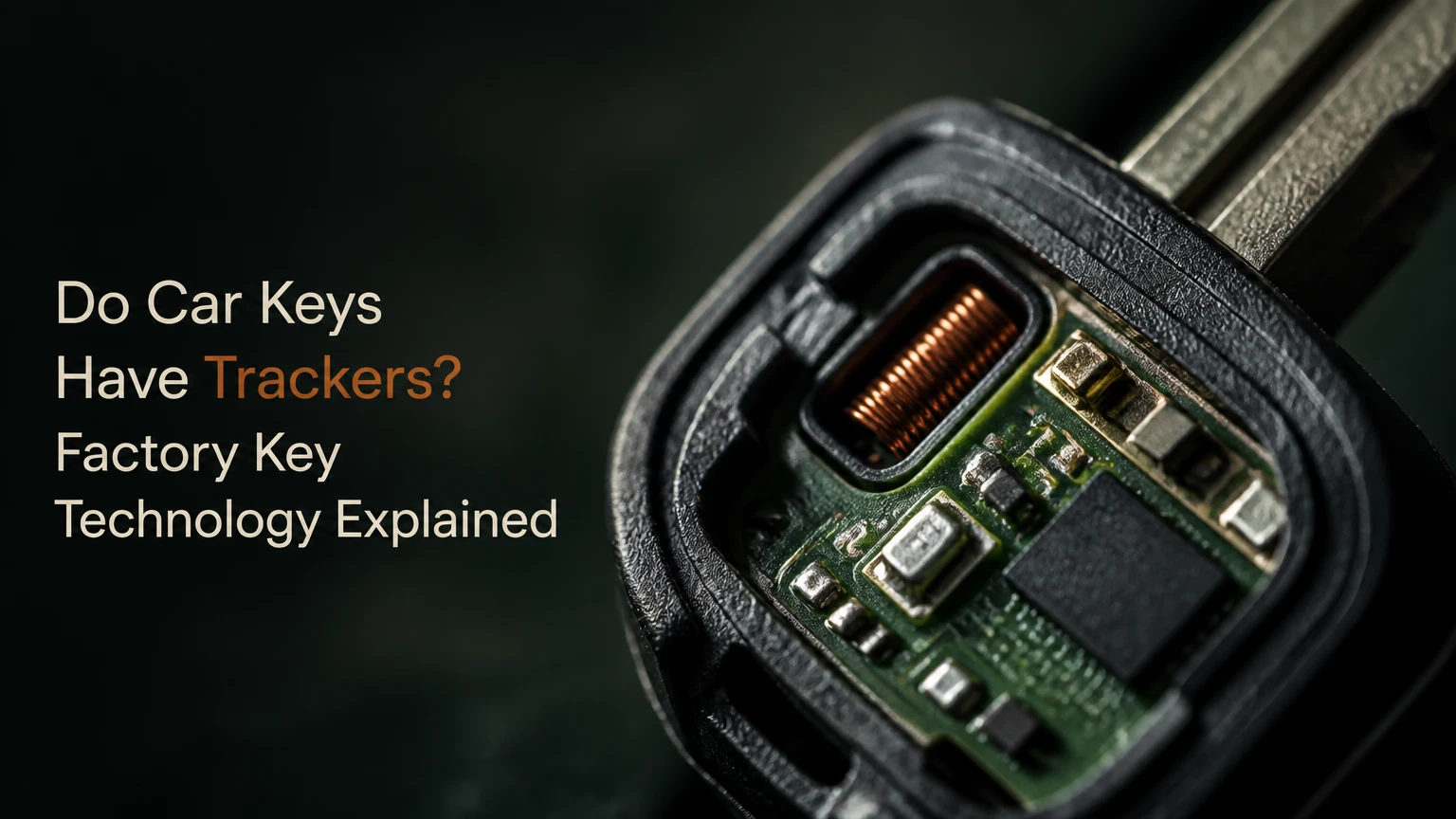
Most factory car keys do not have built-in GPS tracking. Manufacturers generally install a passive immobilizer chip and short-range radio components because the vehicle needs to authenticate a nearby key, not monitor the key’s location after it leaves the vehicle.
A standard remote keyless-entry fob may transmit when the owner presses a button. A passive transponder may respond only when energized by the vehicle’s antenna. Neither design includes the satellite receiver, cellular modem, power capacity, and data service required for independent location tracking.
Some newer digital-key systems use Bluetooth Low Energy or Ultra-Wideband. Those technologies can help a compatible phone or vehicle determine proximity, direction, or distance in a limited area. UWB capability does not mean every key or vehicle can be found worldwide.
What is the difference between a transponder and a tracker?
A transponder authenticates identity; a tracker communicates location. The vehicle reads a coded response from the transponder, checks whether the code is valid, and permits functions such as immobilizer release or engine start.
A location tracker needs a separate location method. GPS calculates position from satellites, Bluetooth reports proximity to a nearby phone or network, and cellular hardware uploads information through a mobile network. These functions consume more power and require a device that can transmit independently.
The distinction matters when a locksmith or dealership replaces a key. Key programming can make a replacement fob operate the vehicle, but programming does not add a map-based tracking function.
How Do Smart Car Keys Work?
Smart car keys use short-range radio communication to authenticate an authorized fob near the vehicle. A passive-entry system typically polls for a nearby key, receives an encrypted response, verifies the credential, and unlocks the doors or enables push-button starting when the conditions are satisfied.
The exact radio design varies by vehicle. Many systems combine low-frequency wake-up signals around the vehicle with higher-frequency radio communication from the fob. The immobilizer function is separate from the vehicle’s navigation, telematics, or stolen-vehicle recovery service.
Smart-key operation in four steps
- The vehicle sends a proximity signal. Antennas inside the cabin, doors, or exterior handles establish a short-range detection area.
- The fob responds with an identifier or cryptographic response. The response proves possession of an authorized credential.
- The vehicle validates the response. A matching key may unlock the car or permit the starter and engine-control system to operate.
- The vehicle records an access event. Some vehicles store diagnostic or security events, but that record does not create a live location history for the key.
The effective range is intentionally limited. A key may work from a few feet to several dozen feet depending on the button, antenna layout, battery condition, obstructions, and vehicle design. That range is not equivalent to GPS coverage.
Does UWB make a car key trackable?
UWB can estimate distance and direction more accurately than ordinary Bluetooth in compatible devices, but UWB alone does not provide worldwide tracking. A compatible vehicle might use UWB to reduce relay-theft risk or improve digital-key positioning near the car.
The system still needs a participating phone, network, or tracking service to report a location beyond the immediate area. UWB in a phone or smart key should therefore be treated as a proximity feature unless the manufacturer explicitly provides a location network.
What Types of Trackers Can You Add to Car Keys?
The three practical categories are Bluetooth network trackers, local RF key finders, and cellular GPS trackers. Bluetooth is the usual choice for personal keys because the device is small and inexpensive; RF is simpler for indoor searching, while cellular GPS is better suited to larger assets than a conventional key ring.
| Tracker type | Typical direct range | Typical battery or charge | Mapping capability | Typical cost |
|---|---|---|---|---|
| Bluetooth tracker | 30-120 m outdoors | 1-3 years | Last seen plus network sightings | $20-$40 |
| Local RF finder | 30-150 m, often indoors | 6-12 months | No remote map | $15-$35 |
| Cellular GPS tracker | Cellular coverage area | 1-7 days per charge | Live or periodic map updates | $40-$150 plus service |
| Bluetooth plus UWB model | 10-60 m for precision finding | 1-2 years | Network map plus nearby direction | $25-$45 |
The ranges are typical product ranges, not guarantees. Walls, vehicles, metal cabinets, radio interference, phone density, and antenna orientation can reduce performance substantially.
How do Bluetooth key trackers locate keys?
A Bluetooth tracker broadcasts a low-power identifier that a paired phone can detect nearby. The companion app saves the phone’s location when the tracker was last connected, and compatible crowdsourced networks may update the map when another participating phone detects the tracker.
Apple AirTag uses Apple’s Find My network. Samsung Galaxy SmartTag2 is designed for Samsung Galaxy users and Samsung’s SmartThings Find system. Products such as Chipolo and Pebblebee offer models compatible with Apple Find My or Google’s Find My Device network, depending on the specific version.
Bluetooth trackers do not generally transmit their own GPS coordinates. A nearby phone supplies the location context. A tracker in an empty rural area may remain at its last known point until a participating device passes close enough to detect it.
How do RF key finders work?
An RF key finder uses a small radio transmitter on the key ring and a separate base station or remote. Pressing a button sends a signal to the tag, which emits a sound or flashes an indicator.
RF systems can be excellent for keys lost under furniture, inside a laundry basket, or in a nearby room. They usually lack an app, map, account, and crowdsourced network, so an RF finder cannot tell you that the keys were left at a restaurant across town.
Do cellular GPS trackers work on key rings?
Cellular GPS trackers can report their position over a mobile network, but most are too large, power-hungry, and expensive for ordinary car keys. A GPS receiver must calculate a position, and a cellular modem must upload that position, which explains the short charge interval in many compact products.
Cellular devices make more sense for a fleet key cabinet, heavy equipment key, rental operation, or high-value asset where the key’s movement has operational significance. They also introduce coverage gaps, monthly fees, charging requirements, and privacy obligations.
Which Key Tracker Is Best for Each Situation?
The best tracker depends on phone compatibility, search environment, network density, and tolerance for charging. An iPhone owner who loses keys in public places usually benefits from an Apple Find My-compatible tracker, while a person who loses keys inside a house may prefer an RF system with a loud dedicated remote.
| User situation | Recommended category | Why it fits | Main limitation |
|---|---|---|---|
| iPhone user, urban travel | Apple Find My tracker | Dense nearby device network and map history | Unwanted-tracking alerts and replaceable battery needed |
| Samsung Galaxy user | Galaxy SmartTag2 | SmartThings Find integration and nearby finding | Best features depend on Samsung hardware |
| Other Android user | Google Find My Device tracker | Android network compatibility | Network availability varies by region and device participation |
| Keys lost indoors | RF key finder | Fast audible search without app setup | No remote location map |
| Rural or low-phone-density area | Bluetooth plus direct search | Low cost and long battery life | Crowdsourced sightings may be rare |
| Fleet or high-value equipment | Cellular GPS tracker | Periodic location reporting over cellular service | Charging and recurring service cost |
Apple states that AirTag uses the Find My network, which relies on nearby Apple devices to relay an encrypted location update. Google describes Find My Device as a network that can use participating Android devices to help locate compatible items. Those network designs explain why Bluetooth trackers can work beyond their direct radio range without containing a GPS receiver.
What should an iPhone owner buy?
An iPhone owner should choose an Apple Find My-compatible tracker when the keys travel through populated places. AirTag is the most recognizable example, while third-party Find My accessories can offer different shapes, mounting holes, or rechargeable designs.
Check the battery type before buying. A replaceable CR2032 battery usually lasts about one year in typical use, although sound playback, cold temperatures, and frequent alerts can shorten that period. AirTag also includes anti-stalking protections that can notify people if an unknown tracker appears to travel with them.
What should an Android owner buy?
An Android owner should select a tracker that explicitly supports the phone’s network, rather than assuming every Bluetooth tag works with every app. Samsung Galaxy users can consider SmartTag2, while other Android users should verify Google Find My Device compatibility on the product package and in the current app.
Basic Bluetooth pairing may work across platforms, but network finding, separation alerts, precision finding, and account features can differ. Compatibility is a purchase specification, not a minor software detail.
How Much Do Key Trackers Cost and How Long Do They Last?
Bluetooth key trackers typically cost $20-$40 and run for one to three years per battery, whereas RF finders commonly cost $15-$35 and last six to twelve months. Cellular GPS products often cost $40-$150 initially, then add a monthly service charge and require charging every one to seven days.
| Ownership factor | Bluetooth tracker | RF finder | Cellular GPS tracker | Practical consequence |
|---|---|---|---|---|
| Initial device price | $20-$40 | $15-$35 | $40-$150 | Cellular costs more upfront |
| Replacement battery | $2-$6, usually annual | $2-$6, usually semiannual | Often rechargeable | Charging becomes a routine |
| Recurring subscription | Usually $0 | $0 | Commonly $5-$25/month | GPS costs more over time |
| Setup time | 2-10 minutes | 1-3 minutes | 10-30 minutes | Cellular setup needs an account |
| Typical weight | 8-15 g | 5-20 g | 20-80 g | GPS may feel bulky on keys |
Prices vary by country, retailer, taxes, and network plan. The important cost difference is usually not the purchase price. It is whether the device requires a recurring cellular service and whether the owner will maintain its battery.
How Do You Find Lost Car Keys With a Tracker?
Use the tracker’s app or remote first, then search the last known location systematically. A Bluetooth tracker may locate the keys within direct radio range, while a crowdsourced network may provide only an approximate or delayed sighting.
- Check the app’s last-known location. Confirm the timestamp before traveling to the displayed point. A location from yesterday is not proof that the keys remain there.
- Play the tracker sound. Search slowly near furniture, bags, coat pockets, vehicle seats, and storage bins because small speakers are easy to muffle.
- Use the nearby-finding function. Walk in a grid rather than circling randomly, and watch for signal-strength or distance changes.
- Retrace the last movement. Check the home entrance, driveway, workplace desk, checkout counter, and car cabin in that order.
- Contact the location owner if necessary. A tracker can identify a place, but retrieving property from a private residence or business requires lawful contact.
- Replace the key or disable it if theft is likely. A vehicle manufacturer or qualified locksmith can erase or reprogram keys on some vehicles.
You will know a nearby search is working when the app connects consistently or the sound responds to repeated commands. If the map does not update, check battery status, permissions, network compatibility, and whether the key is inside a signal-blocking container.
Can you find keys inside the car?
A tracker can help find keys inside a vehicle if the tracker battery works and the phone can communicate with it. Search the center console, door pockets, seat rails, cargo area, and floor mats because key fobs often slide into narrow gaps.
A key fob’s own “lock” or “unlock” button may also produce a sound or visible vehicle response, but that function is not a tracking system. If the key is locked inside the car, use the tracker only to locate it, not to bypass the vehicle’s security.
What Stops a Key Tracker From Working?
Dead batteries, disabled permissions, radio shielding, weak network density, and incompatible accounts cause most tracking failures. A Bluetooth tag can appear offline even when it is physically nearby if the phone cannot scan in the background or the tag is enclosed by metal.
| Failure symptom | Likely cause | Corrective action | Expected result |
|---|---|---|---|
| Map shows an old location | No nearby network device detected | Check timestamp and retrace route | Last sighting is interpreted correctly |
| Tracker will not connect nearby | Dead battery or disabled Bluetooth | Replace battery and enable Bluetooth | Direct connection may return |
| No background updates | Location permission restricted | Allow required background permissions | App can record later sightings |
| Sound is quiet | Speaker covered by lint or casing | Clean speaker opening and test indoors | Audible alert improves |
| Tracker disappears in a pouch | Faraday or metal shielding | Remove shielding during search | Radio signal becomes detectable |
| Alerts appear on another phone | Anti-stalking protection | Identify ownership and follow platform guidance | Unwanted tracking risk is addressed |
A Faraday pouch blocks or attenuates radio signals by design. It can protect a vehicle key from some relay attacks, but it also prevents a Bluetooth tracker from communicating while enclosed.
What happens when the tracker battery dies?
A dead tracker battery stops new sightings and nearby alerts. The app may continue to display the last location recorded before the battery failed, but that location should not be mistaken for a current position.
Replace the tracker battery according to the manufacturer’s instructions, then confirm that the app shows a current connection. Do not confuse the tracker battery with the vehicle key-fob battery. The key may stop unlocking the vehicle while the attached tracker continues operating, or the reverse can occur.
Can a Key Tracker Locate a Stolen Car?
A tracker attached to car keys cannot reliably locate a stolen car if the keys remain with the owner. The tag follows the key ring, not the vehicle, so it is the wrong tool for vehicle recovery unless the keys were taken with the car.
Vehicle location requires factory telematics, a dedicated vehicle GPS device, or a manufacturer recovery service. Services such as connected-car apps may use the vehicle’s own cellular modem and GPS, but availability depends on the model, subscription, region, and whether the vehicle has power and network access.
This limitation is frequently misunderstood. A key tracker is an item-recovery device, not a substitute for a vehicle alarm, immobilizer, insurance-approved tracker, or law-enforcement recovery process.
Can a Dealership Track a Lost Key Fob?
A dealership generally cannot track a lost key fob by its serial number, key code, or vehicle identification number. Those identifiers help identify, program, replace, or invalidate a key, but they do not provide a geographic location.
A dealership may be able to determine which keys are currently authorized by the vehicle, depending on the model and diagnostic equipment. If a key is missing, ask whether the vehicle can have lost keys erased from its authorized-key list and whether replacement keys must be programmed.
Bring proof of ownership and identification when requesting key programming or security changes. Procedures differ by manufacturer and market.
Are Key Trackers Private and Safe to Use?
Key trackers can expose location information through an account, phone, or crowdsourced network, so owners should protect the associated account and understand anti-stalking features. Modern platforms use rotating identifiers and encrypted network communications, but privacy depends on account security, device permissions, and who has access to the tracking account.
Do not attach a tracker to another person’s property without consent. Apple, Google, and Samsung have introduced unwanted-tracking alerts that can notify people when an unfamiliar compatible tracker appears to move with them. Those protections reduce abuse but can also alert a thief to the tracker’s presence.
For business keys, document who can access location history, how long records are retained, and whether employees or contractors receive notice. A tracker on a company vehicle key can become a workplace monitoring issue.
Expert Rules for Choosing and Using a Key Tracker
Experienced locksmiths and fleet administrators treat the tracker as a recovery aid, not a security credential. Three practical rules prevent most disappointed purchases:
- Match the network before comparing features. A tracker with excellent hardware is ineffective if its app or crowdsourced network does not support your phone.
- Test the complete recovery path immediately. Pair the tag, rename it, play its sound, walk outside, and confirm the map timestamp before relying on it.
- Keep a backup plan for dead batteries. Store the correct replacement cell and record the vehicle manufacturer’s emergency key procedure.
A counterintuitive limitation is that a busy city can improve Bluetooth network sightings while making physical recovery harder. The app may show a large public building, not the exact room, desk, or person holding the keys.
Another practical rule concerns attachment. Place the tracker where it remains exposed to radio signals and cannot slide off the key ring. A tag hidden inside a metal key case may have weaker performance than the same tag mounted on an external loop.
Frequently Asked Questions
Do key fobs have GPS chips?
Most key fobs do not have GPS chips. Factory fobs commonly contain an immobilizer transponder and radio transmitter for short-range vehicle access, while GPS requires additional electronics, power, and a method for transmitting coordinates to a network.
Can someone track my car through the key fob?
A normal key fob does not continuously broadcast a map location. Attackers may exploit keyless-entry communication in relay attacks to make a vehicle believe the key is nearby, but that technique is different from tracking the key’s geographic position.
Do AirTags work on all car keys?
AirTags can attach to nearly any key ring with a holder, but their app and Find My network require an Apple account and compatible Apple devices. Android users can detect some unwanted AirTag behavior but cannot use the complete owner experience in the same way.
What is the best tracker for keys without a subscription?
An RF finder or Bluetooth network tracker normally avoids a monthly subscription. RF is better for indoor recovery without a smartphone, while Bluetooth is better when keys may be left at work, in a shop, or elsewhere near participating phones.
Can a dead car-key battery be tracked?
A dead vehicle key-fob battery does not necessarily disable an attached tracker. The tracker has its own battery, but a dead tracker battery prevents new location updates and sound alerts. Replace each battery separately and test both systems.
Does a Faraday bag stop a car-key tracker?
A Faraday bag can block the radio signals used by many Bluetooth and RF trackers. The bag may also reduce the risk of keyless-entry relay attacks, but owners must remove the key and tracker from the pouch when performing a location search.
The Bottom Line
Do car keys have trackers? Standard factory car keys usually do not. Their transponders, Bluetooth features, and UWB functions are primarily for vehicle authentication or nearby access, not worldwide location reporting.
Attach an aftermarket Bluetooth tracker for the best general-purpose recovery option, choose an RF finder for keys lost mainly indoors, and reserve cellular GPS hardware for high-value commercial situations that justify charging and subscription costs. A key tracker can find the key ring, but only a vehicle tracking system can locate the car itself.