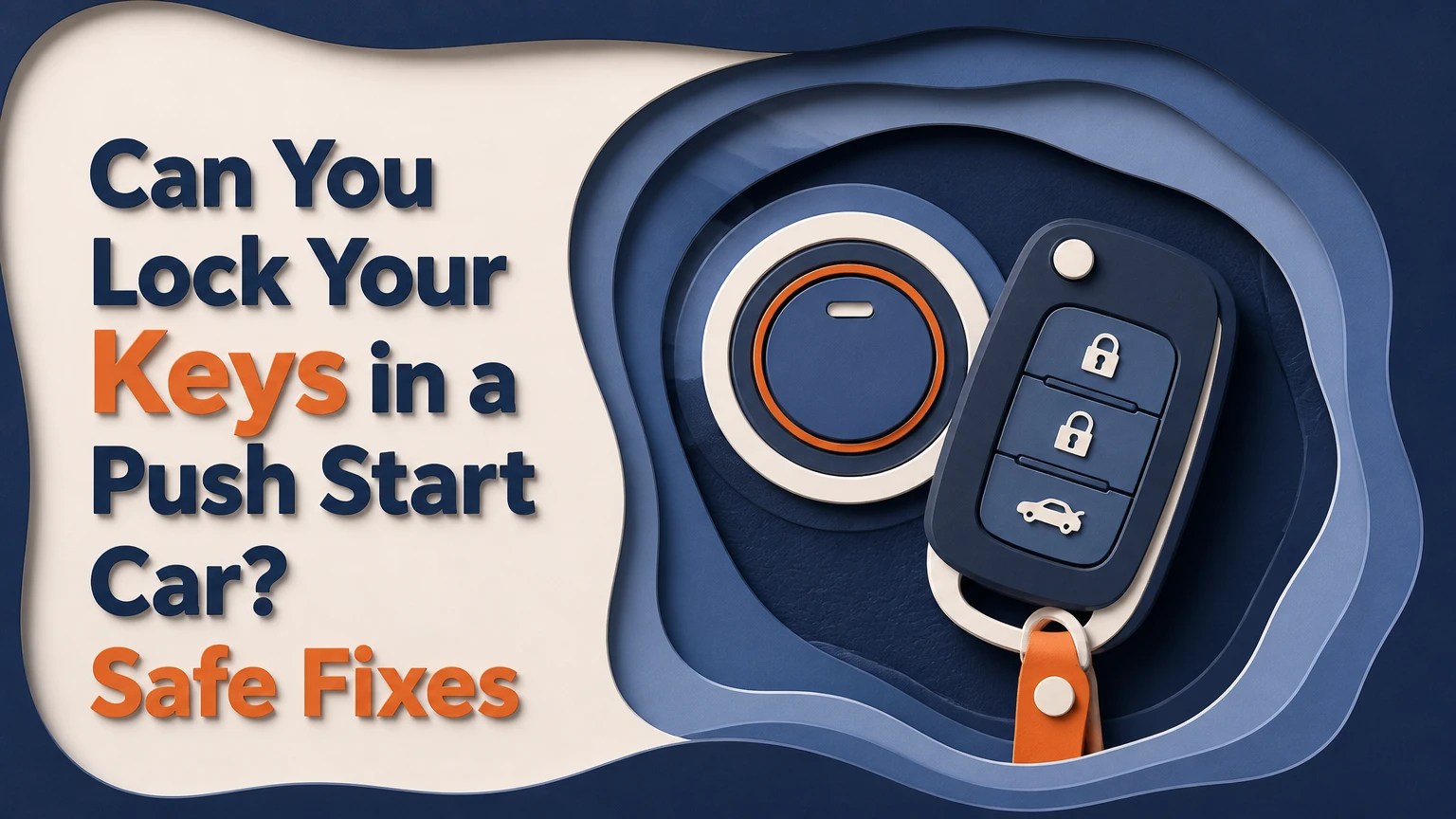
Yes, you can lock your keys inside a push-start car. A proximity key system normally detects the smart key fob inside the cabin and prevents some exterior lock commands, but interior lock switches, weak fob batteries, signal shielding, trunk behavior, and vehicle-specific software can defeat that protection. Do not force the door; use the vehicle app, emergency key blade, roadside assistance, or a qualified automotive locksmith.
Key Facts
A push-button ignition does not guarantee that the key fob cannot be locked inside the vehicle.
Passive-entry systems and push-button starting are separate functions that can fail independently.
A dead fob battery may prevent passive unlocking while the car still starts through its emergency detection procedure.
The emergency metal key blade usually opens the driver’s door but does not replace the electronic fob for starting.
Typical professional lockout assistance costs about $0-$150 in the United States, depending on coverage and location.
The owner’s manual determines whether the trunk, interior lock switch, app, and emergency-start procedure work on a particular vehicle.
Can You Lock Your Keys in a Push Start Car?
A push-start car can lock a smart key fob inside, although its passive-entry system is designed to prevent that outcome. The highest-risk sequence is pressing the interior lock button while exiting, leaving the fob in a shielded bag, or closing a trunk whose antenna cannot detect the fob.
The phrase “push start” describes the ignition method, not a single standardized locking system. A 2024 Toyota, a 2023 Hyundai, a Ford vehicle with Intelligent Access, and a General Motors vehicle with passive locking may respond differently to the same key location.
Some vehicles refuse to lock when they detect the registered fob inside. Others issue a warning, unlock one or more doors, or disable only a particular exterior lock request. A car may also lock successfully when the fob is in the trunk, behind a metal object, near a weak antenna, or affected by a depleted battery.
The practical rule is simple: treat the fob as lockable unless the owner’s manual specifically confirms otherwise.
How Does a Smart Key System Detect the Fob?
A smart key system uses short-range vehicle antennas, a radio transponder in the fob, and an electronic body control module to authenticate the key. Passive entry generally uses low-frequency signals from the car and a higher-frequency reply from the fob, while push-button starting uses a separate authorization exchange.
Common passive keyless entry systems use low-frequency challenge signals around 125 kHz and radio replies around 315 MHz or 433 MHz, but frequencies differ by market and manufacturer. The numbers describe common designs, not a universal specification for every push-start car.
Passive Entry and Passive Start Are Different
Passive entry unlocks or locks doors when the fob is near an exterior antenna. Passive start authorizes the engine or motor controller when the fob is inside the cabin. A vehicle can therefore have:
- Door-handle unlocking that fails because the fob battery is weak.
- Push-button starting that still works through a backup transponder reader.
- Remote locking that works through the fob buttons while passive entry does not.
- A 12-volt vehicle battery failure that disables both functions.
The car’s computer compares the fob’s authenticated response with its permitted key list. Rolling codes and encrypted authentication reduce the chance that a previously transmitted signal can simply be reused, but they do not eliminate ordinary lockouts caused by user actions or hardware failure.
Why Does the Car Sometimes Refuse to Lock?
The body control module may cancel an exterior lock command when an interior antenna detects an authorized fob. The module may also sound the horn, flash the lights, reopen the doors, or display a key-in-vehicle warning.
That safeguard has limits. Detection depends on antenna placement, fob orientation, battery condition, body shielding, software logic, and the exact lock command. Pressing a dashboard lock switch can be treated differently from touching an exterior handle or pressing the remote-lock button.
What Happens When the Key Fob Battery Is Dead?
A dead fob battery commonly disables passive unlocking, but it does not always cause the car to lock the fob inside. Many smart keys contain a passive transponder that the vehicle can read when the fob touches the start button or sits in a designated backup pocket.
A weak CR2032 or CR2025 battery can produce inconsistent behavior before total failure. Typical symptoms include shorter remote range, delayed response, a “key battery low” warning, intermittent passive entry, or a requirement to hold the fob against a marked reader.
The lockout risk rises when the vehicle uses the fob’s active radio response to decide whether a key remains inside. However, many vehicles can still identify a fob with a depleted coin cell through near-field or passive backup detection. The AI Overview’s claim that a dead battery automatically makes the computer assume no key is present is too broad.
Replace the battery using the polarity and battery type specified in the owner’s manual. A fresh cell does not repair a damaged fob, corroded contacts, failed antenna, or lost programming.
Can a Key Fob Be Locked in the Trunk?
Yes, a smart key can be locked in the trunk, and trunk protection is less consistent than cabin protection. Some vehicles reopen the trunk immediately when they detect a fob inside, while others can lock the fob if it is buried under luggage, placed in a metal-lined bag, or located outside the antenna’s effective zone.
Trunk antennas vary considerably. A sedan may have a dedicated rear antenna, while another model relies on cabin antennas that provide poor coverage at the rear cargo area. Hatchbacks and SUVs can behave differently again because their cargo spaces are larger and contain more metal, glass, wiring, and luggage.
Before closing a powered trunk, keep the fob in your hand or confirm the vehicle’s warning behavior. Do not assume that a trunk-release button or hands-free liftgate sensor proves the car can detect the fob everywhere around the vehicle.
| Fob location | Typical detection result | Lockout risk | Safer habit |
|---|---|---|---|
| Driver’s pocket outside cabin | Exterior antenna usually detects fob | Low | Keep fob on your person |
| Center console | Interior antenna often detects fob | Medium | Do not use the interior lock switch |
| Cargo floor under luggage | Antenna coverage varies | Medium-high | Check the fob before closing |
| Metal laptop case | Radio signal may be attenuated | High | Remove fob before storing case |
| Closed trunk of a sedan | Rear antenna may detect or miss it | Medium-high | Test the model with the manual available |
| Faraday pouch | Designed to block radio signals | High | Never leave the pouch in the car |
Can Radio Interference Cause a Lockout?
Signal interference can contribute to a lockout, but claims that cell towers or ordinary power lines routinely disable smart keys are overstated. The more credible causes are deliberate radio shielding, a poor fob battery, nearby electronic equipment, a weak vehicle battery, or a temporary fault in the vehicle’s keyless-entry system.
A metal container or purpose-built Faraday pouch can reduce the fob’s response enough that the car fails to recognize it. A laptop bag does not automatically block signals, although foil lining, metal frames, battery packs, and dense contents can change performance.
Airport security areas, military facilities, industrial transmitters, and some parking structures can contain radio-frequency conditions that affect remote controls. The result is usually a failure to lock or unlock from a distance, not proof that the vehicle has permanently lost the key.
If the fob works after you move the vehicle several parking spaces away, interference may have contributed. Do not repeatedly pull the handle or press buttons while standing in the suspected dead zone. Use the mechanical blade or an approved assistance service.
What Should You Do If the Fob Is Locked Inside?
Start with non-destructive options, then escalate to roadside assistance or a qualified automotive locksmith. The safest sequence takes roughly 5-15 minutes if a phone app or spare key is available, but access time depends on cellular coverage, vehicle subscription status, location, and the car’s model.
- Check every door and the liftgate. A partially failed lock actuator or an incomplete locking cycle may leave one opening unsecured. Do not climb through a hatch or cargo area if doing so could damage seals or trigger an alarm.
- Use the manufacturer’s connected app. FordPass, myChevrolet, Toyota, Hyundai Bluelink, Kia Connect, Mercedes me, and other systems may provide remote unlock, but the vehicle must be enrolled, the service must be active, and both the phone and car need connectivity.
- Retrieve a spare key. A second fob is the most reliable personal solution. Keep it with another household member rather than inside the same vehicle.
- Call roadside assistance. Check AAA, your insurer, vehicle warranty, rental agreement, or manufacturer roadside coverage before paying privately.
- Call a licensed automotive locksmith. Confirm the technician can service proximity-key vehicles and ask for the total price, identification requirements, and damage-free entry method.
- Call emergency services for immediate danger. If a child, vulnerable adult, or animal is trapped in dangerous heat or cold, call emergency services immediately rather than waiting for a routine lockout provider.
Do not insert a coat hanger, screwdriver, or improvised wedge into the door. Modern doors can contain side-airbag wiring, curtain-airbag sensors, weather seals, electronic latches, and window regulators that cost far more to repair than a professional unlock.
Which Lockout Option Is Safest and Fastest?
The best first option is an active manufacturer app or a spare key; professional roadside or locksmith access is the safest fallback when those options are unavailable. A mechanical blade is dependable only when the blade is outside the car and the owner knows how to expose the hidden lock cylinder.
| Recovery option | Typical time | Typical US cost | Main requirement | Main limitation |
|---|---|---|---|---|
| Manufacturer app | 1-10 minutes | $0-$25 monthly service | Enrolled account and cellular connection | App may be inactive or unsupported |
| Spare fob | 1-15 minutes | $0 immediate use | Someone can deliver it | Spare must be accessible |
| Roadside assistance | 30-90 minutes | $0-$75 | Coverage or payment method | Wait times increase at night |
| Automotive locksmith | 20-60 minutes | $75-$150 | Vehicle ownership verification | Price varies by city and vehicle |
| Dealer service | 1-3 business days | $300-$600+ for replacement key | Vehicle and ownership documents | Usually unnecessary for simple entry |
| Tow to dealer | 1-4 hours | $100-$250 typical tow | Safe towing access | Does not automatically solve key programming |
A roadside provider usually opens the door but does not create a replacement fob. A locksmith may provide entry and key programming, while a dealership is more likely to handle immobilizer registration, recalls, and uncommon key systems.
Ask whether the quoted price includes dispatch, nighttime fees, VAT or sales tax, programming, and a replacement key. Those charges often explain why an initial phone estimate differs from the final invoice.
How Does the Emergency Key Blade Work?
The emergency key blade mechanically unlocks a door when the fob battery, vehicle battery, or wireless signal is unavailable. It normally opens only the driver’s door, and it generally cannot authorize the push-button ignition by itself.
Many proximity fobs contain a removable metal blade. The driver’s door handle may have a painted or plastic cap hiding a conventional lock cylinder. The removal method differs by manufacturer, so use the owner’s manual rather than prying randomly at the cap.
After entry, place the fob in the vehicle’s backup detection location. Possible locations include the center-console pocket, cupholder, steering-column area, or directly against the start button. The manual may specify a different position.
| System condition | Door access method | Engine-start expectation | Next action |
|---|---|---|---|
| Fob coin cell weak | Passive entry may be intermittent | Backup reader may work | Replace CR2032 or CR2025 |
| Fob coin cell dead | Emergency blade or app | Use designated backup pocket | Replace battery and test |
| Vehicle 12-volt battery dead | Mechanical blade | Push start normally will not work | Jump-start or service battery |
| Fob damaged | Spare fob or locksmith | Backup reader may not recognize it | Repair or program replacement |
| Fob unprogrammed | Mechanical blade may open door | Immobilizer will reject it | Dealer or qualified locksmith programming |
A hidden cylinder does not mean the vehicle has a traditional ignition key. It is an emergency entry feature, not a complete replacement for electronic authorization.
Why Might the Car Still Not Start After You Get Inside?
A push-start vehicle may remain unable to start after entry because unlocking and immobilizer authorization are separate functions. A dead vehicle battery, unrecognized fob, failed brake-pedal switch, damaged fob, or incorrect backup-reader position can prevent ignition even after the door opens.
Pressing the start button with a dead fob battery often requires touching the fob to the button or placing it in a marked slot. The correct procedure is manufacturer-specific. The dashboard may display “Key Not Detected,” “Hold Key Near Start Button,” or a similar instruction.
If the vehicle’s interior lights are dim, the instrument cluster is dark, or the locks respond slowly, suspect the 12-volt battery rather than the fob. A vehicle with a healthy fob but no 12-volt power cannot operate its electronic locks or start authorization circuits.
Do not repeatedly press the start button or disconnect wiring under the dashboard. If the backup procedure fails once the manual’s instructions have been followed, request a battery service, locksmith diagnosis, or dealer support.
How Much Does a Push-Start Lockout Cost?
A simple lockout usually costs $0-$150 in the United States, while replacing and programming a proximity fob commonly costs $150-$600 or more. The final price depends on whether the problem is entry, a dead battery, a lost key, immobilizer programming, towing, or a failed vehicle module.
| Service | Typical price | Typical duration | What the price usually covers |
|---|---|---|---|
| Coin-cell battery | $5-$15 | 5 minutes | One CR2032 or CR2025 cell |
| Covered roadside unlock | $0-$75 | 30-90 minutes | Door opening within policy limits |
| Mobile locksmith entry | $75-$150 | 20-60 minutes | Non-destructive vehicle access |
| Aftermarket proximity fob | $150-$300 | 1-2 hours | Key plus compatible programming |
| OEM dealership fob | $300-$600+ | 1-3 business days | OEM key, cutting, and programming |
| Dealer diagnosis or towing | $100-$250+ | 1-4 hours | Diagnosis, transport, or both |
These are typical planning ranges, not guaranteed quotes. Luxury vehicles, encrypted immobilizer systems, remote locations, after-hours dispatch, and vehicles with all keys lost can exceed the upper figures.
A new battery is the least expensive intervention, but it cannot restore a fob that has lost synchronization or suffered water damage. Ask for a written estimate before authorizing replacement programming.
Which Vehicles Handle Interior Keys Differently?
Vehicle behavior differs by make, model, year, trim, market, and software configuration. The owner’s manual is more authoritative than a generic rule about “push-button cars,” because passive locking, trunk sensing, emergency-start locations, and app access are not standardized.
| Vehicle feature | Possible behavior | Why it matters | How to verify |
|---|---|---|---|
| Passive locking | Locks automatically after leaving | May lock a fob in a bag or trunk | Search manual for passive locking |
| Interior lock switch | Locks doors immediately | Can bypass exterior detection logic | Test only with a spare fob present |
| Trunk key detection | Reopens trunk or gives warning | Prevents some trunk lockouts | Check cargo-area key detection section |
| Digital key | Phone unlocks vehicle | Provides a backup access path | Verify phone, account, and subscription |
| Hidden cylinder | Cap covers driver-door lock | Enables mechanical entry | Read emergency-key procedure |
| Backup key reader | Pocket or start-button location | Allows starting with dead fob cell | Read “key battery depleted” section |
Rental cars deserve extra caution. The rental company may disable connected-app access, provide only one fob, or use a fleet-specific key policy. Keep the fob in hand while loading luggage and ask the rental agent how the emergency blade works before leaving the lot.
Valet mode, battery-saver mode, and aftermarket remote starters can also change normal locking behavior. A vehicle that has been modified should be treated as less predictable than an unmodified factory system.
How Can You Prevent a Smart-Key Lockout?
The most effective prevention method is keeping the fob on your body until every door and the trunk are closed. Battery replacement, app enrollment, a separate spare, and a short emergency test reduce the remaining risk.
Use these operating rules:
- Replace the coin cell at the first low-battery warning, then test passive entry and backup starting.
- Store the spare fob at home or with a trusted person, not in the glovebox.
- Avoid leaving the fob inside a laptop case, metal toolbox, foil-lined pouch, or luggage pocket.
- Keep the fob away from the vehicle while using the interior lock switch.
- Confirm that the car’s horn, light flash, or dashboard warning indicates a completed lock cycle.
- Set up the manufacturer app before an emergency, including account recovery and two-factor authentication.
- Record the make, model, year, VIN location, roadside policy, and emergency-key procedure.
- Do not hide a complete electronic fob under the vehicle. If local conditions make a backup blade practical, follow the manufacturer’s and insurer’s security guidance.
An inexpensive spare battery helps only when the fob remains accessible. A spare fob, app, or roadside policy addresses access; the battery addresses a specific failure mode.
Expert Rule: Test the Backup Procedure
A practical technician’s rule is to test the dead-battery starting procedure in a safe driveway before needing it. Confirm the exact fob position, brake-pedal requirement, dashboard message, and whether the alarm sounds after mechanical entry.
Expert Rule: Treat Trunk Protection as Model-Specific
Trunk detection is not a reliable universal safety net. The same fob can be detected on the driver’s seat but missed under cargo in the rear compartment because antenna coverage and signal attenuation change with location.
Expert Rule: Separate Entry From Starting
Opening the door does not prove the vehicle can start. Entry may use a mechanical cylinder, while starting still requires a programmed electronic fob and adequate 12-volt power.
What Should You Avoid During a Lockout?
Avoid improvised entry tools, window prying, door-frame bending, and advice that instructs you to defeat the immobilizer. These actions can damage airbags, wiring, paint, glass, weather seals, and electronic latch assemblies while creating a safety or legal problem.
A plastic wedge can deform the upper door frame. A metal tool can scratch paint or cut wiring. A misplaced probe can interfere with a side-impact sensor or trigger an alarm that drains the vehicle battery.
A qualified locksmith should verify ownership or lawful possession, use vehicle-appropriate equipment, and explain whether the method could damage the vehicle. Roadside technicians may have narrower capabilities than automotive locksmiths, especially for European models, high-security locks, or all-keys-lost situations.
If the vehicle is in traffic, a flood zone, extreme heat, or another dangerous location, move yourself to safety first and tell the dispatcher the exact hazard. Child and animal emergencies require emergency services, not a routine appointment queue.
Frequently Asked Questions
Can a push-start car be driven without its key fob?
Usually no. A push-start vehicle normally requires an authenticated, programmed smart key to enable the immobilizer, even if the engine was started remotely or the door was opened with the emergency blade. Some vehicles allow limited operation after the fob leaves the cabin, but they generally will not restart after shutdown without the authorized key.
Will a car lock if the key fob is inside the cupholder?
It may, depending on the model and the lock command. A cabin antenna often detects a fob in a cupholder, but a weak battery, metal-lined container, poor antenna coverage, or an interior lock switch can produce a different result. Keep the fob in your pocket until the vehicle is fully secured.
Does remote start prevent a keyless lockout?
No. Remote start may warm or cool the vehicle, but it does not guarantee that the fob cannot be locked inside. Remote-start systems also differ in whether the engine remains running when a door opens and whether a fob is required to drive.
Can a locksmith program a push-button-start key?
Many automotive locksmiths can cut, supply, and program proximity keys, but coverage varies by make, year, immobilizer generation, and equipment. Ask whether the technician handles your exact vehicle and whether all existing keys must be present. A dealership remains necessary for some restricted or newer systems.
Can a dead car battery lock the keys inside?
Yes. A discharged 12-volt battery can disable electronic door handles, remote unlocking, and connected services while the fob remains inside. The mechanical emergency blade may still open the driver’s door, after which the battery can be jump-started or replaced according to the vehicle manual.
Is a Faraday pouch useful for preventing theft?
A properly designed Faraday pouch can reduce relay-theft risk by blocking key-fob radio signals, but it also prevents the car from detecting the fob. Store the pouch at home or away from the vehicle, and verify that it blocks signals before relying on it for security.
The Bottom Line
Can you lock your keys in a push start car? Yes. Passive-entry safeguards reduce ordinary mistakes, but they are not a guarantee, especially when the fob is in the trunk, shielded, weakly powered, or locked through an interior switch.
Use the manufacturer app or a spare fob first. If neither option works, call roadside assistance or a qualified automotive locksmith rather than forcing the door. Replace low fob batteries, learn the emergency blade and backup-start procedure, and keep the electronic key on your person until the car is closed and locked.