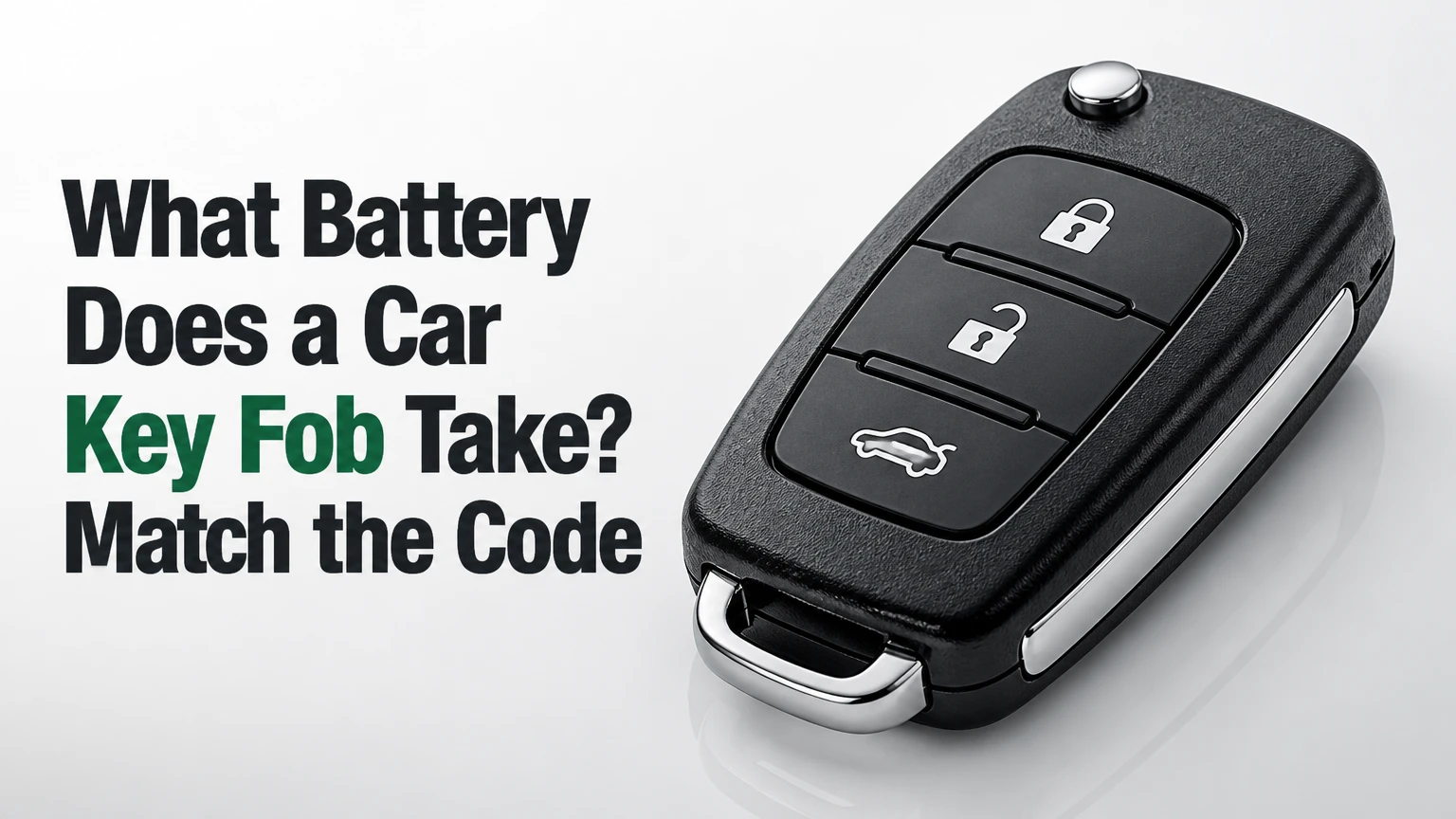
Most car key fobs take a 3-volt lithium coin-cell battery, with CR2032 the most common size. The correct battery is the exact code printed on the old cell, listed in the owner’s manual, or specified by the fob’s battery holder; common alternatives include CR2025, CR2016, CR1632, and CR2450.
Key Facts at a Glance
- A CR2032 battery measures approximately 20 mm across and 3.2 mm thick.
- A CR2025 has the same 20 mm diameter as a CR2032 but is 0.7 mm thinner.
- Most standard remote fobs use one 3-volt lithium coin cell, not two stacked cells.
- The plus sign usually faces the marked side of the battery holder, but orientation varies by design.
- A typical button-operated fob battery lasts 2-4 years; passive-entry fobs often last 1-3 years.
- Replacing the cell usually costs $2-$8 at retail and takes about 5-10 minutes.
What Battery Does a Car Key Fob Take?
The correct key-fob battery is the coin-cell code specified for that particular remote, not the battery associated with the car brand generally. A CR2032 is the most frequent choice, but a Toyota, Ford, Honda, BMW, or Mercedes-Benz fob may use another code depending on model year, remote design, and whether the key has passive entry; RAV4 fobs may use CR2032, CR1632, or CR2016 depending on design.
The fastest reliable check is to remove the old battery and read its code. The marking may appear on the top face, although worn lettering, a retaining clip, or a factory battery label can hide it. Confirm the code against the vehicle owner’s manual before purchasing a replacement.
Brand-based charts provide useful leads but cannot identify a battery with certainty. Even two vehicles with the same badge can use different remote housings, and aftermarket replacement fobs may contain a different holder from the original equipment remote.
How Do You Identify the Correct Coin Cell?
Use these checks in order:
- Read the code on the installed battery.
- Check the key-fob battery specification in the owner’s manual.
- Inspect the molded marking beside the battery holder.
- Compare the replacement’s diameter and thickness with the old cell.
- Contact a dealer or locksmith with the vehicle year, model, and remote part number if the marking is unreadable.
A VIN can help a dealer identify the original remote configuration, but a VIN lookup does not always reveal an aftermarket fob or a previously replaced key shell. Physical confirmation remains the final check.
How Does a Key-Fob Battery Work?
A key-fob battery supplies low-voltage DC power to the remote’s microcontroller, button circuits, indicator light, and radio transmitter. When a driver presses lock or unlock, the controller creates a coded radio-frequency transmission that the vehicle receiver evaluates before operating the locks.
Modern remotes generally use encrypted or rolling-code authentication rather than broadcasting a simple permanent command. Passive-entry fobs add a low-power receiver and periodic communication, so the vehicle can detect the key nearby without a button press.
A weak battery can reduce transmission range before the buttons stop working completely. The car may also display a “key battery low” warning, although that warning depends on vehicle software and fob design. The battery powers communication; it does not normally erase the vehicle’s immobilizer pairing when removed briefly.
Does a Dead Key-Fob Battery Stop the Car From Starting?
A dead remote battery usually stops remote locking and passive-entry detection, but it does not automatically disable the engine immobilizer. Many vehicles contain a passive transponder or backup detection method that allows starting after the fob is placed in a specified location.
Common backup locations include the center-console slot, cup holder, steering-column area, dashboard pocket, or a marked starting recess. The exact procedure differs by manufacturer. The owner’s manual is more authoritative than a generic internet sequence because Toyota, Ford, BMW, Volkswagen, and Hyundai use different backup positions.
Which Coin-Cell Batteries Fit Car Key Fobs?
The main automotive coin cells are all nominally 3-volt lithium batteries, but they differ in diameter and thickness. A battery can have the correct voltage and still fail because it is too thin for the contacts, too thick for the casing, or the wrong diameter for the holder.
| Battery code | Diameter | Thickness | Typical key-fob use |
|---|---|---|---|
| CR2016 | 20 mm | 1.6 mm | Slim older remotes and selected Toyota designs |
| CR2025 | 20 mm | 2.5 mm | Thin remote housings and selected Mazda or Mercedes-Benz fobs |
| CR2032 | 20 mm | 3.2 mm | Common standard remote and smart-key size |
| CR1632 | 16 mm | 3.2 mm | Compact fobs with smaller battery holders |
| CR2450 | 24 mm | 5.0 mm | Larger proximity remotes and selected BMW or Volvo designs |
What Do the Numbers on a CR2032 Mean?
The “CR” designation identifies a round lithium manganese-dioxide coin cell under the common IEC naming convention. The first two digits, 20, indicate an approximate 20 mm diameter, while the final two digits, 32, indicate an approximate 3.2 mm thickness.
The same logic applies to CR2025, CR2016, CR1632, and CR2450. Dimensions are nominal, so small manufacturing tolerances exist, but the code remains the correct shopping reference for a compatible holder.
The code does not identify capacity precisely. Two CR2032 cells from different manufacturers may have different rated capacities, discharge performance, shelf dates, or temperature specifications. For a key fob, correct physical fit and fresh stock generally matter more than choosing the highest advertised capacity.
Can You Replace a CR2032 With a CR2025?
A CR2025 may work in a holder designed for a CR2032 because both cells are 20 mm wide and provide approximately 3 volts, but the thinner CR2025 can make unreliable contact. A CR2032 should not be forced into a housing designed for a CR2025 because the extra 0.7 mm can distort contacts or prevent the case from closing.
| Substitution | Electrical voltage | Main mechanical issue | Practical verdict |
|---|---|---|---|
| CR2025 for CR2032 | 3.0 V nominal | 0.7 mm too thin | Temporary only if contacts hold firmly |
| CR2032 for CR2025 | 3.0 V nominal | 0.7 mm too thick | Do not force into the housing |
| CR2016 for CR2025 | 3.0 V nominal | 0.9 mm too thin | Usually unreliable |
| CR2016 for CR2032 | 3.0 V nominal | 1.6 mm too thin | Poor contact and lower capacity |
| CR1632 for CR2032 | 3.0 V nominal | 4 mm smaller diameter | Will not properly fit a 20 mm holder |
| Two CR2016 for CR2032 | 6.0 V combined | Excess thickness and overvoltage | Never use |
The practitioner rule is simple: match the printed code whenever possible. A correct-voltage substitute is not automatically a correct replacement.
Which Key-Fob Battery Brand Should You Buy?
Choose a fresh lithium coin cell from a reputable manufacturer, such as Panasonic, Energizer, or Duracell, and buy from a retailer with good stock rotation. A recognized brand does not compensate for an incorrect size, damaged packaging, or a battery that has spent years in a hot warehouse.
Duracell CR2032 cells may include a bitterant coating intended to discourage ingestion by children. That coating can occasionally interfere with a tight contact design, so wipe the cell with a clean, dry cloth if the fob fails immediately after installation. Do not scrape the battery aggressively or apply liquid to the circuit board.
Energizer and Panasonic lithium coin cells are common choices for vehicles exposed to cold winters or hot interiors. Temperature claims depend on the specific product datasheet, and ordinary key-fob duty does not require a specialty industrial cell.
| Buying option | Typical price | Best use | Main limitation |
|---|---|---|---|
| Single branded cell | $2-$5 | Immediate replacement | Highest price per battery |
| Branded two-pack | $4-$8 | One spare for home | Spare may age unused |
| Six-pack online | $5-$12 | Multiple household fobs | Counterfeit or old stock risk |
| Dealer-installed cell | $15-$50 | Difficult sealed fob | Labor and markup |
| Locksmith replacement | $5-$20 | Battery plus inspection | Availability varies by location |
Do not buy a rechargeable substitute unless the fob manufacturer explicitly specifies one. Rechargeable coin cells can have different voltage characteristics, charging requirements, and dimensions from a disposable CR-series cell.
How Long Does a Car Key-Fob Battery Last?
A standard button-operated key fob typically lasts 2-4 years, while a passive-entry or always-available proximity key often lasts 1-3 years. Actual life depends on button frequency, polling behavior, temperature exposure, battery capacity, and whether a button is being pressed inside a pocket or bag.
| Fob type | Typical battery life | Common early-drain cause | First symptom |
|---|---|---|---|
| Button-only remote | 2-4 years | Frequent lock-button use | Shorter operating range |
| Remote-start fob | 1-3 years | Repeated start commands | Intermittent response |
| Passive-entry smart key | 1-3 years | Continuous proximity detection | Vehicle warning message |
| Damaged or stuck-button fob | Days to months | Button held continuously | Rapid battery depletion |
| Spare fob in storage | 3-5 years | Shelf aging and heat | Weak response at first use |
Heat accelerates chemical aging, so a coin cell stored in a vehicle glovebox may lose useful life faster than one kept indoors. A spare battery belongs in a cool, dry drawer, not loose beside metal objects that can bridge its terminals.
How Do You Replace a Car Key-Fob Battery?
Replacing a car key-fob battery usually takes 5-10 minutes, costs $2-$8 for the cell, and requires a small flat screwdriver or plastic pry tool. The factor that determines success is correct battery orientation and complete seating in the holder.
Before You Start
- Time: 5-10 minutes
- Difficulty: Easy, with moderate care for sealed or clip-covered housings
- Cost: $2-$8 retail, or $15-$50 through a dealer
- Materials: One exact replacement coin cell, clean microfiber cloth
- Tools: Plastic pry tool or small flat screwdriver
- Prerequisite: Confirm the battery code and note the positive-side orientation
Step 1: Remove the Emergency Key
Press the release latch and slide out the mechanical key if the fob contains one. The exposed slot often provides the intended opening point, but some housings have a separate seam.
You will know it worked when the emergency key comes out without bending. A common mistake is prying at the wrong seam and breaking decorative trim rather than separating the case.
Step 2: Open the Fob Case
Insert the mechanical key, plastic tool, or small flat screwdriver into the marked notch. Twist gently in short movements around the seam until the retaining clips release.
Use controlled pressure. If the casing flexes substantially without separating, stop and look for a hidden latch or second screw. Forcing a sealed shell can break clips that cannot be restored with adhesive.
Step 3: Record the Battery Orientation
Before removing the cell, photograph the holder or write down which side faces upward. Many fobs place the positive side upward, but some designs reverse the orientation.
The plus sign on the replacement battery must align with the fob’s positive contact. Orientation is more reliable than assuming the printed face always points outward.
Step 4: Remove the Old Cell
Release the retaining clip with a plastic tool or fingernail, then lift the coin cell from its edge. Avoid levering against the circuit board, antenna, surface-mounted components, or thin contact spring.
Metal tweezers can short the battery if they touch both terminals at once. They do not necessarily drain a cell instantly, but preventing a short is safer and avoids sparks, heat, or accidental contact damage.
Step 5: Install the New Battery
Wipe the new cell with a dry cloth, place the edge under the fixed clip, and press the opposite edge down until it is fully retained. Do not bend the holder to make a loose substitute fit.
You will know it worked when the cell lies flat, the contact spring touches it firmly, and the battery cannot rattle when the fob is gently moved. A battery that sits at an angle can cause intermittent operation.
Step 6: Close and Test the Fob
Align the case halves and press around the perimeter until every clip engages. Reinsert the mechanical key, then test lock and unlock from several meters away.
A successful replacement produces a consistent response and a normal operating range. Test the spare fob too if the vehicle has one, because a second remote helps separate a battery problem from a vehicle receiver problem.
Why Does the Fob Not Work After a Fresh Battery?
A key fob that fails after a battery change usually has reversed polarity, poor contact, an incorrectly sized cell, a stuck button, or a damaged circuit board. Recheck the mechanical fit before attempting reprogramming, because most ordinary battery swaps do not erase the fob’s pairing.
Use this diagnostic sequence:
- Confirm the code: Compare the installed cell with the old code, not only the voltage.
- Check polarity: Verify the plus sign against the holder marking or your original photograph.
- Inspect contact pressure: Ensure the spring tab touches the battery surface.
- Clean contamination: Wipe accessible contacts with a small amount of isopropyl alcohol, then let them dry completely.
- Test a second battery: A new cell can be depleted, damaged, or old stock.
- Check the buttons: A stuck button can drain the cell and prevent normal commands.
- Test near the vehicle: Range loss may indicate interference or a weak battery.
- Try the spare fob: If both fobs fail, inspect the vehicle rather than repeatedly replacing cells.
A vehicle receiver fault, blown fuse, antenna problem, radio interference, or immobilizer issue can mimic a dead remote. Reprogramming is vehicle-specific; some models use an ignition-and-button sequence, while others require diagnostic equipment.
Can You Start a Car With a Dead Key Fob?
Most modern vehicles can start with a dead key-fob battery by placing the fob at the manufacturer’s backup detection point or touching it to the start button. The passive transponder can remain readable even when the coin cell cannot power remote transmission.
Vehicles with traditional ignition switches may require the mechanical emergency key to unlock the door, followed by a transponder-based starting procedure. The backup location varies by model, so consult the owner’s manual rather than guessing.
Do not assume a dead fob means a dead car battery. If the interior lights, dashboard, and other fob functions work normally but the remote has short range, the coin cell is the likely fault. If the entire vehicle is unresponsive, vehicle battery diagnosis comes first.
How Should You Handle and Dispose of Coin Cells?
Lithium coin cells are small ingestion hazards and should be kept away from children and pets. The U.S. Consumer Product Safety Commission warns that swallowed button batteries can cause severe internal injury quickly, so tape both sides of a used cell and place it in a secured recycling container.
Never carry a loose coin cell with keys, coins, or metal tools. A short circuit can generate heat and damage the cell. Do not install a swollen, corroded, leaking, dented, or visibly damaged battery.
Use a household battery recycling program, retailer collection point, or local hazardous-waste service where available. Do not burn a coin cell or place a damaged lithium battery into ordinary household recycling unless local instructions specifically allow it.
When Should You Replace the Whole Fob?
Replace or repair the fob housing when the battery holder is broken, the case cannot latch, buttons are missing, or water has reached the circuit board. A fresh battery cannot correct damaged traces, corroded contacts, a failed transmitter, or a cracked antenna.
A locksmith can often move working electronics into a replacement shell at a lower cost than buying and programming a complete dealer fob. A dealer may be necessary when the immobilizer transponder is damaged, the key is lost, or the replacement remote requires vehicle-specific registration.
Water damage deserves prompt attention. Remove the battery, do not power the board, and have the electronics inspected before corrosion spreads. Drying alone does not reverse residue damage.
Which Battery Choice Fits Your Situation?
The best choice for most drivers is one fresh, correctly coded branded cell installed according to the original polarity. A commuter with a CR2032 fob can keep one sealed spare at home, while an owner of a passive-entry key should replace the cell promptly after the first low-battery warning.
- Everyday commuter: Buy a branded two-pack and store the spare indoors.
- Cold-climate driver: Choose fresh lithium cells and avoid leaving spares in a freezing vehicle.
- Infrequent driver: Inspect the spare’s package date and test the remote before a long trip.
- Multiple-vehicle household: Record each fob’s code because the vehicles may not share a battery size.
- Luxury or sealed-fob owner: Use the owner’s manual or a locksmith if the casing has no obvious opening point.
- Budget-conscious driver: A reputable multipack offers lower cost, but verify seller quality and expiration information.
The battery code matters more than brand prestige. Correct fit comes first.
Frequently Asked Questions
Can I use any 3-volt battery in a key fob?
No. A 3-volt rating identifies electrical output but not physical compatibility. A CR1632, CR2025, and CR2032 all provide approximately 3 volts, yet their diameters or thicknesses differ. Use the code specified by the old cell, owner’s manual, or holder, and never force a battery into place.
Do key fobs need to be reprogrammed after battery replacement?
Usually not. A normal coin-cell replacement does not erase the remote’s stored identification, especially when the battery is changed promptly. Some vehicles may require a synchronization sequence after prolonged power loss, but the procedure differs by manufacturer and should come from the owner’s manual or an authorized locksmith.
Why does a key fob battery keep dying?
Repeated battery failure usually indicates a stuck button, moisture, damaged contacts, poor-quality or old cells, or a fob that remains active near the vehicle. If a new battery dies within days or weeks, inspect the housing and buttons instead of installing another cell. The circuit may need repair.
Can I leave a spare key-fob battery in the glovebox?
A spare can remain in a glovebox temporarily, but indoor storage is better because vehicle interiors experience high heat and cold. Keep the cell in its original package, away from keys and coins. Replace a spare that is corroded, damaged, unsealed, or past the manufacturer’s recommended shelf period.
What if the battery code is unreadable?
Compare the old cell’s diameter and thickness with the holder, inspect the owner’s manual, and contact the manufacturer, dealer, or automotive locksmith using the fob part number. Do not guess from the car badge. Remote revisions within one model range can use different coin-cell sizes.
Is CR2032 the same as CR2025?
No. CR2032 and CR2025 share a 20 mm diameter and nominal 3-volt output, but CR2032 is 3.2 mm thick while CR2025 is 2.5 mm thick. A CR2025 may work temporarily in some CR2032 holders, but the thinner cell can lose contact and should not be treated as an equivalent replacement.
The Bottom Line
The answer to “what battery does a car key fob take” is usually a 3-volt lithium coin cell, most often CR2032, but the exact battery is the code printed on the old cell or specified for the fob. Match the code, diameter, thickness, and polarity, then test the remote and the vehicle’s backup-start procedure.