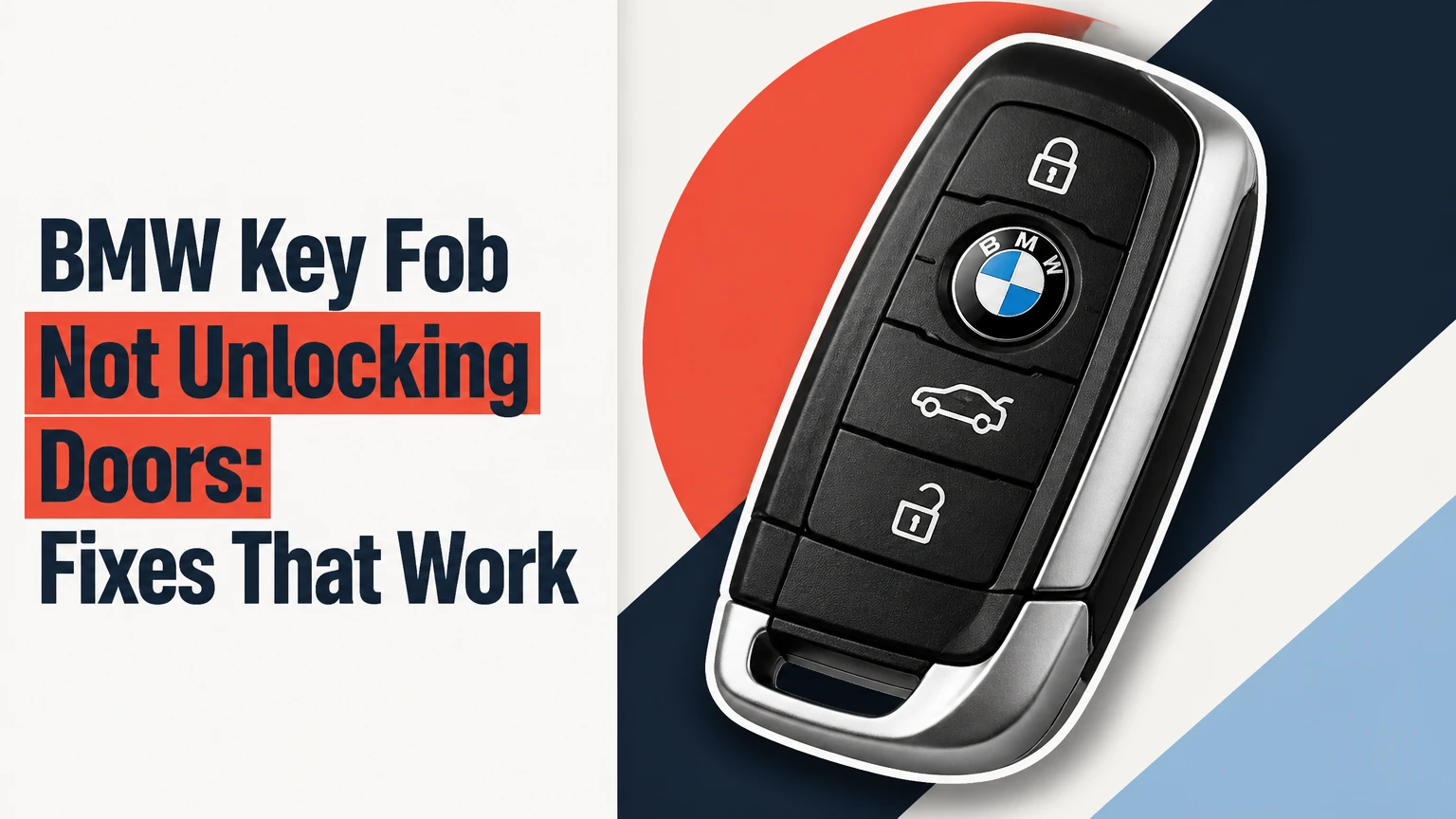
A BMW key fob that is not unlocking the doors usually has a depleted battery, lost remote synchronization, damaged buttons, vehicle low voltage, or a central-locking fault. Use the mechanical key for immediate entry, hold the fob against the steering-column detection mark to start newer BMWs, then test the battery and identify whether every door or only one door is affected.
Key Facts at a Glance
- A BMW key fob can still start the vehicle after its remote battery has failed.
- The hidden mechanical key blade usually unlocks the driver’s door manually.
- Newer BMW keys commonly use a replaceable CR2032 or CR2450 coin cell.
- E46, E39, and E53 diamond keys commonly contain rechargeable VL2020 cells.
- A fob that starts the car but cannot unlock doors points toward remote transmission, antenna, or body-module faults.
- A fob that unlocks every door except one usually indicates a failed door-lock actuator.
How Do You Get Inside Immediately?
Use the BMW key’s internal metal blade to unlock the driver’s door, even when the remote buttons produce no response. BMW door handles with Comfort Access often conceal the lock cylinder beneath a removable handle cap, so forcing the blade into the handle can damage the trim.
- Press the release button on the fob and slide out the metal key blade.
- Look for a visible key cylinder on the driver’s door.
- If no cylinder is visible, inspect the underside or rear edge of the handle cap for a small release slot.
- Insert the blade into the slot only far enough to release the cap, then remove the cap carefully.
- Insert the blade into the exposed cylinder and turn it to unlock the door.
- Refit the cap by aligning its tabs before pressing it into place.
The mechanical key may unlock only the driver’s door. That behavior is normal on many BMW models because the physical cylinder operates one door while the electronic central-locking system controls the others.
What If the Mechanical Lock Will Not Turn?
Do not apply heavy torque to a key that will not rotate. A seized cylinder, frozen moisture, damaged blade, or disconnected lock linkage can make the emergency entry method fail, and twisting harder can break the blade inside the cylinder.
Use a lock-safe lubricant intended for automotive cylinders, not a thick grease. In freezing weather, warm the key and use a proper de-icer; never pour boiling water into the lock. If the cylinder remains immobile, call BMW Roadside Assistance or an automotive locksmith, particularly if the alarm activates after manual entry.
How Can You Start the BMW With a Dead Fob?
Hold the BMW key fob against the marked key-detection area while pressing the Start/Stop button and depressing the brake pedal. On many newer BMWs, the detection mark is on the right side of the steering column, although the exact position varies by model and owner’s manual.
- Enter the vehicle with the mechanical blade.
- Sit in the driver’s seat and close the doors.
- Press and hold the brake pedal.
- Place the fob directly against the key icon or marked detection zone.
- Press the Start/Stop button once.
- Keep the fob in position for several seconds if the vehicle does not respond immediately.
BMW owner manuals describe this procedure with wording similar to “hold the vehicle key against the marked area,” but the marked area differs between model years. A fob with a dead coin cell may still contain a functioning immobilizer transponder, allowing the BMW to authorize starting at close range.
You will know the procedure worked when the instrument cluster wakes, the engine starts or the vehicle enters drive-ready mode, and a key-not-detected warning disappears. If the car still shows no response, test the spare key before assuming the primary key is defective.
Which BMW Key Battery Do You Need?
The correct BMW key battery depends on the fob generation, not simply the vehicle’s model year. Modern rectangular and metal fobs generally use a replaceable CR2032 or CR2450, while older diamond-shaped keys often use a soldered rechargeable VL2020 cell.
| BMW key type | Common BMW examples | Typical battery | Replacement method |
|---|---|---|---|
| Diamond-shaped key | E46, E39, E53 | VL2020 rechargeable | Case cutting and soldering |
| Rectangular F-series key | F30, F10, F15 | CR2032 or CR2450 | Open cover and replace |
| Sleek G-series key | G20, G30, G05 | CR2032 | Open service panel |
| BMW Display Key | Selected 7 Series, i8, X models | Rechargeable lithium-ion | USB or wireless charging |
| Digital Key phone setup | Many 2021-and-newer models | Phone battery | Charge phone and verify pairing |
Check the marking on the old battery before purchasing a replacement. CR2032 and CR2450 cells share a 20-millimeter diameter but have different thicknesses, so the wrong cell can prevent the cover from closing or fail to contact the terminals.
How Do You Replace the Battery Safely?
Open a replaceable-battery BMW fob with the integrated blade or a plastic pry tool, remove the old cell, and install the new cell with the positive side facing the marking inside the holder. Avoid metal screwdrivers across the battery terminals because a short circuit can damage the key electronics.
Typical replacement time is 5-10 minutes and typical battery cost is $3-$12. After replacement, test lock, unlock, trunk release, and comfort-entry functions from several distances. A new battery that works only within a few feet suggests an antenna, transmitter, or vehicle-receiver problem rather than another bad battery.
Can You Resynchronize an Older BMW Key?
Older E-chassis BMW keys can lose remote synchronization, and the standard initialization sequence may restore the buttons without replacing the key. The procedure applies mainly to older systems such as many E46, E39, E53, and related vehicles; F-series and G-series keys generally use a different recognition system.
- Enter the BMW and close all doors.
- Insert the key into the ignition.
- Turn the key briefly to Position 1, then switch it off and remove it within five seconds.
- Press and hold the unlock button.
- While holding unlock, press the lock button three times within approximately 10 seconds.
- Release the unlock button.
- Watch for the locks to cycle, which confirms initialization.
- Repeat the sequence for additional keys within the same session.
The exact ignition positions and timing can vary by E-chassis system. If the locks do not cycle, verify that the battery is installed correctly and try the spare key. Do not repeatedly apply the older sequence to a newer BMW, because F-series and G-series vehicles do not normally use that manual resynchronization routine.
Why Does the Fob Work Close Up but Not Remotely?
A BMW key fob that works only beside the vehicle usually has a weak battery, damaged transmitter, radio interference, or a vehicle antenna fault. Comfort Access may fail first because passive entry requires the fob to communicate reliably with several antennas around the vehicle.
Test the fob at distances of approximately 1 meter, 5 meters, and 15 meters in an open area. Compare the result with the spare key. If both keys have poor range, suspect the vehicle receiver or diversity antenna; if only one key has poor range, suspect that key.
On some newer BMW keys, motion-sensitive sleep behavior reduces unnecessary transmission while the fob remains still. Move the key, wait several seconds, and test again. Keep the fob away from a mobile phone, metal wallet, wireless charging pad, and other keys during diagnosis.
What Does the Diversity Antenna Do?
The diversity antenna amplifier receives radio-frequency commands from the key fob and forwards them to the body-control system. BMW wagons, hatchbacks, and SUVs often locate related antenna components near the rear spoiler, tailgate, or C-pillar, where water intrusion can cause intermittent remote failure.
Poor radio reception can support this diagnosis because the antenna assembly may serve both radio and remote functions. Wet headliners, damp tailgate trim, corrosion near the rear glass, and remote failure after heavy rain are strong clues. Water damage should be repaired before replacing a key, since a new fob will not correct a leaking antenna amplifier.
What If the Fob Unlocks Some Doors?
A BMW key fob that unlocks some doors but not one specific door most often has a failed lock actuator, latch mechanism, wiring connection, or local fuse. A transmitter problem normally affects the locking command across the vehicle rather than isolating one door.
| Symptom | Most likely area | Useful confirmation test | Typical repair direction |
|---|---|---|---|
| All doors ignore both keys | Vehicle receiver, fuse, body module | Test interior lock button | Electrical diagnosis |
| One door stays locked | Door actuator or latch | Operate interior and exterior handles | Replace actuator or latch |
| Doors lock but do not unlock | Unlock relay, actuator, wiring | Test manual interior release | Module or actuator diagnosis |
| Trunk responds, doors do not | Central-locking circuit | Compare all fob buttons | Scan body module |
| Interior button also fails | GM5, FEM, BDC, fuse | Check every locking input | Module and power-supply test |
The E46 General Module 5, commonly called the GM5, is associated with central-locking relay failures. Newer BMWs use different body electronics, including FEM or BDC systems, so a technician must identify the chassis before selecting a module diagnosis.
How Do You Separate a Fob Fault From a Car Fault?
Use the spare key, the interior lock switch, the mechanical cylinder, and the vehicle’s starting response to isolate the failed component. A single test cannot identify every BMW central-locking fault because the remote transmitter, receiver, body module, wiring, and actuators operate as separate parts of the system.
| Test result | Probable diagnosis | Next action |
|---|---|---|
| Primary key fails, spare key works | Primary battery or electronics | Replace battery or repair key |
| Both keys fail, interior switch works | Receiver or key-frequency issue | Inspect antenna and scan module |
| Both keys and interior switch fail | Vehicle power, fuse, or body module | Check battery voltage and fuses |
| Key starts car but buttons fail | Remote battery, transmitter, receiver | Test range and replace cell |
| One door fails mechanically and electronically | Actuator or latch | Inspect door hardware |
| No key starts the vehicle | Recognition, immobilizer, or car battery | Use detection zone and diagnostic scan |
A typical healthy vehicle battery should measure approximately 12.4-12.7 volts after resting, although voltage alone does not prove battery condition. Low vehicle voltage can disable comfort functions, create multiple unrelated warnings, and make a key-fob fault appear more serious than it is.
What Common Mistakes Make the Problem Worse?
BMW owners often replace the key before testing the spare, buy the wrong coin cell, or force the hidden door-lock cap. These mistakes increase cost and can turn a simple battery problem into broken trim or damaged electronics.
- Using a CR2032 instead of a CR2450: Confirm the old cell marking and holder depth.
- Installing the coin cell upside down: Match the positive symbol inside the fob.
- Assuming a dead remote battery means a dead immobilizer chip: Use the steering-column detection procedure.
- Programming a used key from an online marketplace: Many BMW keys remain paired to their original vehicle and cannot be freely reassigned.
- Replacing an actuator when every door fails: Test the interior switch and spare key first.
- Ignoring water intrusion: Inspect the tailgate, rear spoiler, C-pillar, and trunk trim after rain-related failures.
An electronics repair shop can sometimes replace a rechargeable VL2020 cell or transfer a working circuit board into a compatible shell. That repair is appropriate only when the board, transponder, and buttons remain serviceable.
How Much Does BMW Key Replacement Cost?
Typical BMW key replacement costs range from $10 for a coin cell to $650 or more for a dealer-supplied smart key, depending on the fob type, vehicle generation, location, and programming requirement. A qualified European-vehicle locksmith is often less expensive than a dealership but may not support every CAS or BDC system.
| Option | Typical cost | Typical time | Best use |
|---|---|---|---|
| Coin-cell replacement | $3-$12 | 5-10 minutes | Modern replaceable fob |
| VL2020 repair | $15-$80 | 1-3 hours | Older diamond key |
| Replacement shell | $10-$50 | 30-90 minutes | Worn buttons or cracked case |
| Automotive locksmith | $250-$450 | Same day | Lost or damaged key |
| BMW dealership | $400-$650+ | 1-2 days | VIN-ordered replacement |
Dealerships generally require proof of ownership, identification, and vehicle information before ordering a security key. Locksmith pricing depends on whether the technician can access the vehicle, cut the emergency blade, and program the specific immobilizer generation.
A replacement key is not a universal remote. Used BMW keys may be locked to their original vehicle identification number, and a seller’s claim that a key is “programmable” does not guarantee compatibility with CAS4, FEM, or BDC systems.
What Alternatives Work If the Fob Fails?
The mechanical blade, interior locking switch, BMW Digital Key, spare fob, and roadside assistance are the practical alternatives when a BMW remote stops working. Digital Key availability depends on the vehicle, phone, market, software version, and owner profile.
BMW Digital Key uses compatible iPhone or Android hardware and may use NFC or ultra-wideband features, depending on the implementation. NFC-equipped phones can sometimes provide limited access after the phone battery is exhausted, but the duration and behavior depend on the phone and BMW configuration, so Digital Key should not replace a charged spare key during a long trip.
For a stranded driver, the safest order is:
- Try the spare key.
- Use the mechanical blade.
- Start with the detection-zone procedure.
- Check for BMW Digital Key access.
- Contact roadside assistance if the cylinder, alarm, or immobilizer creates a problem.
When Should You Stop Troubleshooting?
Stop DIY troubleshooting when the lock cylinder will not turn, the key blade is bending, water has reached electronic modules, or the vehicle rejects both known-good keys. A locksmith or BMW specialist can prevent broken trim, damaged immobilizer wiring, and unnecessary module replacement.
Professional diagnosis is especially appropriate when the vehicle has a dead battery, a persistent alarm, a flooded trunk area, or a recently replaced body-control module. Module coding and key authorization involve vehicle security systems, so avoid unsupported bypass tools and disclose all existing keys to the technician.
BMW Key Fob Not Unlocking Doors: The Bottom Line
A BMW key fob not unlocking doors is most often fixed by replacing the correct battery, using the emergency blade, or restoring synchronization on an older E-chassis key. Test the spare key and interior lock switch before buying a replacement; if the BMW starts but remote entry fails, inspect the transmitter, diversity antenna, and body-control system rather than the immobilizer.
Frequently Asked Questions
Will a BMW start if the key fob battery is dead?
Yes, many BMW vehicles can start with a dead remote battery because the immobilizer transponder can be read at close range. Enter with the mechanical blade, hold the fob against the marked steering-column detection area, press the brake, and press Start/Stop. The exact detection position varies by model.
Why does my BMW key lock the doors but not unlock them?
A BMW key that locks but does not unlock may have a worn unlock button, damaged circuit contact, failed unlock relay, or actuator problem. Test the second key and interior unlock switch. If the interior switch also fails, investigate the vehicle’s central-locking module rather than replacing the fob.
How long do BMW key fob batteries last?
A replaceable BMW key battery commonly lasts one to three years, with Comfort Access often shortening that interval because passive-entry communication increases usage. A rechargeable diamond-key battery can last many years but may fail after extended service life, especially when its internal cell no longer charges in the ignition.
Can a locksmith make a BMW key without the original?
A qualified automotive locksmith may create and program a BMW key without the original, but capability depends on the chassis, immobilizer generation, vehicle access, and local security rules. The locksmith will normally require proof of ownership. Some newer CAS, FEM, and BDC systems require specialist equipment or dealer support.
Can cold weather stop a BMW key fob from working?
Cold weather can reduce coin-cell output and expose a marginal battery, although it rarely causes a healthy key to fail completely. Warm the fob naturally, test the spare, and replace the battery if range improves indoors. Do not heat the key with a flame, heat gun, or boiling water.
Does replacing the BMW key battery require programming?
Replacing a battery in a modern BMW key normally does not require programming, provided the key electronics remain intact and the correct cell is installed. Older E-chassis keys may need remote initialization after battery work. A new replacement key, unlike a battery, may require vehicle-specific authorization or programming.