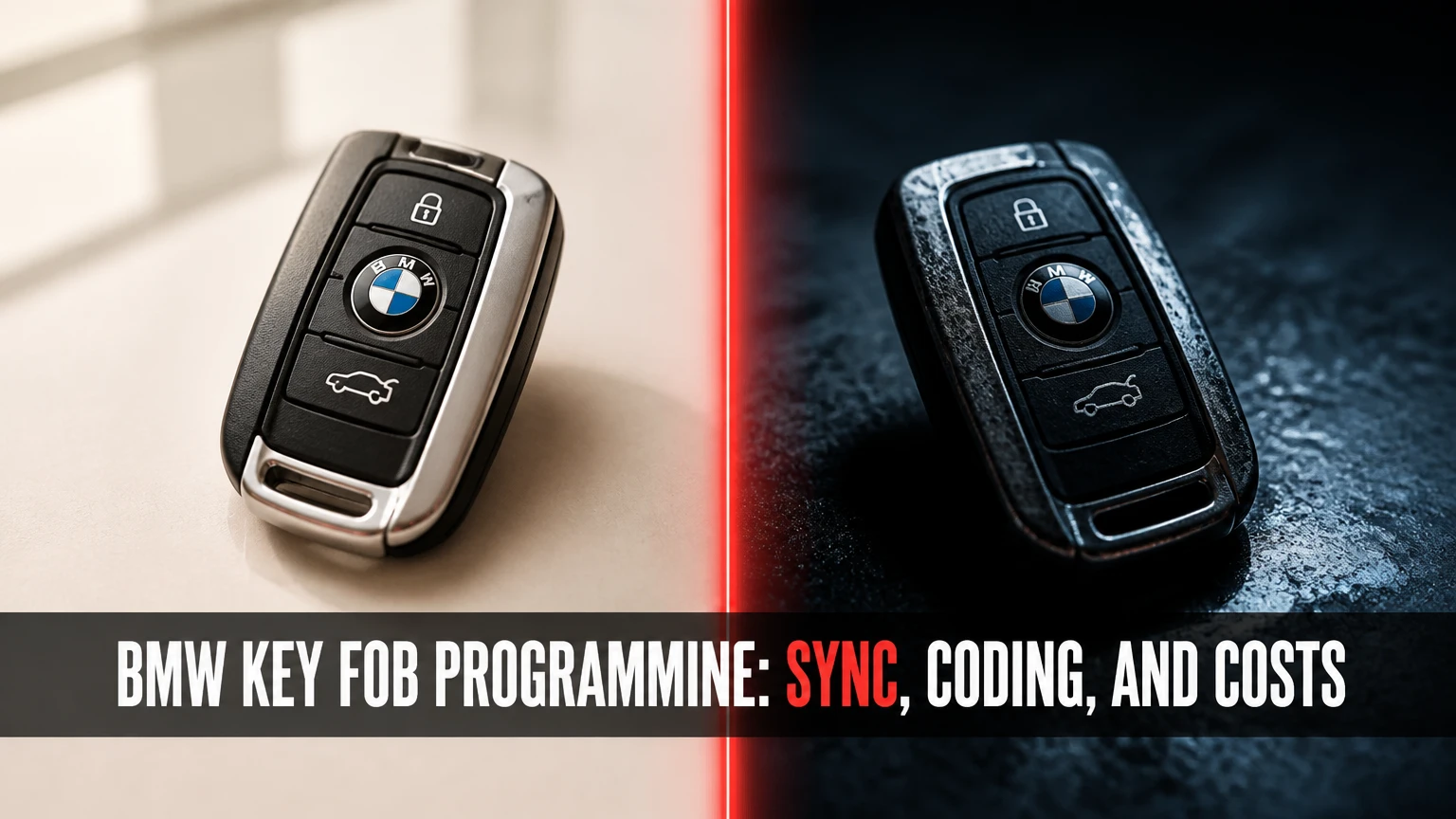
BMW key fob programming can mean remote-button synchronization, immobilizer-key registration, or replacement-key coding, depending on the BMW chassis and security module. Older E-Series remotes may resynchronize manually, while most F-Series and G-Series replacement keys require vehicle-specific diagnostic equipment, authorized ordering, or both.
Key Facts at a Glance
- Remote synchronization makes lock, unlock, trunk, or panic buttons communicate with the body-control system; it does not necessarily authorize engine starting.
- A BMW immobilizer key contains security data managed by EWS, CAS, FEM, or BDC modules, depending on vehicle generation.
- The older lock-button procedure generally requires one working key, all doors closed, and a sequence completed within seconds.
- A steering-column key-detection procedure can provide emergency starting on many modern BMWs, but it is not universal proof that the remote has been permanently programmed.
- Typical U.S. replacement costs range from $150-$300 for some older remote solutions to $300-$800 or more for newer Comfort Access or Display Keys.
- Used BMW keys are often unusable for immobilizer registration because their transponder authorization is locked to another vehicle.
What BMW Key Fob Programming Actually Changes
BMW key fob programming is the process of pairing a remote transmitter and, when required, an immobilizer transponder with the vehicle’s electronic access system. The correct procedure depends on whether the task is remote resynchronization, a replacement key registration, or diagnosis of a failed key system.
The distinction matters because a BMW can lock and unlock normally while refusing to start. The remote transmitter uses radio-frequency communication with the central locking system, whereas the immobilizer uses encrypted vehicle authorization through systems such as EWS, CAS, FEM, or BDC.
BMW owner documentation and BMW technical information treat key replacement as a security-controlled process. A dealer normally orders a VIN-associated replacement from BMW, verifies ownership, and supplies a key intended for that vehicle. An independent automotive locksmith may perform equivalent work on some platforms, but coverage depends on the chassis, market, tool capability, and security access.
A manual button sequence is therefore limited. It can often restore remote-button operation after a battery replacement or synchronization loss, but it cannot universally add an immobilizer identity or convert a used key into a valid replacement.
How BMW Keys Separate Remote and Immobilizer Functions
BMW keys combine at least two systems: an RF remote for convenience functions and a passive transponder for engine authorization. The RF portion needs a battery or stored electrical energy, while the passive immobilizer portion can often be read by the vehicle even when the remote battery is discharged.
| Function | Typical signal or component | Main vehicle system | Common symptom when faulty |
|---|---|---|---|
| Lock and unlock | 315 MHz or 433 MHz RF transmitter | General Module, CAS, FEM, or BDC | Buttons do not operate doors |
| Passive engine authorization | Encrypted transponder | EWS, CAS, FEM, or BDC | Engine will not start or crank authorization fails |
| Comfort Access | Proximity antennas and key battery | CAS, FEM, or BDC | Touch-handle entry fails |
| Emergency start detection | Inductive key reader near column or marked area | CAS, FEM, or BDC | Key not detected until held at backup location |
| Physical entry | Emergency blade and door cylinder | Mechanical lock | Battery-dead vehicle cannot be unlocked remotely |
The exact radio frequency is market- and part-number-dependent. A 433 MHz European remote is not automatically interchangeable with a 315 MHz North American remote, even when the housing looks identical.
A useful practitioner rule is to diagnose the failed function first. If the engine starts but the buttons fail, begin with battery, remote synchronization, transmitter frequency, and RF reception. If the buttons work but starting fails, investigate transponder authorization, key-slot detection, antenna faults, or module errors instead.
Which BMW Key System Do You Have?
BMW key architecture follows broad generation patterns, but production date and options can change the answer. Confirm the VIN, chassis code, key part number, and presence of Comfort Access before buying a replacement.
| BMW generation or example | Approximate period | Access hardware | Typical programming reality |
|---|---|---|---|
| E36, E38, E39, E46, E53 | 1990s-2005 | Diamond or square remote key | Remote resynchronization may be manual; immobilizer hardware varies |
| E60, E61, E87, E90, E70 | 2004-2011 | Slot-in fob, CAS2 or CAS3 | Some remotes resync manually; replacement immobilizer keys require coding |
| F10, F15, F25, F30 | 2011-2019 | Slotless smart key, CAS4, FEM, or related system | New keys usually require specialized programming or VIN ordering |
| G20, G30, G05 and later | 2018-present | Smart Key, Display Key, or Digital Key | BDC, NFC, UWB, iDrive, and phone-wallet enrollment may be involved |
The table is a guide, not a programming guarantee. An early E90 with Comfort Access can use a different battery and initialization method from a standard E90. A G-Series Digital Key may depend on a compatible smartphone, BMW ConnectedDrive account, vehicle option package, and market support rather than a conventional remote procedure.
How Do You Re-Synchronize an Older BMW Remote?
On many older BMW E-Series vehicles, a working remote can be re-synchronized without diagnostic equipment, usually in under five minutes. The sequence affects central locking only, so a successful door-lock cycle does not prove that a replacement immobilizer key can start the vehicle.
Before You Start
| Requirement | Typical specification |
|---|---|
| Vehicle condition | Battery above 12.2 V, doors and windows fully closed |
| Keys | Existing working keys and the key needing synchronization inside the cabin |
| Time window | Ignition removal within about 5 seconds; button sequence within about 10 seconds |
| Equipment | No scan tool for remote resynchronization; fresh correct battery recommended |
| Skill level | Basic; stop if the vehicle does not match the sequence |
Step 1: Close the Vehicle and Enter With Every Key
Sit in the driver’s seat with every remote available for the synchronization session. Close all doors, the trunk, and windows, and keep the keys away from other vehicles that might respond to the buttons.
You will know the setup is correct when the cabin is closed and the existing key can still start the vehicle. A common mistake is leaving a key at home and assuming the procedure will add it later.
Step 2: Cycle the Ignition Quickly
Insert the working key, turn it to Position 1, then return it to Position 0 and remove it. Complete the cycle within approximately five seconds; do not start the engine.
The dashboard may illuminate briefly. If the vehicle does not enter synchronization mode, repeat the ignition cycle once with the doors closed rather than holding the key in the accessory position.
Step 3: Synchronize the Working Remote
Hold the unlock button, press the lock button, often marked with the BMW roundel, three times in quick succession, then release unlock. Many BMW procedures describe the lock presses as occurring within roughly ten seconds.
The vehicle should lock and unlock, or otherwise provide a central-locking confirmation. That cycle indicates that the remote receiver accepted the sequence.
Step 4: Synchronize Each Additional Remote
Within the vehicle’s short programming window, repeat the same button sequence on every other remote. Do not insert the additional remote into the ignition during this step.
The confirmation cycle should occur after each accepted remote. If one remote does not respond, check its battery, button condition, part number, frequency, and compatibility before repeating the entire process.
Step 5: Exit Programming Mode and Test
Turn the ignition on briefly, or follow the chassis-specific completion instruction, then test lock, unlock, trunk release, and alarm functions from several feet away.
The procedure succeeded when the remote operates the central locking consistently. The procedure did not program the immobilizer if the key still cannot authorize engine starting.
Can You Program a Modern BMW Key Yourself?
Most modern BMW owners cannot fully program a new F-Series or G-Series immobilizer key with a button sequence. A dealer-ordered key may already contain vehicle-specific security data, while an independent locksmith uses specialized diagnostic equipment to register or learn the key through CAS, FEM, or BDC systems.
A key held against the steering-column symbol can help some BMW vehicles recognize a valid key when the remote battery is weak or the normal detection path fails. Pressing the brake and Start/Stop button may then allow emergency starting. That procedure is a backup detection method, not a universal replacement-key programming method.
DIY OBD programming is unsuitable for casual experimentation. Interrupted voltage, incorrect software selection, unsupported module versions, or a failed security-data write can leave the vehicle unable to start and may require module recovery.
| Situation | DIY button sync | Dealer or locksmith programming | Likely outcome |
|---|---|---|---|
| Existing E-Series remote stopped locking | Often appropriate | Usually unnecessary | Remote resynchronization |
| New E-Series immobilizer key | No | Usually required | Key registration or replacement |
| F-Series replacement key | No | Usually required | CAS or FEM-compatible coding |
| G-Series Smart Key | No | Usually required | BDC and vehicle-specific enrollment |
| Digital Key phone setup | No OBD programming | Account and vehicle setup | NFC or UWB phone access |
Modern BMW owners should use a locksmith or dealer when no working key remains, the vehicle has Comfort Access, the key is Display or Digital Key hardware, or the car reports a CAS, FEM, BDC, or immobilizer fault.
How Much Does BMW Key Fob Programming Cost?
Typical U.S. BMW key replacement and programming costs range from $150-$300 for some older remote solutions, $250-$500 through an independent automotive locksmith, and $350-$800 or more through a dealership for newer Comfort Access or Display Keys. All-keys-lost service, towing, blade cutting, and module recovery can increase the total.
These are practitioner ranges, not BMW’s universal price list. BMW dealer pricing varies by vehicle, region, key type, and labor rate, while locksmith pricing varies by travel distance, equipment, security complexity, and whether the provider supplies a genuine key.
| Service path | Typical total cost | Typical time | Best fit |
|---|---|---|---|
| Older remote resynchronization | $0-$100 | 5-30 minutes | Existing key, buttons out of sync |
| Independent locksmith | $250-$500 | 1-3 hours | F-Series or E-Series replacement |
| BMW dealership | $350-$800+ | 2-10 business days | OEM key ordered to VIN |
| All keys lost, mobile service | $400-$1,000+ | 2-6 hours | Vehicle access and security programming |
| Display Key or advanced Comfort Access | $500-$1,200+ | 2-10 business days | G-Series, special-order hardware |
Ask for a written quote that separates the key, programming, emergency callout, blade cutting, diagnostic labor, and VAT or sales tax. A low advertised price may cover only a shell or remote board, not a valid immobilizer key.
Which Programming Option Is Safest?
A BMW dealership is usually the safest choice for a late-model vehicle or an all-keys-lost case, while a qualified automotive locksmith is usually faster and less expensive for supported chassis. DIY remote synchronization is reasonable for an older BMW when the existing key still starts the car and only central locking has stopped working.
| Option | Strength | Limitation | Module risk | Typical use |
|---|---|---|---|---|
| BMW dealer | VIN-matched OEM supply and factory process | Higher price and shipping delay | Low when factory procedure is followed | New G-Series key |
| Automotive locksmith | Mobile service and broad diagnostic capability | Capability differs by provider | Moderate if inexperienced | F-Series replacement |
| Independent BMW specialist | BMW-focused diagnostics and coding | May not stock security hardware | Low to moderate | CAS, FEM, or BDC diagnosis |
| DIY remote sync | Minimal cost and no coding tool | Works only for limited older procedures | Low for correct button sequence | E-Series remote issue |
| Generic key programmer | Lower equipment cost | Compatibility and support vary | High with wrong procedure | Rarely appropriate for owners |
Choose the dealer when OEM provenance, warranty documentation, and security accountability matter most. Choose a locksmith only after confirming the exact chassis, year, module, key type, and whether the provider handles all-keys-lost cases.
Can You Program a Used BMW Key?
A used BMW key generally cannot be reused for immobilizer authorization because the transponder or security data is assigned to the original vehicle. A used housing may be reusable, and some remote circuit boards may be repairable, but replacing the shell does not create a valid key for another BMW.
The phrase “programmable BMW key” is frequently applied to virgin aftermarket hardware, refurbished remotes, and empty shells as though they were equivalent. They are not. Ask whether the item is virgin, VIN-locked, frequency-matched, and compatible with the vehicle’s CAS, FEM, or BDC generation.
A used key can also create a physical mismatch. The emergency blade may not fit the door cylinder, the battery type may differ, and Comfort Access hardware may be absent even when the housing appears correct.
What Changes When Every BMW Key Is Missing?
All-keys-lost BMW programming requires vehicle access, ownership verification, and security-level key registration, not remote resynchronization. The dealer or locksmith may need the VIN, government identification, registration or title, vehicle location, and a method to connect diagnostic equipment.
| All-keys-lost requirement | Why it matters | Possible consequence if absent |
|---|---|---|
| VIN and chassis code | Identifies the correct key and security system | Wrong part ordered |
| Photo identification | Confirms the requester | Service refusal |
| Registration or title | Demonstrates vehicle ownership | Programming delayed |
| Vehicle access | Allows diagnostic connection and testing | Tow or lockout service required |
| Stable vehicle voltage | Protects module programming | Failed coding or module recovery |
Do not rely on a cheap online key when every key is gone. A dealer may ship a VIN-matched key, but the vehicle still needs testing, and a locksmith may need to retrieve or calculate security data using equipment appropriate to that exact platform.
Why Does the Remote Work When the Engine Will Not Start?
A BMW remote can lock the doors while the engine remains unauthorized because remote RF synchronization and immobilizer authentication are separate functions. The fault may involve a non-programmed transponder, damaged key electronics, CAS or FEM communication, a weak vehicle battery, or a key-detection antenna.
Start diagnosis with the simplest split:
- Confirm whether the engine cranks.
- Test a second known-good key if available.
- Replace the remote battery only when the remote functions are weak or absent.
- Hold the key at the BMW emergency-detection location and follow the dashboard instruction.
- Scan the vehicle for CAS, FEM, BDC, EWS, or antenna faults.
A remote that works from a distance proves only that the RF transmitter and receiver are communicating. It does not prove that the immobilizer transponder is valid.
What Should You Check When BMW Says Key Not Detected?
When BMW displays “Key not detected,” first place the key at the vehicle’s designated emergency-detection location, then check the key battery, vehicle battery, interior antenna area, and key compatibility. A successful emergency start points toward a battery or detection-path problem, while repeated failure may indicate a key or vehicle module fault.
| Symptom | Most likely starting point | Practical check |
|---|---|---|
| Remote range is short | Weak coin-cell battery | Install the specified CR2032 or CR2450 |
| Remote buttons work, no start | Immobilizer authorization | Test a second key and scan CAS, FEM, or BDC |
| Key works at column only | Battery or antenna path | Replace battery and inspect detection area |
| No remote and no start | Dead key, wrong key, or vehicle battery | Measure batteries and verify part number |
| Comfort Access fails, buttons work | Door-handle antenna or option fault | Test each handle and scan access system |
A fresh battery cannot repair a VIN-locked used key. It also cannot correct a wrong frequency, damaged transponder, failed antenna, or corrupted security module.
Common Mistakes and How to Fix Them
Mistake 1: Treating remote synchronization as key programming
Remote synchronization restores convenience buttons. Immobilizer programming registers the authorization needed to start the vehicle. If the engine will not start afterward, obtain proper key programming rather than repeating the lock-button sequence indefinitely.
Mistake 2: Buying by appearance alone
BMW used several frequencies, key shapes, battery types, and module generations. Match the VIN, market, key part number, frequency, Comfort Access status, and chassis before purchasing.
Mistake 3: Programming with low vehicle voltage
Diagnostic key registration should be performed with a stable power supply, commonly maintained around 13.2-14.5 V by a suitable battery-support unit. A weak battery can interrupt communication during coding and create a much larger repair.
Mistake 4: Assuming every missing key is erased
On many older remote synchronization procedures, a key omitted from the session may lose remote synchronization. That rule does not mean every immobilizer credential is automatically deleted from CAS, FEM, or BDC.
Mistake 5: Using a generic OBD tool
Basic OBD readers retrieve emissions codes. They do not necessarily perform BMW security access, key learning, EEPROM recovery, or BDC programming. Use a provider that can name the exact tool and procedure for the vehicle.
How to Test a Newly Programmed BMW Key
Test a replacement BMW key in six stages: passive unlock or mechanical entry, remote lock, remote unlock, trunk release, engine authorization, and Comfort Access if equipped. Complete testing before the technician leaves or before accepting a dealer handover.
- Lock and unlock from several feet away.
- Confirm trunk release and panic or alarm behavior where equipped.
- Start the engine, then switch it off and restart once.
- Test the emergency blade in the driver’s door cylinder.
- Test each Comfort Access door handle and the trunk sensor.
- Confirm that the dashboard no longer reports a missing key.
The key passes when every purchased function works consistently. A key that starts the car but lacks remote operation may need RF synchronization, a correct battery, or a compatible transmitter rather than another immobilizer write.
FAQ
Does BMW key fob programming erase the old key?
Remote-button synchronization can affect which remotes respond to central locking on some older BMW systems, especially when keys are not included in the same synchronization session. Immobilizer authorization is a separate security function, and deletion behavior varies by module and diagnostic procedure.
Can I replace a BMW key battery without programming it again?
Replacing the battery normally does not require immobilizer programming. Older rechargeable diamond keys may require remote resynchronization after a prolonged discharge, while newer keys commonly use a specified CR2032 or CR2450 cell. Confirm polarity, battery type, and housing design before closing the key.
How long does BMW key programming take?
A simple older remote resynchronization usually takes 5-30 minutes. A locksmith replacement often takes 1-3 hours when the correct key is available, while a dealer-ordered key can take 2-10 business days because the key may need VIN ordering, shipping, and appointment time.
Does Comfort Access change the programming process?
Comfort Access adds proximity antennas, touch-handle sensors, and a battery-dependent key transmitter. A standard remote may start the vehicle without providing passive entry, so the replacement must match the vehicle’s Comfort Access configuration and key part number.
Can a BMW dealer program a key I bought online?
A dealer may refuse an online key because the part could be used, VIN-locked, counterfeit, incorrectly matched, or from another frequency market. Ask the service department before purchase. A VIN-ordered BMW key avoids many compatibility problems, but ownership documents remain necessary.
What information should I give a locksmith?
Provide the VIN, model, production year, chassis code if known, number of working keys, Comfort Access status, current symptoms, and vehicle location. Ask whether the quote includes the key, blade cutting, programming, emergency service, taxes, and post-programming testing.
The Bottom Line
BMW key fob programming is not one universal procedure. Older E-Series remotes may accept a manual central-locking resynchronization, but replacement immobilizer keys and most F-Series or G-Series keys require vehicle-specific security programming through a BMW dealer or qualified automotive locksmith.
Use the simple remote sequence only when the key already starts the car and the problem is limited to the buttons. For all-keys-lost cases, Comfort Access, Display Keys, CAS, FEM, BDC, or “key not detected” faults, verify the VIN and key type, maintain stable vehicle voltage, and use a provider equipped for the exact BMW platform.