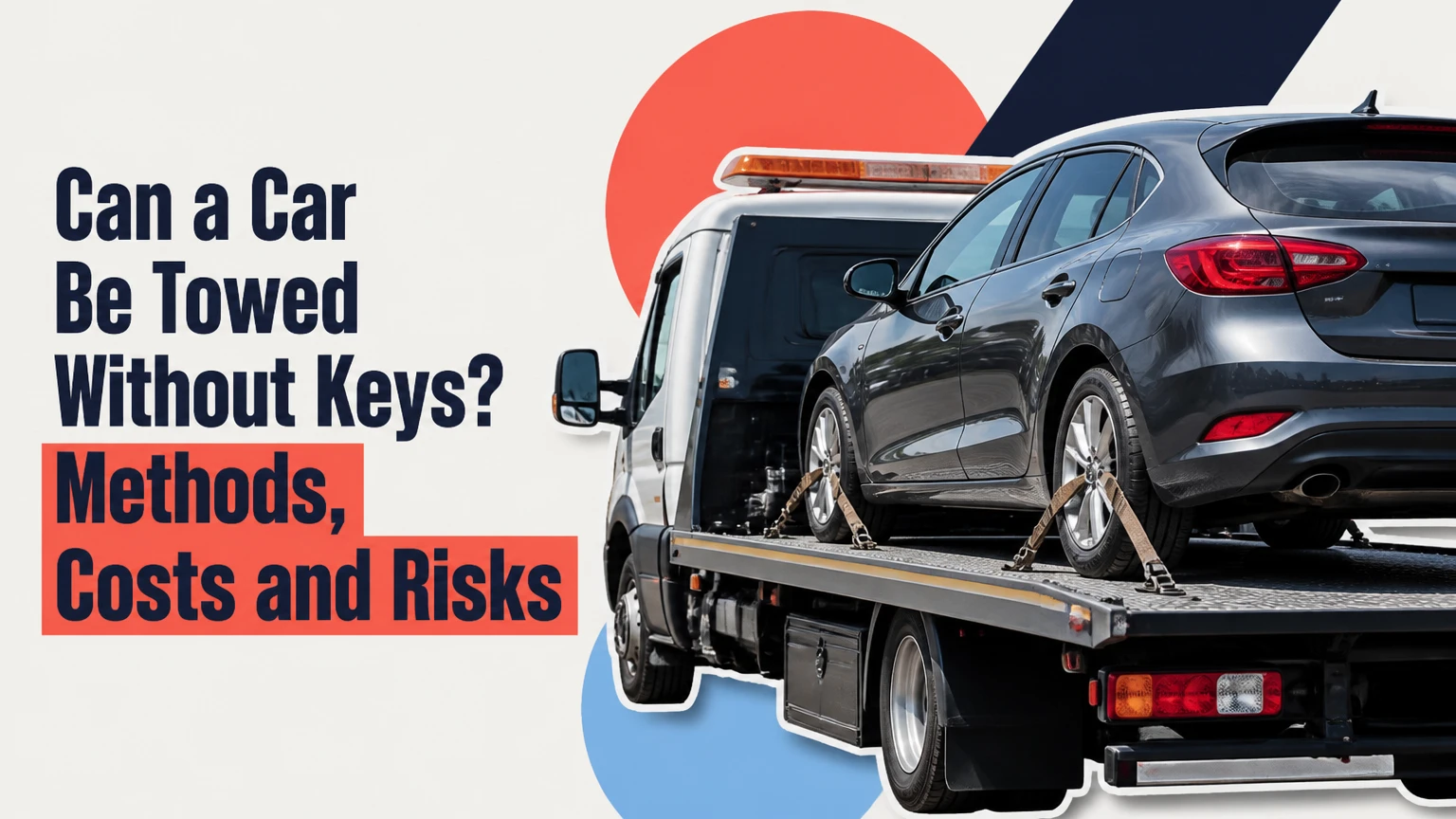
Yes, a car can be towed without keys, provided the towing company has lawful authority and uses equipment suited to the vehicle. A professional operator can load a locked car with a flatbed, wheel skates, tow dollies, or a compatible wheel lift without starting the engine. The safest method depends on drivetrain, parking brake status, steering position, clearance, and manufacturer instructions.
Key Facts at a Glance
- A flatbed with wheel skates can transport most locked vehicles without rotating their wheels.
- A vehicle does not always need to be shifted into neutral before professional loading.
- AWD, 4WD, many EVs, and low-clearance vehicles require method selection based on the owner’s manual.
- An electronic parking brake may require vehicle power, a documented release procedure, or wheel dollies.
- Typical local no-key towing costs range from $150-$350, but impounds, garages, distance, and specialty equipment can raise the quote.
- Physical ability to tow a car does not establish legal permission to remove it.
Is It Legal to Tow a Car Without Keys?
Towing a car without keys is lawful when the person ordering the tow has ownership, possession, or another recognized legal authorization. A vehicle owner can normally arrange roadside recovery, while police, lenders, property owners, and private impound operators may have separate authority governed by local law.
A tow company may request a driver’s license, registration, title information, police report, lease or lender documentation, or a property-owner authorization form. Requirements differ by state, province, municipality, and the reason for removal. A private property tow generally requires posted signs, documented authorization, and compliance with local notice rules.
A missing key is not proof that a removal is illegal. However, a towing operator should not bypass a lock or remove a vehicle merely because a caller provides an address. Ask the dispatcher what proof of authority the operator needs before arrival, especially for a repossession, rental vehicle, estate vehicle, or disputed parking situation.
What information should you give the dispatcher?
Tell the dispatcher that the vehicle is locked and the keys are unavailable. Provide the make, model, model year, approximate weight class, drivetrain if known, wheel position, parking-brake status, steering angle, location, and whether the car is in a garage or blocked by another vehicle.
Also disclose whether the vehicle is an EV, hybrid, luxury model, modified vehicle, or accident-damaged vehicle. These details determine whether the company sends a flatbed, wheel-lift truck, dollies, skates, low-clearance equipment, or a recovery unit.
Why Can a Car Move Without Its Keys?
A locked car presents several mechanical obstacles, but towing does not require the engine to run. The operator’s goal is to prevent locked wheels from dragging or rotating in a way that damages the tires, brakes, transmission, transfer case, or steering components.
The main obstacles are:
- Transmission Park position: An automatic transmission’s parking pawl can prevent the driven wheels from turning.
- Parking brake: A mechanical or electronic brake can hold one axle or all four wheels.
- Steering lock: A locked steering column can leave the front wheels angled instead of aligned with the truck.
- Wheel access: Tight parking spaces may prevent a standard wheel lift from reaching the vehicle safely.
- Vehicle electronics: Keyless ignition, electronic shifters, and electronic parking brakes may need battery power.
The operator solves these obstacles by lifting the relevant wheels, placing tires on dollies or skates, or following a manufacturer-approved neutral and brake-release procedure. The car can therefore be transported without the key, even though it may not be drivable.
Does the car need to be in neutral?
A car does not necessarily need to be in neutral for a no-key tow. A flatbed can carry the vehicle with the drive wheels immobilized, while skates or dollies prevent locked tires from dragging during loading.
Neutral is still preferable when the manufacturer’s procedure allows it because rolling resistance is lower and loading is easier. Operators should not guess at a transmission override. A hidden shift-lock release, underbody procedure, or electronic service mode is model-specific, and using the wrong component can damage the transmission or create a safety hazard.
Which Towing Method Is Safest?
A flatbed is usually the safest general-purpose choice for a locked passenger vehicle because all four tires can remain off the road during transport. Wheel skates or tire dollies allow the operator to winch a car onto the bed when the steering is locked, the parking brake is engaged, or the transmission remains in Park.
A wheel lift with additional dollies can work well for conventional FWD or RWD cars when a flatbed cannot access the location. A wheel lift alone is less suitable when the unlifted wheels are locked, the vehicle is AWD, or the manufacturer prohibits that wheel arrangement.
| Method | Typical setup time | Suitable vehicles | Main limitation |
|---|---|---|---|
| Flatbed with skates | 20-40 minutes | AWD, 4WD, EV, luxury sedan | Needs truck access and ramp clearance |
| Wheel lift only | 10-20 minutes | Select FWD or RWD cars | Locked or driven wheels may drag |
| Wheel lift plus dollies | 20-35 minutes | FWD, RWD, some immobilized cars | More equipment and slower loading |
| Four-wheel skates or GoJacks | 25-45 minutes | Tight spaces and blocked wheels | Designed for positioning, not road towing |
| Traditional sling or chain | 20-30 minutes | Scrap or severely damaged vehicles | Highest risk of body and suspension damage |
How does a flatbed load a locked vehicle?
The tow operator first aligns the truck and checks the approach path. If the car cannot roll, the operator places wheel skates or dollies beneath the affected tires, lowers the flatbed or ramp, and uses a winch to pull the vehicle aboard without relying on the engine.
After loading, the operator centers the vehicle, applies tire straps at approved locations, and checks that no strap contacts brake lines, suspension parts, wiring, or body panels. The car should be secured over its tires rather than by improvised hooks attached to steering or suspension components.
When are wheel lifts and dollies appropriate?
Wheel lifts and dollies are appropriate when the tow truck can safely lift one axle and the remaining wheels can either roll freely or sit on independent dollies. A FWD sedan with its front wheels lifted may be suitable for a short transport if the rear wheels are free and the manufacturer permits the arrangement.
A RWD vehicle generally requires the rear driven wheels to be lifted or supported. AWD and 4WD vehicles require extra caution because the axles may be connected through a driveshaft, transfer case, viscous coupling, clutch pack, or electronic torque system. The owner’s manual, not a generic drivetrain rule, controls the final method.
How Does Drivetrain Change the Towing Method?
Drivetrain determines which wheels can safely remain on the ground. FWD, RWD, AWD, and 4WD vehicles transfer torque through different components, so a wheel-lift configuration that is acceptable for one vehicle can damage another.
| Vehicle type | Preferred no-key method | Wheels to protect | Verification source |
|---|---|---|---|
| FWD gasoline sedan | Flatbed or front lift with rear dollies | Front drive wheels | Owner’s manual, towing section |
| RWD pickup | Flatbed or rear lift with front dollies | Rear drive wheels | Owner’s manual, driveline limits |
| AWD crossover | Full flatbed with skates | All four wheels | Manufacturer-specific instructions |
| 4WD truck | Flatbed or approved disconnect procedure | Transfer case and axles | Manufacturer-specific instructions |
| Hybrid vehicle | Flatbed when neutral status is uncertain | Drive motor and transmission | Hybrid towing procedure |
| Battery EV | Flatbed with wheels prevented from spinning | Motor, inverter, reduction gear | EV emergency guide |
The common warning that “two wheels on the ground always destroy an AWD system” is too absolute. Some vehicles permit limited movement in a specified configuration, while others require all wheels off the ground. Damage risk depends on the exact drivetrain, distance, speed, lubrication, and manufacturer limits.
What changes for electric and hybrid vehicles?
Many EV manufacturers specify a flatbed or a method that prevents powered wheels from rotating during transport. Spinning wheels can turn the electric drive motor and generate electrical energy, while the vehicle may also have restrictions related to the reduction gear, inverter, regenerative braking, or high-voltage system.
Tesla emergency guidance, for example, varies by model and distinguishes loading procedures from transport procedures. Ford, Hyundai, Kia, Rivian, and other manufacturers publish model-specific roadside instructions. An EV owner should tell dispatch the exact model and request the manufacturer-approved method rather than relying on a general “AWD” label.
A hybrid may have similar transport restrictions, but the presence of a gasoline engine does not make ordinary dragging safe. Treat an EV or hybrid as a specialized vehicle until the manual confirms otherwise.
What Is the Professional No-Key Towing Process?
A professional no-key tow normally takes 15-40 minutes on site, excluding delays caused by restricted access, damage, missing equipment, or a vehicle trapped behind another car. The operator assesses the vehicle first, selects a non-damaging loading method, and secures the car before transporting it.
Step 1: Confirm authority and vehicle details
The operator verifies the dispatch information and inspects the vehicle’s condition. The operator records existing damage, identifies the drivetrain, checks for an EV or hybrid powertrain, and notes whether the steering wheel, parking brake, or wheels are locked.
Step 2: Create a safe loading path
The operator checks overhead clearance, ramp angle, traffic exposure, curb height, floor slope, and the distance available for the tow truck. A low garage ceiling may rule out a standard flatbed even when the vehicle itself is easy to move.
Step 3: Decide whether neutral is necessary
If lawful entry is authorized and the vehicle has a documented shift-release process, the operator may place the transmission in neutral. If the battery is dead, a jump pack may restore enough power for an electronic shifter or parking brake, but power restoration is not a universal release solution.
Step 4: Support locked or nonrolling wheels
The operator places approved skates or dollies under the wheels that cannot roll. Wheel skates are intended to let tires slide across a ramp or bed; they are not a substitute for road-rated transport equipment.
Step 5: Winch and secure the vehicle
The operator winches the vehicle onto the bed or positions it on the tow equipment at controlled speed. Tire straps, safety chains where required, and the truck manufacturer’s tie-down points keep the vehicle stable during braking and turns.
Do not attempt to reproduce this process with rope, a consumer jack, or improvised chains. A car weighing 3,000-5,000 pounds can move unpredictably when a pawl releases or a tire slips from a dolly.
How Much Does a No-Key Tow Cost?
A typical local no-key tow costs about $150-$350 for a trip under 15 miles, while a basic hookup commonly adds $75-$125 and specialty equipment can add $50-$150. These are typical U.S. market ranges, not regulated prices, and urban labor, after-hours dispatch, tolls, storage, and recovery conditions can change the quote.
| Cost component | Typical range | What changes the price |
|---|---|---|
| Local hookup fee | $75-$125 | Region, time, vehicle class |
| Mileage charge | $3-$7 per mile | Distance, route, fuel surcharge |
| No-key equipment fee | $50-$150 | Skates, dollies, winch setup |
| Garage extraction fee | $75-$250 additional | Clearance, ramps, access difficulty |
| Impound storage | $25-$75 per day | Facility rules and local law |
| Local total under 15 miles | $150-$350 | Drivetrain, access, operating hours |
Ask whether the quoted price includes loading, dollies, skates, mileage, tolls, storage, and release paperwork. A low hookup price can become expensive when the dispatcher did not know that the car is in a basement garage with a dead battery and an engaged electronic brake.
How Long Does a No-Key Tow Take?
A straightforward no-key loading usually takes 15-30 minutes, while a tight-space recovery commonly takes 30-60 minutes. The largest time variables are access, wheel freedom, vehicle weight, equipment changes, and whether the operator must document or obtain authorization before moving the car.
| Situation | Typical on-site time | Likely equipment |
|---|---|---|
| Accessible FWD sedan, wheels free | 15-25 minutes | Wheel lift or flatbed |
| Locked steering and Park position | 20-40 minutes | Flatbed and skates |
| AWD or EV with no neutral | 25-45 minutes | Full flatbed and skates |
| Parallel parking with blocked wheels | 30-60 minutes | GoJacks or four dollies |
| Low-clearance garage | 30-60 minutes | Low-profile wheel lift |
| Accident-damaged vehicle | 45-120 minutes | Recovery truck, winch, dollies |
What If the Car Is in a Garage or Tight Space?
A car can be removed from a garage without keys, but the truck must match the building’s clearance and the vehicle’s position. A standard flatbed may not fit beneath a low ceiling or may require more straight-line approach distance than the garage provides.
For a parallel-parked car, operators may use GoJacks or wheel dollies to move the vehicle sideways into a position where a wheel lift or flatbed can reach it. GoJacks support positioning on a firm, relatively level surface; they are not intended to carry a vehicle at road speed.
Tell dispatch the garage height, entrance width, floor slope, vehicle orientation, and whether another car blocks the front or rear. Measure the lowest overhead obstruction, not merely the posted entrance height.
What If the Battery Is Dead or the Parking Brake Is On?
A dead battery can prevent an electronic shifter, steering lock, or electronic parking brake from operating, but it does not make the vehicle impossible to tow. A tow operator may use the manufacturer’s jump points, a portable power pack, approved dollies, or a flatbed that carries the vehicle without releasing the brake.
An electronic parking brake is not the same as a traditional handbrake. Forcing a wheel to rotate against an engaged EPB can damage brake hardware, tires, or the vehicle’s control system. The operator should identify the exact model and follow its emergency release instructions.
If the vehicle suffered flood, fire, collision, or high-voltage damage, do not connect a jump pack without professional assessment. A damaged battery or wiring system can present risks beyond ordinary towing.
What Mistakes Cause Damage?
The most expensive towing mistakes come from choosing equipment before identifying the drivetrain and brake condition. A locked wheel should be supported, not dragged, and a vehicle should never be pulled by steering linkage, control arms, bumpers, or random suspension parts.
- Using a wheel lift on an AWD vehicle without checking the manual: This can create driveline rotation or transfer-case stress.
- Dragging a vehicle in Park: The parking pawl is a holding device, not a towing device; forced movement can damage the pawl or transmission.
- Pulling against a sideways steering lock: The tire can scrub, the car can veer, and the ramp edge can contact the body.
- Hooking to suspension or steering parts: Incorrect attachment can bend components that are not rated for recovery loads.
- Treating an EV like a gasoline sedan: Wheel rotation may conflict with the EV manufacturer’s transport instructions.
- Failing to photograph existing damage: A pre-tow record helps distinguish old bumper, wheel, and body damage from loading damage.
An experienced operator’s rule of thumb is simple: if the car cannot roll freely, support every nonrolling wheel before applying winch force. Winch tension should move the vehicle, not overcome a locked tire by brute force.
Should You Call a Locksmith Instead?
A locksmith is usually the better first call when the only problem is a lost key and the vehicle is otherwise safely parked. A replacement mechanical key, transponder key, or programmed smart key may cost less than a tow, particularly when the car can then be driven to a dealer or repair shop.
A tow company is usually better when the vehicle has a flat tire, accident damage, dead battery, seized brake, blocked access, an immobilizer fault, or a destination that cannot be reached safely under its own power. Some roadside providers coordinate both locksmith and towing services.
| Situation | Better first option | Typical reason |
|---|---|---|
| Lost key, car undamaged | Automotive locksmith | Key creation may cost $80-$300 |
| Key locked inside, car operable | Lockout service | Often $50-$150 |
| Dead battery and locked EPB | Tow operator | Equipment can support locked wheels |
| AWD or EV transport | Flatbed tow company | Keeps all wheels off the road |
| Accident with suspension damage | Recovery specialist | Controls winch and loading forces |
| Private impound removal | Authorized tow operator | Requires legal documentation |
Key programming prices vary widely by model. Dealer-only systems, proximity keys, European vehicles, and all-keys-lost situations usually cost more than a basic mechanical duplicate.
What Should You Do Before the Truck Arrives?
Prepare information and access rather than attempting to unlock or move the vehicle yourself. The following checklist reduces dispatch delays and gives the operator the details needed to bring the correct equipment.
- Photograph all four corners, wheels, glass, bumpers, and visible underbody damage.
- Record the make, model, year, drivetrain, fuel type, and EV or hybrid status.
- Tell dispatch whether the transmission is in Park, the steering is locked, and the parking brake is engaged.
- Measure garage height, doorway width, approach distance, and floor clearance.
- Remove loose belongings and provide the destination address and contact person.
- Keep registration, identification, title, police report, or property authorization available.
- Ask for the truck type, total estimate, specialty fees, and expected arrival time.
- Confirm that the operator will follow the manufacturer’s towing instructions.
Do not leave a child, pet, firearm, medication, or valuable document inside the vehicle. Do not authorize a shortcut that conflicts with the owner’s manual merely to reduce loading time.
Frequently Asked Questions
Can a locked car be towed with the wheels turned?
Yes, a locked car with turned wheels can be towed, but the operator should use skates, dollies, or a method that prevents the tires from scrubbing against the ramp. A flatbed approach is usually safer than dragging the turned wheels behind a wheel-lift truck.
Can a repossession company tow a car without keys?
Yes, a repossession company can often recover a vehicle without keys when it has valid lender authority and follows local repossession laws. The company may use a wheel lift, dollies, skates, or a flatbed, but it cannot lawfully breach a locked structure or use force that creates a disturbance in many jurisdictions.
Can a car be towed if the transmission is stuck in Park?
Yes, a car stuck in Park can be transported with a flatbed, wheel skates, or dollies that keep the driven wheels from dragging. A qualified operator may use a model-specific neutral override, but forcing the parking pawl to release can damage the transmission.
Will towing without keys damage the car?
Towing without keys does not inherently damage a vehicle. Damage becomes more likely when an operator drags locked tires, uses the wrong axle configuration, ignores AWD or EV instructions, attaches to steering parts, or loads a damaged vehicle without recovery equipment.
Can a manual-transmission car be towed without keys?
Yes, a manual-transmission car can usually be loaded without keys if the parking brake is released and the wheels roll. If the brake is engaged or the steering is locked, the operator can use skates, dollies, or a flatbed rather than relying on the clutch or gear position.
Can someone tow a car from private property without the owner present?
Possibly, but the answer depends on local law, posted notice, property authorization, and the towing reason. A private-property owner or manager may be able to authorize removal, while an unrelated individual generally cannot establish lawful authority simply by claiming that a car is abandoned.
The Bottom Line
A car can be towed without keys when an authorized towing company uses equipment that supports locked wheels and matches the vehicle’s drivetrain. For most locked cars, a flatbed with skates is the lowest-risk option; AWD vehicles, 4WD trucks, hybrids, EVs, dead-battery cars, and tight garages require model-specific planning. Tell dispatch the exact vehicle and parking conditions, confirm the total price, and insist on the manufacturer-approved towing method. The answer to “can a car be towed without keys” is yes, but safe and lawful removal depends on authorization, equipment, and vehicle-specific limits; if a dealership is involved, check whether the paperwork promises a spare key.