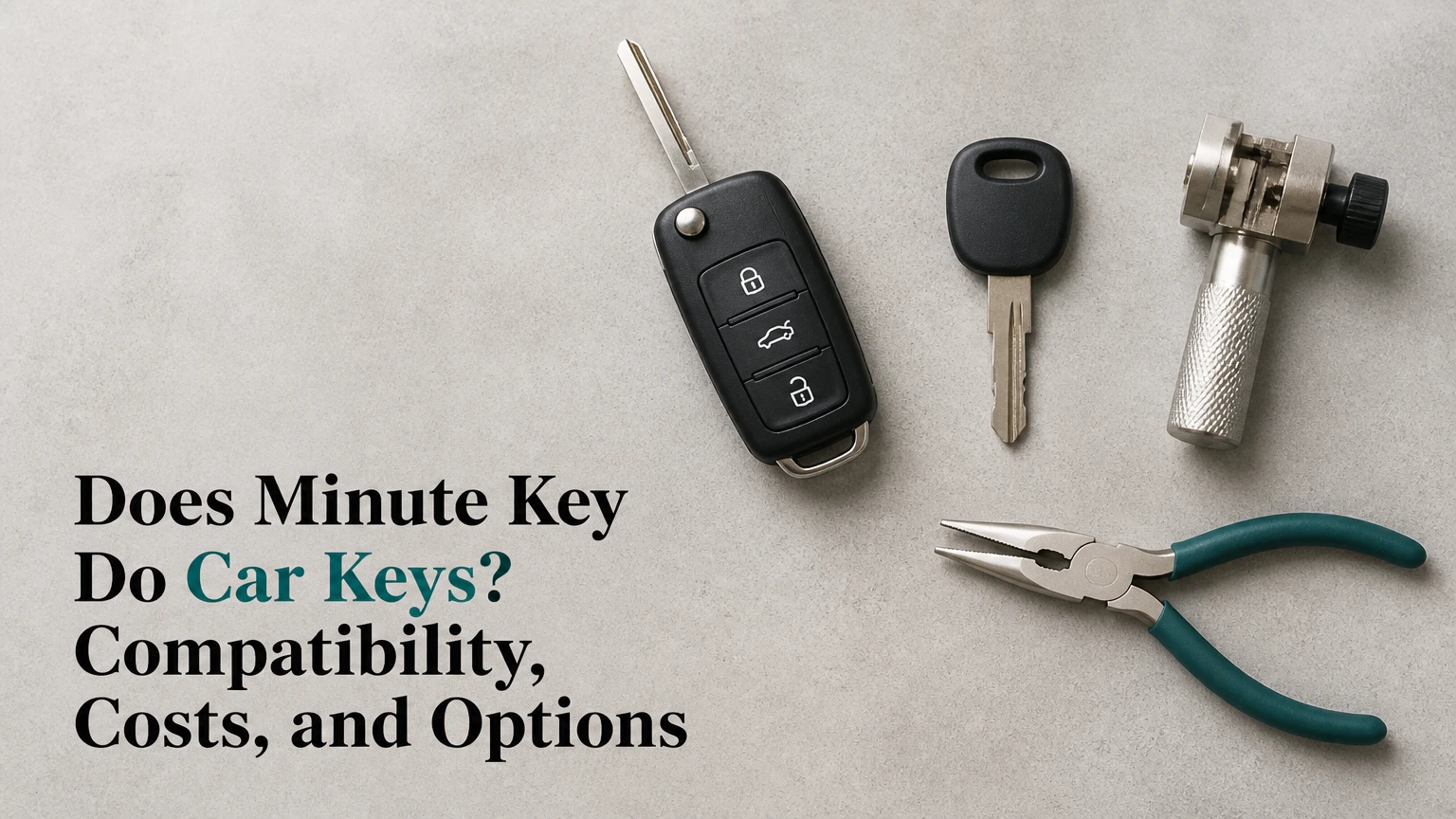
Yes, Minute Key duplicates some car keys, but not every automotive key is supported. A basic metal key may be cut at a kiosk when the correct blank is available, while a transponder key or smart fob may require separate programming or a locksmith, dealer, or other automotive-key provider. Check your vehicle and kiosk before paying.
Key Facts at a Glance
- Minute Key car-key service depends on the kiosk, vehicle year, make, model, key design, and local inventory.
- A mechanical duplicate can unlock doors and turn an ignition, but a chipped key also needs a programmed transponder.
- A push-to-start vehicle normally needs a compatible proximity fob and electronic registration, not merely a cut metal blade.
- Minute Key kiosks are designed for duplicates when a working original is available; all-keys-lost situations usually require a locksmith or dealer.
- Typical planning prices range from about $5-$20 for a simple metal duplicate, $75-$180 for many chipped keys, and $150-$350 or more for smart-fob replacements.
- A copied key should be tested in the door and ignition before the original key is discarded or heavily used.
Does Minute Key Do Car Keys?
Minute Key does make or duplicate certain automotive keys, but the service is a compatibility-based option rather than a universal car-key replacement service. The most straightforward case is a conventional metal blade with a supported profile and a working original. The more electronics a vehicle uses, the less likely a kiosk alone can complete the job.
Minute Key kiosks are commonly installed in retailers such as Lowe’s, Home Depot, Walmart, and other participating stores, but the retailer’s location does not prove that its kiosk supports your vehicle. Automotive blanks, cutting equipment, ordering functions, and programming arrangements can differ by site and may change over time.
The decisive questions are simple: Do you have a working key, what kind of key is it, and does the current Minute Key menu list your vehicle? A vehicle lookup or kiosk menu is more reliable than a generic list of supported makes.
Which vehicles are usually compatible?
Older vehicles with a plain metal key are the strongest candidates. Many newer vehicles use a transponder, side-milled blade, remote head, switchblade mechanism, or proximity fob, so compatibility depends on the exact key system rather than the car brand alone.
| Key situation | Minute Key likelihood | What the car needs | Better fallback |
|---|---|---|---|
| 1980s-1990s plain metal blade | Often high | Correct mechanical cuts | Hardware store or locksmith |
| Early-2000s metal key with no chip | Often moderate to high | Correct blade profile | Automotive locksmith |
| Standard transponder key | Vehicle and service dependent | Cut blade plus immobilizer programming | Locksmith or dealer |
| Side-milled or laser-cut blade | Variable | High-security cutting machine | Automotive locksmith |
| Push-to-start proximity fob | Limited and vehicle dependent | Fob registration and remote pairing | Locksmith or dealer |
| Luxury vehicle smart key | Often limited | OEM-compatible electronics and coding | Specialized locksmith or dealer |
The phrase “car key” hides several different products. A vehicle may have a key that looks mechanical but contains a small immobilizer chip inside its plastic head. Visual inspection helps, but the owner’s manual, original part number, vehicle menu, or a locksmith’s diagnostic check gives a more dependable answer.
How does automotive key duplication work?
Automotive key duplication has two separate stages: creating the physical key shape and making the vehicle accept the key electronically. A kiosk can sometimes perform the first stage without being able to complete the second, which explains why a new key may turn the lock yet fail to start the engine.
For a mechanical key, the machine reads the original blade’s cuts and transfers that pattern to a matching blank. The process is similar in principle to duplicating a house key, although automotive blanks may use different shoulder positions, blade widths, grooves, and cut depths.
A transponder key adds an immobilizer check. The engine control system expects a coded chip, often called a transponder, before it enables fuel or ignition functions. Cutting the blade does not automatically teach the chip the vehicle’s security system.
A smart key adds more requirements. The replacement must communicate with the vehicle at the correct radio frequency, contain compatible buttons and circuitry, and be registered through the vehicle’s programming procedure. Some vehicles also require a security PIN, diagnostic tool, or an existing authorized key.
What should you do at the kiosk?
Use the kiosk only after confirming that it supports the exact vehicle and key type. The normal duplicate workflow is:
- Identify the vehicle. Enter the year, make, and model, or use the available automotive-key lookup.
- Inspect the original. Choose a fully working key with straight, readable cuts and no cracks near the head.
- Insert the key as directed. Follow the screen orientation instructions instead of assuming every blade faces the same way.
- Review the product. Confirm the blade style, button layout, chip requirement, delivery method, and total price.
- Pay only after checking fulfillment. A kiosk may cut a key immediately, dispense an order receipt, or arrange shipment for a later step.
- Complete programming if required. Follow the instructions for an appointment or use a qualified automotive locksmith.
- Test the result. Check the driver-door lock, ignition, remote buttons, alarm response, and engine start.
The success checkpoint is a duplicate that operates every function your original operates. A key that unlocks the door but cannot start the engine is incomplete, not necessarily incorrectly cut.
What kinds of car keys can Minute Key copy?
Minute Key may support traditional metal keys and selected electronic automotive keys, but the available service differs by vehicle and location. Classifying the key before visiting prevents the common mistake of ordering a blade when the vehicle actually requires an immobilizer chip or proximity fob.
Traditional metal keys
Traditional keys contain no transponder and rely entirely on the blade’s mechanical pattern. They are common on older cars, utility vehicles, trailers, motorcycles, and some fleet vehicles, although model year alone cannot prove that a key is non-electronic.
Typical examples include generic automotive blank families such as Ford H75, General Motors B102, and Toyota TR47. Those identifiers are examples, not universal recommendations, because the same manufacturer can use different blanks within one model year.
Transponder keys
A transponder key contains an RFID-style chip that communicates with the vehicle’s immobilizer. The blade may be cut correctly while the engine remains disabled because the chip has not been programmed or because the replacement uses an incompatible chip type.
Some transponder keys have a large plastic head, while others use a remote-head design with lock, unlock, and panic buttons. A locksmith can identify the chip family and test whether the vehicle accepts the key, whereas a basic key-cutting transaction may address only the blade.
Smart keys and proximity fobs
Smart keys allow a vehicle to detect an authorized fob nearby. Push-button-start vehicles generally use this system, although some models also include an emergency mechanical blade for unlocking the door.
A replacement fob can require frequency matching, button configuration, immobilizer registration, and remote-control pairing. Replacing the battery does not pair an unrecognized fob, and pairing instructions that work for one Toyota, Ford, Honda, or Nissan model may fail on another.
| Key technology | Physical component | Electronic requirement | Typical duplicate route |
|---|---|---|---|
| Metal blade | Cut steel or brass blade | None | Kiosk, hardware store, locksmith |
| Transponder key | Cut blade and chip | Immobilizer registration | Locksmith, dealer, supported provider |
| Remote-head key | Blade, chip, remote buttons | Immobilizer and remote pairing | Automotive locksmith or dealer |
| Switchblade key | Folding blade, chip, remote | Chip and remote programming | Automotive locksmith or dealer |
| Proximity fob | Fob, antenna, emergency blade | Vehicle registration and pairing | Locksmith or dealer |
How much does a Minute Key car key cost?
A simple metal duplicate commonly costs about $5-$20, while an electronic key can cost roughly $75-$350 or more depending on the vehicle, key hardware, programming, delivery, and local provider. Minute Key pricing is not one national fixed rate, so the kiosk’s current quote matters more than an online average.
The lowest price applies to a mechanical duplicate. Transponder and proximity products cost more because the replacement includes electronics and may require a technician, diagnostic equipment, or a security procedure.
| Replacement type | Typical planning range | Possible completion time | Main cost variable |
|---|---|---|---|
| Plain metal blade | $5-$20 | 1-10 minutes | Blank profile and local price |
| Transponder duplicate | $75-$180 | Same day to several business days | Chip, cutting, programming |
| Remote-head key | $100-$250 | Same day to several business days | Buttons, chip, pairing |
| Smart or proximity fob | $150-$350+ | 30 minutes to several days | OEM-equivalent electronics |
| Mobile locksmith duplicate | $100-$300+ | Often 30-90 minutes onsite | Dispatch and programming |
| Dealer replacement | $200-$600+ | Same day to several days | OEM part, coding, labor |
These are typical U.S. planning ranges, not a Minute Key price schedule. Taxes, shipping, mobile service, emergency timing, vehicle security level, and whether a working key exists can move the final amount substantially.
A duplicate made before the only key fails is usually cheaper than an all-keys-lost replacement. Owners who wait may pay for vehicle entry, key generation, programming, towing, or a dealer security-code procedure.
Does Minute Key program chipped car keys?
Minute Key may offer automotive products or fulfillment options for selected electronic keys, but customers should not assume that every kiosk cuts and programs a transponder key onsite. Cutting the blade and programming the immobilizer are separate services, and the current vehicle-specific checkout should state what is included.
The key must be electronically recognized by the vehicle before the engine starts. Some vehicles permit owner programming when two existing keys are present, while others require a scan tool or security access. Instructions vary by manufacturer and model year.
Ask four questions before payment:
- Is the quoted product a complete programmed key or an unprogrammed blank?
- Is programming performed at the kiosk, by a mobile technician, or by the customer?
- Are shipping, appointment, diagnostic, and service charges included?
- What happens if the vehicle rejects the key?
The practical rule is conservative: treat a transponder order as unfinished until the key starts the car and the remote functions work. A receipt, shipping confirmation, or successful blade cut does not prove immobilizer compatibility.
Can Minute Key make a car key if all keys are lost?
Minute Key kiosks are primarily suited to duplicating a key that you can present, not generating every replacement from an empty key set. When all keys are lost, an automotive locksmith or dealership is usually the correct route because the provider must create, cut, and program a key without copying a working blade.
A lost-key appointment normally requires proof of ownership, vehicle identification, and access to the car. The provider may use the VIN to identify the key profile, but the VIN alone does not guarantee immediate cutting because manufacturers protect key codes and security data.
| Situation | Recommended first call | Typical requirements | Likely complication |
|---|---|---|---|
| One working metal key exists | Minute Key or local locksmith | Original key and vehicle details | Wrong blank |
| One working chipped key exists | Automotive locksmith | Working key, vehicle, ownership proof | Programming |
| One working smart fob exists | Locksmith or dealer | Fob, vehicle, ownership proof | Remote registration |
| All keys lost, vehicle unlocked | Automotive locksmith | VIN and ownership documents | Security access |
| All keys lost, vehicle locked | Mobile locksmith | Vehicle location and ownership proof | Entry plus key generation |
| Luxury vehicle with no key | Dealer or specialist | VIN, title, identification | OEM coding and towing |
A locksmith can often travel to the vehicle and reduce towing costs, but availability and equipment vary. Dealers provide manufacturer-specific support but may require the vehicle at the service department and charge more for labor and OEM hardware.
How does Minute Key compare with alternatives?
Minute Key is most attractive for a supported mechanical duplicate when a working key is available. An automotive locksmith is usually better for electronic programming, worn originals, side-milled blades, mobile service, and all-keys-lost cases; a dealer is the safest choice for proprietary systems but often the most expensive.
| Option | Plain metal duplicate | Electronic programming | All keys lost | Typical cost |
|---|---|---|---|---|
| Minute Key kiosk | Often available | Vehicle dependent | Usually unsuitable | $5-$350+ |
| Hardware store | Often available | Rarely available | Unsuitable | $3-$20 |
| Automotive locksmith | Available | Common capability | Often available | $100-$300+ |
| Dealership | Available | Manufacturer support | Available with restrictions | $200-$600+ |
| Online key seller | Ships blank or fob | Customer or locksmith required | Usually unsuitable | $20-$200 before labor |
When is a locksmith or dealer necessary?
Choose an automotive locksmith when the key has a transponder, remote, side-milled profile, damaged blade, or missing key set. A locksmith can inspect the vehicle, cut from a code in some cases, read security data, and complete programming onsite when the equipment supports that model.
Choose the dealership when the vehicle uses a restricted key system, a high-security European platform, or a replacement process that requires manufacturer authorization. Mercedes-Benz, BMW, Audi, some newer Land Rover models, and other luxury vehicles may involve ordering, identity checks, specialized coding, and nonstandard remote systems.
Minute Key is not a strong choice when the vehicle is immobilized, the original key is badly worn, or the replacement must be created from the VIN. Convenience cannot compensate for a missing programming capability.
What if the kiosk cannot read or cut the key?
Stop the transaction if Minute Key rejects the original, misidentifies the vehicle, or produces a visibly incorrect blade. Clean dirt from the grooves, straighten the key, and verify the vehicle selection once, but do not force a key into the machine or pay for a product that does not match the original.
A key may be rejected because the blade is bent, the cuts are too worn, the blank is unavailable, or the profile is outside the kiosk’s supported range. A cracked plastic head can also make insertion unsafe even when the metal blade looks usable.
Use this recovery sequence:
- Photograph the original and the kiosk error message.
- Cancel before payment if the machine allows cancellation.
- Ask the retailer employee for kiosk support, not vehicle programming advice.
- Contact the customer-service channel printed on the receipt or kiosk.
- Request a refund, recut, or replacement under the applicable satisfaction policy.
- Use a locksmith if the original is worn enough that copying it would reproduce its errors.
If the new key does not turn smoothly, do not force the ignition. A tight duplicate can damage the lock cylinder and create a more expensive repair.
Why does the new key turn but not start the engine?
A new car key that turns the ignition but does not start the engine usually has a programming or transponder problem, not a blade problem. The mechanical cuts may be accurate enough to rotate the cylinder while the immobilizer still blocks fuel or ignition authorization.
First, compare the new key with the original. Check whether the security indicator flashes, whether the remote locks and unlocks the vehicle, and whether the vehicle starts normally with the original key.
| Symptom | Most likely cause | Safe next action |
|---|---|---|
| Key will not enter cylinder | Wrong blank or blade profile | Stop and request correction |
| Key enters but will not turn | Incorrect cut or shoulder position | Do not force it |
| Key turns, engine does not start | Unprogrammed or wrong transponder | Arrange programming |
| Engine starts, remote buttons fail | Remote not paired or dead battery | Pair remote or replace battery |
| Fob not detected | Wrong frequency, weak battery, or registration issue | Use emergency-start procedure, then service |
| Door unlocks, alarm activates | Remote or immobilizer mismatch | Reprogram or replace key |
A locksmith can test the transponder and vehicle communication with diagnostic equipment. Minute Key support can address an order or cut issue, but electronic compatibility may require a provider with automotive programming capability.
What mistakes should you avoid?
The most expensive mistakes involve confusing a duplicate with a replacement, copying a worn original, and leaving before electronic programming is complete. A short inspection before ordering prevents most avoidable failures.
- Copying a damaged key: A duplicator reproduces the existing cut pattern, including worn or inaccurate edges. Use the least-worn working key, or have a locksmith decode the lock.
- Assuming a metal-looking key has no chip: Many transponder keys hide the chip inside the plastic head. Check the owner’s manual or key identification before ordering.
- Ignoring the remote battery: A new fob may be correctly programmed but appear dead because its coin-cell battery is depleted.
- Ordering by vehicle year alone: Model-year changes can alter blade profiles and immobilizer systems. Use year, make, model, trim, and original key details.
- Discarding the original immediately: Keep the working key until every function of the duplicate has been tested.
- Using an online blank without programming budget: A low-priced fob can become expensive after cutting, shipping, diagnostic access, and locksmith labor.
- Expecting a kiosk to solve an emergency: A kiosk cannot unlock a locked vehicle, travel to a parking lot, or reliably handle every immobilizer system.
Expert rule: duplicate before failure
The best time to make a spare is while one fully functional key remains. The working key supplies a physical pattern, permits comparison, and may reduce the programming path, whereas a lost final key can require mobile entry, VIN research, security authorization, and towing.
Expert rule: test every function separately
Test the door lock, ignition rotation, engine start, lock button, unlock button, trunk release, panic function, and proximity detection independently. A replacement can pass one test and fail another because mechanical operation, immobilizer authorization, and remote pairing use different systems.
Expert rule: price the completed job
Compare the final working-key price, not the advertised blank price. A $35 unprogrammed fob plus $120 programming can cost more than a $110 complete duplicate from a local locksmith.
Which option should you choose?
Choose Minute Key for a low-cost duplicate when the original is fully functional, the kiosk lists the exact vehicle, and the key is mechanical or has a clearly supported fulfillment path. Choose a locksmith for electronic keys, urgent service, damaged originals, high-security blades, or all-keys-lost situations.
| Driver situation | Best first option | Why | Avoid if |
|---|---|---|---|
| Older car with plain blade | Minute Key or hardware store | Low cost and quick cutting | Original is badly worn |
| Daily driver with one chipped key | Automotive locksmith | Completed cutting and programming | You only need a simple blade |
| Push-button-start vehicle | Locksmith or dealer | Fob registration is the main task | Provider cannot confirm frequency |
| All keys lost | Mobile automotive locksmith | Can travel and generate a replacement | Vehicle requires dealer-only coding |
| Luxury or high-security vehicle | Specialist locksmith or dealer | Better equipment and OEM access | Price is the only concern |
| Spare key for a fleet vehicle | Contract locksmith or supported kiosk | Repeatable procurement and records | Keys use restricted systems |
Minute Key can be the efficient answer, but only for the portion of the job its current kiosk and fulfillment network actually supports. The correct choice follows the key technology, not the retailer logo.
FAQ
Can a hardware store copy my car key?
A hardware store can often copy a plain metal automotive blade if it stocks the correct blank and its equipment supports the profile. Most hardware stores do not program immobilizer chips or proximity fobs, so a key that turns the lock may still fail to start the vehicle.
How can I tell whether my car key has a chip?
Look for a thick plastic head, a transponder symbol in the owner’s manual, or a security indicator on the dashboard. Appearance is not conclusive because some chipped keys look ordinary. A locksmith or vehicle-specific key database can identify the system more reliably.
Can I program a transponder key myself?
Some vehicles support owner programming when two already-programmed keys are present, but many models require a diagnostic tool or security authorization. Follow the manufacturer’s exact instructions, because an incorrect procedure can erase keys or leave the replacement unrecognized.
Is an aftermarket key fob safe to buy?
An aftermarket fob can work when its frequency, circuit board, chip, button layout, and vehicle compatibility match exactly. Confirm the return policy and programming cost first. A cheap fob with the wrong frequency or incompatible electronics cannot be fixed through mechanical cutting.
Should I make a spare if my current key still works?
Yes, making a spare while the original works is usually less expensive and less disruptive than replacing the final lost key. The original provides a reference for cutting, and some vehicles use an existing authorized key during programming.
What information should I bring to a locksmith?
Bring the vehicle, all existing keys, photo identification, proof of ownership, and the vehicle identification number. Tell the locksmith whether the car uses a physical ignition, transponder, remote-head key, or push-button start so the provider brings appropriate equipment.
The Bottom Line
Does Minute Key do car keys? Yes, Minute Key can duplicate some automotive keys, especially supported mechanical blades, but service availability and electronic programming differ by vehicle and kiosk. Confirm the exact key type and total completed price before ordering. Use a qualified automotive locksmith or dealership when the key is chipped, proximity-based, high-security, damaged, or completely lost.