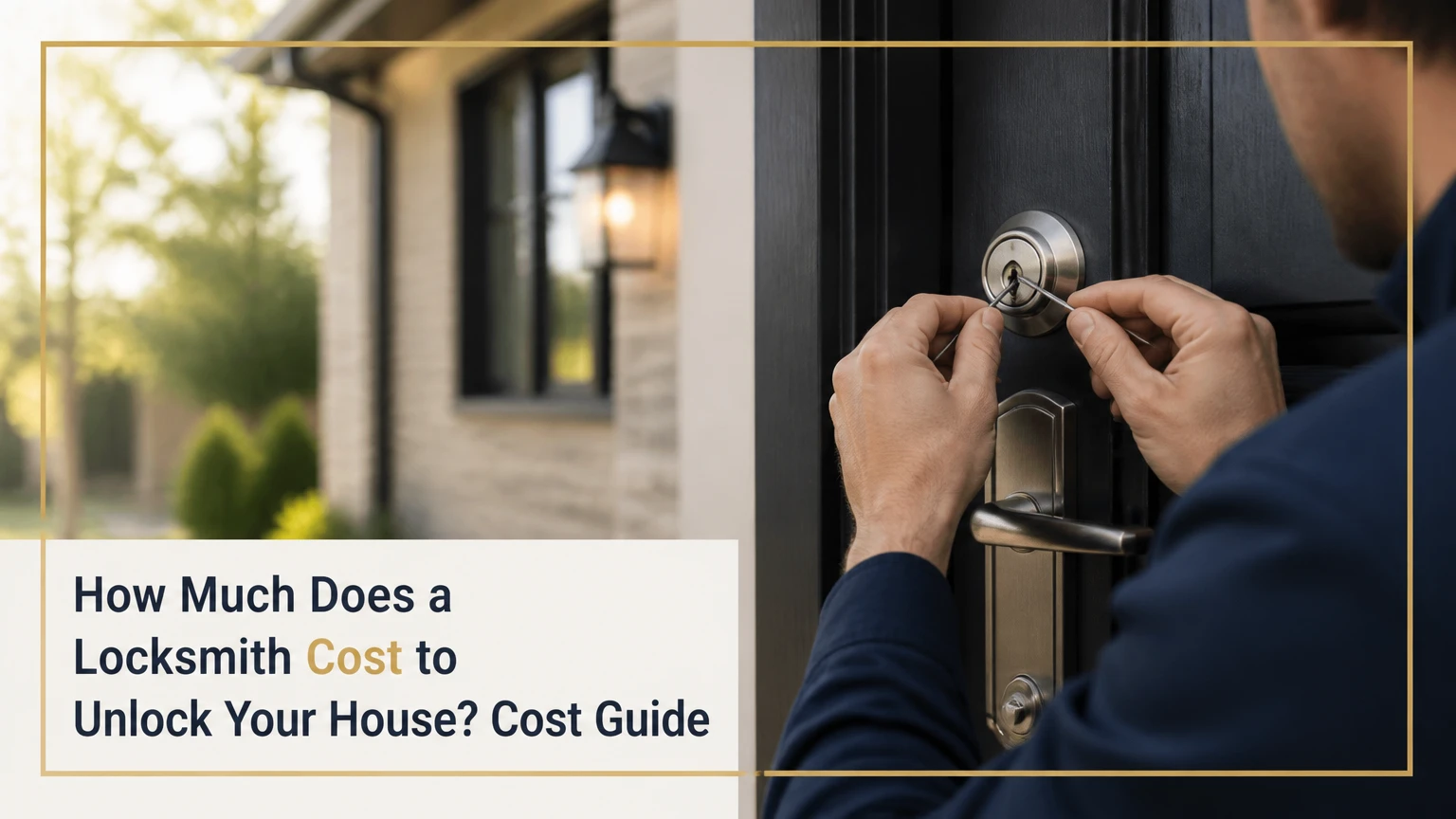
A locksmith usually charges $75-$200 to unlock a house during standard daytime hours and $150-$300 or more for nights, weekends, holidays, long-distance travel, or difficult locks. The final bill depends on the service call, entry method, lock condition, replacement hardware, and whether emergency pricing applies.
Key Facts at a Glance
- A standard daytime residential lockout commonly costs $75-$200 in the United States.
- After-hours, weekend, and holiday service commonly totals $150-$300+.
- A simple lockout often takes 15-30 minutes after arrival, but waiting time depends on technician availability and distance.
- Non-destructive entry is normally attempted before drilling or replacing a lock.
- Drilling can add $50-$200 or more for labor, plus the cost of a replacement cylinder, deadbolt, or smart lock.
- A legitimate locksmith should provide the service-call fee, labor price, surcharge, and replacement-cost rules before beginning work.
What Does a House Lockout Locksmith Do?
A house lockout locksmith gains authorized entry when a resident cannot use the normal key, code, app, or access route. The technician identifies the door and lock, verifies that the caller has a lawful connection to the address, assesses the hardware, and chooses the least damaging practical method.
The service is different from changing a lock. A lockout aims to restore entry, while rekeying changes which keys operate an existing lock, and replacement installs new hardware. A lockout may end with the original lock intact, a repaired lock, or a replacement if the cylinder is broken or entry requires destructive work.
A mobile locksmith generally arrives in a service vehicle with entry tools, replacement cylinders, deadbolts, key blanks, lubricants, and diagnostic equipment. The technician should explain any change in scope before adding drilling, extraction, or hardware charges.
What Does a Locksmith Check Before Opening the Door?
A locksmith commonly checks the lock type, door alignment, visible damage, key condition, and the caller’s authorization. Identification requirements vary by provider and local law, but a driver’s license, lease, property record, utility bill, or landlord confirmation may establish a legitimate connection to the address.
Technicians may ask the caller to wait outside while they verify the address. That step protects residents and locksmiths from unauthorized entry claims. A locksmith who refuses to confirm identity, will not identify the company, or insists on immediate cash payment creates a significant risk.
Do not provide more personal information than necessary. Ask what document is acceptable before dispatch, and cover unrelated account numbers or sensitive details on paperwork.
How Much Does a Locksmith Cost to Unlock Your House?
The typical total is $75-$200 during business hours and $150-$300+ during nights, weekends, holidays, or difficult calls. A short-distance daytime call for a standard residential deadbolt may fall near the lower end, while a rural emergency visit, high-security cylinder, or replacement lock can exceed the normal range.
Locksmith pricing is often a flat-rate service package rather than a simple hourly calculation. The invoice may combine a dispatch fee, entry labor, an emergency surcharge, travel beyond a service area, and parts. HomeAdvisor, HomeGuide, Thumbtack, and local locksmith price pages publish overlapping ranges, but these are market estimates rather than a guaranteed national price.
Typical House Lockout Price Breakdown
| Charge component | Typical amount | When it applies | Payment question |
|---|---|---|---|
| Service call or dispatch | $50-$100 | Most mobile visits | Is this included in the quoted total? |
| Daytime entry labor | $25-$100 | Standard residential lockout | Is labor flat-rate or hourly? |
| After-hours surcharge | $50-$150 | Nights, weekends, holidays | What time does emergency pricing begin? |
| Long-distance travel | $25-$100+ | Rural or out-of-area calls | Is mileage charged separately? |
| Lock extraction or drilling | $50-$200+ | Failed or damaged cylinder | Is replacement hardware included? |
| New deadbolt or cylinder | $30-$250+ | Hardware cannot be reused | What brand and grade is installed? |
A provider may quote $29 for a dispatch and then add labor, travel, and emergency charges at the door. The meaningful number is the maximum expected total for the described job, not the lowest number in an advertisement.
How Much Is an Emergency Locksmith at Night?
An emergency residential lockout commonly costs $150-$300 or more at night, with higher totals possible for holidays, remote locations, restricted-access buildings, and damaged high-security hardware. The surcharge reflects staffing and dispatch conditions, but it should be disclosed before the technician starts.
Ask whether “emergency” means any call outside business hours or only calls requiring immediate priority. A 7:30 p.m. weekend visit may have a different rate from a 1:00 a.m. holiday call. Some companies use a fixed night rate; others add a percentage or separate trip charge.
| Call scenario | Typical total | Typical arrival or work time | Main cost driver |
|---|---|---|---|
| Weekday, standard deadbolt | $75-$150 | 15-30 minutes on site | Basic entry |
| Weekday evening, standard lock | $125-$225 | 20-40 minutes on site | After-hours fee |
| Weekend apartment lockout | $150-$275 | 20-45 minutes on site | Surcharge and access rules |
| Holiday, high-security cylinder | $200-$400+ | 30-75 minutes on site | Priority labor and hardware |
| Rural call 30-60 miles away | $175-$350+ | 30-90 minutes on site | Travel and limited availability |
| Broken key with replacement | $150-$400+ | 30-90 minutes on site | Extraction, rekeying, or parts |
These are typical planning ranges, not fixed tariffs. Local labor markets, taxes, building access, and lock brands can move the total substantially.
Which Lock Types Change the Price?
Lock type changes price because each design has different access, repair, and replacement requirements. A standard single-cylinder deadbolt is usually faster and cheaper than a mortise lock, restricted key system, commercial-grade cylinder, or connected smart lock.
| Lock or access type | Typical entry cost | Typical on-site time | Likely complication |
|---|---|---|---|
| Standard knob latch | $75-$150 | 10-25 minutes | Door alignment or locked deadbolt |
| Residential deadbolt | $75-$200 | 15-35 minutes | Security grade and cylinder condition |
| High-security cylinder | $150-$300+ | 30-75 minutes | Restricted keyway or anti-drill features |
| Mortise lock | $150-$350+ | 30-90 minutes | Integrated case and replacement fit |
| Smart keypad lock | $75-$250 | 15-45 minutes | Dead battery, app access, or failed motor |
| Broken key in cylinder | $100-$250 before repair | 20-60 minutes | Extraction and possible rekeying |
| Security door or multi-point lock | $200-$500+ | 45-120 minutes | Multiple locking points and alignment |
Lock grades help describe durability, but an ANSI/BHMA Grade 1, Grade 2, or Grade 3 label does not by itself determine the price. Brand, cylinder design, door construction, and damage matter more during a lockout.
A smart lock can be cheaper when its emergency battery contacts work and the mechanical override remains available. A failed motor, stripped gearbox, or inaccessible backup key can make it more expensive than a conventional deadbolt.
How Does a Locksmith Open a Locked House?
A locksmith first attempts authorized, non-destructive entry, then moves to repair or replacement only when the lock cannot be opened safely by less invasive means. The exact technique depends on the lock and door, and a professional should not need to explain sensitive bypass details to a stranger over the phone.
The usual sequence is:
- Verify authorization. The technician checks identification, address evidence, or landlord confirmation.
- Inspect the door and lock. The technician identifies the cylinder, latch, deadbolt, damage, alignment, and security features.
- Attempt non-destructive entry. The technician uses professional methods appropriate to the hardware without forcing the frame.
- Explain the next option. If the first approach fails, the technician states whether repair, extraction, drilling, or replacement is necessary.
- Restore security. After entry, the locksmith tests the lock, supplies keys or codes when applicable, and replaces damaged hardware if authorized.
The entry work itself may take 5-30 minutes, but a difficult lock can require longer. Arrival time is separate and may range from 15 minutes in a dense service area to more than an hour in a rural location.
Is Locksmith Drilling Normal?
Drilling is a legitimate last-resort method for a seized, damaged, or high-security cylinder, but drilling should not be the default response to an ordinary lockout. The technician should explain why non-destructive entry is unsuitable and quote the replacement hardware before drilling begins.
Drilling destroys at least part of the lock cylinder. The door may remain usable if the lock body and surrounding hardware survive, but a new cylinder, deadbolt, mortise component, or smart-lock assembly may be required.
A legitimate invoice should separate entry labor from parts. Ask to keep the old hardware and request the package, brand, grade, and warranty details for the replacement.
How Long Does a Locksmith Take to Unlock a House?
A straightforward residential lockout usually takes 15-30 minutes after the locksmith arrives. The full experience can take 30 minutes to two hours because dispatch distance, traffic, identity verification, apartment access, lock damage, and replacement work all affect the schedule.
| Stage | Typical duration | What affects it |
|---|---|---|
| Dispatch and travel | 15-90 minutes | Distance, traffic, call volume |
| Identity verification | 2-10 minutes | Available documents or landlord response |
| Lock assessment | 5-15 minutes | Lock type, damage, door alignment |
| Non-destructive entry | 5-30 minutes | Cylinder condition and security features |
| Replacement or repair | 20-90 minutes | Parts availability and door fit |
A technician who promises a two-minute opening without seeing the door may be using a sales script rather than a reliable estimate. The better question is whether the quoted price covers the first entry attempt and what happens if the lock requires replacement.
Does a Locksmith Charge by the Hour or by the Job?
Many residential locksmiths use flat-rate pricing for common lockouts, although some add hourly labor for unusual repairs, extended travel, or complex hardware. A caller should request both the service-call charge and the maximum total before dispatch.
A clear phone quote should answer these questions:
- What is the total price for entry if the existing lock remains usable?
- Is the service call included in that total?
- Does the price change after 6 p.m., 9 p.m., midnight, or on holidays?
- What travel, parking, tax, or building-access charges may be added?
- What is the labor price if drilling becomes necessary?
- What are the exact prices for common replacement locks?
- Which payment methods are accepted, and is a receipt provided?
What Might a Real Locksmith Invoice Look Like?
A weekday example could include a $65 service call and $60 entry labor, producing a $125 pre-tax total. A late-night example could include a $85 dispatch, $90 entry labor, and $75 emergency surcharge, producing $250 before any replacement hardware.
A damaged cylinder may add $100 for extraction or drilling labor and $40-$180 for a replacement cylinder or deadbolt. A smart-lock replacement can add more because compatible hardware, batteries, installation, and programming may be billed separately.
The exact invoice matters less than consistency between the telephone quote and on-site authorization. Photograph the written estimate before work starts.
Should You Rekey, Replace, or Only Unlock the Door?
Choose simple entry when the lock works normally and the key was merely lost inside or outside the home. Choose rekeying when the hardware is sound but old keys may be in someone else’s possession, and choose replacement when the lock is damaged, unsuitable, or no longer meets the household’s security needs.
| Resolution | Typical cost | Typical duration | Best use |
|---|---|---|---|
| Unlock existing hardware | $75-$200 daytime | 15-30 minutes | Key lost or locked inside |
| Rekey existing cylinder | $50-$150 per lock | 20-45 minutes | Lost keys with sound hardware |
| Replace standard deadbolt | $120-$300 installed | 30-60 minutes | Worn or weak residential lock |
| Replace high-security lock | $200-$600+ installed | 45-120 minutes | Restricted keyway or upgraded security |
| Replace smart lock | $200-$600+ installed | 45-120 minutes | Failed electronics or new access system |
Rekeying is often less expensive than replacing several matching locks. However, rekeying cannot repair a cracked housing, worn latch, failed smart motor, or damaged door frame.
A locksmith should not pressure a locked-out customer into an expensive upgrade without explaining whether the original lock can be opened and reused. Emergency decisions benefit from a temporary repair followed by a daytime comparison of replacement options.
What Should You Do Before Calling a Locksmith?
Check lawful alternatives before paying for dispatch, but do not force the door, climb dangerously, or manipulate the lock with improvised tools. A spare key, property manager, trusted household member, building concierge, or manufacturer support line may solve the problem without a lockout charge.
Use this short checklist:
- Check the front, back, side, garage, and patio doors.
- Contact a landlord, property manager, roommate, or trusted neighbor with a spare key.
- Check whether an exterior key safe, garage keypad, or smart-lock backup code is available.
- If a smart lock has an external battery terminal, follow the manufacturer’s instructions for temporary power.
- If a key is inserted but will not turn, stop twisting when resistance increases.
- If the door is under pressure, gently push or pull the door while using the normal key, without forcing the cylinder.
- Call emergency services when a child, vulnerable adult, active fire, medical crisis, or immediate threat is inside.
Graphite powder is not a universal remedy. Some lock manufacturers warn against unsuitable lubricants, and excessive oil can collect dust or affect internal components. Use only a product approved for the specific lock, and do not spray anything into a smart lock without manufacturer guidance.
How Can You Avoid Locksmith Scams?
Avoid any locksmith who advertises an unusually low dispatch price, refuses to give a total range, arrives in an unmarked vehicle, or changes the price dramatically after seeing an ordinary residential lock. Consumer complaints commonly describe bait-and-switch patterns involving a low phone quote followed by large on-site charges.
Before dispatch, verify:
- The legal business name, phone number, and local service address.
- The technician’s name and company identification.
- The service-call price, entry price, emergency surcharge, and parts policy.
- Whether taxes, mileage, parking, or payment fees are excluded.
- The maximum total for non-destructive entry.
- The price range for drilling and replacement before that work begins.
Do not allow drilling until you understand the reason, replacement cost, and total estimate. If the technician demands cash, threatens to leave you locked out, or will not provide an invoice, stop the job when safely possible and contact local consumer protection authorities.
An honest low quote is possible, but a $15 or $29 total house lockout is unlikely in many markets once dispatch and labor are included. Compare the complete price, not the headline number.
Can Insurance or a Membership Cover a House Lockout?
Homeowners insurance often does not pay for a routine lost-key lockout, although some policies, home warranties, roadside memberships, bank accounts, or employer benefits include limited locksmith assistance. Coverage depends on the contract, deductible, provider network, and maximum reimbursement.
Call the insurer or membership provider before dispatch if the situation is not dangerous. Ask whether you must use an approved locksmith, whether authorization is required, and whether reimbursement covers emergency surcharges or replacement hardware.
Keep the itemized receipt, payment record, technician details, and photographs of damaged hardware. Even when coverage is available, reimbursement may be capped at a fixed amount, such as a service allowance, rather than the full invoice.
What Should Renters Do When Locked Out?
Renters should contact the landlord, property manager, or building’s emergency maintenance number before hiring an independent locksmith. A lease may assign lockout fees to the tenant, require an approved vendor, or prohibit unauthorized lock changes.
A property manager may have a master key, an on-call technician, or a contracted rate below the open-market emergency price. If the landlord cannot respond and immediate access is necessary, obtain written permission by text or email when possible, then request an itemized receipt.
Do not replace or rekey a rented property’s lock without checking the lease. The tenant may be responsible for returning the original cylinder, providing new keys, or paying for a lock that does not meet the building’s fire or access requirements.
What If the Key Broke Inside the Lock?
A broken key inside a cylinder usually costs $100-$250 for extraction or entry, with rekeying or replacement adding another $50-$300+. The price rises when the broken fragment is deep, the cylinder is damaged, or the key broke because the lock mechanism has seized.
Stop turning the key and avoid gluing another object to the fragment. Glue can spread into the keyway and convert a simple extraction into a cylinder replacement. Tell the locksmith whether the door is locked, whether a spare key exists, and whether the key previously felt stiff.
A locksmith may extract the fragment, test the cylinder, cut a replacement key, or rekey the lock. The correct choice depends on whether the cylinder remains smooth and secure after removal.
What If a Smart Lock Battery Died?
A dead smart-lock battery may cost nothing to resolve if the lock has an external emergency power contact and the homeowner has the correct battery type and PIN. If the motor, keypad, app, gearbox, or mechanical override has failed, professional service commonly costs $75-$250 for entry, with replacement hardware adding $150-$500+.
Check the manufacturer’s manual or support page for the exact emergency-power procedure. Common systems use a temporary 9-volt battery or USB power source, but the location, voltage, and sequence differ by model.
Do not pry the keypad or force the thumb turn. Damage to the exterior housing can make a battery issue an electronics replacement.
Which Option Is Cheapest Besides a Locksmith?
The cheapest safe option is usually an available spare key or authorized building contact. A landlord, roommate, trusted neighbor, concierge, or property manager may provide entry without a dispatch fee, while a membership provider may arrange covered service.
| Alternative | Likely direct cost | Typical delay | Limitation |
|---|---|---|---|
| Household spare key | $0 | 5-30 minutes | Someone must possess it |
| Landlord or building manager | $0-$75 | 15-120 minutes | Limited hours or authorization |
| Smart-lock backup code | $0 | 2-10 minutes | Battery and system must work |
| Manufacturer support | $0-$50 | 15-60 minutes | Cannot fix physical damage |
| Membership dispatch | $0-$100 copay | 30-180 minutes | Coverage limits and network rules |
| Independent locksmith | $75-$300+ | 15-120 minutes | Full out-of-pocket cost |
Do not treat lock-picking tutorials, improvised shims, credit cards, or forced entry as reliable cost-saving methods for lockouts; safe lock-picking practice belongs only on a lock you own or have explicit permission to test. They can damage the latch, weather seal, frame, or security hardware, and they can create legal questions when authorization is not obvious.
The Bottom Line
The answer to how much does a locksmith cost to unlock your house is usually $75-$200 during the day or $150-$300+ after hours. Ask for a complete written or texted quote that includes dispatch, labor, surcharge, travel, taxes, and the cost of drilling or replacement before authorizing work.
Use the landlord, building manager, spare key, smart-lock backup, or membership benefit first when those options are safe and available. If a locksmith must come, choose non-destructive entry when practical, document the invoice, and treat any unexplained price increase as a reason to pause.
Frequently Asked Questions
Does a locksmith need proof that I own the house?
A locksmith usually needs evidence that you are authorized to enter, not necessarily proof that you hold the deed. A government ID, lease, utility bill, property manager confirmation, or address-matching document may be accepted. Requirements vary by company and jurisdiction, so ask before dispatch and protect unrelated personal information.
Can a locksmith open a deadbolt without replacing it?
A locksmith can often open a standard deadbolt without replacing it when the cylinder and surrounding door hardware remain functional. High-security, damaged, seized, or restricted-keyway locks may require extraction, drilling, or replacement. Request the non-destructive entry price and replacement price separately before work begins.
How much does it cost to change locks after a house lockout?
Changing a lock after a lockout commonly costs $120-$300 for a standard installed deadbolt and $200-$600 or more for high-security or smart hardware. The total includes parts and installation, while rekeying several sound locks may cost less than replacing them.
Will a locksmith make a new key during the lockout?
A locksmith may cut or program a replacement key after gaining entry, but the price depends on the lock, key type, and whether the original cylinder works. Standard duplicate keys may cost $5-$25, while restricted, transponder, or smart-lock credentials can cost substantially more.
Can I claim a locksmith bill on my taxes?
A routine personal house lockout is generally not a normal personal tax deduction in the United States. Business, rental-property, or documented insurance-related expenses may receive different treatment, so retain the itemized invoice and ask a qualified tax professional about the specific property and use.
Should I call 911 if I am locked out?
Call emergency services when a child, vulnerable person, pet in immediate danger, medical crisis, fire, gas leak, or active security threat requires urgent intervention. A normal lost-key lockout is not a 911 matter. Tell the dispatcher the specific danger and follow their instructions rather than forcing entry.