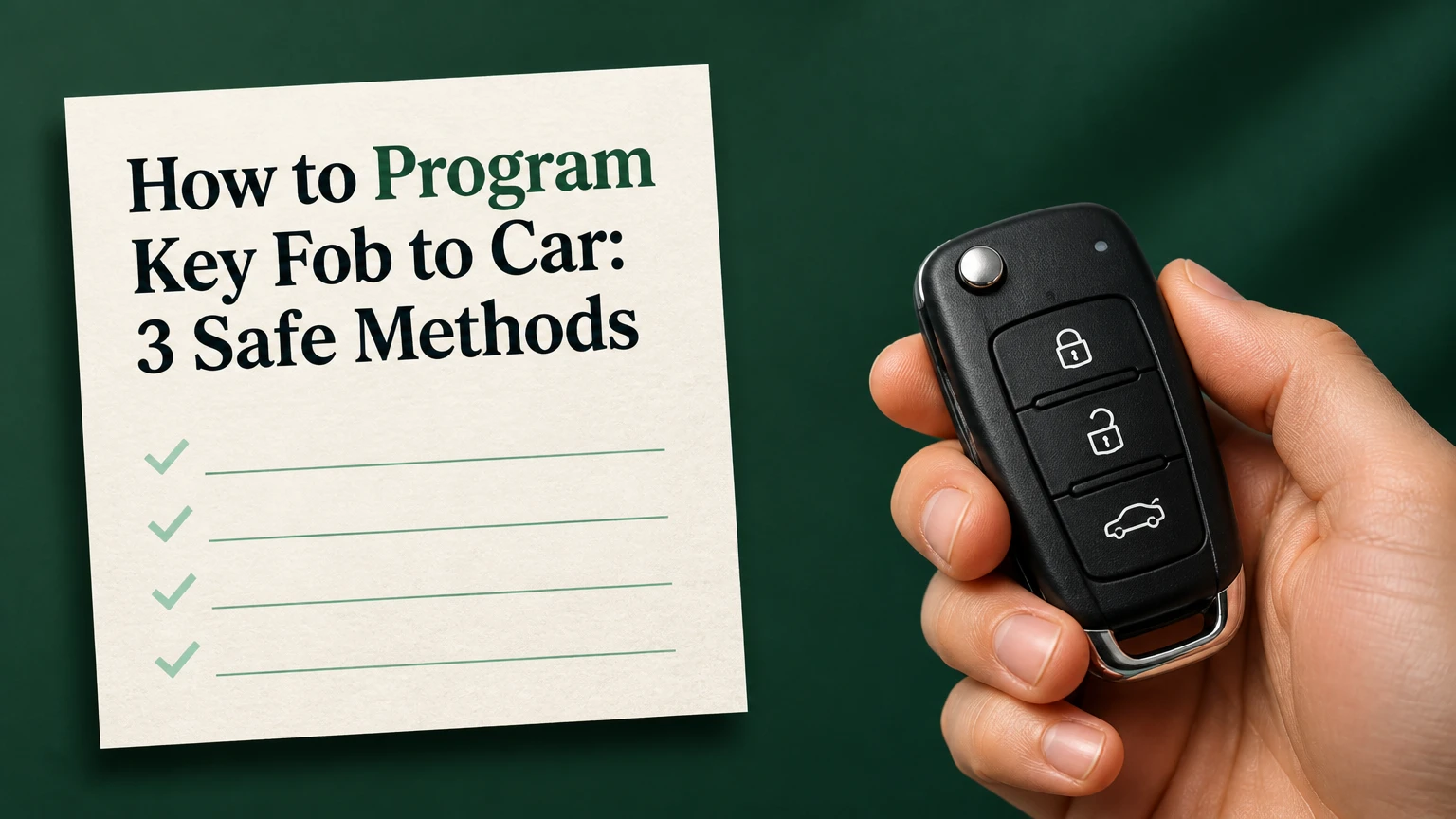
To program a key fob to a car, match the replacement fob to the vehicle by FCC ID, part number, frequency, and VIN, then use the manufacturer’s onboard procedure, a compatible OBD-II programmer, or a locksmith or dealer. Remote-lock programming and immobilizer-chip programming are separate processes, so a fob may unlock doors without allowing the engine to start.
Key Facts
A key fob can contain separate systems for remote locking, proximity detection, and engine immobilization.
The FCC ID and manufacturer part number must match the vehicle’s required transmitter specification.
Many older vehicles support onboard remote programming, but modern vehicles often require diagnostic equipment.
A replacement fob battery usually does not erase programming, although a weak battery can prevent successful pairing.
All-keys-lost situations commonly require a locksmith or dealer because the vehicle must verify ownership before adding keys.
Typical programming costs range from $20-$100 for simple DIY work and $150-$600 or more for professional service.
What Does Key-Fob Programming Actually Do?
Key-fob programming registers a remote transmitter or electronic key with the vehicle’s body control module, receiver, or immobilizer system. The process teaches the car to recognize the fob’s encrypted identification data rather than merely matching a visible button layout.
A conventional remote-head key may contain a metal blade, a remote transmitter, and a passive transponder. A smart key usually adds low-frequency proximity antennas, push-button-start authorization, and sometimes an emergency mechanical key. These components can require different programming procedures.
Remote keyless entry normally controls the locks, trunk, panic alarm, and sometimes remote start. The immobilizer system controls whether the engine may run. A rolling-code system changes the valid transmission code after each accepted button press, which prevents a previously recorded signal from being reused.
That design creates a common diagnostic trap. If the doors respond but the engine will not start, the remote transmitter may be paired while the transponder or proximity credential remains unregistered.
Key-Fob Systems and Their Functions
| Component | Typical location | Function | Common symptom when unprogrammed |
|---|---|---|---|
| Remote transmitter | Fob circuit board | Sends lock, unlock, trunk, and panic commands | Buttons do nothing |
| Immobilizer transponder | Fob shell or circuit board | Authorizes engine operation | Engine cranks but will not run |
| Proximity antenna circuit | Smart key and vehicle cabin | Detects an authorized key nearby | “Key not detected” message |
| Mechanical blade | Fob housing | Unlocks a door or operates ignition cylinder | Door cannot be opened manually |
| Vehicle receiver module | Body control or radio module | Receives and validates fob signals | Several correctly matched fobs fail |
What Should You Check Before Programming?
Verify the replacement fob before starting. Compare the original fob, the vehicle owner’s manual, and the replacement listing for FCC ID, OEM part number, button configuration, frequency, vehicle year, model, trim, and region.
The FCC ID identifies the radio transmitter approved for a particular design. It is not always sufficient by itself, because one vehicle may use multiple FCC IDs across different production years or trim levels. A part number and VIN lookup provide stronger confirmation.
Frequency also matters. Vehicles commonly use 315 MHz transmitters in North America and 433 or 434 MHz transmitters in many other markets, but frequency alone does not prove compatibility. The modulation, encryption, board version, immobilizer type, and receiver software must also match.
A used fob can be physically identical to a new one yet remain locked to another vehicle. Some manufacturers permit reprogramming used remotes, while others require a virgin or reset transmitter.
Replacement-Fob Compatibility Checklist
| Check | Where to find it | Acceptable match | Failure risk |
|---|---|---|---|
| FCC ID | Back of fob or transmitter label | Exact identifier required | Receiver ignores signal |
| OEM part number | Fob label, manual, parts catalog | Same suffix and revision | Buttons or frequency differ |
| Frequency | Label, service data, diagnostic tool | Vehicle-market specification | No radio communication |
| Button layout | Original fob and replacement | Same lock, trunk, panic, start layout | Missing functions |
| VIN fitment | Manufacturer catalog or locksmith database | Exact year, model, trim | Programming blocked |
| Key type | Blade, remote-head, smart, proximity | Same immobilizer architecture | Remote works, car will not start |
Which Programming Method Fits Your Car?
The right method depends on vehicle age, key type, manufacturer security policy, and whether one authorized key still works. Onboard programming is cheapest when available, an OBD-II tool handles many supported vehicles, and a professional is usually necessary for proprietary systems or all-keys-lost situations.
| Situation | Likely method | Typical time | Typical cost |
|---|---|---|---|
| Older vehicle with one working key | Onboard remote procedure | 5-15 minutes | $10-$60 |
| New replacement smart key, one working key present | Compatible OBD-II kit | 15-45 minutes | $60-$200 |
| Modern vehicle with security gateway | Locksmith or authorized diagnostic tool | 30-90 minutes | $150-$400 |
| All authorized keys lost | Locksmith or dealer | 45-180 minutes | $250-$800+ |
| Luxury vehicle with proprietary key | Dealer or specialist locksmith | 1-3 hours | $400-$1,000+ |
| Digital key on supported phone | Manufacturer application | 10-30 minutes | Usually included |
When Is Onboard Programming Available?
Onboard programming is most common on older domestic vehicles and selected Toyota, Honda, Nissan, and other models. The owner inserts a valid key, cycles the ignition, operates a door switch, or presses a specific combination while the vehicle enters a learning mode.
The procedure is not universal. “Turn the ignition eight times” is a Ford-style pattern found on some models, not a general instruction for every car. A similar-looking Toyota, GM, or Honda may require a different door, timing sequence, or existing-key condition.
Use the exact owner’s-manual procedure whenever possible. A wrong sequence normally does not damage the car, but repeated failed attempts can waste the learning window or leave previously paired remotes needing re-synchronization.
How Do You Program a Key Fob Without a Tool?
You can program a remote without a scan tool only when the vehicle supports an onboard learning procedure. Set aside 5-15 minutes, install a fresh fob battery, close every door, and keep all existing remotes inside the vehicle because some systems erase or replace the complete remote list.
Step 1: Confirm the Vehicle and Fob
Match the FCC ID, part number, frequency, button layout, and model-year application. Remove other wireless remotes from the cabin, because aftermarket alarms, garage-door transmitters, and nearby RF devices can occasionally interfere with a learning cycle.
Success checkpoint: The replacement fob has an exact or manufacturer-confirmed application.
Common mistake: Buying a fob because the shell looks identical.
Step 2: Prepare the Vehicle
Sit in the driver’s seat, close all doors, release the hood and trunk switches if required, and place the transmission in Park. Turn off accessories and use a fully charged vehicle battery, particularly when the procedure requires several ignition cycles.
Success checkpoint: The dome light and door-ajar indicator respond normally.
Common mistake: Ignoring a failed door-latch switch, which can prevent programming mode.
Step 3: Enter the Manufacturer’s Learning Mode
Follow the model-specific ignition, door, or key sequence. Some vehicles use OFF-to-RUN cycles; others require an existing key, a driver-door sequence, or a lock-button command. Do not turn the ignition to START unless the manual specifically instructs it.
Success checkpoint: Door locks cycle, a chime sounds, or the instrument cluster displays a programming message.
Common mistake: Using a generic internet sequence from another year or trim.
Step 4: Pair Every Remote During the Time Window
Press the required button, often LOCK, within the specified period, commonly 10-20 seconds after the vehicle signals learning mode. Program every remote during the same session because some vehicles overwrite the prior remote list rather than append one new fob.
Success checkpoint: The locks cycle or the vehicle chimes after each accepted remote.
Common mistake: Programming only the new fob and accidentally removing the working original.
Step 5: Exit and Test Each Function
Turn the ignition off or open the driver’s door according to the manual. Test lock, unlock, trunk release, panic alarm, remote start if equipped, mechanical-key operation, and engine starting.
Success checkpoint: Each button performs its intended function from a consistent distance.
Common mistake: Assuming successful door operation proves immobilizer programming.
How Do You Use an OBD-II Key Programmer?
An OBD-II programmer connects to the vehicle’s diagnostic port and communicates with the body-control or immobilizer system. Use only a tool explicitly listed for the exact year, model, trim, key type, and market, because a generic code reader cannot normally add an immobilizer key.
The port is usually below the dashboard near the steering column. Keep the vehicle battery above approximately 12 volts during programming; a battery maintainer is sensible for procedures lasting more than 20 minutes, provided the tool manufacturer permits one.
Some vehicles require a security PIN, two existing keys, an online account, or an authorized gateway token. FCA/Stellantis vehicles equipped with a Security Gateway module may block unsupported aftermarket access, while newer Ford, Toyota, BMW, Mercedes-Benz, and Volkswagen systems can require manufacturer-specific credentials or encrypted diagnostic functions.
OBD-II Programming Sequence
- Identify the tool: Confirm exact vehicle coverage, supported key frequency, and whether the kit programs remote functions, immobilizer functions, or both.
- Prepare ownership documents: Have the VIN, registration, identification, and existing keys available if the tool or locksmith requests them.
- Stabilize power: Charge the vehicle battery and do not operate headlights, climate controls, or audio equipment during the procedure.
- Connect the tool: Plug into the OBD-II port with the ignition off unless the instructions specify another state.
- Select the vehicle: Enter the correct model, year, region, and immobilizer system rather than relying on automatic detection.
- Add or learn the key: Follow prompts precisely, including button presses and timing.
- Test both systems: Verify remote entry and engine authorization separately.
Success checkpoint: The tool reports a completed key-learning operation and the vehicle recognizes the key with no immobilizer warning.
Common mistake: Treating a universal OBD-II emissions scanner as a key programmer.
Can a Phone Be Programmed as a Digital Car Key?
A phone can function as a digital car key only when the vehicle, phone, account, and region support the manufacturer’s digital-key system. Setup usually requires the brand’s application, Bluetooth or NFC, an authenticated owner account, and sometimes two physical keys inside the vehicle.
Tesla, BMW, Hyundai, Kia, Ford, Genesis, Mercedes-Benz, and other manufacturers offer digital-key features on selected models, but compatibility varies by model year and phone hardware. Apple and Google wallet support also differs by manufacturer.
A phone key is an access credential, not a universal replacement for a physical fob. Keep a physical key or emergency NFC method available, because a dead phone battery, disabled Bluetooth, damaged phone, or expired account authorization can prevent entry.
| Digital-key requirement | Typical condition | What to verify |
|---|---|---|
| Vehicle support | Selected model years and trims | Manufacturer application |
| Phone support | Compatible iPhone or Android model | Operating-system version |
| Account status | Verified vehicle owner account | VIN linked to profile |
| Wireless method | Bluetooth, NFC, or ultra-wideband | Phone hardware |
| Physical-key requirement | Often one or two keys present | Setup instructions |
| Backup access | Mechanical key or NFC reserve | Emergency procedure |
What Are the Costs and Timeframes?
A simple remote replacement typically costs $20-$100 when the vehicle supports self-programming. A smart key, transponder, or proximity fob generally costs $150-$600 professionally, while luxury display keys and all-keys-lost jobs can exceed $1,000.
Prices vary by OEM versus aftermarket part, blade cutting, mobile labor, security-code access, vehicle location, and whether old lost keys must be erased. The replacement part often costs more than the programming labor.
| Service component | Typical price | Typical time | Main price driver |
|---|---|---|---|
| Remote fob only | $20-$100 | 5-20 minutes | OEM versus aftermarket |
| Cut mechanical key | $10-$75 | 10-30 minutes | Laser or sidewinder cutting |
| Transponder key | $80-$250 | 20-60 minutes | Immobilizer system |
| Proximity smart key | $150-$600 | 30-120 minutes | Vehicle security architecture |
| All keys lost | $250-$800+ | 45-180 minutes | Erasure and ownership verification |
| Luxury display key | $600-$1,200+ | 1-3 hours | OEM-only availability |
Should You Use a Locksmith or Dealer?
Choose a mobile automotive locksmith for most replacement keys when the locksmith has documented coverage for the vehicle. Choose a dealer when the vehicle requires proprietary online authorization, an OEM-only key, or a specialized digital-key credential.
| Decision factor | DIY programmer | Automotive locksmith | Dealership |
|---|---|---|---|
| Typical total cost | $20-$200 | $150-$600 | $300-$1,200+ |
| Mobile service | No | Often available | Rare |
| All keys lost | Limited | Common capability | Supported |
| OEM access | Product-dependent | Database-dependent | Factory system |
| Same-day availability | Depends on parts | Often 30-120 minutes | Appointment-dependent |
| Ownership verification | Usually user-controlled | Required | Required |
| Main risk | Wrong part or coverage | Incorrect provider | Higher price and travel |
Ask a locksmith whether the quote includes the key, cutting, remote pairing, immobilizer registration, programming-cable charge, and VAT or sales tax. A low advertised price may cover only cutting or only remote synchronization.
Why Does the Fob Unlock the Doors but Not Start the Car?
A fob that unlocks the doors but does not start the engine usually has a programmed remote transmitter but an unprogrammed or defective immobilizer credential. Remote-entry pairing and engine authorization use separate data paths, even when both functions share one plastic housing.
First, test whether the engine cranks. A no-crank condition may involve the brake switch, push-button authorization, vehicle battery, or starter interlock. An engine that cranks and immediately stops, or displays “key not detected” or an immobilizer symbol, points more strongly toward transponder or proximity programming.
A dead fob battery usually affects buttons and proximity range, but many vehicles can still start through a backup transponder location. Consult the manual for the emergency placement, which may be near the start button, steering column, center console, or cup holder.
Common Programming Failures and Fixes
Programming failures usually result from an incorrect fob, insufficient vehicle voltage, a failed door switch, exceeded key memory, or a procedure that covers remote entry but not immobilizer registration. Diagnose the exact symptom before buying another programmer.
| Symptom | Probable cause | Recovery action |
|---|---|---|
| No buttons work | Dead battery or wrong FCC ID | Replace battery and verify part number |
| Locks enter learning mode but reject fob | Wrong frequency or full memory | Confirm specification and erase unused keys |
| Remote works, engine will not start | Immobilizer not programmed | Run transponder or proximity-key registration |
| Nothing happens during ignition cycle | Door switch or wrong sequence | Check dome-light response and manual |
| “Key not detected” appears | Weak battery, antenna fault, wrong key | Use backup location, then test another key |
| Tool stops during programming | Low voltage or unsupported software | Stabilize battery and verify coverage |
Does Replacing the Fob Battery Erase Programming?
Replacing a key-fob battery normally does not erase the fob’s stored identity or vehicle registration. The new battery must have the correct voltage, polarity, and physical size, commonly a CR2032 or CR2025, but the exact cell belongs in the vehicle manual or fob housing.
After replacement, press LOCK several times near the vehicle or perform the model-specific resynchronization sequence if the buttons stopped responding. Do not confuse resynchronization with immobilizer programming. A resynchronized remote may still need a separate security procedure to start the car.
What If All Keys Are Lost?
All-keys-lost programming normally requires an automotive locksmith or dealer because the vehicle must authenticate ownership and create a new authorized-key list. Onboard remote procedures generally cannot create the first immobilizer credential without an existing authorized key.
Bring government identification, vehicle registration or title, and the VIN. Ask the provider whether the service deletes the missing keys from memory. Deleting lost credentials reduces the chance that a recovered old key will still unlock or start the vehicle, although mechanical locks may require separate rekeying.
Can Too Many Keys Prevent Programming?
Many vehicles store a limited number of authorized keys or remotes, often four to eight depending on the model. When memory is full, the car may reject a correct replacement until old credentials are erased or the complete list is relearned.
Record every currently working key before starting. If a procedure says to program all remotes in one session, place every key together and test them afterward. A locksmith can often clear missing keys, but some systems erase all stored keys and require every remaining key to be present.
Practical Variations for Common Situations
Adding a Spare While One Key Works
Adding a spare is usually the least expensive scenario. Confirm whether the vehicle permits owner-added keys, buy a correctly matched blank or fob, and program the new key before the original fails.
Replacing Only the Housing
A damaged shell does not always require programming. If the original circuit board and immobilizer transponder transfer intact, a replacement housing may restore physical operation without changing the vehicle’s electronic registration. Do not discard a small transponder capsule hidden separately inside the old shell.
Buying a Used Fob
A used fob may be economical for remote-entry functions, but compatibility and reset capability determine whether it can be reused. Ask for the FCC ID, part number, frequency, and donor vehicle information before purchase, and avoid listings that provide only a photograph.
Frequently Asked Questions
How long does key-fob programming take?
Simple onboard remote programming takes about 5-15 minutes. OBD-II programming commonly takes 15-45 minutes, while modern security systems and all-keys-lost jobs may require 45-180 minutes. Waiting time for a correct replacement fob often exceeds the actual pairing time.
Will a new key fob work without programming?
A new key fob will not normally operate a vehicle until its remote and immobilizer credentials are registered. Some aftermarket remotes arrive preconfigured for a specific vehicle, but the owner must still complete the vehicle-side learning procedure unless the seller explicitly confirms pre-programming.
Can AutoZone program my car key fob?
An automotive-parts retailer may sell batteries, shells, replacement remotes, or selected programming kits, but service availability varies by location and vehicle. Call the specific store with the year, model, FCC ID, and key type; a mobile locksmith is more likely to handle immobilizer programming.
Why did my key fob stop working after sitting near the car?
A rolling-code remote can become out of synchronization after repeated button presses outside the vehicle, although battery failure is more common. Replace the battery, test the spare fob, and perform the manufacturer’s resynchronization procedure before attempting full key registration.
Can I program a key fob with the car battery disconnected?
Disconnecting the vehicle battery does not usually erase registered keys, but it interrupts programming and may create low-voltage or module-reset issues. Keep the vehicle battery connected and charged during pairing unless the manufacturer’s service procedure specifically requires disconnection.
How do I know whether I need a locksmith or dealer?
Use a locksmith when the provider confirms exact vehicle coverage, mobile service, and immobilizer capability. Use the dealer for OEM-only display keys, proprietary online authorization, unresolved module faults, or digital-key systems that require factory account support.
The Bottom Line
To program a key fob to a car, first verify the FCC ID, part number, frequency, VIN fitment, and key type. Then choose onboard programming for supported older vehicles, a vehicle-specific OBD-II tool for compatible modern models, or a locksmith or dealer for proprietary systems and all-keys-lost situations.
Test door functions and engine authorization separately. If the fob unlocks the car but will not start it, the remote transmitter is probably programmed while the immobilizer credential is not. Exact manufacturer instructions, stable battery voltage, and a correctly matched fob determine success more reliably than a generic programming sequence.