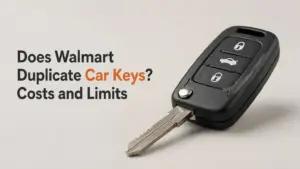
You can make copies of car keys at an automotive locksmith, a vehicle dealership, and, for some older mechanical keys, a hardware store. Modern transponder keys, remote-head keys, and smart fobs usually require both precision cutting and electronic programming, so a locksmith or dealership is the reliable choice.
Key Facts
An automotive locksmith is usually the best balance of price, speed, and programming capability for a spare key.
A hardware store can often copy a plain metal blade, but most stores cannot program a modern immobilizer chip or proximity fob.
A dealership provides an OEM key and manufacturer-approved programming, but usually costs more and may require an appointment.
A transponder key can turn the ignition correctly and still fail to start the engine if its chip is not programmed.
A working original key reduces cost and failure risk because the technician can verify the blade profile and electronic compatibility.
Typical U.S. prices range from $10-$25 for a basic metal duplicate and $150-$500 or more for some smart-key replacements.
What Does Copying a Car Key Involve?
Copying a car key means duplicating the physical key pattern and, when applicable, registering an electronic identifier with the vehicle’s immobilizer system. A plain metal key needs only accurate cutting, while a transponder or smart key also needs a compatible chip, remote, or proximity module.
The physical portion opens the driver’s door, trunk, and ignition cylinder. The electronic portion tells the engine control system that the key is authorized. Those functions can fail independently, which explains why a key may unlock the doors but not start the engine.
A technician may duplicate a working key, cut a replacement from a vehicle key code, or originate a key after all keys are lost. “Copy” therefore covers several services that have different prices and equipment requirements.
Cutting, Cloning, and Programming Are Different Services
Key cutting creates the blade profile. Cloning transfers compatible transponder data from an existing key to another chip, where the vehicle permits that method. Programming adds a new key identity to the car through an onboard procedure or diagnostic connection.
A cloned key may avoid changing the vehicle’s stored key list, while a newly programmed key becomes an additional authorized key. When a key is stolen or lost, ask the provider whether the old key can be deleted from the vehicle’s memory. Duplication alone does not cancel a missing key.
Which Type of Car Key Do You Have?
The key type determines where you can get a copy, whether programming is required, and how much the service will cost. Examine the key head, buttons, blade, ignition system, and dashboard before contacting a provider.
| Key type | Identifying feature | Typical service | Typical U.S. price |
|---|---|---|---|
| Mechanical key | All-metal blade, no buttons or plastic head | Duplicate cutting | $5-$25 |
| Transponder key | Plastic head, hidden immobilizer chip | Cutting plus chip programming | $50-$150 |
| Laser-cut key | Thick blade with central or winding groove | High-precision cutting plus programming | $100-$250 |
| Remote-head key | Blade and lock buttons in one housing | Cutting, remote pairing, chip programming | $100-$250 |
| Proximity smart key | Push-button start and pocket-carry fob | Fob registration and emergency-blade cutting | $150-$500+ |
A vehicle’s model year provides a clue but does not identify the key with certainty. Trim level, market, ignition system, and factory options can change the correct part number. A 2010 vehicle may use a simple transponder key, a remote-head key, or a separate remote and metal key.
How Can You Tell Whether a Key Has a Transponder?
A plastic key head, security indicator on the dashboard, or an engine that refuses to start with an unprogrammed copy indicates a transponder system. The strongest confirmation comes from the vehicle owner’s manual, a manufacturer parts lookup, or a qualified locksmith’s key database.
A transponder chip usually has no visible battery. The ignition antenna powers the chip at close range, so replacing the fob battery does not fix a failed immobilizer key. Push-button vehicles use additional radio communication, but many also retain a passive backup chip or emergency starting procedure.
Where Can You Make Copies of Car Keys?
The four practical sources are automotive locksmiths, dealerships, hardware stores, and online key suppliers. Automotive locksmiths handle the widest range of vehicles at a lower typical price than dealerships, while hardware stores are appropriate mainly for plain metal keys.
| Provider | Keys commonly handled | Typical price | Typical time | Main limitation |
|---|---|---|---|---|
| Automotive locksmith | Transponder, laser, remote, smart | $90-$350 | 15-60 minutes | Tool coverage varies by vehicle |
| Dealership | OEM keys and brand-specific fobs | $150-$500+ | 30 minutes-3 days | Higher price and possible towing |
| Hardware store | Mechanical blades, selected models | $5-$90 | 5-20 minutes | Limited electronic programming |
| Online supplier | Blanks, fobs, selected DIY kits | $40-$180 | 2-7 days | Compatibility and programming risk |
Is an Automotive Locksmith the Best Choice?
An automotive locksmith is usually the best choice for a spare key when a local provider has confirmed coverage for the exact make, model, year, and key system. A mobile technician can cut and program the key at your home, workplace, or roadside location without a dealership tow.
Typical locksmith pricing is $90-$250 for many standard electronic keys and $150-$350 for many smart keys, although European vehicles, encrypted systems, emergency service, and parts availability can increase the bill. A reputable locksmith should provide a complete quote covering the blade, fob, programming, travel, and tax.
Mobile convenience has a trade-off. Some technicians carry broad diagnostic coverage, while others specialize in particular brands. Ask for the business name, physical address, license or registration details required in your jurisdiction, and a written total before authorizing work.
When Should You Use a Dealership?
Use a dealership when the vehicle requires brand-specific online authorization, a restricted OEM key, a complicated European immobilizer system, or warranty-supported programming. A dealership is also sensible when the vehicle is nearly new and preserving factory parts and documentation matters more than minimizing cost.
Dealership prices commonly fall between $150 and $500 or more. The wait may be 30 minutes for an in-stock key or several days if the part must be ordered by VIN. If no working key remains, the dealership may require the vehicle on-site for programming.
A dealership is not automatically necessary for every smart key. Many independent locksmiths can service common Ford, Toyota, Honda, Hyundai, Kia, Nissan, and General Motors systems. Confirm capability before assuming that push-button start requires dealer service.
Can a Hardware Store Copy a Car Key?
A hardware store can usually duplicate a plain metal car key if the store has the correct blank and cutting machine. Some locations sell or cut selected automotive blanks, but availability and electronic programming capability differ by branch.
A kiosk may copy the visible blade or shell without creating a functioning immobilizer key. A metal duplicate can unlock a door yet fail to start the engine because the original transponder data is absent. Store staff may not be able to identify that failure in advance.
Hardware stores make the most sense for older vehicles with non-electronic keys, inexpensive door-only duplicates, or an emergency mechanical blade. Call the specific location rather than relying on the retailer’s general website.
How Much Does a Spare Car Key Cost?
A spare car key typically costs $5-$25 for a mechanical blade, $50-$150 for a transponder key, and $150-$500 or more for a proximity fob. The final price depends on the key type, OEM or aftermarket parts, programming method, vehicle security system, location, and whether the original key works.
| Situation | Typical parts cost | Programming or cutting | Typical total | Typical completion |
|---|---|---|---|---|
| Plain metal spare | $3-$10 | $5-$15 | $5-$25 | 5-15 minutes |
| Working transponder spare | $25-$80 | $30-$90 | $50-$150 | 15-45 minutes |
| Remote-head replacement | $60-$150 | $40-$100 | $100-$250 | 20-60 minutes |
| Smart-fob replacement | $80-$300 | $70-$200 | $150-$500+ | 30-90 minutes |
| All keys lost | $100-$350 | $100-$400 | $200-$750+ | 1-4 hours |
These are typical U.S. consumer ranges, not fixed rates. Rural travel, nighttime callouts, luxury vehicles, immobilizer security access, and required towing can add $50-$200 or more. Insurance or roadside-assistance plans sometimes cover part of a lost-key service, but coverage limits and exclusions vary.
The cheapest quote may exclude programming, emergency access, a new fob battery, or the service call. Request an itemized price before the technician cuts anything.
What Happens During Professional Duplication?
Professional duplication normally takes 15-60 minutes when a working key is available and the replacement part is in stock. The technician verifies the vehicle, selects a compatible blank or fob, cuts the blade, programs the electronic component, and tests every relevant function.
Step 1: Verify the Vehicle and Key
Provide the make, model, year, trim if known, and whether the vehicle uses a metal key, ignition slot, or push-button start. The provider may also check the VIN, existing key markings, FCC ID, frequency, blade profile, and immobilizer platform.
The VIN is a vehicle identifier, not a universal permission slip for instant key creation. A locksmith or dealer may require photo identification, registration, title, or other proof of ownership before accessing key codes or programming the vehicle.
Step 2: Select the Correct Part
The FCC ID identifies the radio device used in many fobs, but matching the FCC ID alone does not guarantee compatibility. Part number, frequency, button layout, immobilizer chip, vehicle market, and software version can also matter.
Aftermarket fobs can work well when they come from a reputable supplier and match the application exactly. Cheap marketplace parts may contain locked, previously assigned, counterfeit, or incompatible chips that cannot be programmed.
Step 3: Cut the Mechanical Blade
The technician duplicates the working key or cuts the replacement to the manufacturer’s key code. Cutting to code is preferable when the original blade is visibly worn, because a machine copying a worn key can reproduce its inaccurate edges.
A laser-cut or sidewinder blade needs specialized equipment. A standard edge-cut machine cannot reproduce the central groove accurately, even when the blank looks similar.
Step 4: Program the Immobilizer and Remote
The technician uses the vehicle’s approved procedure, a compatible diagnostic tool, or a supported cloning method. Some vehicles allow owner programming when two recognized keys are present, while others require security access or dealer-level authorization.
Remote lock buttons and engine-start authorization are separate functions on some vehicles. A technician must test both rather than assuming that successful door locking proves successful immobilizer programming.
Step 5: Test the Finished Key
The completed key should operate the driver’s door, passenger doors where applicable, trunk, ignition, remote buttons, and engine start system. The security warning light should behave normally after startup.
Do not leave until the new key starts the vehicle and the old key still works. If a lost key was excluded from memory, confirm that deletion was performed and understand which keys remain authorized.
What Should You Bring to the Key Appointment?
Bring the vehicle, every working key, photo identification, registration or title, and the key-fob information if available. Having the car present is especially important for programming because the technician may need direct access to the diagnostic connector.
| Item to bring | Where to find it | Why it matters |
|---|---|---|
| VIN | Dashboard, door jamb, title | Confirms vehicle identity and parts application |
| Working keys | Key ring or vehicle | Enables testing and sometimes cloning |
| FCC ID | Rear of many fobs | Helps identify radio hardware |
| Registration or title | Glove box or digital records | Supports ownership verification |
| Owner’s manual | Glove box or manufacturer app | May list emergency-start and programming procedures |
Never send a vehicle title, VIN photograph, or registration to an unverified seller. A VIN is not normally secret, but ownership documents and key-programming access should be handled by an established provider.
Should You Buy a Key Online and Program It Yourself?
Online replacement kits can reduce the parts price to roughly $40-$180, but DIY success depends on the vehicle and the kit. The buyer must match the part number, FCC ID, frequency, blade style, immobilizer chip, and programming method before ordering.
DIY kits are most suitable when a working key remains, the supplier guarantees compatibility, the vehicle supports the included procedure, and the buyer can accept a failed-part return restriction. Some kits require an existing recognized key; others use an OBD-connected programmer with model-specific limitations.
Online purchasing is a poor choice when all keys are lost, the vehicle uses restricted security access, the key must be cut from a code, or the buyer cannot verify the exact part. A misidentified key may be unreturnable after cutting, and an incorrect programmer can interrupt the vehicle’s security procedure.
A professional quote often costs more than the online part but includes diagnosis, cutting, programming, and a functional test. Compare the complete installed price, not the advertised shell or blank price.
Which Provider Is Best for Your Situation?
The best provider depends on whether the priority is low cost, immediate mobility, OEM assurance, or specialized security support. A working key usually favors a locksmith, while all-keys-lost and restricted systems require more careful provider selection.
| Driver situation | Best first option | Expected total | Reason |
|---|---|---|---|
| Older all-metal key | Hardware store | $5-$25 | Cutting is the only required service |
| Working key, modern daily driver | Automotive locksmith | $90-$250 | Mobile programming and moderate price |
| All keys lost at home | Mobile automotive locksmith | $200-$750+ | On-site decoding, cutting, and programming |
| New luxury European vehicle | Authorized dealership | $300-$1,000+ | Restricted parts and manufacturer authorization |
| Spare needed before a trip | Local locksmith with stock | $90-$350 | Same-day testing reduces travel risk |
| Budget DIY owner with two keys | Verified online kit | $40-$180 | Lower parts cost with existing-key backup |
If You Still Have a Working Key
Arrange a duplicate before the original becomes unreliable. A locksmith can test the original, cut a fresh blade to code if needed, and confirm that the spare starts the vehicle before an emergency occurs.
Keep the spare in a secure location separate from the primary key. Do not store both keys in the same vehicle, bag, or unlocked drawer.
If All Keys Are Lost
Call an automotive locksmith first if mobile service is available and the vehicle is a common model. The technician may decode the lock, cut a key from the vehicle code, and program a new credential at the vehicle’s location.
Ask whether the provider can erase missing keys from the immobilizer memory. If the vehicle uses online authorization or restricted OEM credentials, the locksmith may refer the job to a dealership. A tow may be necessary in that situation.
If the Vehicle Is a Luxury or European Model
Get a brand-specific quote before authorizing work. BMW, Mercedes-Benz, Audi, Volvo, and some newer Land Rover systems can involve encrypted credentials, dealer authorization, or modules that independent equipment cannot safely access.
The statement that every European vehicle must go to a dealership is too broad. Independent specialists support many European models, but the provider must identify the exact immobilizer generation rather than relying on the badge alone.
What Mistakes Make Car-Key Copies Fail?
Most failed duplicates result from the wrong key type, worn source key, incompatible electronic part, or incomplete testing. Correcting the problem is easier when the technician diagnoses the mechanical and electronic functions separately.
- Copying a worn key: The duplicate inherits inaccurate cuts. Request a code-cut key when the original sticks, rocks in the ignition, or visibly has rounded edges.
- Buying by appearance alone: Similar-looking fobs can use different frequencies or chips. Match the part number and application, not only the button layout.
- Testing only the remote: Working lock buttons do not prove that the immobilizer will authorize engine startup.
- Ignoring the emergency blade: A smart fob may contain a removable metal blade for the door lock. Test that blade before storing the fob.
- Accepting an incomplete quote: Ask whether programming, cutting, travel, batteries, tax, and key deletion are included.
- Using a weak fob battery: A dead battery can prevent remote operation, although it does not usually erase the programmed identity.
A practical locksmith rule is: “Test the blade, the buttons, and the start authorization before you leave.” The rule matters because each function uses different hardware and can fail independently.
How Do You Find a Reliable Key Service Near You?
Search for an automotive locksmith rather than a general residential locksmith, then verify exact vehicle coverage by telephone. A credible provider should discuss the key type, ownership documents, programming method, warranty, and complete price before dispatching a technician.
Use this checklist:
- Ask whether the technician supports your exact make, model, year, and key style.
- Request the total price, including service call, cutting, programming, parts, and tax.
- Confirm whether the replacement is OEM, aftermarket, refurbished, or customer-supplied.
- Ask whether a failed part or failed programming attempt carries an additional charge.
- Verify licensing, insurance, business address, and recent local reviews where applicable.
- Confirm arrival time and whether the technician carries the required key in stock.
- Bring proof of ownership and every working key.
Avoid providers that quote an unusually low “starting at” price but refuse to state the programmed total. A low blank-only price is not comparable with a mobile, cut-and-programmed key.
What If the New Key Does Not Work?
A key that turns the lock but will not start the engine usually has a programming, transponder, or chip problem rather than a cutting problem. A key that will not enter or turn the lock has a blade, blank, cylinder, or alignment problem.
| Symptom | Likely cause | First action |
|---|---|---|
| Unlocks doors, engine will not start | Unprogrammed or wrong transponder | Return to programmer for immobilizer diagnosis |
| Remote buttons fail, engine starts | Dead battery or unpaired remote | Replace battery, then verify remote pairing |
| Key will not turn | Incorrect cut or worn cylinder | Stop forcing it and request code cutting |
| Push-start vehicle reports no key | Weak battery, wrong fob, or antenna fault | Use emergency-start position and test fob |
| New key works, old key fails | Key memory changed or old key was deleted | Ask provider to review stored key list |
Do not repeatedly force a tight blade into the ignition. A damaged ignition cylinder can turn a low-cost recut into a larger repair. If a push-button vehicle has a dead fob battery, consult the owner’s manual for the designated backup location, which may be near the start button, steering column, or center console.
FAQ
Can a locksmith make a car key without the original?
Yes, an automotive locksmith can often create a key without the original by using the VIN, manufacturer key code, lock decoding, or vehicle-specific diagnostic equipment. The provider will normally require proof of ownership, and some restricted vehicles require dealer authorization or an on-site dealership visit.
How long does it take to get a spare car key?
A spare usually takes 15-60 minutes when the key or fob is in stock and a working key is available. Dealer orders can take 1-3 days, while online purchases commonly take 2-7 days before cutting and programming.
Can I program a replacement key myself?
Some vehicles support owner programming, particularly when two recognized keys are already available. Many transponder and proximity systems require a diagnostic tool, security PIN, or online authorization, so the owner’s manual and exact vehicle application must be checked before buying a DIY kit.
Does a replacement car key need a new battery?
A remote fob normally needs a correctly sized battery for lock and unlock buttons, but a passive transponder chip may not need a battery to authorize ignition. A smart key with a dead battery may still start the vehicle through its manufacturer-specified emergency detection location.
Are aftermarket car keys safe to use?
A reputable aftermarket key can function correctly when its part number, frequency, chip, and programming compatibility match the vehicle. Unverified marketplace keys may contain incompatible or locked electronics, and a locksmith may decline to program a customer-supplied part that cannot be tested or returned.
Should I delete a lost key from the car?
Yes, ask whether the lost or stolen key can be removed from the vehicle’s authorized-key memory. Deletion prevents that credential from starting the vehicle on systems that support key-list management, although it does not replace physical lock changes or address every remote-entry function.
The Bottom Line
You can make copies of car keys at an automotive locksmith, dealership, hardware store, or online supplier, but the correct choice depends on the key technology. Choose a hardware store for a plain metal blade, an automotive locksmith for most programmed spares, and a dealership or brand specialist for restricted luxury systems.
When comparing quotes, confirm cutting, programming, parts quality, testing, ownership verification, and lost-key deletion. The safest time to make a spare is while the original still works, because the technician can verify every function before the vehicle becomes an emergency.