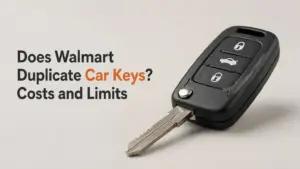
A car key usually will not turn because the steering-lock pin is under pressure, the automatic transmission is not registering Park, the key is worn or damaged, or the ignition lock cylinder is failing. A weak battery can also prevent an electronic steering lock from releasing. Use light pressure only, because a snapped key creates a more expensive repair.
Key Facts
A steering wheel pressed against a curb can bind the locking pin tightly enough to prevent any key rotation.
A fresh spare key is the fastest practical test for a worn or badly copied key.
Automatic vehicles may block key rotation when the Park position switch or shift interlock does not register correctly.
A battery problem matters mainly on vehicles with an electronic steering lock or electronic ignition system.
WD-40 and thick oils can trap dirt inside an ignition cylinder; dry PTFE or manufacturer-approved lock lubricant is safer.
Never use pliers or excessive twisting force on a stuck key, because soft key metal can bend or break inside the cylinder.
Why Won’t My Car Key Turn?
A car key that will not turn is usually facing a mechanical lockout, not an engine problem. The most common cause is steering-wheel tension, followed by an incorrect Park signal, a worn key, or damaged wafers inside the ignition lock cylinder.
The key must align the cylinder’s internal wafers or pins before the cylinder can rotate. At the same time, the steering-lock mechanism must release, and many automatic vehicles must confirm Park before the ignition system permits the key to move.
The symptom matters more than the age of the car. A completely rigid key with a steering wheel locked in one direction points toward steering-lock pressure; a key that feels gritty in every position points toward cylinder contamination or wear. If a new spare works immediately, replacing the ignition cylinder may be unnecessary.
How Does an Ignition Lock Cylinder Work?
An ignition lock cylinder uses a precisely cut key to align internal wafers or pins at a shear line, allowing the plug to rotate inside its housing. The cylinder then operates the ignition switch or electronic start authorization system, while a separate immobilizer checks whether the key is authorized.
Older mechanical systems use a direct chain: key, cylinder, ignition switch, starter circuit. Modern vehicles often separate those functions. A key may rotate the cylinder mechanically while a transponder chip authorizes fuel and ignition, or an electronic steering-lock module may control access before the start command is accepted.
This distinction prevents a common misdiagnosis. A failed immobilizer usually allows the key to turn but prevents the engine from starting. A seized cylinder prevents rotation before the starter circuit is even involved.
Mechanical Jamming
Mechanical jamming occurs when pressure, dirt, bent wafers, or damaged components prevent the cylinder plug from rotating. Steering-lock pressure is external to the key cuts, while worn wafers and contamination interfere inside the keyway.
Heavy key rings can accelerate wear because the key blade repeatedly moves under load while driving. The effect is gradual, so drivers often notice occasional catching weeks before complete failure.
Electronic Lockouts
Electronic lockouts occur when an electronic steering lock or authorization module cannot complete its release sequence. A low battery, poor battery connection, blown fuse, failed actuator, or communication fault can produce this symptom.
Battery voltage alone does not prove the diagnosis. A healthy, fully rested 12-volt battery generally measures about 12.6 volts, while approximately 12.0 volts indicates a significantly discharged battery. A vehicle-specific service manual determines the actual release threshold, and some systems require stable voltage during actuator operation.
What Should You Check Before Turning the Key?
Check the shifter, steering-wheel position, key condition, dashboard response, and battery symptoms before applying more force. These observations take about two minutes and separate simple lock tension from a likely cylinder or electrical fault.
Use this quick diagnostic sequence:
- Confirm the key is the correct key for the vehicle.
- Set an automatic transmission firmly in Park and press the brake.
- Move the steering wheel gently in both directions.
- Inspect the key blade for bends, rounded cuts, cracks, or heavy burrs.
- Try a factory-cut spare key, not another poorly copied duplicate.
- Note whether dash lights, interior lights, or remote functions work.
- Check whether the key is stuck in LOCK, ACC, or another position.
Do not twist harder after the key stops abruptly. Normal ignition operation should not require pliers, a hammer, or forceful rocking.
| Symptom | Most likely cause | Safe first test | Typical next action |
|---|---|---|---|
| Key is completely rigid, wheel has limited movement | Steering-lock tension | Pull wheel toward its free direction | Replace or repair lock only if release fails |
| Key inserts smoothly but will not catch | Worn key cuts | Try an original spare | Cut a key from the VIN or working key |
| Key feels gritty or stops halfway | Dirty or damaged cylinder | Inspect key and use approved dry cleaner | Locksmith diagnosis or cylinder replacement |
| Key turns but engine does not crank | Electrical, starter, or immobilizer fault | Check dash lights and battery | Diagnose starting circuit, not key cylinder |
| Key will not turn in Park | Park switch or shift interlock fault | Shift through positions and return to Park | Inspect linkage, switch, or interlock |
| Dash and interior lights are dead | Discharged battery or poor connection | Measure battery voltage | Charge, jump, or replace battery after testing |
How to Troubleshoot the Problem Safely
Follow the steps in order. Most steering-lock and Park-position problems take less than five minutes to identify, while cylinder contamination should receive only one careful cleaning attempt before professional diagnosis.
Step 1: Set the Transmission Correctly
Press the brake, move the automatic shifter out of Park, and return it firmly to Park. Keep light rotational pressure on the key while performing the shift cycle, but do not force the key through a hard stop.
A Park interlock switch may fail to report the selected position even when the lever appears correctly placed. Slightly moving the shifter within the Park gate can reveal a marginal switch, especially when the key rotates after the lever is repositioned.
Success checkpoint: The key moves from LOCK toward ACC without unusual resistance.
Common mistake: Repeatedly slamming the shifter, which can damage the shift linkage without correcting a failed position switch.
Manual-transmission vehicles normally use a different starting interlock. They may require the clutch pedal to be depressed for starting, but clutch position usually does not prevent a traditional key from rotating.
Step 2: Release Steering-Wheel Pressure
Hold the steering wheel firmly and test left, then right, for the direction with even a small amount of movement. Hold the wheel toward that free direction while turning the key with normal fingertip pressure.
Parking with the front wheels against a curb, or leaving the wheel loaded after switching off the car, can trap the steering-lock pin. Turning the wheel away from the pressure often makes the key release immediately.
Success checkpoint: The steering wheel gains movement and the key rotates smoothly.
Common mistake: Pulling the wheel violently or turning the key harder than the wheel, which can bend the key blade.
Never use the steering wheel as a lever while the key is under heavy torque. If the wheel has no movement in either direction and the key remains frozen, stop after two or three controlled attempts.
Step 3: Test a Straight, Original Key
Remove the key and inspect it under good light. Compare its peaks, valleys, shoulder, and tip with a known-good original; rounding along the cut edges can prevent the wafers from reaching the shear line.
Try the spare key once. A spare that turns normally identifies key wear with high confidence, although a copied spare may reproduce the same cutting error and provide a false result.
Success checkpoint: The spare inserts fully and rotates without lifting, pulling, or repeated jiggling.
Common mistake: Spraying lubricant onto a damaged key instead of replacing or accurately recutting it.
A transponder chip does not usually control the mechanical turning of a conventional key. The chip authorizes engine operation after rotation, so programming a key will not repair a physically worn ignition cylinder.
Step 4: Clean and Lubricate the Keyway Carefully
Use a small amount of electrical contact cleaner only when the product label confirms compatibility with plastics and electrical components, or use a purpose-made dry lock lubricant such as PTFE. Insert and remove the key several times, then wipe the blade clean.
Graphite can work in some traditional metal lock cylinders, but it is not ideal for every automotive design because excess powder can contaminate nearby electrical components. Thick oil, grease, and general-purpose penetrating sprays can retain dust and interfere with delicate wafers.
Success checkpoint: The key inserts fully and feels less gritty, without requiring more force.
Common mistake: Flooding the cylinder, which can wash debris deeper into the housing or affect adjacent switch components.
Cleaning cannot repair a broken wafer, collapsed spring, distorted housing, or electronic actuator. If one careful application produces no improvement, further spraying is unlikely to solve the fault.
Step 5: Check Battery and Electrical Symptoms
Test the battery if the vehicle has an electronic steering lock, push-button ignition, or no functioning interior and dashboard lights. A typical resting reading near 12.6 volts indicates a charged battery, while readings near 12.0 volts or lower justify charging and load testing.
Inspect the battery terminals for looseness or white corrosion. A jump-start may restore enough voltage to release an electronic actuator, but it will not fix a failed steering-lock module or a mechanically seized barrel.
Success checkpoint: The vehicle’s electronics wake normally and the steering-lock release completes.
Common mistake: Continuing to jump-start a car with a failed actuator, which delays the correct locksmith or electrical diagnosis.
If the battery is swollen, leaking, hot, or producing a burning smell, do not jump it. Arrange roadside assistance and keep sparks away from the battery.
What Does a Failing Ignition Cylinder Feel Like?
A failing ignition cylinder often feels rough, intermittent, or inconsistent rather than completely locked from the first attempt. The key may require slight lifting, pulling back, or repeated jiggling, and the same resistance may occur with two accurately cut keys.
A cylinder can fail through worn wafers, broken springs, accumulated debris, or damage from a previously forced key. A heavy keychain is a contributing wear factor, but it is rarely the sole explanation for a sudden failure.
A locksmith can test whether the key cuts are correct and whether the cylinder accepts a known-good key. On some vehicles, the cylinder can be rekeyed to the existing key; on others, the lock housing, ignition switch, steering-lock module, or complete column assembly may require replacement.
| Diagnostic result | Probable fault | Confidence | Recommended repair |
|---|---|---|---|
| Original key fails, factory spare works | Worn or damaged key | High | Cut a replacement key accurately |
| Both keys fail with gritty resistance | Cylinder wear or debris | High | Locksmith inspection and cylinder service |
| Wheel releases, key still frozen | Internal lock-cylinder fault | Medium-high | Extract, repair, or replace cylinder |
| Battery charge restores operation temporarily | Low voltage or weak battery | Medium-high | Battery and charging-system test |
| Key turns after shifter movement | Park switch or linkage | High | Adjust or replace interlock component |
| Key turns normally but no start authorization | Immobilizer or starter system | High | Scan and diagnose electrical system |
Can a Weak Battery Prevent the Key From Turning?
A weak battery can prevent key rotation on vehicles with electronic steering locks, but it usually does not stop a purely mechanical ignition cylinder from turning. Dead dashboard lights, an inactive electronic steering lock, and a low voltage reading strengthen the battery diagnosis.
Many modern vehicles perform an authorization sequence before releasing the steering column. The actuator needs stable voltage and a functioning control-module network, so a battery that still powers a small interior lamp may be too weak for the release motor.
A jump pack can be a useful diagnostic step when the battery is safe and the manufacturer permits it. If the key remains locked with a known-good power source, the fault may involve a fuse, wiring, actuator, steering-lock module, or immobilizer communication problem.
Should You Lubricate a Stuck Ignition?
Use only a small amount of vehicle-compatible dry lubricant or electrical contact cleaner when the cylinder is dirty, and avoid WD-40, grease, and thick oil as routine ignition-cylinder lubricants. Lubricant is appropriate for contamination, not for a mechanically broken cylinder.
Automotive lock cylinders contain small moving parts with close clearances. Wet residue can combine with dust, pocket lint, and worn brass particles, producing a paste that makes wafers stick.
The vehicle manufacturer’s service information takes precedence over generic lubricant advice. Some high-security cylinders and electronic ignition assemblies should not receive any spray because the keyway connects closely to sensors or electronic components.
How Much Does a Car Key or Ignition Repair Cost?
Typical repair costs range from about $80-$250 for a straightforward replacement key, $120-$300 for key extraction or minor locksmith work, and $250-$900 or more for an ignition-cylinder or electronic steering-lock repair. Dealer programming, towing, vehicle security design, and after-hours service create the largest variations.
These are typical North American consumer ranges, not fixed quotes. A locksmith should confirm whether the price includes travel, cutting, immobilizer programming, extraction, parts, and tax before dispatch.
| Repair path | Typical cost | Typical time | Best use case |
|---|---|---|---|
| Accurate mechanical replacement key | $80-$250 | 20-60 minutes | Worn, bent, or lost key |
| Mobile locksmith diagnosis | $100-$250 | 30-90 minutes | Vehicle is stranded roadside |
| Broken-key extraction | $120-$300 | 30-90 minutes | Key tip remains visible or accessible |
| Ignition-cylinder replacement | $250-$700 | 2-5 hours | Worn or seized mechanical cylinder |
| Electronic steering-lock repair | $400-$1,200+ | 3-8 hours | Module or actuator failure |
| Dealer diagnosis and programming | $150-$900+ | Same day to 3 days | Security coding or OEM module work |
| Tow to repair facility | $75-$250 | 30-120 minutes | Vehicle cannot be safely moved |
The lowest advertised part price is not the lowest total cost. A replacement cylinder may need key matching, immobilizer programming, steering-column disassembly, or removal of trim near an airbag.
Should You Call a Locksmith, Dealer, or Mechanic?
Choose a mobile automotive locksmith when the key, lock cylinder, extraction, or on-site programming is the likely problem. Choose a dealer when the vehicle uses a proprietary electronic steering-lock module, factory security coding, or a VIN-specific part that an independent technician cannot program.
A general mechanic is usually appropriate when the key turns but the car will not crank, the Park switch fails, the battery is weak, or the starter and ignition circuits need testing. A mechanic may still refer key-security work to a locksmith or dealer.
| Service provider | Strength | Limitation | Typical decision |
|---|---|---|---|
| Mobile automotive locksmith | On-site key cutting and cylinder work | Some modules require dealer software | Best for stranded mechanical faults |
| Dealership | OEM parts and factory programming | Higher labor and towing cost | Best for proprietary security systems |
| Independent mechanic | Battery, interlock, starter, and wiring diagnosis | May not cut or program keys | Best when key turns but engine does not |
| DIY repair | Lowest parts cost | Airbag, coding, and extraction risk | Suitable only for documented simple designs |
When Is DIY Replacement Reasonable?
DIY replacement is reasonable only when the service manual clearly documents the procedure, the vehicle has no airbag or electronic steering-lock complication in the work area, and the owner can safely disconnect and wait for the restraint system as specified.
A mechanical cylinder can cost $30-$150 in parts, but incorrect disassembly may damage column trim, clockspring components, security modules, or the replacement lock itself. Do not bypass an immobilizer or drill a cylinder without a vehicle-specific procedure and proof of ownership.
What Should You Never Do to a Stuck Key?
Never use pliers, a hammer, a screwdriver, or forceful twisting on a key that will not turn. Never keep driving for weeks after the key begins sticking, because intermittent wafer movement often precedes complete lock failure.
Avoid these specific mistakes:
- Do not pull with pliers. The key blade can shear at the shoulder and leave metal inside the cylinder.
- Do not force the wheel against the lock. Steering-wheel torque increases the load on the locking pin.
- Do not flood the keyway with oil. Residue attracts abrasive dirt and may reach electrical contacts.
- Do not assume programming fixes physical resistance. A transponder authorizes starting but does not align mechanical wafers.
- Do not remove column trim casually. Some vehicles place airbags, clocksprings, and restraint wiring nearby.
- Do not tow in an unsafe steering position. A locked column may require a flatbed or wheel dollies.
A broken key changes the job. Stop touching the ignition, photograph the key position, and call a locksmith who performs automotive extraction.
What Changes in Different Vehicle Situations?
Vehicle design changes the diagnosis, especially between older mechanical ignitions, modern electronic steering locks, and push-button systems. The same symptom can represent a worn key on a 1990s car or a low-voltage authorization fault on a newer luxury vehicle.
Older and Classic Cars
Older vehicles commonly use a mechanical cylinder and separate starter wiring. A spare key, steering-wheel release, and cylinder inspection usually provide more information than battery testing.
Classic vehicles may have non-original ignition switches, worn aftermarket keys, or altered wiring. Confirm the installed lock and ignition arrangement before ordering a replacement based only on the vehicle’s model year.
Modern Luxury Vehicles
Mercedes-Benz, BMW, Audi, Jaguar, and other high-security vehicles may combine laser-cut keys, electronic steering locks, immobilizer modules, and encrypted programming. A low battery can be part of the symptom, but module failure and key authorization errors require model-specific equipment.
Do not drill or bypass these systems as a first response. A specialist locksmith or dealer can verify ownership, scan the system, and protect the vehicle’s security configuration.
Cold Weather
Cold weather can stiffen contaminated lubricant, freeze moisture inside the keyway, and reduce battery output. Warm the key gently in your hand, remove visible moisture, and avoid pouring boiling water into the lock or around electrical components.
If the problem disappears when temperatures rise, inspect the keyway and battery rather than treating the temperature change as a permanent repair.
Frequently Asked Questions
Why does my key turn but the car still will not start?
A key that turns normally but produces no crank usually indicates a battery, starter, ignition-switch, Park or clutch interlock, fuse, or wiring issue. If the engine cranks but does not run, investigate fuel, ignition, immobilizer authorization, and engine-management faults instead of replacing the lock cylinder.
Why is my key stuck in the ACC position?
A key stuck in ACC may result from a worn cylinder, a failed electrical ignition switch, a steering-lock problem, or a transmission-position signal fault. Keep the vehicle stationary, set the parking brake, confirm Park, and avoid pulling hard; a locksmith or mechanic should extract or repair the cylinder if gentle repositioning fails.
Why will my key not come out of the ignition?
An automatic vehicle may retain the key when the shifter is not registering Park, the battery is low, or the key-release interlock has failed. Move the selector firmly into Park, apply the brake, and check the battery. Do not force removal if the key is bent or the cylinder feels damaged.
Can a duplicate key cause the ignition not to turn?
A duplicate key can fail to turn when a worn copy machine, incorrect blank, poor cutting, or inaccurate depth reproduces the wrong key profile. A factory-cut spare or VIN-cut replacement provides a better test. Remote buttons and transponder programming do not correct inaccurate mechanical cuts.
Can I drive if the key only turns after wiggling?
Driving with a key that turns only after wiggling is unsafe because the cylinder may seize during the next shutdown. Arrange repair promptly, remove heavy accessories from the key ring, and carry the spare key. Repeated jiggling can accelerate wafer wear and eventually trap the key.
What information should I give a locksmith?
Provide the vehicle year, make, model, trim, exact key position, whether the key turns at all, whether a spare was tested, dashboard-light behavior, battery condition, and your location. Ask whether the quote includes extraction, replacement parts, key cutting, programming, travel, and after-hours fees.
The Bottom Line
Why won’t my car key turn? Start with steering-wheel pressure and the automatic shifter, then test a straight factory-cut spare key and inspect the battery if the vehicle uses electronic steering authorization. Use light pressure only. If those checks fail, stop spraying and forcing the key, because a locksmith can often repair the cylinder or extract the key for less than the cost of damage caused by a broken blade.