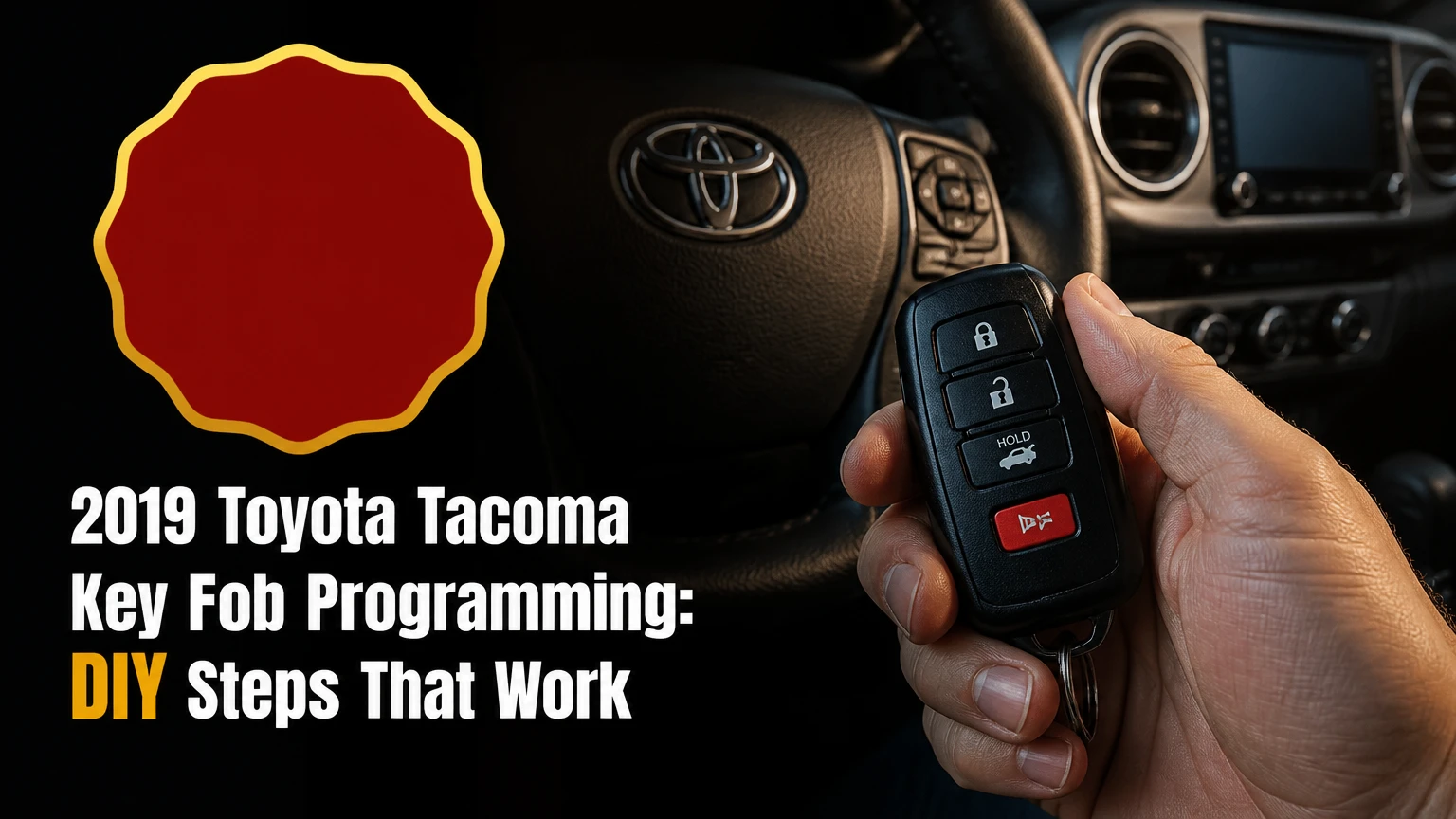
A 2019 Toyota Tacoma key fob can often have its lock, unlock, and panic remote registered through an onboard sequence, depending on the truck’s equipment and replacement transmitter. Programming the key’s engine-start transponder or push-button Smart Key is a separate security operation that generally requires Toyota-capable diagnostic equipment, a locksmith, or a dealership.
Key Facts
A 2019 Toyota Tacoma has either a physical ignition cylinder or a push-button Smart Key system.
Remote-button registration and engine immobilizer registration are separate procedures.
A generic OBD2 code reader cannot add a key because it reads faults but does not perform immobilizer security functions.
The replacement transmitter must match the Tacoma’s frequency, FCC ID, Toyota part number, button layout, and system type.
A typical mobile locksmith charge is $100-$220, while dealer supply and programming commonly total $150-$350.
If every registered key is missing, expect ownership verification and professional immobilizer programming.
What Is Actually Being Programmed?
2019 Toyota Tacoma key fob programming can refer to two different registrations: remote-control pairing and engine-start authorization. Remote pairing teaches the Body ECU or related keyless-entry controller to recognize the fob’s radio commands, while immobilizer programming stores the transponder or Smart Key identity that permits the engine to start.
The remote section controls convenience functions. Pressing LOCK, UNLOCK, or PANIC sends a radio-frequency transmission containing the fob’s identification and a changing security code. The vehicle accepts the command only when the transmitter matches the truck’s configuration.
The immobilizer section controls theft prevention. A turn-key Tacoma reads a transponder chip inside the key head. A push-button Tacoma communicates with a Smart Key through interior and exterior antennas. A fob that locks the doors but cannot start the engine is not necessarily defective; its remote portion may be registered while its immobilizer portion is not.
Toyota’s 2019 Tacoma owner documentation distinguishes key operation, wireless remote operation, and engine immobilizer functions. That distinction matters because replacing a CR2032 battery can restore button operation, but a battery replacement does not erase or create key registration.
Which 2019 Tacoma System Do You Have?
The ignition hardware identifies the programming route. A physical key cylinder means the Tacoma uses a transponder-equipped remote-head key, while a START button means the truck uses a proximity Smart Key system.
| Feature | Turn-key Tacoma | Smart Key Tacoma |
|---|---|---|
| Driver input | Metal key rotates ignition cylinder | Push-button START |
| Engine authorization | Embedded transponder chip | Proximity Smart Key code |
| Emergency backup | Cut metal blade | Mechanical emergency blade |
| Remote battery | Commonly CR2032, verify old fob | Commonly CR2032, verify old fob |
| Professional equipment | Toyota-capable immobilizer tool | Toyota-capable Smart Key tool |
| Main failure symptom | Key turns, security light remains active | “Key Not Detected” or no start |
Trim level alone does not identify the system. Tacoma SR, SR5, TRD Sport, TRD Off-Road, Limited, and TRD Pro equipment can vary by package, market, and original purchaser configuration. Check the ignition rather than relying on a seller’s trim description.
How Do You Identify the Correct Fob?
Match the replacement fob by physical system first, then verify its identification markings against the original. A similar-looking shell does not prove compatibility because Toyota used different transmitter and Smart Key configurations across applications.
Check these items before purchasing:
- FCC ID: Compare the label or molded marking on the original housing. Common listings may show codes such as GQ4-52T for a remote-head application or HYQ14F-series identifiers for Smart Key applications, but the exact code must match the vehicle and fob variant.
- Toyota part number: Use the VIN, the original fob, or a Toyota parts department to verify the number. Published online listings can contain superseded or market-specific numbers.
- Button layout: Three-button and four-button housings are not interchangeable merely because the shell fits.
- Frequency and market: North American and other-market transmitters can differ in frequency and certification.
- Chip type: A remote-head key needs the correct transponder; a Smart Key needs the correct proximity electronics.
Do not buy by appearance alone. The most reliable order is VIN verification, part-number confirmation, then FCC ID comparison.
Can You Program the Remote Without a Scanner?
The remote buttons on some 2019 Toyota Tacoma turn-key models can be registered with an onboard procedure, so the blanket claim that every 2019 Tacoma requires a diagnostic scanner is too broad. The procedure does not program the immobilizer chip, and it may not apply to every production configuration or aftermarket transmitter.
Manual Remote Registration for a Turn-Key Tacoma
Use a known-good key and a charged vehicle battery. Keep the replacement remote nearby, but do not press buttons until the vehicle enters registration mode.
- Sit in the driver’s seat with the driver door open and the other doors closed.
- Insert and remove the key from the ignition twice within approximately five seconds.
- Close and open the driver door twice.
- Insert and remove the key once.
- Close and open the driver door twice again.
- Insert the key and leave it in the ignition.
- Close the driver door.
- Turn the ignition from LOCK to ON, then back to LOCK. Do not start the engine.
- Remove the key. The door locks should cycle to indicate registration mode.
- Press and hold LOCK and UNLOCK together on the new remote for about one second.
- Release both buttons, then press and hold LOCK for about two seconds.
- Watch the locks for the confirmation cycle, then open the driver door to exit.
Exact timing and confirmation behavior can vary by Tacoma configuration. A single lock cycle commonly indicates acceptance, while a double cycle commonly indicates rejection, but the vehicle’s service information and the tool or instruction set for the specific fob take priority.
Success checkpoint: The locks respond to the newly registered remote after you exit the procedure.
Common mistake: Using the manual sequence to solve a no-start condition, even though the transponder still has not been registered.
When Manual Remote Registration Fails
A failed sequence does not automatically mean the truck needs a new Body ECU. First verify that the remote matches the truck, the battery is fresh, every door is fully latched, and the vehicle battery is strong.
The onboard method is also a poor choice when every key is lost, when the truck uses Smart Key, or when the replacement contains an uncut blade and an unregistered transponder. In those situations, a Toyota-capable scan tool provides a more complete diagnosis.
How Do You Program a Smart Key Tacoma?
A 2019 Toyota Tacoma with push-button start normally requires a Smart Key registration function in a Toyota-capable diagnostic tool. The process authenticates the vehicle and stores the new proximity key, rather than merely pairing a lock-button radio signal.
A professional sequence generally follows this order:
- Connect the diagnostic programmer to the Tacoma’s OBD2 port below the driver-side dashboard.
- Maintain stable vehicle voltage. A weak battery can interrupt security communication, so a regulated charger may be appropriate.
- Select the correct Toyota, Tacoma, model year, and Smart Key or immobilizer menu.
- Authenticate access using the tool’s supported security process.
- Choose an add-key function when existing keys should remain active.
- Choose erase, rewrite, or all-keys-lost functions only when the situation requires it.
- Follow the tool’s prompt to place the registered key against the START button if requested.
- Present the new Smart Key at the specified location and within the displayed time limit.
- Test passive unlocking, button locking, interior detection, and engine starting.
Toyota-capable tools differ substantially. A Launch X-431, Autel MaxiIM, Toyota Techstream setup, or specialist locksmith programmer may support the required function, but model coverage and subscription status change over time.
Success checkpoint: The Tacoma starts with the new Smart Key and recognizes it inside and outside the cabin.
Common mistake: Assuming that a tool labeled “OBD2” can add keys. Generic readers usually access emissions and diagnostic trouble codes, not protected key registration.
What About a Turn-Key Transponder?
A 2019 Toyota Tacoma turn-key remote has a metal blade, a remote transmitter, and an immobilizer transponder. Cutting the blade makes the key mechanically fit the ignition, but it does not authorize the engine.
A scan tool or locksmith procedure is normally required to register the transponder. The technician verifies ownership, connects to the vehicle, selects the immobilizer system, and follows the tool’s key-add or erase-and-register workflow. Some tools can add a key only when a valid master key is present; others support an all-keys-lost process through additional security access.
The red security indicator provides useful evidence but not a complete diagnosis. A flashing or remaining security light after inserting the new key can indicate an unregistered chip, an incompatible key, a damaged transponder, or an immobilizer communication problem.
Do not repeatedly cycle an unknown aftermarket key while guessing. Incorrect procedures can consume timed security attempts, and a low vehicle battery can create misleading communication failures.
Which Tools Can Register a Key?
Only equipment with explicit 2019 Toyota Tacoma immobilizer or Smart Key coverage can perform engine-key registration. Tool brand alone is insufficient because a programmer’s Toyota software version, subscription, region, and security gateway support determine whether the function is available.
| Equipment type | Remote buttons | Transponder or Smart Key | Typical user | Typical cost |
|---|---|---|---|---|
| Generic OBD2 reader | No | No | Vehicle owner | $20-$80 |
| Toyota-capable aftermarket programmer | Sometimes | Often, coverage dependent | Experienced DIY user | $250-$1,500 |
| Rental programming kit | Usually guided | Model dependent | DIY owner with one working key | $70-$125 plus fob |
| Mobile locksmith equipment | Yes | Yes, subject to coverage | Stranded or time-sensitive owner | $100-$220 service total |
| Toyota dealer diagnostic system | Yes | Yes | Dealer technician | Included in service charge |
Tool rental packages can be economical when the supplier confirms the VIN and exact key type before shipment. They are not risk-free: a wrong fob, weak battery, unsupported configuration, or interrupted connection can leave the owner needing a professional anyway.
How Much Does Tacoma Key Programming Cost?
A typical 2019 Toyota Tacoma replacement key costs approximately $100-$350 when the fob, cutting, programming, and labor are combined. A mobile locksmith is commonly the least expensive full-service option, while a Toyota dealer usually costs more but provides factory parts and direct VIN-based ordering.
| Service route | Typical total | Typical time | Includes | Main limitation |
|---|---|---|---|---|
| Mobile automotive locksmith | $100-$220 | 20-60 minutes | Key or fob, cutting, programming | Coverage varies by technician |
| Toyota dealership | $150-$350 | 45-120 minutes | OEM part and factory programming | Appointment and towing may add cost |
| DIY rental kit | $70-$125 plus fob | 15-45 minutes after arrival | Guided tool access | Deposits, shipping, compatibility risk |
| Used online fob | $20-$100 plus service | Variable | Hardware only | May be locked, incompatible, or damaged |
| Dealer-ordered Smart Key | $200-$450 in some markets | 1-3 hours or order delay | OEM Smart Key and programming | Price varies sharply by region |
These are typical market ranges, not Toyota’s fixed prices. Regional labor rates, emergency callout fees, taxes, key availability, and whether an existing master key remains can change the invoice.
Ask for a complete quote containing the part, cutting, programming, travel, ownership verification, and tax. A low advertised programming price may exclude the replacement transmitter.
Which Route Fits Your Situation?
The best route depends on whether the truck still has a working key and whether the problem affects remote buttons, engine starting, or both.
| Situation | Recommended route | Expected time | Why |
|---|---|---|---|
| Remote buttons stopped after battery warning | Replace battery and test | 5-10 minutes | Registration may still be intact |
| Spare turn-key remote, existing key starts truck | Manual remote attempt, then locksmith if needed | 15-45 minutes | Remote and transponder can be handled separately |
| Push-button spare Smart Key | Toyota-capable locksmith or dealer | 30-120 minutes | Protected Smart Key registration is required |
| One key remains, second key lost | Add-key service | 20-60 minutes | Existing key can usually remain active |
| Every key is missing | Mobile locksmith or dealer | 1-3 hours | Ownership proof and reset-capable equipment required |
| Truck will not communicate with programmer | Diagnose battery, fuses, DLC, and network | Variable | Programming should not continue until communication is stable |
A mobile locksmith is usually the practical choice for a stranded owner or an owner with one working key. A dealer is sensible when factory OEM sourcing, warranty documentation, or unusual Smart Key faults matter more than price.
What Happens When Every Key Is Missing?
All-keys-lost programming is more involved than adding a spare. The technician must verify ownership, obtain the correct key, access the immobilizer or Smart Key system, and register a new credential without relying on an already-authorized key.
Bring the vehicle registration, government identification, VIN, and any proof of ownership requested by the service provider. Some locksmiths can perform the procedure at the truck; others require towing to a shop or dealer because their equipment does not support the specific Tacoma configuration.
Erase or rewrite functions deserve care. Erasing lost keys can prevent a missing key from starting or operating the vehicle, but it may also remove every previously stored key. Confirm how many keys will be active before authorizing the operation.
Avoid internet instructions that promise a universal reset. Security access differs by system and software version, and failed attempts can increase downtime without creating a usable key.
Why Does a New Fob Fail to Program?
Most failed 2019 Toyota Tacoma key fob registrations result from incorrect compatibility, inadequate battery voltage, or confusing remote pairing with immobilizer programming. Replacing parts before checking those three causes often increases cost without addressing the failure.
Use this troubleshooting sequence:
- Test the old key. If the old key starts the truck, the vehicle-side immobilizer is probably functioning.
- Install a fresh battery. Many remotes use a CR2032 cell, but confirm the marking and polarity in the original fob.
- Check compatibility. Compare FCC ID, Toyota part number, button layout, frequency, and Smart Key versus turn-key type.
- Inspect the housing. A damaged button membrane or poor aftermarket circuit board can transmit inconsistently.
- Check door status. A door that appears open on the instrument panel can interrupt an onboard remote sequence.
- Stabilize vehicle voltage. Do not program during a weak-battery condition or while accessories drain the truck.
- Interpret the result. Lock confirmation suggests remote acceptance; engine starting confirms immobilizer success.
An aftermarket shell can be physically perfect and electronically wrong. Conversely, a remote that locks the doors can still contain an unregistered or incompatible start-authority chip.
Can Battery Replacement Erase Programming?
Replacing the fob battery normally does not erase the Toyota Tacoma’s stored key registration. Battery replacement changes the power source for the transmitter, while registration data remains stored in the vehicle’s control module.
Install the battery with the positive side in the orientation shown by the fob housing. Avoid bending the contact tabs, mixing old and new cells, or touching the cell excessively with wet fingers. Test LOCK and UNLOCK near the vehicle, then test engine authorization separately.
If the remote worked before the battery change but not afterward, inspect the battery seating, contact pressure, rubber button alignment, and case closure. Reprogramming is not the first response to a simple battery-contact problem.
Expert Rules That Prevent Expensive Mistakes
Treat remote and engine functions as separate tests. A lock response proves only that the wireless transmitter was accepted. Start authorization requires the transponder or Smart Key to be stored correctly.
Use the VIN before ordering a fob. FCC ID matching is valuable, but VIN confirmation catches superseded part numbers, regional differences, and equipment variations that product photos cannot reveal.
Keep one working key away from the new key during Smart Key registration when instructed. Multiple keys close to the cabin can cause the vehicle or tool to detect the wrong credential, especially during proximity-learning prompts.
Do not erase keys casually. Add mode preserves known keys, while rewrite or erase mode can remove them. Choose the mode according to whether a key is missing, compromised, or simply being duplicated.
Frequently Asked Questions
Can I program a 2019 Tacoma key fob with a phone app?
A phone app cannot directly register a 2019 Toyota Tacoma immobilizer or Smart Key. Some apps can help identify a part, order a replacement, or communicate with supported hardware, but actual key registration requires approved diagnostic equipment connected to the vehicle or a manual remote sequence where the configuration supports it.
Does a Toyota Tacoma key need to be cut before programming?
A turn-key blade should be cut before final testing because the key must mechanically operate the ignition. Cutting does not program the transponder, however, and a correctly cut key can still fail to start the truck until its immobilizer chip is registered.
How many keys can a 2019 Tacoma store?
The maximum number depends on the Tacoma’s immobilizer or Smart Key configuration and the programming tool’s supported procedure. Ask the technician to confirm the limit before adding keys, particularly when several old keys may remain stored or when a rewrite operation is planned.
Can a used Tacoma fob be reprogrammed?
A used fob may be reusable if its electronics, identification, frequency, and system type match the truck, but some Smart Keys remain locked to a previous vehicle or cannot be reliably reset. A new, VIN-verified OEM or reputable compatible fob reduces that uncertainty.
Why does the truck lock but not start with the new key?
The remote transmitter has likely been registered while the immobilizer transponder or Smart Key has not. Confirm the key type, then have the engine-start credential programmed with Toyota-capable equipment; remote button operation alone does not authorize ignition.
The Bottom Line
The correct 2019 Toyota Tacoma key fob programming method depends first on the ignition system and second on the function that failed. A compatible turn-key remote may accept an onboard button-registration sequence, but engine starting still depends on transponder registration. A push-button Tacoma generally needs Toyota-capable Smart Key equipment.
Verify the VIN, FCC ID, part number, button layout, and battery before buying a replacement. For one working key, a mobile locksmith commonly offers the fastest $100-$220 solution; for all keys lost or unusual Smart Key faults, use a qualified locksmith or Toyota dealer. The essential distinction is simple: remote pairing operates the locks, while immobilizer programming authorizes the engine.