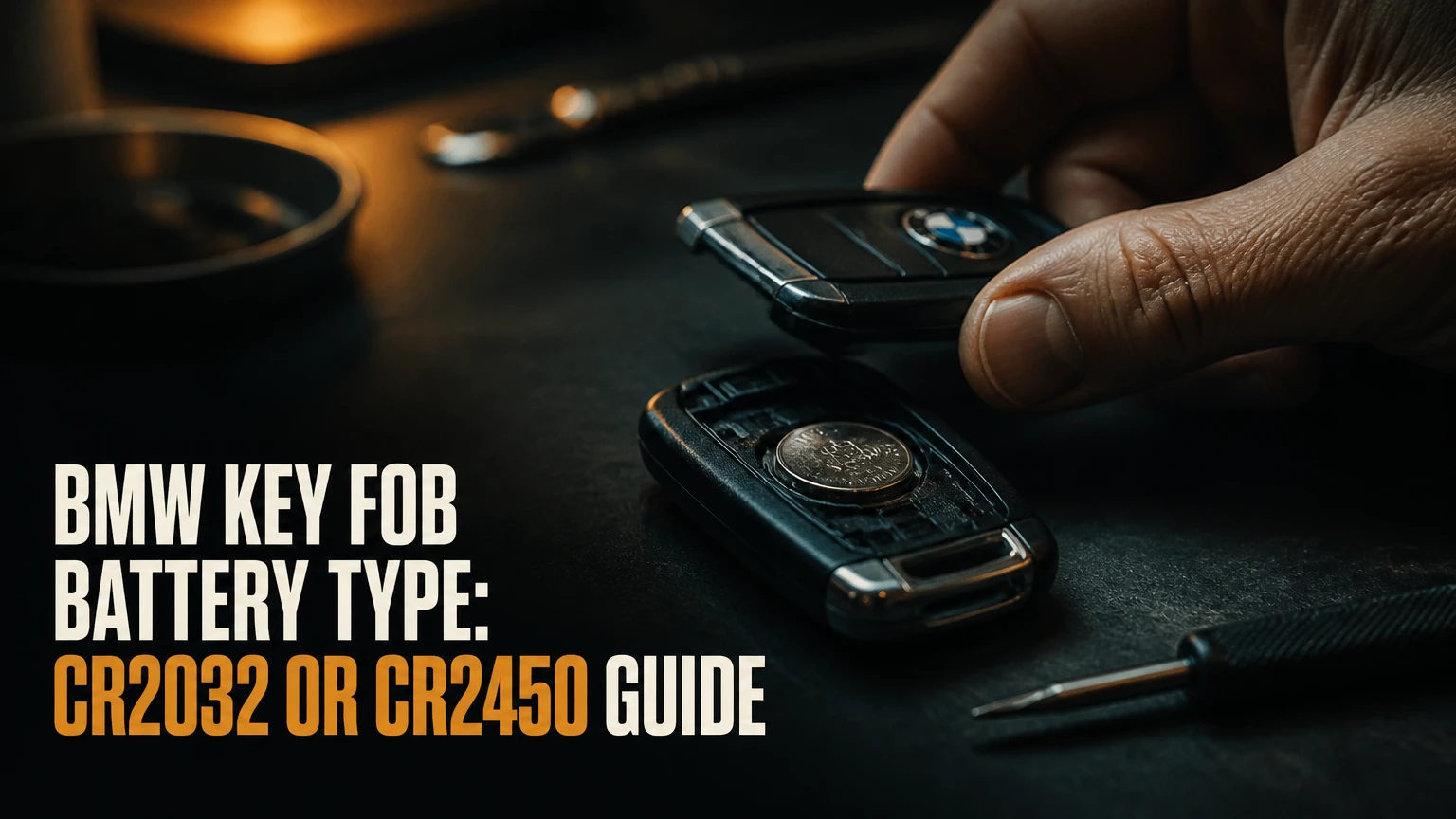
The correct BMW key fob battery type is usually a CR2032 or CR2450 disposable lithium coin cell, but older non-Comfort Access keys commonly use a soldered VL2020 rechargeable battery. BMW Display Keys use an internal rechargeable lithium-ion battery and must be charged rather than fitted with a coin cell. Verify the marking inside the fob before buying.
Key Facts
A CR2032 measures approximately 20 mm wide and 3.2 mm thick.
A CR2450 measures approximately 24.5 mm wide and 5.0 mm thick.
BMW Comfort Access keys normally have a user-accessible battery compartment.
Older diamond keys and many non-Comfort Access keys use a rechargeable VL2020 cell.
Replacing a normal coin cell does not erase the key’s immobilizer programming.
A BMW Display Key charges through its charging port or compatible wireless charging tray.
How Do You Identify the Correct BMW Key Battery?
The fastest reliable method is to remove the metal blade, open the battery cover, and read the code printed on the existing cell. The outside shape and BMW model year narrow the answer, but they do not prove it, because BMW changed transmitter designs within some model families and production periods.
A silver or black slant-shaped “blade” fob often uses a CR2450, especially on many F-Series vehicles. A smaller cell compartment or a key marked for CR2032 requires the thinner CR2032 instead. Do not force a CR2032 into a compartment designed for a CR2450, or press a CR2450 into a shallow holder.
The battery code describes the physical cell. In the IEC naming system, the first two digits indicate approximate diameter in millimeters and the final two digits indicate approximate thickness in tenths of a millimeter. Therefore, CR2032 is about 20 mm by 3.2 mm, while CR2450 is about 24.5 mm by 5.0 mm.
BMW Key Shape and Battery Type
| BMW key design | Common production period | Typical battery | Replacement method |
|---|---|---|---|
| Slant-shaped modern blade key | 2011-present | CR2450 or CR2032 | Usually replaceable |
| Rectangular Comfort Access key | 2006-2011 | CR2032 | Replaceable battery door |
| Rectangular non-Comfort Access key | 2006-2011 | VL2020 | Rechargeable, often soldered |
| Diamond-shaped older key | 1999-2006 | VL2020 | Rechargeable, sealed case |
| BMW Display Key | 2016-present | Internal lithium-ion battery | USB or wireless charging |
These ranges are typical rather than absolute. BMW market, body style, equipment package, replacement key shell, and production date can change the battery specification. A physical battery marking remains more authoritative than a generic model-year chart.
Which BMW Models Commonly Use CR2032 or CR2450?
BMW 3 Series, 4 Series, 5 Series, X3, X4, X5, and X6 vehicles with modern replaceable blade keys commonly use either CR2032 or CR2450, depending on the transmitter housing. Examples include F30 3 Series, F10 5 Series, F25 X3, G20 3 Series, and G05 X5, but no model list can replace inspection of the fob.
| Example BMW family | Key-generation example | Common cell seen | Verification point |
|---|---|---|---|
| 3 Series | E90, F30, G20 | VL2020, CR2450, or CR2032 | Key housing and equipment |
| 5 Series | E60, F10, G30 | VL2020, CR2450, or CR2032 | Comfort Access and fob revision |
| X3 | E83, F25, G01 | VL2020, CR2450, or CR2032 | Battery compartment marking |
| X5 | E53, F15, G05 | VL2020, CR2450, CR2032, or Display Key | Key generation and options |
| 7 Series | E65, F01, G11 | VL2020, CR2450, CR2032, or Display Key | Transmitter version |
The most useful distinction is not the vehicle badge. It is whether the fob has a removable battery cover and whether the cell is stamped with a CR or VL designation.
What Is the Difference Between CR2032 and CR2450?
CR2032 and CR2450 are both nominal 3-volt, non-rechargeable lithium coin cells, but the CR2450 is wider and thicker and generally has greater capacity. The two batteries are not interchangeable when the holder, retaining clip, or fob cover is designed for only one size.
| Specification | CR2032 | CR2450 | Practical BMW consequence |
|---|---|---|---|
| Nominal voltage | 3.0 V | 3.0 V | Same electrical voltage |
| Diameter | 20 mm | 24.5 mm | CR2450 needs a larger holder |
| Thickness | 3.2 mm | 5.0 mm | CR2450 needs a deeper cover |
| Typical capacity | 210-240 mAh | 500-620 mAh | CR2450 may last longer |
| Rechargeable | No | No | Never recharge either cell |
| Chemistry | Lithium manganese dioxide | Lithium manganese dioxide | Use only the specified format |
A CR2450 cannot be substituted merely because both cells read 3 volts. The larger diameter can prevent insertion, while excess thickness can bow the cover or damage the spring contact. A CR2032 in a CR2450 holder may sit loosely and lose contact when the fob is carried.
Is a CR2032 a Substitute for a CR2450?
A CR2032 is not a dependable substitute for a CR2450 unless the BMW transmitter specifically permits it with a correctly designed adapter or alternate holder. Electrical voltage alone does not establish compatibility; physical retention and contact pressure determine whether the remote works consistently.
Some sellers advertise replacement shells that convert one battery arrangement to another. Treat those products as a new transmitter housing, not as evidence that the original BMW fob accepts both cells. Match the battery to the printed compartment marking, circuit-board holder, or original cell.
What Does VL2020 Mean in an Older BMW Key?
VL2020 is a 3-volt rechargeable lithium coin cell used in many older BMW keys that charge inductively while the key is in the ignition. Unlike a CR2032 or CR2450, VL2020 is intended for recharging and is often soldered to the transmitter circuit board rather than held in a removable spring clip.
Older diamond keys associated with E46, E39, and E53 vehicles frequently use this arrangement. Some E60 and E90 keys without Comfort Access also use rechargeable cells. The key receives energy from the ignition cylinder during driving, so a key that has remained unused for years may have a depleted or aged battery.
| Battery system | Charging method | Typical key age | DIY replacement risk |
|---|---|---|---|
| CR2032 | None | Newer or Comfort Access fobs | Low if cover is designed to open |
| CR2450 | None | Many modern blade fobs | Low if correct cell is fitted |
| VL2020 | Inductive ignition charging | Older diamond and sealed keys | Moderate to high |
| Display Key battery | USB or wireless charging | Later premium models | Not normally user-serviceable |
A VL2020 replacement may require opening a glued case and desoldering the original tabs. The battery must have the correct welded tabs, orientation, and charging characteristics. Installing a standard CR2032 in a circuit designed for rechargeable charging can create a safety and reliability problem.
Does a BMW Display Key Use a Replaceable Coin Cell?
A BMW Display Key does not normally use a replaceable CR2032 or CR2450 coin cell. The touchscreen transmitter contains a rechargeable lithium-ion battery, which BMW documents as chargeable through the key’s charging connection and, on supported vehicles, through the vehicle’s wireless charging tray.
Display Key charging behavior varies by generation and market. BMW USA’s vehicle-access guidance identifies charging as the normal maintenance method, while the vehicle owner’s manual specifies the applicable port and charging instructions. A Display Key that loses capacity after repeated charging generally requires specialist or dealer service rather than a coin-cell swap.
A Display Key may still unlock or start the vehicle when its screen is inactive, depending on remaining transmitter power and vehicle design. Hold the key at the designated emergency detection location shown in the owner’s manual if the vehicle cannot detect it normally. Do not pry open a Display Key as though it were a CR2032 fob.
How Do You Replace a BMW Coin-Cell Battery?
Replacing a user-serviceable BMW coin cell normally takes 2-5 minutes, costs about $3-$10 for the battery, and requires the correct cell plus the integrated metal blade or a small plastic pry tool. The factor that determines success is correct identification, because CR2032, CR2450, VL2020, and Display Key batteries follow different procedures; BMW 3 Series key-generation instructions distinguish G20 CR2032, F30 CR2450, and soldered E90 or E46 VL2020 cells.
Before You Start
| Requirement | Typical value |
|---|---|
| Time | 2-5 minutes |
| Difficulty | Easy for replaceable holders |
| Battery cost | $3-$10 retail |
| Tools | Existing key blade, plastic pick, or small flat screwdriver |
| Required battery | One CR2032 or CR2450, matching the old marking |
| Safety condition | Keep coin cells away from children and pets |
Work over a clean table so the metal blade, back cover, or small retaining clip cannot fall into a gap. Take a photograph of the old battery orientation before removal, especially if the marking is partly hidden.
Step 1: Remove the Metal Key Blade
Press the release button on the side or rear of the BMW fob and pull the mechanical key blade from its slot. The blade is not the battery cover, but removing it exposes the release area or pry notch used on many replaceable housings.
Success checkpoint: The blade slides out without bending and the battery-cover seam becomes visible.
Common mistake: Pulling on the cover before pressing the release button can break the retaining tab.
Step 2: Open the Battery Cover
Insert the end of the metal blade, a plastic pick, or a small flat screwdriver into the marked notch. Apply controlled upward pressure rather than twisting aggressively across the long edge, because older plastic covers become brittle from heat and ultraviolet exposure.
Success checkpoint: The cover separates along its designed seam and the circuit board remains seated.
Common mistake: Inserting a tool too deeply can scratch the board or lift a contact.
Step 3: Confirm the Battery Marking and Polarity
Read the cell code before removing it. Record whether the positive side, usually marked with a large “+”, faces upward, downward, or toward a particular end of the housing; BMW fob layouts are not universal.
Success checkpoint: The replacement has the same code and the same physical orientation.
Common mistake: Assuming every BMW coin cell installs with the positive side facing up.
Step 4: Install the New Cell
Remove any insulating sticker from the replacement battery. Slide the cell beneath the fixed retaining lip first, then press the opposite edge down until the holder captures it without excessive force.
Success checkpoint: The battery remains flat, the retaining clip contacts its surface, and the cover closes without pressure.
Common mistake: Using a coin, knife, or wet fingers to force the cell into place can deform contacts or contaminate the battery surface.
Step 5: Close the Housing and Test It
Snap the cover into place, reinstall the mechanical blade, and test lock, unlock, trunk, and panic functions near the vehicle. If the remote works only at very short range, inspect the contact pressure and battery freshness before attempting synchronization.
Success checkpoint: The vehicle responds consistently from a normal parking distance.
Common mistake: Discarding the old battery before confirming that the new one works makes diagnosis harder.
Lithium coin cells should be recycled through a battery collection program where available. Do not place loose cells in a pocket, toolbox, or household waste stream where the terminals can contact metal objects.
Does Changing the BMW Key Battery Require Programming?
Changing a BMW key battery normally does not require programming because the battery powers the remote transmitter but does not erase the immobilizer identification stored in the key. A key that starts the car but no longer locks or unlocks it usually has a battery, contact, synchronization, or button problem rather than a lost immobilizer code.
Remote-button synchronization procedures vary by BMW generation. A commonly documented older procedure involves entering the vehicle, closing the doors, switching the ignition on and off without starting, then holding the unlock button while pressing the lock button three times; later vehicles may use a different sequence.
Because the sequence is not universal, use the owner’s manual or BMW repair documentation for the exact chassis. Do not repeatedly perform an older E-series procedure on a G-series vehicle and assume that the absence of a response means the key is unprogrammed.
When Should You Use Emergency Key Recognition?
Emergency key recognition is appropriate when a healthy key battery cannot communicate normally, the vehicle reports that the key is missing, or the remote battery is completely depleted. BMW places the emergency detection area in a different physical location depending on the vehicle, such as near the steering column or a marked tray.
The correct method is vehicle-specific. BMW owner manuals identify the required location and usually instruct the driver to hold the key there while pressing the start control with the brake pedal applied. This procedure reads the key at close range; it does not replace the battery or repair a damaged transmitter.
Why Does a New BMW Key Battery Not Work?
A new BMW key battery most often fails because the wrong cell size, incorrect polarity, protective film, weak contact, or damaged fob housing prevents electrical continuity. A fresh battery cannot overcome a bent terminal, a cracked solder joint, liquid contamination, or a failed transmitter circuit.
| Symptom | Likely cause | Corrective action |
|---|---|---|
| No buttons work | Polarity reversed or sticker attached | Reinstall with correct orientation |
| Works only beside car | Weak cell or poor contact | Test another fresh cell and inspect clip |
| Vehicle starts but buttons fail | Remote circuit issue | Synchronize, then inspect transmitter |
| Cover will not close | Wrong battery thickness | Replace CR2450 with CR2032, or reverse only if specified |
| One button fails | Worn microswitch or button pad | Repair or replace the fob |
| Battery dies within weeks | Parasitic circuit fault or poor cell | Test another brand and seek key diagnosis |
| Display Key remains blank | Low internal charge or failed battery | Charge by approved method and seek service |
Check the expiration date and packaging condition. Panasonic, Energizer, and Duracell all produce suitable lithium coin cells, but counterfeit or heat-damaged batteries from unknown marketplace sellers create more risk than a modest brand-price difference.
Some Duracell coin cells include a bitter coating intended to discourage ingestion. If the coating interferes with a particular contact design, the fob may behave inconsistently, although the more common explanation remains incorrect seating or a damaged spring contact. Never scrape a battery coating with a metal tool.
How Long Should a BMW Key Battery Last?
A disposable BMW CR2032 or CR2450 key battery commonly lasts 2-4 years under ordinary use, although frequent Comfort Access detection, repeated button presses, cold temperatures, and a transmitter left near the vehicle can shorten that period. Rechargeable VL2020 cells may operate for many years but eventually lose capacity.
A key stored within a few feet of a vehicle may communicate more often than a key stored in a drawer. Comfort Access systems also monitor proximity, so owners who keep the key beside the garage door may notice faster depletion than owners who store it farther away.
Do not use battery life as proof of the correct type. A CR2032 can last less time than a CR2450 because it has lower capacity, but a poor contact can drain either battery rapidly.
How Much Does BMW Key Battery Replacement Cost?
DIY replacement for a CR2032 or CR2450 typically costs $3-$10 and takes 2-5 minutes. Dealer replacement commonly costs about $15-$50 for a standard coin-cell fob, while a sealed rechargeable key, replacement transmitter, or Display Key service can cost substantially more.
| Service situation | Typical parts cost | Typical labor or service cost | Typical total |
|---|---|---|---|
| DIY CR2032 replacement | $3-$8 | $0 | $3-$8 |
| DIY CR2450 replacement | $4-$10 | $0 | $4-$10 |
| Dealer coin-cell service | $5-$15 | $10-$35 | $15-$50 |
| Locksmith diagnosis | $5-$15 | $40-$120 | $45-$135 |
| Sealed VL2020 repair | $10-$30 | $60-$150 | $70-$180 |
| New BMW programmed key | $150-$500+ | Included or variable | $150-$500+ |
Prices vary by country, dealer, key-generation availability, and whether programming is included. A dealer quote for an older VL2020 key may involve a complete replacement key rather than a simple battery service.
What Should You Buy?
Buy a fresh, name-brand CR2032 or CR2450 from a retailer with controlled stock, and verify the expiration date before opening the package. Purchase one extra matching cell only if the package can be stored in a dry location away from heat, children, and loose metal objects.
Do not buy a rechargeable LIR2032 or LIR2450 as a substitute for a disposable CR cell. Rechargeable lithium cells have different voltage characteristics and charging requirements. Do not buy a VL2020 for a fob whose holder is marked CR2032 or CR2450.
What If the BMW Key Is Completely Dead?
A completely dead BMW key can often still unlock the driver’s door with its mechanical blade and start the vehicle through the emergency detection procedure. Remove the blade from the fob, locate the concealed driver-door lock cylinder, and follow the owner’s manual for alarm and emergency-start instructions.
Unlocking the door mechanically may trigger the alarm on some vehicles until the key is recognized and the vehicle starts. Keep the key at the designated detection point, press the brake where required, and use the start button. If the vehicle still does not respond, try the spare key to distinguish a vehicle-side fault from a key-side fault.
A dead remote does not prove that the immobilizer transponder has failed. The remote buttons and immobilizer authorization are separate functions, which explains why a BMW may start normally while its lock and unlock buttons remain inactive.
What Are the Most Common Replacement Mistakes?
The most damaging mistake is buying a battery from a model-year list without checking the fob. BMW used multiple transmitter housings within overlapping years, so the same 5 Series generation can appear with a rechargeable sealed key, a replaceable Comfort Access key, or a later blade-style fob.
Other avoidable errors include:
- Installing CR2032 where the holder requires CR2450, or reversing that substitution.
- Forgetting the protective film on a new cell.
- Copying the polarity from a different BMW key design.
- Prying across the wrong seam and breaking the cover clips.
- Shorting the cell with a screwdriver or metal tweezers.
- Treating a Display Key as a coin-cell fob.
- Replacing a good battery when the real fault is a worn microswitch.
- Throwing away the old cell before recording its marking and orientation.
A practical technician rule is simple: photograph the open fob, read the battery code, and test every remote button before closing the case permanently.
Frequently Asked Questions
Can I Use Any 3-Volt Battery in a BMW Key?
No. BMW key fobs require the specified battery format, such as CR2032, CR2450, or rechargeable VL2020. A battery with the same nominal voltage can still have the wrong diameter, thickness, chemistry, charging behavior, or terminal arrangement. Match the code printed on the old cell or inside the holder.
Why Does My BMW Say Remote Control Battery Empty?
The warning means the vehicle detects low transmitter-battery voltage or reduced remote performance. Replace the specified CR2032 or CR2450 promptly if the fob has a removable cover. For a sealed VL2020 key or Display Key, charge or service the correct rechargeable system instead of installing a disposable coin cell.
Can a BMW Key Charge While Driving?
Older BMW keys with rechargeable VL2020 cells can receive inductive charging through the ignition system while the key is inserted and the vehicle is driven. Modern CR2032 and CR2450 keys are disposable and do not charge in the ignition. Display Keys use their specified USB or wireless charging system.
Why Does My Spare BMW Key Work After Years?
A spare key with a disposable coin cell may retain enough charge if it is stored away from the vehicle and used rarely. A rechargeable VL2020 key can gradually discharge while unused, and its aged cell may fail after years without ignition charging. Test both remote functions and vehicle recognition separately.
Can a Locksmith Replace a BMW VL2020 Battery?
A qualified automotive locksmith can often replace a soldered VL2020 cell, but the repair requires opening the case, using the correct tabbed rechargeable cell, and protecting the circuit board. A locksmith may recommend a replacement key when the housing, charging circuit, or transmitter board is already damaged.
What Is the Safest Way to Confirm My BMW Battery Type?
Open the fob, read the battery code, measure the old cell if the marking is illegible, and compare the holder depth and diameter. A dealer parts department or qualified locksmith can verify the transmitter by its key number or vehicle identification number, but physical inspection remains the fastest check.
The Bottom Line
The correct BMW key fob battery type depends on the transmitter, not only the BMW model or year. Use CR2032 for a holder marked CR2032, CR2450 for a deeper and wider holder marked CR2450, VL2020 for many older rechargeable keys, and charging service for a BMW Display Key. Confirm the marking before purchase, preserve polarity during installation, and investigate contacts or synchronization if a fresh cell does not restore normal range.