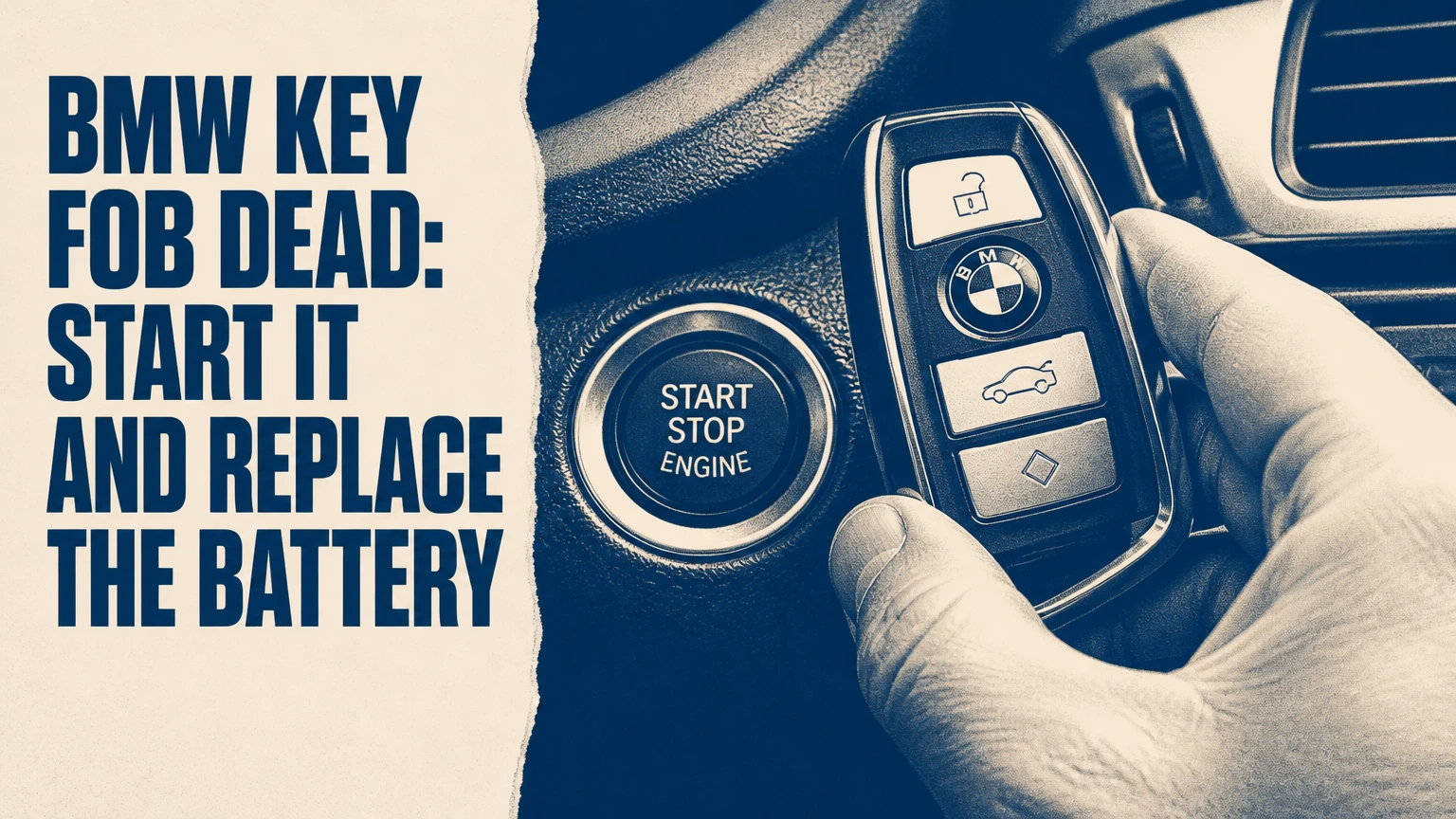
A BMW key fob with a dead battery can usually unlock and start the vehicle without immediate programming or towing. Remove the concealed metal key to open the driver’s door, then hold the fob against the BMW recognition mark while pressing the brake and Start/Stop button. The correct replacement battery depends on the fob design and vehicle generation.
Key Facts
A dead BMW key-fob battery does not normally disable the vehicle’s immobilizer.
The metal emergency key opens the driver’s door but does not start the engine by itself.
BMW key batteries commonly include CR2032, CR2450, and rechargeable VL2020 cells.
F-Series and G-Series BMW keys usually resynchronize automatically after a coin-cell replacement.
A BMW Display Key uses a rechargeable internal battery rather than a normal replaceable coin cell.
A replacement BMW key typically costs $150-$600 or more, depending on the model and provider.
Can You Unlock a BMW With a Dead Key Fob?
Yes. A BMW with a dead remote battery can be unlocked mechanically using the metal emergency key stored inside the fob. The emergency blade operates the driver’s door lock, while the remote buttons, Comfort Access, and welcome lighting may remain unavailable until the fob battery is replaced.
Press the release button on the side or underside of the remote and pull out the metal blade. Insert the blade into the driver’s door cylinder and turn it. Some BMW models trigger the alarm when opened mechanically; that reaction does not necessarily indicate theft or a second fault.
Many newer BMWs hide the key cylinder beneath a removable cap on the driver’s exterior handle. Look for the small access slot under or beside the handle cap. Use the tip of the metal blade to release the cap carefully, then expose the lock cylinder.
Do not pry against painted surfaces with a steel screwdriver. Place a cloth between the blade and trim if the cover resists removal. The exact release direction varies by body style, so the vehicle’s owner’s manual remains the safest reference for a concealed lock cover.
How Do You Start a BMW When the Key Fob Battery Is Dead?
To start a BMW with a dead key fob battery, place the fob against the marked emergency-recognition area, press the brake pedal, and press the Start/Stop button. The recognition area is commonly on the right side of the steering column, but some models place it in the center console or a designated tray.
Follow this sequence:
- Enter the vehicle and close the doors.
- Place the entire rear or top end of the fob against the key symbol, molded receiver, or marked steering-column area.
- Keep the fob stationary against that area.
- Press the brake pedal firmly on automatic-transmission models, or press the clutch on applicable manual-transmission models.
- Press the Start/Stop button while maintaining contact.
- Remove the fob only after the engine starts or the instrument display confirms key recognition.
The immobilizer reads the transponder through short-range communication even when the remote coin cell cannot power the buttons. BMW owner instructions commonly reduce the procedure to the phrase, “Hold the remote control against the marked area,” because the passive transponder and emergency antenna perform the identification.
A single failed attempt does not prove the key is defective. Move the fob to the explicitly marked location, remove other wireless keys, and try again after waiting approximately 10 seconds. If the dashboard remains completely dark, investigate the vehicle’s 12-volt battery before buying a key.
Where Is the BMW Emergency Recognition Area?
The BMW emergency recognition area is usually beside the steering column, near a key icon, or inside a marked storage tray. The location changes by chassis, production year, equipment package, and market, so a generic steering-column instruction is not universal.
| BMW feature or generation | Typical recognition location | Practical clue | Main limitation |
|---|---|---|---|
| F-Series, approximately 2012-2018 | Right side of steering column | Key symbol or textured receiver | Exact position varies by chassis |
| G-Series, approximately 2018 onward | Steering-column area or center-console tray | Printed key icon or molded recess | Owner’s manual gives the definitive location |
| Comfort Access models | Designated interior emergency area | Receiver may be separate from door antennas | Passive start works even when touch entry fails |
| BMW Display Key vehicles | Marked console or steering-column receiver | Larger screen-equipped fob | Display Key still requires adequate vehicle power |
Which Battery Does a BMW Key Fob Need?
A BMW key fob may require a CR2032, CR2450, rechargeable VL2020, or a proprietary rechargeable Display Key battery. Fob shape alone cannot guarantee battery size, because BMW used different transmitters across overlapping model years and equipment packages.
Check the old battery for its printed designation before disposal. Also inspect the fob’s rear label, molded battery compartment, parts number, and the vehicle’s owner’s manual. A VIN lookup from BMW or a reputable parts catalog is more reliable than a year-and-model shortcut.
| Key design | Common application | Typical battery | Replaceable by owner? |
|---|---|---|---|
| Modern blade-style remote | Many G-Series 3 Series, 5 Series, X3, X5, and X7 models | CR2032 or model-specific cell | Usually yes |
| Sleek sloped F-Series remote | Many 2012-2018 BMW cars and SUVs | Often CR2450 | Usually yes |
| Rectangular E-Series remote | Some 2006-2011 vehicles with Comfort Access | Often CR2032 | Usually yes |
| Diamond-shaped older remote | E46, E39, E53, and related vehicles | Rechargeable VL2020 or equivalent | Usually no, sealed case common |
| BMW Display Key | Selected 7 Series, i8, X7, and newer vehicles | Internal rechargeable battery | Chargeable, not normally user-replaceable |
The table gives common patterns, not a guaranteed fitment chart. For example, a CR2032 and CR2450 share a 3-volt nominal rating but differ in thickness and capacity. Installing the thinner cell where a CR2450 is required can create intermittent contact, while forcing a thicker cell can bend contacts or damage the cover.
Is a CR2032 the Same as a CR2450?
No. A CR2032 is approximately 20 millimeters wide and 3.2 millimeters thick, while a CR2450 is approximately 24 millimeters wide and 5.0 millimeters thick. Both are 3-volt lithium coin cells, but their dimensions and capacity are different.
| Battery | Diameter | Thickness | Nominal voltage | BMW relevance |
|---|---|---|---|---|
| CR2032 | 20 mm | 3.2 mm | 3 V | Common in many modern remotes |
| CR2450 | 24 mm | 5.0 mm | 3 V | Common in several F-Series remotes |
| VL2020 | 20 mm | 2.0 mm | 3 V rechargeable | Used in some sealed older keys |
| Display Key cell | Model-specific | Internal pack | Model-specific | Recharge through USB or wireless charging |
Use a reputable Panasonic, Energizer, or Duracell cell when possible. Battery-brand quality does not override an incorrect size, and a premium CR2032 cannot substitute for a required CR2450.
How Do You Replace a BMW Key Fob Battery?
Most owner-replaceable BMW key batteries take 5-10 minutes to change and require only the metal valet key, a plastic pry tool, or a small flat tool; 5 Series battery and casing differences determine which replacement steps apply. The highest-risk step is opening the housing without cracking clips or bending the battery contacts.
Before You Start
| Requirement | Typical specification |
|---|---|
| Time | 5-10 minutes |
| Difficulty | Easy for replaceable-cell remotes |
| Battery cost | $3-$10 for one reputable cell |
| Tools | Existing metal blade, plastic trim tool, clean cloth |
| Preparation | Confirm battery code and photograph polarity |
| Safety | Keep the old and new cells away from children and pets |
Step 1: Remove the Metal Key
Press the release button and slide the emergency blade out of the fob. Set the blade on a clean surface because the blade tip may be needed to release the housing.
You will know the step worked when the empty key slot exposes a small notch, tab, or groove. Do not insert the blade deeply into an unknown opening, because the slot may contain a release mechanism rather than a pry point.
Step 2: Open the Fob Housing
Insert the blade tip or plastic tool into the designated seam or slot. Apply light, controlled pressure until the rear cover separates from the front shell, then work around the clips instead of twisting one point aggressively.
A successful opening leaves the circuit board and battery holder intact. The common mistake is using a large flathead screwdriver as a lever, which can gouge the housing, snap retaining tabs, or short exposed contacts.
Step 3: Match the Battery Orientation
Read the old cell before removal and note whether the positive side faces upward. Remove the battery without scraping the circuit board, then install the identical designation with the same polarity.
A battery that sits flat beneath the retaining spring is correctly installed. If the cover will not close with normal finger pressure, stop and verify the size rather than compressing the housing.
Step 4: Close and Test the Remote
Snap the cover fully into place, reinstall the metal blade, and test lock, unlock, trunk, and panic functions beside the vehicle. Test each button separately because a partially seated cell can power one operation while failing under a higher current load.
The remote works when the vehicle responds consistently from several meters away. If the buttons remain silent, inspect polarity, battery voltage, contact tension, water damage, and whether the replacement cell still has its protective packaging removed.
Does a BMW Key Need Programming After a Battery Change?
A BMW key normally does not need programming after a routine battery replacement, especially on most F-Series and G-Series vehicles. The remote retains its vehicle pairing, while the new cell restores power; changing the battery is different from adding a new key.
Older E-Series remotes may require an initialization procedure if the buttons stop operating after battery service. A typical older-key sequence is:
- Sit inside the vehicle and close all doors.
- Turn the ignition to Position 1, then return it to Off within approximately five seconds.
- Remove the key.
- Hold the unlock button.
- Press the lock button three times within approximately 10 seconds.
- Release unlock and watch for a lock-unlock confirmation.
This procedure applies only to compatible older systems, such as certain E46, E39, and E53 vehicles. It does not program a newly purchased key, bypass immobilizer security, or repair a failed remote circuit board.
Do not perform old-key initialization repeatedly on a newer BMW based on an internet video. The correct action for a modern key is usually battery verification, emergency-area recognition, and diagnostic testing.
Why Does a BMW Still Say Battery Empty?
A BMW battery-empty warning that remains after replacement usually results from an incorrect cell, weak contact, low-quality battery, a damaged fob circuit, or a delayed vehicle status update. The vehicle may need several start cycles before the warning disappears, but a persistent warning deserves testing rather than indefinite driving.
Check these failure points in order:
- Confirm the printed battery designation, including CR2032 versus CR2450.
- Verify that the positive and negative sides match the original installation.
- Inspect the spring contacts for bending, corrosion, or flattened pressure points.
- Try a second battery from a known manufacturer.
- Test the fob close to the vehicle and from several meters away.
- Compare the suspect fob with the spare key.
- Check the vehicle’s 12-volt battery if both remotes fail together.
A dead remote battery does not usually cause a no-crank condition when the emergency recognition procedure works. If the vehicle recognizes neither key, the likely causes broaden to a discharged vehicle battery, a failed antenna, a key-memory problem, or a control-module fault.
What If Both BMW Keys Stop Working?
When both BMW keys stop locking, unlocking, or starting the vehicle, test the car’s 12-volt battery before ordering two replacement fobs. A weak vehicle battery can disable the receiver, prevent the starter from operating, and create symptoms that resemble simultaneous key failure.
Use the emergency blade to enter the vehicle, then observe the instrument cluster. Dim interior lighting, rapid clicking, a blank display, or multiple unrelated warning messages support a vehicle-power diagnosis. If the cluster is normal but neither key is recognized, professional BMW diagnostic equipment may be required.
Keep the spare key away from the vehicle during testing. Two fobs stored beside a strong wireless charger, phone, or other transmitting device can occasionally complicate Comfort Access behavior, although interference is less common than low battery voltage or physical damage.
Water exposure creates a separate failure mode. Remove the battery immediately, do not heat the board with a hair dryer, and have the fob inspected if corrosion or liquid residue appears under the cover.
Can You Repair an Older Diamond BMW Key?
An older diamond-shaped BMW key often contains a rechargeable VL2020 cell soldered to the circuit board, so ordinary coin-cell replacement is not a safe owner procedure. Driving for approximately 30 minutes may restore a weak rechargeable cell if the key still accepts charge through the ignition, but a failed cell or damaged board needs specialist repair or replacement.
Do not cut open a sealed diamond key unless you have electronics-repair experience. The case can crack, the transponder can be lost, and incorrect soldering can destroy the charging circuit or immobilizer data.
Some older Comfort Access variants have a removable rear cover and a replaceable CR2032. Confirm the internal layout before assuming every diamond key is rechargeable. A specialist locksmith can identify the transmitter by its part number and test whether the fault is the cell, buttons, antenna coil, or circuit board.
How Does a BMW Display Key Differ?
A BMW Display Key uses a rechargeable internal battery and a screen, so it should be charged through its specified USB connection or compatible wireless charging surface. It is not interchangeable with a CR2032 or CR2450, and opening the sealed housing can compromise water resistance and security components.
A Display Key may show a blank screen while the vehicle still starts through its passive transponder. Hold the key at the BMW emergency recognition area and use the brake and Start/Stop procedure. Charge the key before concluding that the vehicle requires a replacement.
| Symptom | Likely cause | First action | Typical next step |
|---|---|---|---|
| Screen blank, car starts | Display Key discharged | Charge through specified port | Replace internal cell only through specialist |
| Screen blank, car does not recognize key | Key or vehicle power fault | Charge and test emergency area | BMW or qualified locksmith diagnosis |
| Touchscreen works briefly | Aging rechargeable cell | Complete a full charge | Battery-health evaluation |
| Charging symbol absent | Cable, port, or charger fault | Try known-good compatible charger | Inspect port and internal battery |
BMW’s official charging guidance should take priority over generic USB advice, because charging hardware and Display Key versions differ. A standard spare remote is more practical for daily use than relying on the screen-equipped key alone.
How Much Does a BMW Key Replacement Cost?
A replacement BMW key typically costs $150-$600 or more in the United States, with the final price determined by the chassis, key type, programming requirements, provider, and whether the original key is repairable. A coin-cell replacement costs about $3-$10, making diagnosis financially important.
| Option | Typical cost | Typical time | Ownership requirement | Best use |
|---|---|---|---|---|
| DIY coin-cell replacement | $3-$10 | 5-10 minutes | No provider visit | Replaceable CR2032 or CR2450 |
| BMW dealership | $300-$600+ | 2-5 business days | Identification and registration commonly required | New OEM key and official ordering |
| Automotive locksmith | $150-$400 | Same day to 2 days | Proof of ownership commonly required | Mobile service and eligible vehicles |
| Specialist fob repair | $60-$150 | 1-7 days | Key usually mailed or delivered | Rechargeable cell, buttons, or board repair |
| Used online key | $50-$150 before programming | Variable | VIN and compatibility uncertainty | Usually poor choice for immobilizer keys |
A used BMW key generally cannot be treated like a universal remote. Many keys are cryptographically paired with a vehicle or become locked after initial programming, and newer G-Series systems may require equipment unavailable to general locksmiths.
Ask a locksmith whether the exact chassis, immobilizer generation, and key number are supported before paying a deposit. The cheapest advertised service can become expensive if the provider cannot complete programming or return the original key intact.
Which Fix Should You Choose?
Choose a battery replacement when one fob fails gradually, the vehicle starts through the emergency recognition area, and the housing has a removable cover. Choose specialist repair when an older rechargeable key, water-damaged board, or failed button is involved. Choose a dealer or qualified locksmith when the key is missing, immobilizer pairing is required, or both keys fail.
| Situation | Recommended action | Avoid | Expected result |
|---|---|---|---|
| Fob buttons stopped after months of weak range | Correct coin-cell replacement | Guessing battery size | Remote operation returns |
| Key starts car but will not lock remotely | Battery and contact inspection | Reprogramming immediately | Remote fault isolated |
| Older diamond key stays dead after driving | Specialist rechargeable-cell repair | Cutting case casually | Existing key may be preserved |
| Lost only key | Dealer or qualified locksmith | Used unverified online key | Secure replacement ordered |
| Both keys and cluster are dead | Test vehicle 12-volt battery | Buying two fobs first | Vehicle-power fault identified |
| Water entered fob | Remove cell and seek board inspection | Applying heat or powering repeatedly | Corrosion damage limited |
One practitioner rule is especially useful: a remote that works only when held against the steering-column receiver has a local fob-power or antenna problem, while a remote that works normally but fails to start the car points toward recognition, vehicle voltage, or immobilizer diagnosis.
How Can You Prevent Another Dead BMW Key?
Replace a weak battery when remote range declines, rather than waiting for Comfort Access to stop working completely. Keep the spare key in a dry location, test it every few months, and avoid storing either fob directly beside a wireless charging pad or high-power transmitter.
Use these prevention practices:
- Record the battery designation inside the owner’s manual or service notes.
- Test both keys before long trips.
- Replace coin cells before winter if range has already declined.
- Keep Display Keys charged without leaving them permanently on a hot surface.
- Protect fobs from rain, washing machines, and pockets with loose metal objects.
- Store a spare key outside the vehicle, not inside the center console.
- Ask a dealer or locksmith to disable a lost key from the vehicle’s access system when supported.
Cold weather reduces practical coin-cell performance, especially in an already weak battery. A new, correctly sized lithium cell usually resolves the issue, but a fob with corrosion, cracked solder joints, or a damaged antenna will not become reliable through battery replacement alone.
FAQ
Will a dead BMW key fob drain the car battery?
A dead key-fob coin cell normally does not drain the BMW’s 12-volt battery because the fob is a passive transmitter until a button or proximity function activates it. A damaged Comfort Access key can transmit abnormally, but persistent vehicle drain requires a parasitic-draw test rather than assuming the fob is responsible.
Can I start my BMW without the metal key?
Yes, if the electronic key remains recognized through its passive transponder. Place the fob against the vehicle’s marked emergency-recognition area, press the brake or clutch, and press Start/Stop. The metal blade is needed for mechanical door entry, not for the emergency electronic starting sequence.
How long does a BMW key-fob battery last?
A replaceable BMW key-fob battery commonly lasts about two to four years, depending on button use, Comfort Access proximity, temperature, and storage conditions. Short range, delayed locking, or intermittent detection usually appears before complete failure. Rechargeable older keys and Display Keys follow different aging patterns.
Can a BMW key fob be recharged?
A BMW Display Key can be recharged through its specified USB or wireless method, and some older diamond keys recharge while used in the ignition. Standard CR2032 and CR2450 remotes are disposable-cell designs and must not be connected to a charger. Installing a rechargeable cell where a disposable cell belongs can damage the fob.
Why does my BMW say no key detected after a new battery?
A BMW may display “No key detected” after a new battery because the cell is reversed, the wrong thickness, poorly seated, or blocked by damaged contacts. Hold the fob at the marked emergency area and try starting. If recognition still fails, test the spare and inspect the vehicle’s 12-volt battery.
Should I buy a BMW key online?
Buy a BMW key online only when the seller can verify exact part compatibility and return terms, and understand that a used immobilizer key may not be programmable to your vehicle. A dealer or qualified automotive locksmith is safer for a missing key, newer G-Series vehicle, or sole remaining fob.
The Bottom Line
A BMW key fob dead from a depleted battery is usually recoverable without towing: unlock the driver’s door with the metal blade, hold the fob against the marked recognition area, and start the vehicle with the brake and Start/Stop button pressed. Replace the exact CR2032 or CR2450 cell when applicable, treat older rechargeable and Display Keys differently, and diagnose vehicle voltage or immobilizer faults when both keys fail.