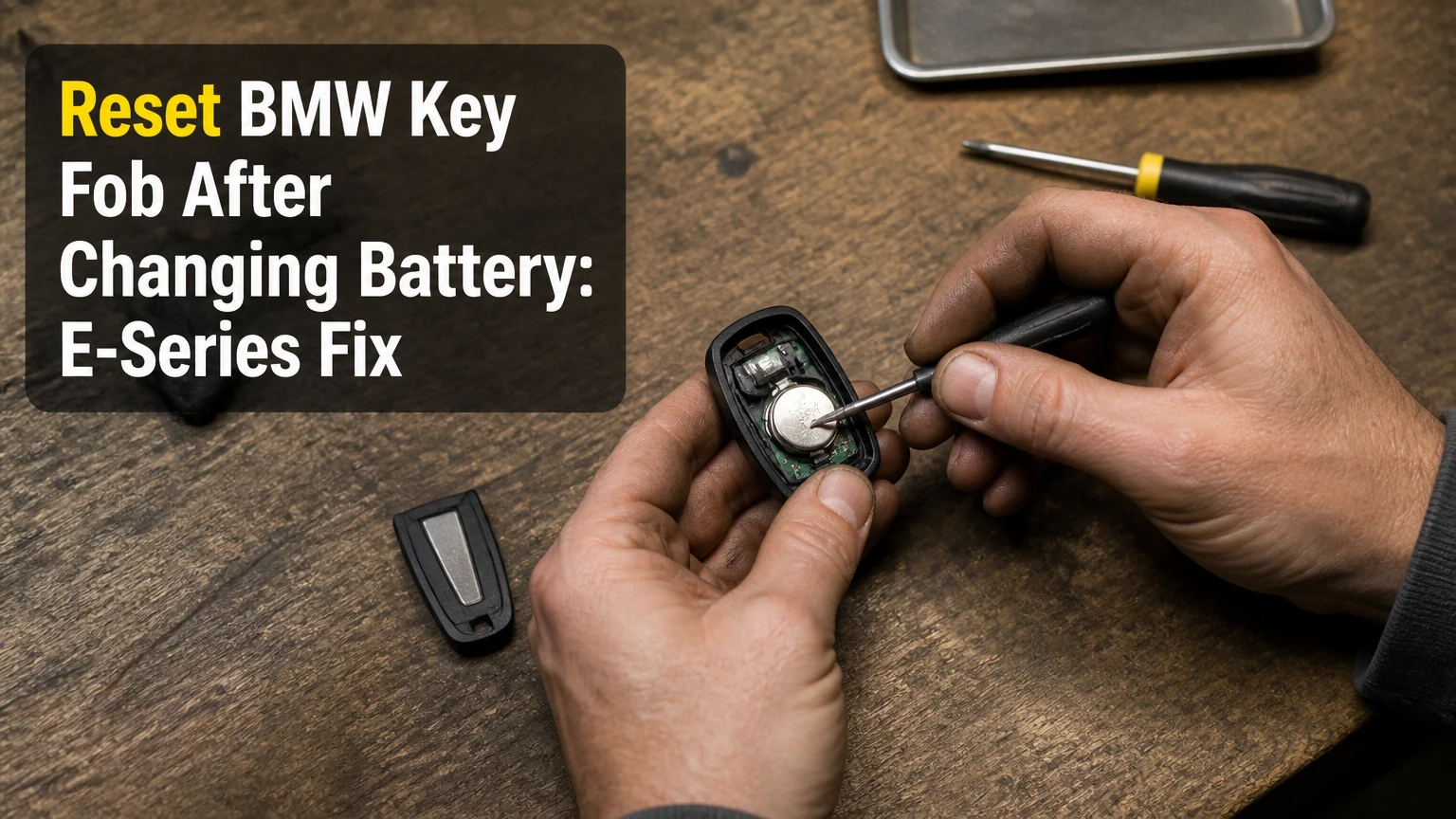
To reset a BMW key fob after changing the battery, first identify whether the vehicle uses an older E-series remote or a newer F/G-series key. Many E-series remotes can be resynchronized by cycling the ignition, then holding Unlock while pressing Lock three times. Newer BMW keys normally do not need button synchronization after a battery replacement.
Key Facts
BMW remote synchronization restores lock, unlock, and trunk-button communication; it does not program a new immobilizer key.
Older E46, E39, E53, and similar BMW models commonly use an ignition-and-button initialization sequence.
All existing remotes may need to be initialized during the same session because the vehicle can erase previously stored remote codes.
A BMW that starts normally but ignores remote buttons usually has a remote-side problem, not an immobilizer problem.
A steering-column emergency reader can help start some newer BMWs with a depleted fob battery, but it is not a universal remote reset.
Rechargeable VL2020 keys and replaceable CR2032 or CR2450 keys require different battery procedures.
What Does BMW Key Synchronization Actually Do?
BMW key synchronization pairs the remote transmitter’s rolling-code signal with the car’s central locking receiver. The procedure affects wireless functions such as locking, unlocking, and opening the trunk, while the immobilizer transponder remains a separate system that authorizes engine starting.
A battery change can interrupt the remote’s power supply, but it does not normally delete the vehicle’s immobilizer authorization. That distinction explains a common symptom: the engine starts, yet the buttons do nothing. The passive transponder can still communicate with the EWS, CAS, FEM, or BDC system while the radio transmitter requires diagnosis or reinitialization.
BMW owner documentation and dealer service procedures distinguish key initialization from adding a replacement key. Initialization is sometimes a driver-performed procedure. Adding a new key requires vehicle-specific security data and diagnostic equipment, especially on CAS, FEM, and BDC vehicles.
Synchronization versus programming
| Function | Affects | Typical DIY possibility | Equipment normally required |
|---|---|---|---|
| Remote synchronization | Lock, unlock, trunk buttons | Yes on many E-series models | Ignition and working remote |
| Immobilizer authorization | Engine start permission | No for a new key | BMW diagnostic or locksmith equipment |
| Key memory assignment | Seat, mirror, climate preferences | Model-dependent | Vehicle memory settings |
| Comfort Access enrollment | Passive entry and starting | Usually no | BMW-capable diagnostic equipment |
| Key battery replacement | Transmitter power | Yes if case permits | Correct battery and plastic tool |
Which BMW Key Type Do You Have?
The key shape narrows the procedure, but the vehicle chassis and production year provide the final answer. A diamond-shaped key generally indicates an older E-series system, while a newer rectangular or Display Key often uses CAS, FEM, or BDC electronics that do not follow the classic button sequence.
| Key or vehicle style | Common BMW examples | Typical battery or power source | Correct first action |
|---|---|---|---|
| Diamond key with fixed blade | E46, E39, E53, E83 | Rechargeable VL2020 on many originals | Check whether the case is sealed and battery is soldered |
| Rectangular slot key | E90, E60, E70, E87 | Rechargeable cell or model-specific internal battery | Confirm the chassis procedure in the owner manual |
| Comfort Access fob | F10, F30, F48, F25 | Often replaceable CR2032 or CR2450 | Replace battery, then test without assuming resync is needed |
| G-series Display Key | G05 X5, G20 3 Series, G30-era vehicles | Rechargeable internal battery | Charge the key and use BMW diagnostic support for persistent faults |
| Non-display G-series fob | G20, G30, G05 and related models | Usually replaceable coin cell | Test lock, unlock, trunk, and passive entry separately |
The same body style can hide different electronics by market and option package. Comfort Access, for example, adds passive antennas and hands-free entry circuits that are not present in a basic remote. The VIN, key part number, and owner’s manual are more reliable than the key’s shape alone.
How to Reset BMW Key Fob After Changing Battery
For many older BMW E-series vehicles, use the ignition initialization sequence below. The exact ignition-cycle count varies by chassis, so the BMW repair information for the specific model takes priority over a generic internet sequence.
Before you start
| Requirement | Typical value | Why it matters |
|---|---|---|
| Time | 3-10 minutes | Includes every remote in one session |
| Difficulty | Low | No scan tool for supported E-series procedures |
| Vehicle state | Doors and trunk closed | Prevents central-locking interruption |
| Battery type | CR2032, CR2450, or VL2020 | Must match the original key design |
| Number of remotes | Up to 4 or more | Initialize every working remote immediately |
| Cost | $0 DIY | Excludes a replacement battery |
Have every existing remote inside the car before beginning. Keep the doors closed, remove metal objects from the key ring, and do not press the brake or clutch during the ignition sequence.
Step 1: Close the vehicle and sit in the driver’s seat
Close all doors, the trunk, and the hood if the vehicle’s alarm system is sensitive to open panels. Insert the first key into the ignition, but do not start the engine.
You will know the setup is correct when the instrument cluster can illuminate without the starter operating. A common mistake is opening the driver’s door to retrieve another key after the procedure has started, which can cancel the initialization mode.
Step 2: Cycle the ignition without starting the engine
Turn the key to Position 1, where accessories and selected dashboard functions switch on, then return it to Position 0 and remove it. Complete the sequence quickly, normally within 5-10 seconds.
Some BMW E-series procedures specify one ignition cycle, while others specify five rapid cycles. The E46, E39, and E53 commonly appear in instructions using five cycles, but chassis, market, and production differences exist. If the vehicle-specific manual specifies five, use five. Do not leave the ignition on for 10-15 seconds as a substitute.
The success checkpoint is a completely removed ignition key with the car still stationary and all doors shut.
Step 3: Hold Unlock and press Lock three times
Point the remote toward the interior receiver. Press and hold the Unlock button, then press the Lock button three times within approximately 10 seconds. Release Unlock only after the three Lock presses are complete.
The lock button may display a BMW logo or a closed-padlock symbol, while Unlock commonly shows an open padlock. Press each button firmly, because worn membrane switches can register inconsistently.
You will know the remote initialized when the central locking system cycles the locks, usually by locking and unlocking automatically. No lock movement means the sequence, battery, contact, key circuit, or vehicle receiver needs further diagnosis.
Step 4: Initialize every other remote immediately
Repeat the Unlock-hold and Lock-three-press sequence for each additional remote without inserting the other keys into the ignition. Perform each remote within roughly 30 seconds of the previous one.
Many older BMW systems treat initialization as a replacement set rather than an individual addition. Initializing only the repaired key can therefore leave another previously working remote inactive. The exact storage capacity varies, so initialize only keys that belong to the vehicle.
Step 5: Exit initialization mode and test each function
Insert a key, switch the ignition to Position 1, then return it to Off. Remove the key and test Lock, Unlock, and trunk release from several feet away.
A successful test includes consistent operation from the front and rear of the vehicle. Test the spare key separately because a working primary remote does not prove that the spare has a healthy battery, transmitter, or switch board.
Do Newer BMW Keys Need a Reset?
Most newer BMW F-series and G-series keys do not require a user reset after a normal battery replacement. If the key starts the vehicle and the remote buttons stopped working immediately after the case was opened, inspect battery orientation, battery contacts, case damage, and the correct battery specification before attempting any ignition sequence.
F-series Comfort Access keys
F-series vehicles such as the F10 5 Series and F30 3 Series can use multiple antenna zones for passive entry and starting. Holding the key against the steering-column emergency reader can allow the vehicle to start when the key battery is weak, but that action does not generally re-pair the remote buttons.
The reader is an emergency transponder location. It does not prove that the radio transmitter is synchronized. If the vehicle starts while Lock and Unlock remain dead, diagnose the remote battery circuit and vehicle receiver separately.
G-series and Display Keys
G-series vehicles use newer security architecture, including FEM or BDC modules depending on model and production date. A Display Key may need charging rather than a coin-cell replacement, and persistent faults can require BMW diagnostic software or an automotive locksmith with appropriate equipment.
A generic “hold the key to the steering column and run the engine for 10 seconds” procedure should not be treated as a universal BMW reset. Starting the engine confirms passive authorization, not successful remote enrollment.
Why Does the BMW Start but the Remote Buttons Not Work?
A BMW that starts but ignores remote buttons has a functioning immobilizer path and a failed remote-control path. Check the new battery, metal contacts, button switches, fuses, vehicle receiver, and antenna amplifier in that order because the starting transponder and radio transmitter are separate circuits.
Battery and contact inspection
| Check | Correct finding | Failure implication | Practical response |
|---|---|---|---|
| Coin-cell voltage | About 3.0 V for a fresh CR2032 or CR2450 | Low transmitter output | Install a reputable new cell |
| Polarity | Positive side matches key markings | No transmitter power | Refit with correct orientation |
| Contact pressure | Metal tabs touch the cell firmly | Intermittent or dead buttons | Carefully restore contact tension |
| Cell shape | CR2032, CR2450, or specified part | Poor fit or case pressure | Use the exact listed size |
| Soldered cell | VL2020 or similar welded battery | Normal coin-cell swap impossible | Repair board or replace key |
Do not bend battery tabs aggressively. A broken solder joint or lifted PCB trace can cost more to repair than a straightforward replacement key. Avoid touching circuit-board contacts with greasy fingers, and do not use a metal screwdriver across the battery terminals.
Remote range and antenna diagnosis
A remote that works only beside the vehicle points more strongly to an antenna or transmitter-output fault than to synchronization. On several BMW designs, the diversity antenna amplifier is located around the rear window, roof area, or tailgate, where water intrusion can damage the receiver.
| Symptom | More likely cause | Useful test | Typical next step |
|---|---|---|---|
| No buttons on one key | Key battery, switch, or PCB | Test spare key | Repair or replace failed key |
| Both keys fail nearby | Fuse, receiver, or vehicle module | Check central-locking operation inside | Scan vehicle and inspect fuse |
| Works only at rear glass | Diversity antenna amplifier | Test at rear window and front door | Inspect water damage and amplifier |
| Trunk button alone fails | Worn switch or coding setting | Test Lock and Unlock | Repair button circuit |
| Locks work manually only | Remote path or central-locking fault | Test interior lock switch | Check fuse, receiver, and module |
| Passive entry fails but buttons work | Comfort Access antenna or handle | Test button operation | Diagnose Comfort Access system |
BMW does not use one universal central-locking fuse number. Fuse assignments vary by chassis, market, and production date, so use the glovebox fuse card or the vehicle’s official wiring documentation rather than assuming Fuse 56 or Fuse 57.
What If the Battery Replacement Did Not Fix the Key?
If the new battery does not restore the BMW remote, repeat the physical inspection before trying another programming sequence. A key that worked weakly before replacement may have a failing switch, cracked solder joint, water-damaged circuit board, or depleted rechargeable cell rather than a synchronization problem.
Use this recovery order:
- Confirm the battery part number and polarity.
- Measure the cell with a multimeter, aiming for approximately 3.0 V.
- Check that both battery contacts touch the cell.
- Inspect the PCB for corrosion, cracked solder, and displaced components.
- Test the spare key at the same distance.
- Check whether the interior central-locking switch works.
- Inspect the vehicle fuse panel and scan relevant modules.
- Have a locksmith or BMW technician test the key’s radio output.
An aftermarket replacement shell can create a deceptively simple failure. Moving the original PCB into a new shell may leave a button misaligned, while buying a complete aftermarket fob may introduce the wrong frequency, transponder, or security configuration. North American and European BMWs can use different radio frequencies, so a visually identical key is not automatically compatible.
What does the all-keys rule mean?
The all-keys rule means that many older BMW initialization procedures write a new remote list to the vehicle. Every existing remote must be initialized during that session, even if only one key received a new battery.
This rule does not mean every BMW stores only one key or that every newer vehicle behaves identically. It applies mainly to supported E-series remote initialization procedures. If one key stops working after another key is initialized, repeat the correct sequence with both remotes.
Can You Program a New BMW Key at Home?
A new BMW key generally cannot be programmed to start the engine with button combinations alone. A replacement key must match the vehicle’s security system and require access to data associated with EWS, CAS, FEM, or BDC, depending on the chassis and production date.
A locksmith with BMW-capable equipment may supply and program an eligible replacement key, while a dealer can verify ownership, order the correct key, and complete required programming. Used keys are often unsuitable because security data can be locked to another vehicle.
Remote synchronization and new-key programming have different costs and risks:
| Service | Typical U.S. price | Typical time | What the service does |
|---|---|---|---|
| DIY battery replacement | $5-$20 | 5-15 minutes | Restores key power |
| DIY E-series synchronization | $0 | 3-10 minutes | Relearns remote buttons |
| Mobile automotive locksmith | $80-$200 | 30-90 minutes | Diagnoses or programs eligible keys |
| Independent BMW diagnosis | $120-$250 | 1-2 hours | Tests modules, fuses, and receiver |
| BMW dealer diagnosis | $180-$350 | 1-3 hours | Performs factory-level diagnosis |
| New dealer key | $300-$700+ | Several days to 2 weeks | Supplies and programs a security-matched key |
Prices vary by country, chassis, key type, proof-of-ownership requirements, and whether the dealer must order the key by VIN. A Display Key, Comfort Access key, or BDC-era replacement usually costs more than an older fixed-blade remote.
When Should You Stop Trying DIY Methods?
Stop repeating button sequences when the car fails to acknowledge a known-good remote, both keys fail simultaneously, or a new key is involved. Continued resets cannot repair a failed antenna amplifier, damaged PCB, blocked key slot, blown fuse, or incompatible replacement fob.
Professional diagnosis is justified in these situations:
- The vehicle starts, but neither remote works after verified batteries.
- A key was lost and a replacement must be added.
- The key has a soldered rechargeable battery.
- Water entered the rear hatch, roof liner, or antenna area.
- The immobilizer warning appears or the vehicle will not start.
- A CAS, FEM, or BDC fault code is present.
- An aftermarket key has the wrong frequency or transponder.
- Central locking also fails from the interior switch.
Bring every available key and proof of ownership to the appointment. A technician can compare the working key, measure transmitter output, read module fault codes, and determine whether the problem is key-side or vehicle-side without replacing parts at random.
Common BMW Key Reset Mistakes
Using the wrong procedure for the generation
The classic five-cycle button routine is associated with many older BMWs, not every F-series or G-series vehicle. Applying it to a modern BDC vehicle can waste time and obscure the actual battery or module fault.
Leaving a door open
Open doors can interrupt initialization or cause the central-locking system to behave differently during the learning sequence. Close the doors before starting and keep them closed until all remotes are complete.
Initializing only one remote
Older systems may delete the other remote entries when a new list is written. Keep every working key in the vehicle and process them consecutively.
Treating emergency starting as synchronization
Holding a newer key against the steering-column reader can prove that the passive transponder works. It does not demonstrate that the coin-cell transmitter or Comfort Access antenna is healthy.
Installing a coin cell in a rechargeable key
Many original E-series diamond keys use a rechargeable VL2020 soldered to the PCB. A CR2032 is not a safe electrical or mechanical substitute unless the key has been professionally modified for that design.
Frequently Asked Questions
Will disconnecting the BMW battery reset the key fob?
Disconnecting the vehicle battery usually does not repair a failed remote and can create additional settings or window-initialization issues. BMW remote synchronization is stored in the appropriate body or central-locking module, so use the model-specific initialization procedure or diagnostic testing instead.
How long should a BMW key battery last?
A replaceable BMW coin cell commonly lasts about 2-4 years, depending on button use, Comfort Access wake-up activity, temperature, and storage. Rechargeable E-series cells depend on vehicle use because the ignition charges the key in some designs. A key used rarely may fail sooner.
Can a dead BMW key battery prevent the engine from starting?
A dead battery usually does not prevent starting when the passive transponder remains functional. Many F-series and G-series BMW vehicles provide a marked emergency reader location, often near the steering column, where the key can be held while pressing the brake and Start/Stop button.
Why does only one BMW key work?
One working key usually isolates the fault to the other remote, its battery contacts, switches, PCB, or transmitter frequency. If both keys fail, investigate the vehicle fuse, receiver, diversity antenna amplifier, and body module before buying another key.
Can a BMW key be reprogrammed without the original key?
A new BMW key cannot normally be authorized for engine starting through the old remote-button sequence alone. A dealer or qualified automotive locksmith must verify ownership and use BMW-compatible equipment, with the exact process determined by the EWS, CAS, FEM, or BDC system.
Should I buy a cheap replacement BMW key online?
A cheap replacement key is suitable only when its frequency, transponder, electronics, and vehicle compatibility are verified. Many marketplace fobs have the wrong regional frequency or an incompatible security chip, making them impossible to synchronize even when the case looks identical.
The Bottom Line
To reset a BMW key fob after changing the battery, identify the key generation first. Use the ignition-and-button initialization procedure for a supported older E-series remote, initialize every existing key in the same session, and treat newer F-series and G-series keys as a diagnostic issue rather than assuming a universal reset. If the BMW starts but the buttons remain inactive, check battery contacts, switches, fuses, antenna components, and vehicle modules before paying for immobilizer programming.