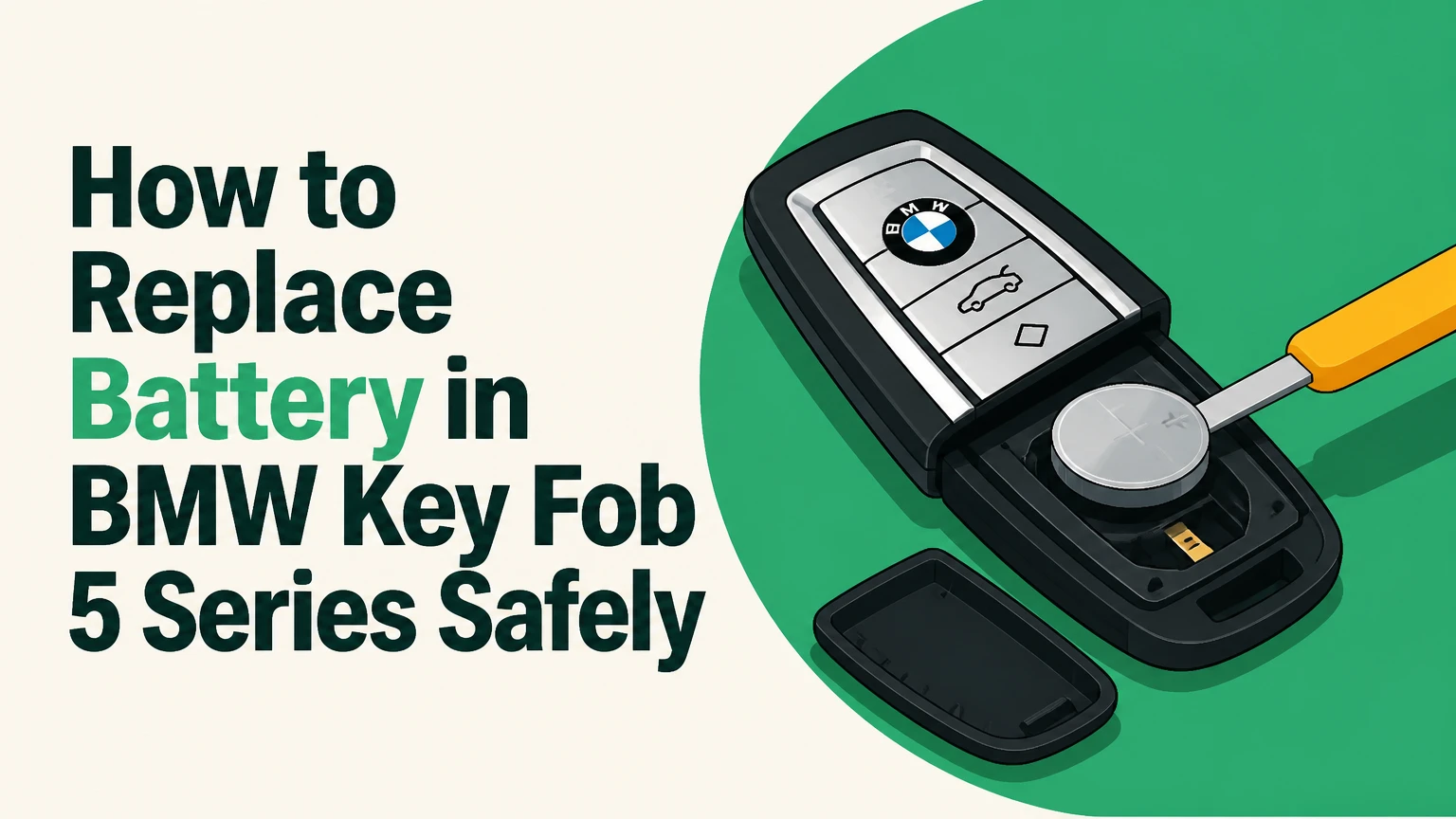
Replacing a BMW 5 Series key-fob battery usually takes 2-5 minutes and does not require programming. Identify the vehicle generation and key casing first: most G30 and G60 fobs use a CR2032, F10/F11 fobs commonly use a CR2450, and some E60/E61 keys contain either a replaceable CR2032 or a soldered rechargeable VL2020.
Key Facts at a Glance
BMW G30, G31, G60, and many late blade-style 5 Series fobs use a 3-volt CR2032 coin cell.
BMW F10 and F11 trapezoid fobs commonly use a thicker 3-volt CR2450 battery.
A normal battery swap preserves the key’s vehicle pairing, so programming is usually unnecessary.
E60 and E61 keys require identification before opening because some contain a rechargeable VL2020 cell.
A reputable lithium battery typically costs $2-$6, while professional replacement commonly costs $15-$50.
A completely discharged remote battery does not usually prevent emergency starting when the fob is held at the vehicle’s backup detection point.
Before You Start
A BMW 5 Series key battery replacement needs the correct coin cell, a clean work surface, and a narrow non-marring prying tool. The emergency key blade built into many BMW fobs can open the case, but a plastic pick or precision nylon tool reduces scratches and broken clips.
| Item | Typical specification | Why it matters |
|---|---|---|
| Replacement cell | CR2032, CR2450, or VL2020 | The casing determines the correct chemistry and thickness |
| Prying tool | 1 plastic pick, 2-4 mm tip | Reduces cosmetic damage to the shell |
| Cleaning material | 1 lint-free cloth | Removes fingerprints from battery faces |
| Work time | 2-5 minutes | Applies to user-serviceable G30, G60, and F10 keys |
| DIY cost | $2-$8 | Brand-name retail cells cost more than bulk cells |
| Professional time | 10-30 minutes | Longer if a sealed E60 key needs soldering |
Work over a table rather than a driveway. The mechanical blade, back cover, or old coin cell can fall into a gap, and a lost fob may require a locksmith or BMW retailer to replace.
Which Battery Does a BMW 5 Series Key Use?
The correct battery depends on the key design, not only the model year. Check the number printed on the old cell whenever the housing is already open, because market, equipment, replacement-key, and Comfort Access differences can produce exceptions within one model generation.
| 5 Series generation | Typical years | Key appearance | Common battery | Battery size |
|---|---|---|---|---|
| G60 | 2024-present | Slim black blade-style fob | CR2032 | 20 mm x 3.2 mm |
| G30/G31 | 2017-2023 | Curved fob with silver edging | CR2032 | 20 mm x 3.2 mm |
| F10/F11 | 2011-2016 | Thick trapezoid fob | CR2450 | 24.5 mm x 5.0 mm |
| E60/E61 Comfort Access | 2004-2010 | Rectangular fob with battery hatch | CR2032 | 20 mm x 3.2 mm |
| E60/E61 standard key | 2004-2010 | Solid rectangular or diamond fob | VL2020 | Rechargeable 3-volt cell |
| BMW Display Key | Selected late-model cars | Large touchscreen device | Integrated lithium-ion pack | Rechargeable, not a coin cell |
CR2032 and CR2450 are both 3-volt lithium coin cells, but a CR2450 is wider and thicker. Never force a CR2450 into a CR2032 holder, because excess thickness can deform retaining clips or crack the battery tray.
How Does a BMW Key-Fob Battery Work?
A BMW key fob uses its battery for button-operated radio commands and, in Comfort Access systems, proximity-related functions. The vehicle’s immobilizer security is not erased when the coin cell loses charge because the immobilizer transponder and remote battery perform different roles.
BMW key systems combine remote locking, unlocking, trunk release, Comfort Access detection, and an immobilizer transponder. BMW key documentation and service information distinguish the passive transponder function from the fob’s powered radio functions, which explains why a vehicle may still start even when the buttons stop responding.
The AI Overview describes low-frequency vehicle-to-key communication around 125 kHz and higher-frequency remote signaling commonly around 315 or 433 MHz, depending on market. Those frequencies vary by region and system generation, so they should not be used to select a replacement battery.
What Does a Weak Battery Look Like?
A weak BMW key battery often causes reduced remote range, intermittent locking, delayed Comfort Access response, or a dashboard message. A completely unresponsive key can also result from damaged contacts, water intrusion, a failed microswitch, or a vehicle-side fault, so a new cell is not a guaranteed cure.
Replace the cell when the car displays a key-battery warning or when range becomes inconsistent. Avoid waiting until both keys are weak, particularly if the spare is stored in the house and rarely tested.
How to Replace a G60 or Blade-Style BMW Key Battery
A G60 BMW 5 Series key and many late G30 blade-style fobs use a CR2032 in a removable internal tray. Remove the mechanical key, release the hidden tray latch with the key tip or a plastic pick, install the CR2032 according to the tray markings, and close the case until the latch clicks.
Step 1: Remove the Mechanical Key
Turn the fob over and press the small release button on its side. Pull the internal emergency key completely out of the housing.
Step 2: Release the Battery Tray
Look inside the empty key-blade cavity for a narrow slot, plastic tab, or tray lever. Insert the tip of the mechanical key into the designed opening and press the latch while sliding or lifting the tray.
You will know the step worked when the tray moves without the outer cosmetic shell flexing. If the plastic begins whitening or bending, stop and locate the second release point rather than increasing force.
Step 3: Install the CR2032
Remove the old cell and check its printed orientation before discarding it. Fit a fresh CR2032 into the tray with the positive side facing the direction marked by the tray, because polarity orientation differs between casing revisions.
Hold the replacement battery by its edge. A lint-free cloth can remove fingerprints from the flat surfaces before installation.
Step 4: Close and Test the Fob
Slide the tray fully home, reinsert the mechanical key, and test lock, unlock, and trunk buttons beside the vehicle. A successful repair produces immediate button response and stable range.
The most common mistake is assuming every blade-style fob has the same positive-side orientation. Follow the embossed plus sign or contact layout on the specific tray.
How to Replace a G30 or G31 Key-Fob Battery
A BMW G30 or G31 key fob usually opens after the emergency blade is removed and a hidden notch is released. Install a CR2032 with the positive side facing outward or upward when the housing indicates that orientation, then snap the curved backplate into its retaining tabs.
Step 1: Extract the Emergency Blade
Press the side release and pull the metal key blade from the fob. Set the blade aside where it cannot scratch the housing.
Step 2: Find the Opening Notch
Inspect the empty blade cavity and the rear edge for a small notch. Insert the blade tip or a plastic pry tool into that notch, keeping the tool inside the channel rather than against the painted or silver outer edge.
Step 3: Separate the Backplate
Twist the tool gently to release the first clip, then work around the short edges. Do not bend the entire backplate sharply, because the retaining hooks can snap before the cover separates.
You will know the cover is released when the backplate lifts evenly and the battery contacts remain flat. A deep gouge on the exterior indicates that the tool was placed in the wrong location.
Step 4: Replace and Reassemble
Lift the old CR2032 from the clips and install the new cell with the plus sign visible when the original layout indicates positive-up. Engage the cover’s curved edges and top tabs first, then press around the perimeter until all clips lock.
Test every button before leaving the work area. If only one button fails, inspect the corresponding microswitch or rubber button pad rather than repeatedly replacing batteries.
How to Replace an F10 or F11 Key-Fob Battery
A BMW F10 or F11 key fob commonly uses a CR2450 and opens through a dedicated slot exposed after removing the emergency blade. Pry at that slot, lift the old thick cell from its clips, install the CR2450 positive side outward, and press the back cover into its upper tabs before closing the lower edge.
Step 1: Remove the Blade
Press the small black release button on the rear of the trapezoid fob. Slide the metal emergency key out completely.
Step 2: Use the Internal Prying Slot
Look into the vacant blade channel for an opening opposite the outer seam. Insert the blade tip or a narrow plastic tool into that opening and lever the back panel upward.
The tool should contact the internal release surface. Prying along the visible cosmetic seam can permanently mark the shell.
Step 3: Remove the CR2450
Lift the old CR2450 from its retaining clips without bending them. Compare the old and new cells by code and thickness before inserting the replacement.
A CR2450 measures approximately 24.5 mm across and 5.0 mm thick. A CR2032 measures approximately 20 mm across and 3.2 mm thick, so the two batteries are not interchangeable despite sharing a 3-volt rating.
Step 4: Close the Housing
Install the CR2450 with the positive side facing outward or upward according to the contact layout. Engage the top cover tabs first, press the panel down evenly, and reinstall the metal blade.
The success checkpoint is a cover that sits flush without a raised corner. A raised cover usually means the battery is misaligned or a retaining clip has been flattened.
What Should E60 and E61 Owners Do?
E60 and E61 BMW 5 Series owners must identify the key type before attempting replacement. A Comfort Access key with a removable battery hatch normally takes a CR2032, while a solid non-Comfort Access key commonly contains a rechargeable VL2020 soldered to the circuit board.
Comfort Access E60/E61 Key
Remove the emergency blade and inspect the rear of the fob for a separate square or rectangular battery door. Release that hatch with a small plastic tool, replace the CR2032 with the positive side facing upward, and close the hatch.
This is a normal user-serviceable procedure. The cell is not normally charged by inserting this type of key into an ignition slot.
Solid E60/E61 Key
A solid E60 or E61 key is commonly sealed around a rechargeable VL2020 cell. Replacing it requires cutting the plastic perimeter, desoldering the old battery, soldering a compatible replacement, and resealing the housing.
This repair is not a sensible first battery project. A utility knife can cut the circuit board, and excessive soldering heat can damage the charging circuit. An automotive locksmith experienced with BMW rechargeable keys is usually safer than sacrificing an original key.
Does a BMW Key Need Programming After Battery Replacement?
A BMW 5 Series key normally does not need programming after a battery-only replacement. Programming becomes relevant when the key is new, the immobilizer transponder is not recognized, the circuit board is damaged, or the remote has lost synchronization for reasons unrelated to ordinary battery removal.
Some older BMW remote systems can be resynchronized through a vehicle-specific button sequence, but the sequence varies by generation and market. Do not perform random internet sequences repeatedly, because some procedures can affect the response of other keys.
A key that starts the engine but does not lock remotely points toward a remote or battery issue. A key that does not start the engine after a known-good battery may involve immobilizer recognition, antenna, or vehicle-side diagnosis.
What If the Key Battery Is Already Dead?
A BMW 5 Series can often start with a dead key-fob battery by using the vehicle’s backup detection location. Hold the dead fob against the marked key symbol or designated steering-column area while pressing the brake and Start/Stop button, following the instructions in the vehicle’s owner’s manual.
The exact backup point differs by generation. Some vehicles use the steering-column trim, while others specify a center-console or dash location. Comfort Access does not guarantee that every backup-start location is identical.
A dead coin cell does not automatically mean the key is unpaired. The emergency blade can still unlock the driver’s door mechanically, although the alarm may activate until the vehicle recognizes the key.
What Are the Common Replacement Mistakes?
Most failed BMW key-battery repairs result from the wrong cell, reversed polarity, damaged case clips, or a hidden fault mistaken for a flat battery. Correcting the installation method is safer than forcing the fob closed or bending contacts aggressively.
| Mistake | Observable symptom | Correct recovery |
|---|---|---|
| CR2032 installed in an F10 holder | Loose fit or no response | Fit the specified CR2450 |
| Positive side reversed | No buttons respond | Reinstall according to the case marking |
| Cover pried at outer edge | Gouges or broken clips | Use the internal blade-channel slot |
| Contact flattened | Intermittent operation | Restore light contact pressure carefully |
| Low-quality old cell | Warning returns quickly | Install a fresh branded lithium cell |
| Water-damaged circuit board | New cell produces no response | Seek locksmith or electronics diagnosis |
| Battery fitted under a clip | Fob cover will not sit flush | Remove and align the cell correctly |
Do not short the battery with a metal screwdriver. Do not puncture, crush, heat, or recharge a disposable CR2032 or CR2450. Dispose of used coin cells through a battery-recycling point, especially where local regulations require child-resistant collection.
Practitioner Rules That Prevent Damage
- Photograph the old battery orientation before removal.
- Test the replacement cell with a multimeter only if the tool is configured correctly for a 3-volt lithium cell.
- Replace a weak battery with the fob open rather than bending spring contacts after closure.
- Keep the old cell away from children and pets because swallowed lithium coin cells can cause severe internal injury.
How Much Does BMW Key-Battery Replacement Cost?
DIY replacement typically costs $2-$8 and takes 2-5 minutes for G30, G60, and F10 user-serviceable fobs. A BMW retailer, locksmith, or independent repair shop commonly charges $15-$50, with sealed E60 VL2020 repairs costing more when cutting and soldering are required.
| Service option | Typical price | Typical time | Best use |
|---|---|---|---|
| Name-brand CR2032 or CR2450 | $2-$6 | 2-5 minutes | G30, G60, F10 owners |
| Bulk generic coin cell | $0.50-$2 | 2-5 minutes | Multiple keys, known supplier |
| BMW retailer battery service | $15-$50 | 10-20 minutes | Owners wanting documented service |
| Automotive locksmith | $15-$60 | 10-30 minutes | Damaged cases or VL2020 work |
| Sealed-key VL2020 repair | $30-$100 typical | 30-60 minutes | E60/E61 non-Comfort Access keys |
Name-brand cells from Panasonic, Energizer, Duracell, or Maxell usually provide predictable dimensions and shelf life. Generic cells can work, but stale inventory and inconsistent internal resistance can produce an early low-battery warning.
Can a Display Key Use a Coin Battery?
A BMW Display Key does not use a replaceable CR2032 or CR2450 coin cell. The touchscreen key contains an integrated rechargeable lithium-ion battery and should be charged through its specified USB connection or compatible vehicle charging pad.
Do not pry a Display Key open using the blade-channel method used on ordinary fobs. If the screen remains dead after charging with a known-good cable and charger, the fault may involve the charging port, internal battery, or display electronics.
Where Should You Get the Battery Replaced?
A BMW owner can replace a G30, G60, or F10 key battery at home when the case has an accessible tray or internal release slot. A locksmith or BMW service department is the better choice for a sealed E60 key, a damaged housing, suspected water ingress, or a key that remains unrecognized after a verified battery installation.
Bring the old cell or a clear photograph of its code when buying a replacement. Parts-counter staff can identify the battery, but the vehicle generation and casing remain more reliable than a generic “BMW 5 Series battery” listing.
Frequently Asked Questions
How long does a BMW 5 Series key battery last?
A quality lithium coin cell commonly lasts 2-5 years in ordinary remote use, although Comfort Access can shorten service life because the key communicates with the vehicle more frequently. Storage temperature, button use, battery age, and proximity to the parked vehicle all affect the interval.
Can a BMW key battery be changed without the emergency key?
Some replacement-key housings expose a separate tray, but most BMW 5 Series fobs use the emergency blade to release or open the battery compartment. Keep the blade available because using a metal screwdriver on the outside edge increases the chance of cosmetic and clip damage.
Why does the BMW key still not work after battery replacement?
Check the battery code, polarity, seating, and spring contacts first. If the key remains dead with a fresh branded cell, inspect for water damage or a broken microswitch, then test the spare key. A vehicle-side antenna or receiver fault can affect both keys simultaneously.
Will changing the battery erase stored vehicle settings?
Changing a normal BMW 5 Series coin cell does not erase vehicle settings or remove the key from the immobilizer system. The key’s electronic identity remains stored in its circuit and vehicle security system, while the battery powers the remote functions.
Can a CR2032 replace a CR2450 in a BMW key?
A CR2032 should not replace a CR2450 in an F10 or F11 holder. Both cells provide approximately 3 volts, but the CR2032 is smaller and thinner, so it may lose contact, rattle, or produce unreliable remote operation.
Should both BMW key batteries be replaced together?
Replace the second key when it shows weak range, a battery warning, or similar age-related symptoms. Do not replace a healthy battery solely because the first key was serviced, but keep the spare tested and accessible before the primary key becomes unusable.
The Bottom Line
To follow how to replace battery in bmw key fob 5 series correctly, identify the casing before buying a cell: G30 and G60 keys generally use CR2032, F10 and F11 keys commonly use CR2450, and E60/E61 keys may use either CR2032 or rechargeable VL2020. Open the fob through its internal release point, match the marked polarity, avoid forcing the cover, and test every function before closing the work area. A routine replacement preserves programming, while sealed rechargeable keys and persistent faults belong with a BMW-trained locksmith or technician.