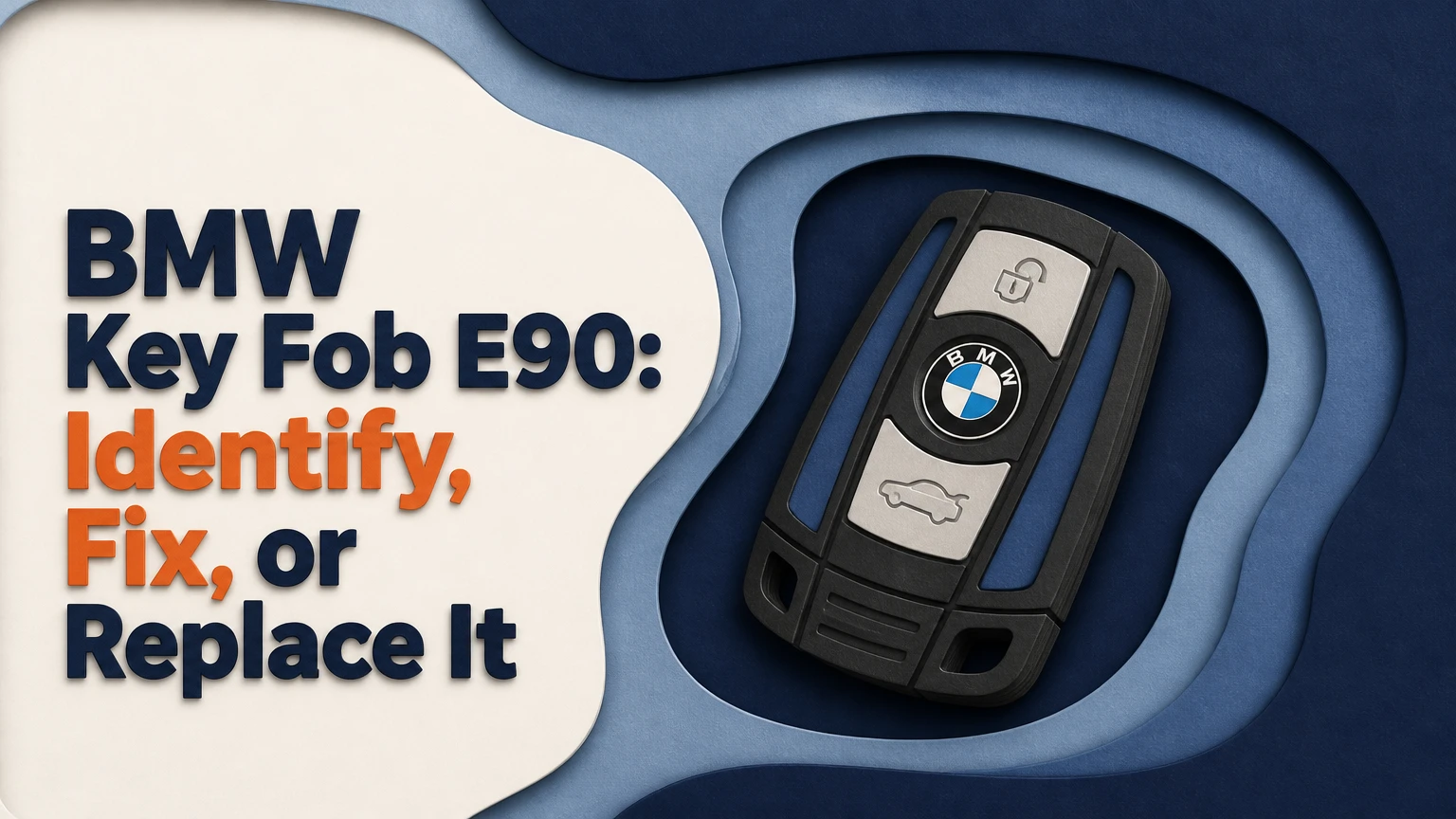
The BMW E90 key fob is either a Comfort Access remote with a replaceable CR2032 battery or a sealed standard remote with a rechargeable VL2020 cell. The correct repair depends on the rear-case design, whether the car starts, and whether the fault affects remote buttons, passive entry, or immobilizer authorization.
Key Facts
A BMW E90 Comfort Access key has a removable rear battery cover and uses a CR2032 coin cell.
A standard non-Comfort Access key has a sealed case and a rechargeable VL2020 battery.
The standard key recharges inductively while installed in the dashboard key slot.
Remote synchronization cannot authorize a used key to start a different vehicle.
Typical replacement costs range from $20-$40 for a shell to $300-$500 through a BMW dealer.
Poor remote range can indicate the vehicle’s diversity antenna, wiring, or amplifier rather than a bad key battery.
What Is the BMW E90 Key Fob?
The BMW E90 key fob is the rectangular electronic remote used by the 3 Series platform introduced for model-year 2005 and produced through 2013 in overlapping body styles. The E90 designation technically identifies the sedan, while the E91 wagon, E92 coupe, and E93 convertible use closely related key systems.
The fob contains several separate functions:
- Remote locking and unlocking
- Trunk or tailgate release
- A removable emergency metal blade
- An immobilizer transponder
- A remote-control transmitter
- Vehicle-specific key memory, where equipped
The key slot in the dashboard is more than a storage location. On standard keys, the slot helps charge the internal rechargeable cell and allows the CAS, or Car Access System, to communicate with the key. The immobilizer function and radio remote function remain separate, so a key may start the engine while its buttons fail.
BMW owner documentation describes the standard remote as containing a rechargeable battery that is charged while the remote is inserted into the ignition or dashboard slot. That statement applies to the sealed standard design, not to a Comfort Access remote with a replaceable coin cell.
How Do You Identify the Two E90 Key Types?
The rear of the fob provides the fastest identification method. A removable battery door indicates Comfort Access, while a smooth sealed rear case indicates the standard non-Comfort Access key.
| Feature | Comfort Access key | Standard key |
|---|---|---|
| Rear case | Removable battery hatch | Smooth, sealed plastic |
| Battery | CR2032, 3 volts | VL2020, rechargeable |
| Passive entry | Available when equipped | Not available |
| Starting method | Key may remain in pocket | Insert key into dashboard slot |
| Battery service | User replaceable | Case opening and soldering required |
| Typical visual clue | Hatch seam on rear panel | No battery-door seam |
Comfort Access allows the vehicle to detect a valid key near the door handle and authorize entry without a button press. The feature also permits starting with the key inside the cabin, although the vehicle still uses the key’s immobilizer authorization.
A car can have a key that looks similar to another E90 key but uses different electronics, frequency, or internal layout. Match the original part number and regional frequency before buying a shell or replacement transmitter.
What Does the E90 Key Battery Do?
The battery powers the remote transmitter and, on Comfort Access vehicles, the low-power communication used for passive entry. The immobilizer transponder has a separate role and may still authorize starting even when the remote battery is weak.
That separation explains a common symptom: the car starts normally, but the lock and unlock buttons stop responding. A second common symptom is the reverse, where buttons work intermittently but the vehicle reports a key recognition or start authorization fault.
Which Battery Does Each E90 Key Use?
A Comfort Access E90 key uses a CR2032 lithium coin cell; the 3 Series battery replacement guide explains how to identify whether the battery is removable, while a standard sealed E90 key normally uses a rechargeable VL2020 cell soldered to the circuit board. Installing a CR2032 in a sealed standard key is not a direct replacement because the charging circuit and battery connections differ.
| Key system | Battery type | User replacement | Charging method | Main risk |
|---|---|---|---|---|
| Comfort Access | CR2032, 3 V | Yes | No charging in slot | Incorrect polarity or damaged cover |
| Standard remote | VL2020, rechargeable | No, normally | Inductive charging in slot | Case or circuit-board damage |
| Repaired standard key | VL2020-compatible cell | Advanced repair | Vehicle slot after repair | Reversed polarity or poor solder joint |
| Replacement key | Vehicle-specified internal cell | Usually no | Factory-designed system | Wrong frequency or part number |
CR2032 cells are widely available, but battery quality affects shelf life and voltage stability. Buy a fresh cell from a reputable battery supplier, avoid touching both faces repeatedly, and keep the replacement dry.
A VL2020 is a rechargeable lithium button cell designed for charging applications. A non-rechargeable CR2032 is not an appropriate substitute in a circuit that repeatedly applies charging current.
How Do You Replace a Comfort Access Battery?
Replacing a Comfort Access battery takes about 5-10 minutes and requires the emergency blade plus a small coin or plastic pry tool. The determining factor is whether the rear hatch opens without cracking the case or cutting into the electronics.
Before You Start
| Requirement | Typical specification |
|---|---|
| Replacement battery | One CR2032, 3 V |
| Tools | Metal emergency blade, small coin or plastic pry tool |
| Time | 5-10 minutes |
| Difficulty | Low |
| Programming | Not required after battery replacement |
| Prerequisite | Confirm the rear hatch belongs to the Comfort Access key |
Step 1: Remove the Emergency Blade
Press the side release and slide the metal blade out of the fob. The blade can help access the battery cover, but do not twist it aggressively because the plastic retainer can break.
Success checkpoint: The blade comes out fully and the rear cover remains intact.
Common mistake: Confusing the blade-release button with a battery-door release.
Step 2: Open the Battery Cover
Use the blade tip, a coin, or a nonconductive plastic tool at the designated cover seam. Apply controlled pressure around the seam instead of forcing one corner, because excessive leverage can deform the cover or its retaining clips.
Success checkpoint: The cover lifts without bending the circuit board or tearing the rubber seal.
Common mistake: Cutting the case. A Comfort Access key should not need to be cut open.
Step 3: Install the CR2032
Remove the old battery and install the new cell in the same orientation. In most E90 Comfort Access remotes, the positive side faces outward, but the markings inside the compartment are the final authority.
Success checkpoint: The battery sits flat and the cover closes evenly.
Common mistake: Installing the cell upside down or using a CR2025 because it appears similar.
Step 4: Test Every Function
Test lock, unlock, trunk release, passive entry, and engine starting. No key coding is normally required after replacing the battery, although an already weak remote may need synchronization if its rolling-code communication was interrupted.
Success checkpoint: The locks respond at normal range and the vehicle recognizes the key.
Common mistake: Assuming a failed button proves the battery is bad when the button microswitch or antenna trace is damaged.
How Does the Sealed E90 Key Recharge?
The standard E90 key recharges through inductive coupling when it remains in the dashboard slot, so a short drive may not restore a deeply depleted cell. BMW’s charging design supports normal periodic use, but an old VL2020 can lose capacity after roughly 10-15 years of service.
The key must be seated correctly in the slot. The vehicle does not charge the remote through a cable, and placing the fob in a cup holder or near the steering column will not recharge it.
A practical charging test is to use the key in the slot for several hours or during multiple drives, then test the remote outside the car. If range improves briefly and collapses again, the VL2020 likely has insufficient capacity rather than a synchronization problem.
Can You Replace a VL2020 Battery Yourself?
A technically experienced person can open the sealed case, desolder the old VL2020, install a compatible rechargeable cell, and reseal the housing. The repair is inexpensive, typically $15-$30 in parts and materials, but the risk is much higher than replacing a CR2032.
| Repair route | Typical cost | Typical time | Skill level | Result |
|---|---|---|---|---|
| New Comfort Access cell | $3-$8 | 5-10 minutes | Low | Restores battery power |
| VL2020 DIY repair | $15-$30 | 1-3 hours | Advanced | Restores cell if board survives |
| Specialist board repair | $50-$120 | 1-5 days | Technician | Repairs battery and some board faults |
| New coded key | $200-$500 | Same day to 5 days | Dealer or locksmith | Replaces complete key |
Opening the standard fob with a utility knife can cut the circuit board, antenna, battery tabs, or transponder components. The circuit board also needs correct polarity and a reliable solder connection, and the replacement battery must be rechargeable.
This repair is not suitable when the key has water damage, broken board traces, severe case deformation, or an unknown history. A replacement key or specialist repair is safer in those situations.
Can a Used E90 Key Be Programmed to Start Another Car?
A used E90 key generally cannot be recoded to start another vehicle because its immobilizer authorization is paired with the original vehicle’s CAS system. Remote buttons may sometimes be synchronized only when the key already belongs to that vehicle, but synchronization does not transfer starting authorization.
| Action | Changes immobilizer authorization? | DIY possible? | Typical outcome |
|---|---|---|---|
| Replace CR2032 | No | Yes | Existing key continues working |
| Synchronize remote | No | Yes, if key is valid | Buttons may operate again |
| Shell swap | No | Yes | Original electronics use a new case |
| Add new key by VIN | Yes, through authorized supply | No | New key starts the vehicle |
| Adapt used donor key | Usually no | No reliable consumer method | Starts donor vehicle, not yours |
The CAS stores vehicle-specific key authorization. BMW dealers order a key against the vehicle identification number and ownership records, while qualified automotive locksmiths use specialized equipment and legally controlled procedures.
Avoid listings that promise a used eBay key can be “programmed to any E90.” A donor shell can be useful, and in some cases a compatible electronic board can be repaired, but a used immobilizer key is not equivalent to a new key ordered for the VIN.
How Do You Synchronize an Existing E90 Remote?
Remote synchronization restores button communication for an already authorized key; it does not add a new key to the CAS. The common sequence takes less than two minutes and must be completed promptly with all doors closed.
- Sit inside the car and close every door.
- Insert the key into the dashboard slot.
- Turn the ignition to Position 1, then switch it off and remove the key within five seconds.
- Hold the unlock button.
- While holding unlock, press the lock button, the BMW logo button, three times within approximately ten seconds.
- Release the unlock button.
- Watch for the locks to cycle.
If you have multiple valid keys, synchronize each one during the same session. Do not turn the ignition on again between keys, because doing so can end the initialization mode.
Success checkpoint: The central locking system locks and unlocks after the sequence.
Common mistake: Synchronizing a donor key and expecting the engine immobilizer to accept it.
How Much Does an E90 Replacement Key Cost?
A replacement E90 key typically costs $200-$500, with the final price determined by country, key type, vehicle records, labor, and whether the key is ordered through BMW or supplied by a qualified locksmith. A shell-only repair costs much less when the original electronics still work.
| Option | Typical price | Timeframe | Best use | Main limitation |
|---|---|---|---|---|
| BMW dealer key | $300-$500 | 2-5 days | Lost key or full replacement | Highest price and ownership verification |
| BMW-specialist locksmith | $200-$350 | Same day | Mobile replacement | Requires CAS-capable equipment |
| Comfort Access battery | $3-$8 | 5-10 minutes | Weak remote battery | Does not repair board faults |
| Shell swap | $20-$40 | 30-90 minutes | Broken buttons or case | Does not fix electronics |
| VL2020 specialist repair | $50-$120 | 1-5 days | Rechargeable-cell failure | Repair quality varies |
Prices are typical consumer ranges, not fixed BMW tariffs. Dealer pricing also varies by market and model-year equipment, while locksmith availability depends on local licensing and whether the technician can read the specific CAS version.
Bring government identification, vehicle registration, and the VIN when ordering a key. Dealers and reputable locksmiths use ownership verification to prevent unauthorized immobilizer work.
Why Does the Remote Work Only Near the Car?
Poor E90 remote range is often caused by the vehicle’s diversity antenna amplifier, wiring, or water intrusion rather than the key battery. A remote that works reliably from 1-2 meters but fails across a parking space requires diagnosis of both the key and the car.
| Symptom | More likely cause | First check | Typical repair direction |
|---|---|---|---|
| Both keys have poor range | Diversity antenna or wiring | Test both keys in same location | Inspect amplifier and connections |
| One key has poor range | Key battery or transmitter | Compare spare key | Replace cell or repair key |
| Remote works only at glass | Antenna amplifier fault | Test around rear window | Inspect antenna module |
| Passive entry fails, buttons work | Comfort Access antenna or key battery | Test each door handle | Scan and inspect CA system |
| Car will not start, buttons work | CAS or transponder issue | Try authorized spare key | Diagnose immobilizer system |
The antenna amplifier location varies by body style and market, but it is commonly integrated near the rear window or roof-rear area. Touring models can develop water-related electrical problems around rear hatch wiring and antenna components.
An expert rule of thumb is simple: test the spare key before buying parts. If both keys show the same range failure, replacing both batteries is less likely to solve the underlying vehicle-side problem.
Can You Start an E90 With a Dead Key Battery?
A standard E90 can often start with a dead remote battery when the key is inserted into the dashboard slot because the vehicle can read the immobilizer transponder through the slot. Comfort Access vehicles also provide an emergency recognition procedure described in the vehicle manual, which may require holding the key at the marked steering-column location.
The exact backup-start method varies with equipment and market. Do not assume a flat CR2032 means the key is erased or that a new key is necessary.
| Condition | Remote buttons | Engine start | Likely next action |
|---|---|---|---|
| Weak Comfort Access cell | Intermittent | Usually yes | Replace CR2032 |
| Flat standard VL2020 | No | Often yes in slot | Charge, then test capacity |
| Damaged transponder | May work | No | Key or immobilizer diagnosis |
| CAS fault | May work | No | Scan CAS and related modules |
| Wrong donor key | May work on donor | No on your E90 | Obtain VIN-matched key |
If the authorized spare key starts the vehicle, the original key is the likely fault. If neither key starts the vehicle, inspect the CAS, battery voltage, steering-column lock system where fitted, and diagnostic fault memory before purchasing another transmitter.
What Is the Glovebox Valet Switch For?
The glovebox valet switch disables trunk or luggage-compartment access through the central locking system while allowing normal vehicle operation. The owner can lock the glovebox with the emergency blade, retain the blade, and give the remote to a valet without granting access to the trunk.
The switch is not a key-programming control. If the trunk button suddenly stops working while the other remote functions remain normal, inspect the switch position before replacing the fob.
The setting can differ by body style and equipment. Confirm operation with the vehicle manual, and never lock the only emergency blade inside the glovebox.
What Other E90 Key Problems Matter?
E90 key faults extend beyond the battery. Worn microswitches, cracked solder joints, liquid intrusion, damaged antenna traces, broken case retainers, and a discharged vehicle battery can all mimic a defective remote.
Use this diagnostic order:
- Test the spare key.
- Confirm the vehicle battery is fully charged.
- Check whether the car starts with the key in the slot.
- Inspect the key case for liquid or impact damage.
- Test remote range in an open area away from radio interference.
- Scan the CAS and body-control systems if both keys fail.
Key-specific personal profiles can store seat, mirror, climate, and radio preferences when the vehicle has the relevant memory equipment. Switching keys may therefore move the seat or change settings without indicating a fault.
Frequency also matters. North American and some Asian-market systems commonly use 315 MHz, while many European-market systems use 868 MHz. Frequency alone is insufficient for ordering, because the CAS generation, button layout, Comfort Access hardware, and BMW part number must also match.
What Is the Best Repair for Each Failure?
| Failure pattern | Recommended solution | Avoid |
|---|---|---|
| Broken outer shell, working remote | Shell swap | Buying a coded key |
| Comfort Access battery warning | CR2032 replacement | Cutting open the case |
| Standard key charges briefly | VL2020 specialist repair or replacement | Fitting a non-rechargeable cell |
| One button fails | Microswitch or board repair | Assuming synchronization fixes hardware |
| Both keys have short range | Vehicle antenna diagnosis | Replacing both fobs first |
| Lost only key | VIN-ordered dealer or locksmith key | Used donor key advertised as programmable |
The best-value repair preserves the original electronics when the vehicle still starts and the buttons or housing are the only damaged parts. A complete replacement becomes more sensible when the transponder, circuit board, or case has suffered extensive damage.
Frequently Asked Questions
Does a new CR2032 need BMW programming?
A new CR2032 does not normally require BMW programming because the battery replacement leaves the existing Comfort Access electronics and immobilizer authorization unchanged. If the buttons do not work afterward, perform remote synchronization once, then investigate the microswitch, battery contacts, transmitter, or vehicle antenna.
How long should an E90 key battery last?
A Comfort Access CR2032 commonly lasts one to several years depending on passive-entry use, temperature, and cell quality. A standard VL2020 rechargeable cell often reaches approximately 10-15 years, but age, charging cycles, heat, and long periods outside the slot can shorten useful capacity.
Why does the BMW key charge while driving but still die?
Charging can restore a temporary surface charge without recovering the lost capacity of an aged VL2020. If the remote works after a long drive and fails again soon afterward, the rechargeable cell likely needs replacement or specialist board repair rather than additional driving time.
Can a shell swap fix a key that will not start the car?
A shell swap cannot fix an immobilizer or transponder fault because it moves the original electronics into a new housing. Shell replacement is appropriate when the buttons, blade holder, or plastic case is damaged but the original key still starts the E90 and communicates with its remote system.
Does the E90 key store the driver’s settings?
The vehicle can associate driver settings with an individual key, including seat, mirror, climate, and audio preferences when the car has the corresponding memory functions. Key memory does not store the immobilizer authorization in a way that makes a used key transferable between vehicles.
Should you buy a 315 MHz or 868 MHz replacement?
Buy the frequency, BMW part number, button configuration, CAS compatibility, and Comfort Access type that match the original key and vehicle market. North American E90 vehicles commonly use 315 MHz, while many European vehicles use 868 MHz, but market-specific verification is safer than relying on geography alone.
The Bottom Line
The BMW key fob E90 is not one universal design. A rear battery hatch means CR2032 replacement, while a sealed case means a rechargeable VL2020 and a higher-risk repair. Confirm whether the engine starts, test the spare key, verify frequency and part number, and diagnose the vehicle antenna before buying an expensive replacement.
A shell swap is the economical answer for cosmetic damage. A specialist can repair a rechargeable cell or circuit board, while a dealer or qualified BMW locksmith is the correct route for a new immobilizer-authorized key. Remote synchronization restores button communication only; it does not make a used donor key start another E90.