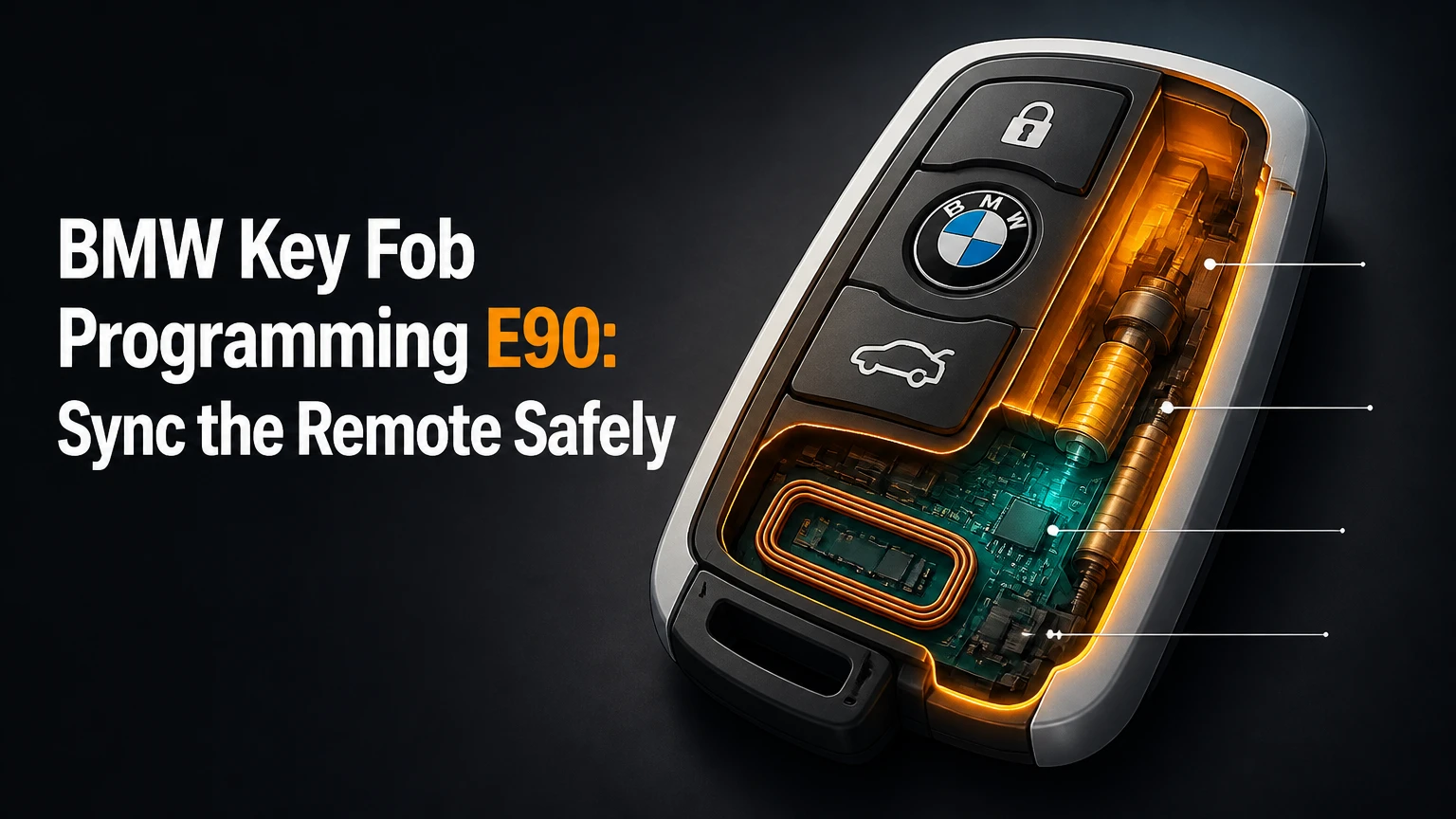
BMW E90 key fob programming has two separate meanings: initializing the remote buttons for central locking, or authorizing the immobilizer transponder to start the engine. Existing keys can usually be synchronized with an ignition-slot sequence, but a new engine-starting key requires vehicle-specific coding by BMW or a qualified automotive locksmith.
Key Facts at a Glance
- BMW E90 remote initialization pairs lock, unlock, and trunk commands; it does not create engine authorization.
- A key that starts the car but does not operate the locks usually needs remote initialization, not immobilizer coding.
- A genuinely new key must match the E90’s market, frequency, key type, CAS system, and Comfort Access configuration.
- Standard E90 keys use a rechargeable internal cell, while Comfort Access keys generally use a replaceable CR2032 battery.
- Used keys are normally locked to another vehicle and are poor candidates for ordinary reprogramming.
- Dealer and specialist locksmith pricing is typically higher than a remote-only repair because immobilizer work requires security-capable equipment.
What Does BMW E90 Key Fob Programming Mean?
BMW E90 key fob programming describes two different operations that owners often combine under one phrase. Remote initialization teaches the vehicle to recognize a key’s radio-button sequence, while immobilizer coding authorizes the transponder to permit engine operation. The first may be completed through the vehicle’s button procedure; the second normally requires a dealer or specialist locksmith.
The E90, including sedan, wagon, coupe, and convertible variants sold during the mid-to-late 2000s, uses a Car Access System, commonly called CAS. The exact CAS generation, market, production date, Comfort Access equipment, and replacement-key design determine the correct service method.
A remote can therefore fail in several distinct ways. The buttons may be unsynchronized, the internal battery may be weak, the diversity antenna may have a fault, or the key may have no valid immobilizer authorization. Testing the symptom before buying parts prevents the most common misdiagnosis.
Remote Initialization Versus Immobilizer Coding
Remote initialization affects convenience functions. The vehicle learns the rolling-code relationship used by the lock, unlock, and trunk buttons, but the process does not write a new engine authorization into the car.
Immobilizer coding affects starting permission. The CAS system validates the transponder through the ignition slot and permits or denies the start authorization exchange. A button sequence cannot turn an ordinary unrecognized blank into a valid engine key.
BMW technical training material separates remote-control operation from vehicle access and start authorization. That distinction matters because a successful lock cycle proves only that the radio remote was accepted. It does not prove that the key can start the engine.
How Does the E90 Key System Work?
The E90 key system uses a key, a radio receiver, the CAS module, and an ignition-slot interface. Pressing a remote button sends a radio signal to the vehicle’s receiver, while inserting a standard key into the dashboard slot allows the car to communicate with the transponder and validate starting permission.
The receiver is associated with the diversity antenna system, located toward the rear of the vehicle. BMW wiring and technical documentation describe the diversity antenna amplifier as part of the radio-frequency reception path. A failed amplifier, power supply, wiring connection, or K-CAN communication fault can imitate a bad key.
The CAS module manages access logic and key authorization. E90 vehicles may use different CAS versions, and the correct diagnosis depends on the vehicle rather than on a generic online programming recipe. Professional tools identify the vehicle configuration before attempting security functions.
| System component | Main function | Typical failure symptom |
|---|---|---|
| Key buttons and RF circuit | Sends lock, unlock, and trunk commands | Buttons do nothing or work only at short range |
| Diversity antenna amplifier | Receives the remote’s radio signal | Multiple known-good keys lose range or response |
| CAS module | Manages vehicle access and start authorization | New key will not start, or access faults affect several functions |
| Ignition slot and transponder interface | Reads a standard key inserted into the dash | Key is not detected in the slot |
| Central locking actuators | Physically lock and unlock doors | One door remains locked despite a confirmed command |
What Are CAS2, CAS3, and CAS3+?
CAS2, CAS3, and CAS3+ are CAS generations found across BMW vehicles of this era, but an E90 owner should not assume the version from the model year alone. Production date, market, equipment, and module replacement history can change the relevant configuration.
A key programmer should read the vehicle identification and CAS data before selecting a procedure. Incorrect module selection, unstable power, or an incompatible key can interrupt a security operation and leave the vehicle unable to start.
A practitioner rule is simple: do not buy a key based only on “E90” in the listing. Match the VIN, market, frequency, physical style, Comfort Access status, and compatible CAS information.
Which E90 Key Type Do You Have?
The key type determines battery behavior, starting method, passive-entry features, and replacement compatibility. Standard keys slide into the dashboard ignition slot, whereas Comfort Access keys can unlock through the door handle and start the vehicle with the key remaining in the cabin.
| Key configuration | How to identify it | Battery arrangement | Starting method |
|---|---|---|---|
| Standard non-Comfort Access | Dashboard slot required; no passive handle unlock | Rechargeable cell, often a VL2020-style coin cell soldered to the board | Insert key into slot |
| Comfort Access | Touching the handle can unlock; vehicle has Start/Stop control | Replaceable CR2032-style battery in the key housing | Key may remain in the cabin |
| Replacement shell only | Existing circuit board is transferred | Depends on original circuit board | Original transponder remains necessary |
| Aftermarket replacement key | Listing specifies E90 and compatible CAS system | Varies by design and board | Requires correct immobilizer compatibility |
How Can You Check for Comfort Access?
Check for passive operation rather than relying on the key’s appearance. With the key in your pocket, touching the exterior door handle should unlock the vehicle if Comfort Access is enabled and functioning; pressing the handle ridges or designated locking area should lock it.
The vehicle should also have a Start/Stop button and should start without inserting the key into the dashboard slot. A replaceable battery door is another strong clue, although aftermarket shells can make visual identification unreliable.
Comfort Access components add more possible failure points. A dead key battery, a failed door-handle sensor, a weak vehicle battery, or a disabled passive-key slot can affect passive entry even when the key starts the vehicle in the emergency slot.
What Frequency Does an E90 Key Use?
North American E90 remotes commonly use 315 MHz, while many European-market vehicles use 868 MHz. Frequency is necessary for compatibility, but frequency alone does not establish that a replacement key will work.
FCC identifiers such as LX8766S or KR55WK49127 may appear on North American keys, but the exact identifier varies by key design and market. Confirm the identifier, frequency, button layout, transponder type, and vehicle equipment against the VIN before purchasing.
A 315 MHz key cannot be made compatible with an 868 MHz vehicle by repeating the initialization sequence. The receiver and remote must operate in the same regional configuration.
How Do You Synchronize an Existing E90 Remote?
You can synchronize an existing authorized E90 key in roughly two to five minutes without diagnostic equipment. The procedure requires a key that is already authorized to start the vehicle, all doors closed, and every remote programmed during the same session because the vehicle may erase previous remote synchronization data.
Before You Start
| Requirement | Typical value or condition |
|---|---|
| Vehicle state | Doors and windows closed; vehicle unlocked |
| Key requirement | Existing key authorized for the vehicle |
| Ignition timing | Position 1 briefly, then off within 5 seconds |
| Remote timing | Three lock-button presses within approximately 5 seconds |
| Additional keys | Program each within approximately 30 seconds |
| Equipment | No scan tool; stable vehicle battery recommended |
Step 1: Enter and Close the Vehicle
Sit in the vehicle and close all doors. Keep every remote that you want to use nearby, because each additional key must be initialized in the same session.
Do not press buttons on other keys before the ignition step. Remove unnecessary key rings or electronic devices if the remote has a history of intermittent operation.
Step 2: Cycle the Ignition
Insert the working key into the dashboard slot. Turn the ignition briefly to Position 1, without starting the engine, then switch it off and remove the key within five seconds.
The timing matters. Leaving the key in the slot or waiting too long can prevent the vehicle from entering the remote-initialization state.
Step 3: Hold Unlock and Press Lock
Press and hold the unlock button on the same key. While holding unlock, press the central BMW lock button three times within approximately five seconds, then release the unlock button.
The vehicle should cycle the locks, normally locking and then unlocking, to confirm acceptance. The BMW logo button is the lock command on the common E90 remote layout.
Step 4: Add Other Authorized Remotes
Within about 30 seconds, take the next authorized remote and repeat the button sequence without inserting that second key into the ignition slot. Continue with each remote you want synchronized.
You will know the session worked when the locks cycle after each accepted remote. If a previously working remote stops responding afterward, repeat the complete procedure with all remotes in one session.
What Commonly Prevents Remote Initialization?
The most common causes are incorrect timing, an exhausted key battery, an unclosed door, a vehicle battery problem, or an incompatible remote. A lock-cycle confirmation is more useful than a flashing LED because the vehicle, rather than the key, confirms acceptance.
Remote initialization cannot repair a damaged circuit board, replace a dead soldered battery, correct an incorrect radio frequency, or authorize a used key to start another vehicle.
What Requires Professional Immobilizer Coding?
A new blank key that has never been authorized to the vehicle requires security programming, not the owner-operated remote sequence. The dealer or locksmith must verify the VIN and CAS configuration, obtain a compatible key, and use an approved security-capable process to add or replace authorization.
Professional programming normally includes vehicle identification, key-status verification, compatibility checking, secure key preparation, and a post-programming start and remote test. Exact steps vary by CAS generation and equipment, so a generic EEPROM or “write key data” tutorial is not a safe universal procedure.
DIY CAS work has a high downside. An interrupted read or write, incorrect file handling, unstable voltage, or incompatible tool can corrupt access data and create a no-start condition. The vehicle may then require module recovery rather than a simple key replacement.
Why Is a Used Key Usually Unsuitable?
A used BMW key is normally associated with the CAS system of its original vehicle. Pressing buttons in an E90 cannot erase that association, and many used keys cannot be reliably converted into a virgin, compatible key.
Listings that say “works after programming” often describe remote synchronization, not immobilizer conversion. Ask whether the key is new and virgin, professionally renewed for the specific CAS generation, or merely a used shell with an old circuit board.
The safest low-cost alternative is often an automotive locksmith that can verify key status before charging for programming. A shell replacement may solve broken buttons or worn plastic, but it does not create new engine authorization.
Which Programming Option Should You Choose?
The best option depends on whether the current key starts the car, whether any authorized key remains, and how quickly the vehicle must return to service. Remote synchronization is the lowest-cost path for an existing key, while a dealer or qualified locksmith is safer for a new or lost key.
| Option | Typical cost in the United States | Typical time | Best use |
|---|---|---|---|
| Remote initialization at home | $0 | 2-5 minutes | Existing key starts car but buttons fail |
| BMW dealer replacement | $250-$450 | 2-5 business days | OEM key, VIN-controlled ordering, documentation |
| BMW-specialist locksmith | $150-$300 | 1-3 hours | New spare, on-site service, faster turnaround |
| Key shell or battery repair | $20-$120 | 30-120 minutes | Broken housing or failed rechargeable cell |
| DIY security programmer | $80-$500 before key cost | 1-4 hours | Experienced technician with recovery equipment |
Prices are typical working ranges, not quoted tariffs. Region, vehicle security generation, emergency travel, key availability, programming complexity, and whether cutting is included can change the final invoice.
| Decision factor | Dealer | Specialist locksmith | DIY security work |
|---|---|---|---|
| Key source | VIN-ordered OEM | OEM or verified aftermarket | Owner-selected part |
| Documentation | Registration and identification commonly required | Identification and ownership proof expected | No provider verification |
| Typical turnaround | 2-5 business days | Same day | Same day if successful |
| Module risk | Lowest for standard service | Low with BMW-capable equipment | Highest without recovery capability |
| All-keys-lost support | Usually available | Often available on site | Vehicle-specific and technically demanding |
| Remote-only repair | Usually unnecessary expense | Battery, shell, and diagnosis available | Requires soldering or electronics skill |
When Is the Dealer the Better Choice?
Choose the dealer when the car has no usable key, the vehicle’s security history is uncertain, or an OEM part and formal ownership verification matter more than speed. Dealer service is also sensible when a previous module replacement has made aftermarket compatibility difficult.
The main disadvantages are waiting time and price. A dealer-ordered key may arrive already cut and configured to the VIN, but the process can still require an appointment and vehicle testing.
When Is a Locksmith the Better Choice?
Choose a locksmith that explicitly supports BMW CAS systems when same-day service matters or when you need diagnosis alongside a replacement key. Ask for the exact key type, CAS coverage, programming warranty, ownership documents required, and whether the quoted price includes emergency blade cutting.
Avoid providers that promise that every used online key can be reprogrammed. The provider should test the vehicle, identify the module, and explain whether the problem is remote synchronization, battery failure, receiver failure, or immobilizer authorization.
Why Does the Key Start the Car but Not Lock the Doors?
A key that starts the E90 but does not lock or unlock the doors usually has a remote synchronization, battery, receiver, or button-circuit problem. Engine starting proves that the transponder authorization works; it does not prove that the radio remote is transmitting or that the vehicle is receiving it.
Use the diagnostic order below:
- Repeat the complete remote-initialization procedure with every key.
- Test the remote immediately beside the vehicle.
- Compare the behavior of a second known-good key.
- Inspect the key battery and circuit board for damage.
- Check vehicle battery voltage and relevant fuses.
- Investigate the diversity antenna amplifier if multiple keys fail.
A standard key’s rechargeable cell may lose capacity after years of service. Driving for an hour may restore a marginal charge temporarily, but it cannot repair a degraded cell or broken solder joint.
Why Do Both Keys Have Poor Range?
When two previously working keys lose range together, suspect the vehicle receiver, power supply, antenna amplifier, or interference before replacing both key batteries. A single dead key commonly indicates the key itself; simultaneous failure points toward the car.
The diversity antenna amplifier is positioned near the rear-window area and can be affected by water intrusion, wiring faults, or fuse problems. The correct fuse number varies by production date and market, so verify it with the vehicle’s fuse diagram rather than copying a number from a different E90.
Can a Low Vehicle Battery Prevent Programming?
Low vehicle voltage can interrupt diagnostic communication and create misleading faults. A qualified technician should use a regulated battery support unit during security programming, especially when the ignition remains on for extended diagnostic sessions.
Do not treat a household trickle charger as equivalent to a workshop power supply. A maintainer may preserve charge, but professional programming equipment should be selected according to the tool manufacturer’s voltage and current requirements.
What If All E90 Keys Are Lost?
An all-keys-lost E90 requires vehicle-security service rather than remote initialization. Contact a BMW dealer or automotive locksmith, provide proof of ownership and the VIN, and arrange access to the vehicle without assuming that an online key can be activated at home.
Before authorizing work, ask whether the provider will disable or remove missing key authorizations where the vehicle configuration permits it. A lost key may remain capable of operating the vehicle if it is still authorized, so replacement should include a security review rather than only a new shell.
If the car is locked, tell the provider whether the mechanical emergency blade is available. Do not force the door glass, pry the frame, or attempt improvised electrical access, because damage to seals, wiring, and airbags can exceed the key-service cost.
What Should You Check Before Buying a Replacement?
Verify the VIN, production date, body style, market, frequency, FCC identifier where applicable, button layout, Comfort Access status, transponder compatibility, and key condition. A listing that provides only “BMW E90 2006-2011” lacks enough information for a reliable purchase.
Use this checklist:
- Confirm 315 MHz or 868 MHz according to the vehicle market.
- Identify standard ignition-slot operation or Comfort Access.
- Match the correct number and arrangement of buttons.
- Confirm whether the key is new, virgin, renewed, or used.
- Check whether a mechanical emergency blade is included.
- Ask who will program the immobilizer and what happens if compatibility fails.
- Keep the invoice, key identification, and programming warranty.
A replacement shell is different from a replacement key. Shells transfer the original electronics and transponder, making them useful for cracked plastic or worn buttons, but they do not solve lost-key or immobilizer-authorization problems.
Expert Rules That Prevent Expensive Errors
Remote success is not starting authorization. A lock-cycle confirmation validates the RF pairing step only. Always test both door commands and engine starting after service.
Two failed remotes change the diagnosis. Replacing batteries in both keys without checking the diversity antenna wastes time when a shared receiver or power fault is more likely.
“Compatible with E90” is incomplete. The decisive attributes are market frequency, CAS generation, Comfort Access configuration, key type, and whether the transponder is virgin or already assigned.
Battery support is a programming requirement. A failed security write can cost far more than the replacement key, so professional technicians stabilize vehicle power before diagnostic work.
FAQ
Can I Program a BMW E90 Key Without a Working Key?
You cannot normally create engine authorization with the owner-operated button sequence when every key is lost. An all-keys-lost case requires a dealer or qualified BMW automotive locksmith with ownership verification and security-capable equipment. Remote initialization applies to an already authorized key, not to a blank immobilizer transponder.
Does Disconnecting the Battery Reset the Key?
Disconnecting the E90 battery does not erase CAS key authorization or reliably restore remote synchronization. Battery removal can also create low-voltage faults and reset vehicle settings. Diagnose the key, receiver, and vehicle battery instead of using disconnection as a programming method.
How Long Does an E90 Key Battery Last?
A standard key’s rechargeable cell can remain serviceable for several years, but capacity depends on age, charging history, temperature, and circuit condition. Comfort Access keys commonly use a replaceable CR2032-style cell. A battery replacement cannot correct an incompatible frequency or an immobilizer authorization problem.
Can a Broken E90 Key Shell Be Replaced?
A broken shell can usually be replaced by transferring the original circuit board, transponder, buttons, and emergency blade where the replacement housing supports them. The shell does not need new immobilizer coding when the original electronics remain intact, but careless transfers can damage the board or lose the transponder.
How Many Keys Can an E90 Have?
BMW CAS systems contain a finite set of vehicle-specific key positions, but usable capacity and Comfort Access behavior depend on the CAS version and vehicle configuration. Do not rely on a universal online number. A BMW-capable diagnostic provider should check active, disabled, and available positions before adding a key.
Is BMW E90 Key Programming Worth Doing at Home?
Home remote initialization is appropriate when an existing key starts the car and only the buttons fail. Home immobilizer programming is a different risk category because CAS data, compatible key hardware, stable voltage, and security-capable equipment are required. For a new or lost key, professional service is usually the safer financial decision.
The Bottom Line
BMW key fob programming E90 is simple only when the required operation is remote initialization for an already authorized key. Use the timed button sequence first when the key starts the car but the locks do not respond; use a dealer or BMW-capable locksmith for a new blank, Comfort Access replacement, or all-keys-lost situation. Match frequency, key type, CAS compatibility, and battery design before buying any replacement.