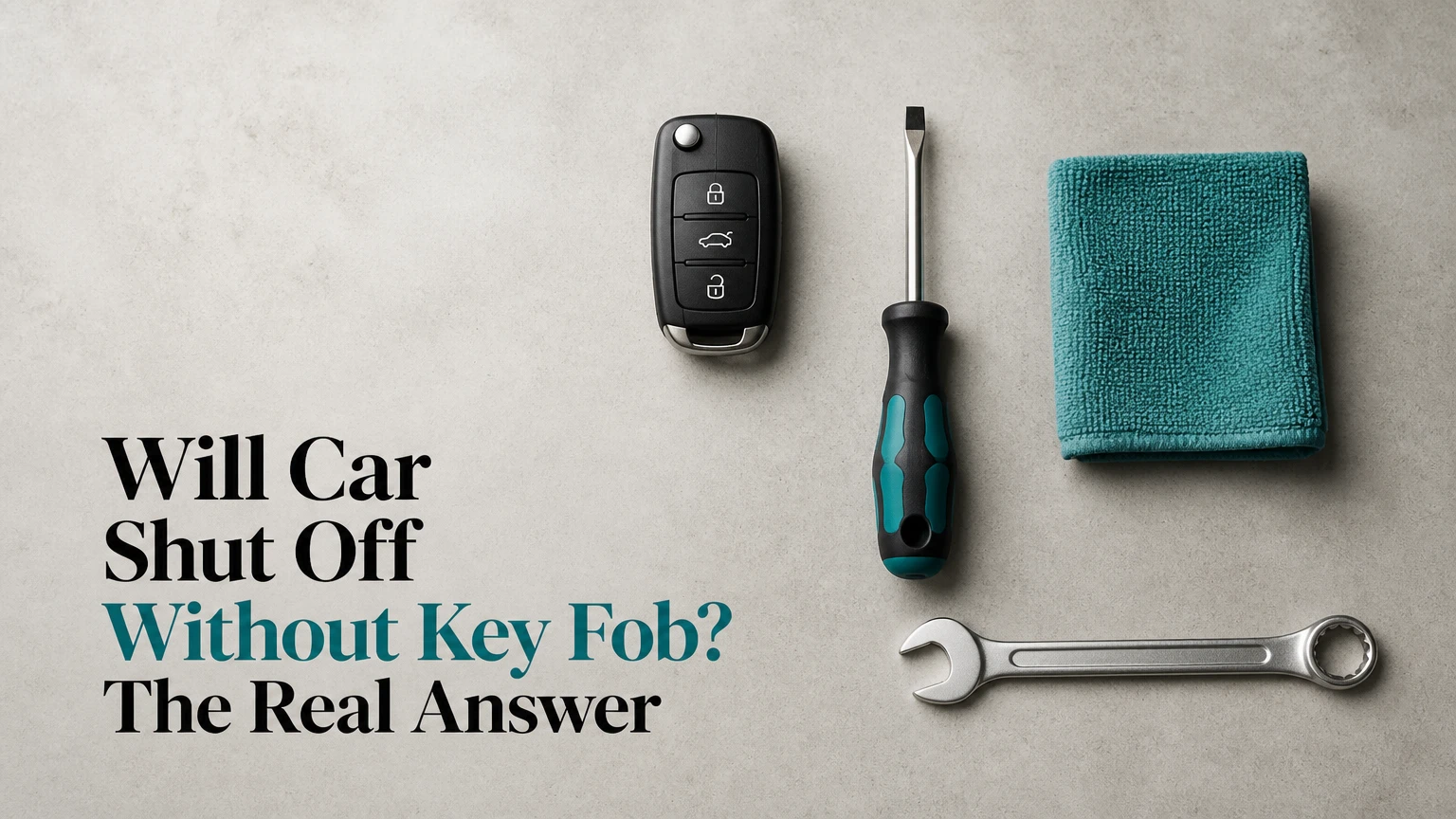
A car with a conventional push-button keyless ignition usually will not shut off immediately when its key fob leaves the vehicle. The engine normally continues running and the dashboard displays a “Key Not Detected” warning, but the car may refuse to restart after the driver switches it off. Remote-start systems and some vehicle-specific digital-key systems follow different rules.
Key Facts at a Glance
- A running vehicle usually does not stall when its authenticated key fob exits the cabin.
- The car normally warns the driver with a chime, message, or flashing key icon.
- A missing fob usually prevents the next start, rather than stopping the current drive.
- Remote-start operation can end when the driver presses the brake without a recognized key.
- A dead fob battery often still permits backup starting at a specified sensor or button.
- The owner’s manual controls the exact warning, restart, idle-shutdown, and backup-start behavior.
Will a Car Shut Off Without a Key Fob?
A normal factory keyless ignition system generally keeps a running car operating after the key fob leaves the cabin. The vehicle confirms the fob before startup, but it does not continuously require successful authentication to keep the engine running because an immediate shutdown could remove engine-driven or electrically assisted braking and steering support while the vehicle is moving.
The dashboard may show “Key Not Detected,” “No Key,” or “Key Fob Not Detected.” Warning timing is not standardized. Some vehicles alert as soon as a door closes, while others wait until the system performs another interior search.
The important distinction is between continuing to run and being able to restart. A driver may reach a destination without the fob, but switching the vehicle off can leave the driver unable to start it again. The vehicle might also prevent remote locking or passive locking because it cannot confirm that the authorized key is outside.
What does the keyless system verify?
A keyless ignition system verifies an authorized electronic credential before enabling ignition or propulsion. Depending on the vehicle, that credential can be an active radio key fob, a passive transponder, a smartphone digital key, a key card, or a manufacturer-specific backup device.
The vehicle uses antennas positioned inside the cabin, around the doors, and sometimes in the trunk or center console. Interior antennas help determine whether the credential is inside the passenger compartment rather than several feet away outside the car. The exact radio technology varies, including low-frequency sensing, radio-frequency communication, Bluetooth Low Energy, ultra-wideband, near-field communication, and passive transponder methods.
The system is not a permanent tether. After startup authorization, the powertrain control system generally allows operation until the driver selects Park and turns the vehicle off, a protective fault occurs, fuel or high-voltage energy is depleted, or an automatic idle timer intervenes.
How Does a Key Fob Leaveing the Cabin Affect Driving?
When a recognized fob leaves a running vehicle, the usual sequence is a warning, continued operation, and a potential restart lockout. The vehicle does not normally shut off simply because an interior antenna can no longer detect the fob.
A typical sequence looks like this:
- The vehicle starts after authenticating the fob.
- A passenger exits with the fob.
- An interior antenna fails to detect the credential.
- The instrument cluster displays a key warning.
- A chime may sound, sometimes repeatedly.
- The driver can usually continue operating the vehicle.
- The vehicle may not restart after manual shutdown.
The warning can appear after a few seconds, after a door closes, or after the vehicle changes operating state. A precise “5 to 10 second” universal delay is inaccurate because manufacturers calibrate warning logic differently.
Why does the car continue running?
The primary reason is motion safety. A sudden engine shutdown could change steering assistance, brake-assist behavior, electrical power, thermal management, or propulsion control while the vehicle is moving. Modern cars have safeguards and reserve systems, but manufacturers generally avoid using key proximity loss as an immediate immobilization trigger.
This safety design creates a practical trade-off. The same feature that prevents a dangerous stall can allow a driver to travel away from the fob and discover the problem only after parking.
The vehicle is not confirming that the current driver remains authorized at every moment. It is confirming authorization at defined stages, especially startup, gear selection, and certain restart conditions.
How Far Can You Drive Without the Fob?
A vehicle can often travel until the driver stops it, but there is no universal distance limit and no guarantee that it will continue indefinitely. Fuel level, high-voltage battery charge, mechanical faults, automatic shutdown programming, and vehicle software determine the practical limit.
For a gasoline vehicle, the distance depends on the remaining fuel and consumption. A car with 8 gallons remaining at 30 miles per gallon could theoretically travel about 240 miles, but traffic, climate control, terrain, and reserve strategy reduce that estimate. An electric vehicle may continue only until its traction battery reaches its low-energy protection threshold.
The phrase “unlimited distance” is therefore misleading. The missing fob usually does not impose a mileage limit, but the car still obeys ordinary energy and safety limits.
| Situation | Likely operating result | Main limitation |
|---|---|---|
| Fob leaves while driving | Vehicle usually continues running | Fuel, charge, or mechanical fault |
| Fob leaves before startup | Vehicle usually refuses startup | Credential must be detected |
| Driver selects Park and presses Stop | Vehicle shuts down normally | Restart may be unavailable |
| Vehicle idles unattended | Timer may stop powertrain | Manufacturer and market settings |
| Remote start is active | Vehicle may stop after brake input | Recognized fob or digital key required |
A driver who notices the warning should avoid unnecessary detours. The safest practical choice is to travel directly to the fob or a secure destination, then retrieve the key before switching the vehicle off.
Can You Restart the Car Without the Key Fob?
A standard keyless vehicle usually cannot be restarted after shutdown without an authorized credential, but a dead fob battery does not always mean the credential is unusable. Many fobs contain a passive transponder or backup communication method that can authorize starting at a specified location.
The backup location varies. Common instructions include holding the fob against the Start/Stop button, placing it in a marked cupholder, inserting it into a dedicated slot, or touching it to a steering-column receiver. The correct procedure is vehicle-specific, so the owner’s manual is more reliable than a generic internet instruction.
If the fob is physically absent, a phone app may unlock the vehicle but still may not authorize driving. Some digital-key systems can replace the fob, while other apps provide remote access only. A roadside technician or dealer may need to verify ownership and program a replacement.
What happens after an accidental shutdown?
An accidental shutdown normally leaves the vehicle in a no-start condition until the fob returns or a recognized backup method is used. Some vehicles may permit an immediate restart if the fob is nearby but shielded, although a guaranteed “10 to 30-second grace period” is not a general feature.
Take these steps:
- Move the fob close to the vehicle if another person can bring it.
- Check the manual for the emergency-start position.
- Try the documented backup procedure once, without repeatedly cycling controls.
- Use the manufacturer’s digital key only if the vehicle supports drive authorization.
- Call roadside assistance, a mobile automotive locksmith, or the dealer if authentication still fails.
Do not leave the vehicle running unattended while waiting for the fob. NHTSA’s consumer safety guidance states, “Never leave a running vehicle unattended,” because an unlocked, running vehicle can move unexpectedly or become a theft target.
Does a Dead Key Fob Battery Stop the Car?
A dead key-fob battery normally does not stop a running car, and many vehicles can still start through a passive backup transponder. The fob battery powers active locking and radio transmission, while the backup chip may work through close-range induction or a dedicated receiver.
Battery symptoms include reduced lock range, intermittent detection, “Key Battery Low,” and failure of passive door handles. Metal objects, a second fob, electromagnetic interference, and a phone placed directly beside the fob can also affect detection.
| Fob problem | Typical symptom | Practical response |
|---|---|---|
| Weak CR2032 or CR2025 cell | Shorter locking range | Replace the cell with the specified type |
| Fully depleted cell | “Key Not Detected” | Use the documented backup-start position |
| Shielding by metal case | Intermittent detection | Remove the case or separate metal objects |
| Damaged transmitter | No lock or start response | Test the spare fob and arrange programming |
| Lost fob | No authorized credential | Use roadside support or obtain a programmed replacement |
Many coin cells last roughly 2-4 years under typical use, but temperature, button frequency, passive-entry polling, and storage conditions change that range. Replace the battery with the same voltage and size specified by the manufacturer, and keep the spare fob separate from the primary one.
What If the Vehicle Uses Remote Start?
A remote-start vehicle can shut off when the driver enters without a recognized key fob because remote start is usually a temporary, restricted operating mode. The engine may run for approximately 10-15 minutes, and the system commonly requires a valid fob before the driver presses the brake or shifts out of Park.
Remote start is not equivalent to a normal ignition cycle. The vehicle starts through an app or remote command, but anti-theft logic keeps the powertrain in a limited state until an authorized credential is detected.
| Starting method | Fob leaves after startup | Brake-pedal behavior | Restart after shutdown |
|---|---|---|---|
| Normal push-button start | Usually keeps running | Normal operation | Usually requires fob |
| Factory remote start | Timed operation | May shut off without fob | Requires fob or digital key |
| Aftermarket remote start | Installer configuration varies | Often requires takeover sequence | Fob usually required |
| Smartphone digital key | Credential-specific | Depends on vehicle system | Phone, card, or fob may work |
| Conventional metal key | Mechanical switch remains active | No proximity check | Physical key required |
Remote-start rules also vary by state, local ordinance, and manufacturer. Never use remote start in an enclosed garage, even with the garage door open, because carbon monoxide can accumulate rapidly.
Does a Phone-as-a-Key System Behave Differently?
A phone-as-a-key system can behave differently because the authorized credential may depend on Bluetooth, ultra-wideband, NFC, an app wallet, or an offline digital token. A phone that loses power or is removed from the vehicle can produce the same restart risk as a missing fob, although some systems continue operating until shutdown.
Digital-key capability is not uniform across brands. Some systems let a paired phone unlock and start the vehicle without cellular service. Others depend on an app login, account status, cloud access, or a stored credential that must be provisioned in advance.
Carry the manufacturer’s physical backup card or secondary fob when traveling. A dead smartphone battery, damaged screen, account lockout, or software failure can remove both entry and start capability if no backup exists.
Why Does the Dashboard Say Key Not Detected?
The “Key Not Detected” message means the vehicle cannot currently authenticate the expected credential at the required antenna location. The message does not automatically mean the engine will stop, and it does not prove that the fob is far away.
Common causes include:
- The fob is in a passenger’s bag outside the cabin.
- The fob battery is weak or depleted.
- The fob is inside a metal container or signal-blocking pouch.
- Another electronic device is interfering with short-range detection.
- The vehicle’s 12-volt battery is weak.
- An interior antenna, receiver, or body-control module has a fault.
- The wrong digital-key profile is active.
Check the physical location first. If the fob is present, remove it from a deep console, luggage compartment, or metal-lined bag and hold it at the backup-start location listed in the manual.
A warning that appears with the fob inside deserves diagnosis, especially if the spare key works normally. Repeated alerts can indicate a failing coin cell, antenna fault, low vehicle voltage, or an unregistered replacement fob.
Can You Lock the Car After the Fob Leaves?
A vehicle may allow manual locking after the fob leaves, but passive locking and remote locking can behave differently. The car may refuse to lock itself because it cannot confirm the authorized key’s location, or it may warn that the key is not present.
Do not assume the doors locked because the mirrors folded or the lights flashed. Verify the lock by touching the handle, checking the instrument display, or using the physical key blade where appropriate.
Some vehicles prevent locking when a recognized fob is detected inside. Others can lock the fob in the trunk under particular conditions, especially if the credential is shielded or the trunk sensor cannot read it. Keep the fob on your person when loading luggage, rather than placing it inside the cargo area.
What Should You Do If a Passenger Takes the Fob?
If a passenger leaves with the fob while the car is running, continue only far enough to reach a safe location or the passenger’s destination, then retrieve the fob before switching the vehicle off. If the passenger is nearby, ask them to return the key before you drive farther.
For a drop-off scenario, the driver may reach work or home without noticing the problem, but the vehicle can become immobile after parking. If the fob is hundreds of miles away, roadside assistance cannot usually restart the vehicle without an authorized credential or compatible programming equipment.
Use this response sequence:
- Read the dashboard message instead of dismissing the chime.
- Confirm whether the passenger has the fob.
- Avoid turning the vehicle off until the fob is available.
- Drive directly to a safe retrieval point.
- Confirm the warning clears before relying on normal locking and starting.
This is a convenience failure, not a reason to drive while distracted. Pull over legally before searching bags, calling the passenger, or consulting the manual.
How Do Normal Keys Compare With Keyless Ignition?
A traditional metal key prevents the vehicle from starting unless the physical key is present, while a keyless system can allow the vehicle to travel after the electronic credential has left. Keyless ignition improves convenience but increases the chance of an unnoticed restart lockout.
| Feature | Keyless ignition | Traditional key |
|---|---|---|
| Startup requirement | Detected electronic credential | Inserted mechanical key |
| Continued operation after removal | Usually continues | Key remains in ignition |
| Typical fob or key replacement | $150-$600 or more | $10-$50 for basic duplication |
| Programming time | About 30-60 minutes typical | Minutes for simple cutting |
| Main lockout risk | Vehicle stops and cannot restart | Key can be lost or broken |
| Common security concern | Relay attack and signal theft | Physical lock picking or forced entry |
Replacement prices depend on brand, whether all keys are lost, immobilizer programming, emergency blade cutting, and local labor. Luxury vehicles and newer systems can exceed $600, while a basic aftermarket-compatible key may cost less if a working key remains.
Keyless ignition is not inherently unsafe, but owners must treat the fob like a required operating credential even when the engine is already running.
Which Vehicle Systems Shut Off Automatically?
Automatic shutdown behavior depends on the powertrain, software, remote-start mode, and market configuration. A normal missing-fob warning is different from an idle timer, an anti-theft response, an automatic stop-start event, and a low-energy shutdown.
| System or condition | Typical trigger | Does missing fob alone stop it? |
|---|---|---|
| Normal gasoline ignition | Driver presses Stop | Usually no |
| Idle-shutdown timer | Extended stationary idling | Usually no while moving |
| Remote start | Brake input without authorization | Often yes |
| Hybrid system | Stop-start or battery management | No, not merely from fob loss |
| Battery electric vehicle | Low traction-battery state | No, energy protection controls it |
| Security or immobilizer fault | Detected system failure | May enter fail-safe mode |
Ford, BMW, Toyota, Honda, General Motors, Nissan, Hyundai, Kia, Tesla, and Rivian do not use identical rules across all models or years. Even two vehicles from the same manufacturer can differ because of trim level, region, powertrain, and software version.
An idle-shutdown timer also does not make unattended operation safe. Automatic shutoff can fail to prevent carbon-monoxide exposure if the vehicle is in a garage, near an open building, or operating in a poorly ventilated area.
How Much Does a Replacement Fob Cost?
A replacement key fob typically costs about $150-$600 or more in North America when the part, cutting, programming, and labor are included. A dealer may charge more than a mobile locksmith, but compatibility, security authorization, and all-keys-lost circumstances determine the final price.
| Replacement situation | Typical parts cost | Typical total time |
|---|---|---|
| Basic remote shell or battery | $5-$40 | 5-20 minutes |
| Compatible aftermarket fob | $40-$180 | 20-60 minutes |
| OEM mainstream-brand fob | $100-$300 | 30-90 minutes |
| Luxury OEM smart key | $250-$600+ | 45-120 minutes |
| All keys lost, immobilizer reset | $200-$800+ | 1-3 hours |
Prices are typical working ranges, not guaranteed quotes. A locksmith may require the vehicle identification number, registration, photo identification, and proof of ownership. Some systems require online manufacturer authorization that only a dealer or approved locksmith can obtain.
Do not buy a fob solely because its shell or button layout looks identical. Frequency, immobilizer generation, FCC or regional compatibility, and programming capability must match the vehicle.
What Are the Most Common Keyless-Ignition Mistakes?
The most common mistake is assuming that a running engine proves the fob is inside the vehicle. The engine proves only that an authorized credential was detected earlier, not that the credential remains available for the next start.
Other recurring errors include:
- Leaving the fob in a passenger’s jacket during a drop-off.
- Putting the fob inside a trunk, metal case, or signal-blocking pouch.
- Ignoring a chime because it sounds like a seatbelt alert.
- Turning the vehicle off before checking the warning.
- Assuming a phone app can authorize driving when it only unlocks doors.
- Keeping the primary and spare fobs together.
- Leaving a running vehicle unattended because the missing fob seems protective.
A useful practitioner rule is to check the key warning before shifting into Drive after every passenger change. That habit catches the drop-off problem before the vehicle reaches a destination where restart failure becomes expensive.
What Is the Safest Response While Driving?
The safest response is to avoid an unnecessary stop, reduce distractions, and travel directly to a safe retrieval point or destination where the fob can be recovered. Do not attempt to test the system by switching the vehicle off on a shoulder or in traffic.
If the vehicle begins losing power, steering assistance, braking assistance, or propulsion, treat that as a mechanical or electrical emergency rather than a normal key warning. Move to a safe location, activate hazard lights when appropriate, and contact roadside assistance.
Do not rely on the missing-fob condition as an anti-theft feature. A running vehicle can still be stolen if someone enters, shifts the transmission, or otherwise operates the vehicle before the system demands a new authentication event. Lock the vehicle whenever it is unattended, and follow NHTSA guidance against leaving it running.
The Bottom Line
Will car shut off without key fob? Usually no, if the vehicle was started normally and is already running. The car normally warns that the fob is missing, continues driving, and then refuses to restart after the driver turns it off.
The exceptions matter. Remote-start sessions, automatic idle shutdown, digital-key systems, security faults, and model-specific software can change the result. If the warning appears, retrieve the fob before stopping whenever possible, use the documented backup-start method for a dead battery, and consult the owner’s manual for the exact make, model, and year.
Frequently Asked Questions
Can I drive my car if the key fob battery is dead?
Yes, a car usually continues driving if the key fob battery dies while the vehicle is already running. Starting may require holding the fob against the Start/Stop button, placing it in a backup slot, or touching it to a marked sensor. The correct emergency-start position differs by vehicle.
Will a keyless car lock itself without the fob?
A keyless car may not passive-lock or remote-lock when the fob is absent, although some vehicles allow manual locking. Verify the doors physically rather than relying on mirror folding or light flashes. The owner’s manual specifies whether the physical key blade can secure the driver’s door.
Can a car be stolen while the key fob is far away?
A running car can potentially be stolen while the fob is far away because the vehicle may not request authentication again until shutdown or another protected event. Keyless systems also face relay attacks when the fob is nearby. Store fobs away from exterior doors and use the manufacturer’s security settings.
Does push-button start work without a battery?
Push-button start can work with a depleted fob battery if the vehicle has a passive backup transponder and the driver uses the specified close-range procedure. A completely missing, damaged, or unprogrammed fob cannot normally be replaced by pressing the button alone.
How long will a car run after remote start?
A factory remote-start session commonly runs for about 10-15 minutes, though the exact timer varies by manufacturer and configuration. The vehicle may shut off when the driver presses the brake without a recognized key. Remote start should never be used inside an enclosed garage.
What should I do if I shut the car off without the fob?
Check whether the fob is nearby, then use the manual’s emergency-start procedure if the battery may be dead. If the fob is physically unavailable and no authorized phone or card key works, contact roadside assistance, a mobile automotive locksmith, or the dealer instead of repeatedly attempting ignition cycles.