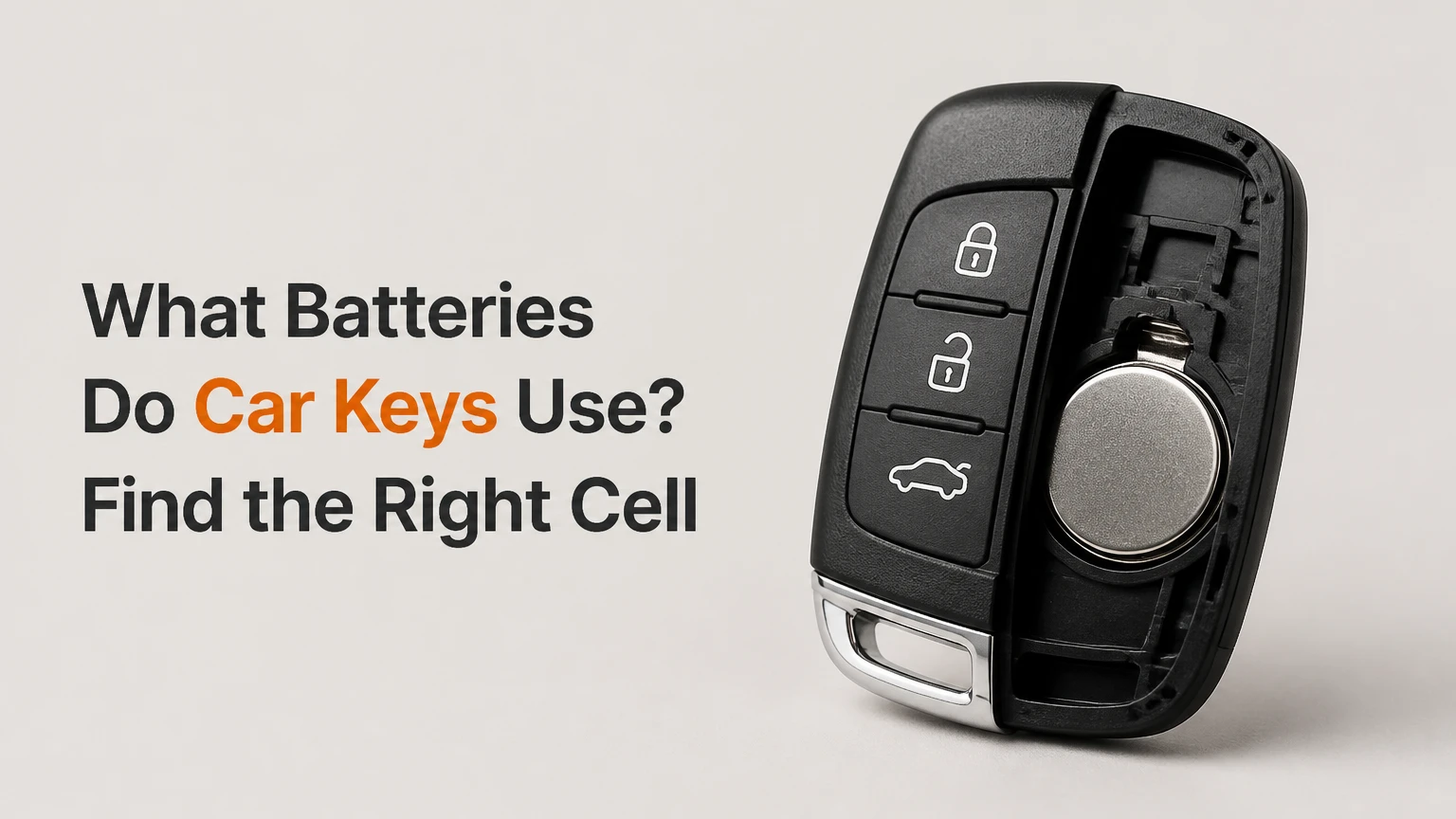
Car keys and remote key fobs usually use a 3-volt lithium coin-cell battery, most often a CR2032, CR2025, CR2016, CR1632, or CR2450. The correct battery is determined by the code printed on the old cell, the vehicle or key manual, and the holder’s physical dimensions. A matching voltage alone is not enough.
What Batteries Do Car Keys Use?
The most common factory key-fob battery is the CR2032, a 20-millimeter-wide, approximately 3.2-millimeter-thick lithium coin cell. CR2025 and CR2016 cells share the same 20-millimeter diameter but are thinner, while CR2450 cells are wider and thicker. A key fob can require a different code even when two batteries look similar.
A battery marked CR uses lithium manganese dioxide chemistry under the IEC naming system. The “R” identifies a round cell, while the first two digits generally indicate diameter in millimeters and the final two digits indicate nominal thickness in tenths of a millimeter. The code is a size identifier, not a guarantee that every brand has identical capacity or discharge performance.
Key Facts at a Glance
- Most factory car remotes use a 3-volt lithium coin cell.
- CR2032 is common, but the vehicle model and fob version determine the correct battery.
- CR2025 is 0.7 millimeters thinner than CR2032 and may lose contact in a CR2032 holder.
- CR2450 measures about 24 millimeters across and does not fit a standard CR2032 compartment.
- A key-fob coin cell typically lasts 2-4 years, with passive-entry keys often using power faster.
- Battery replacement usually costs $2-$6 for the cell and approximately $15-$30 through a dealer or locksmith.
How Does the CR Battery Code Work?
A CR battery code communicates the cell’s approximate diameter and thickness, while the CR prefix identifies a round lithium manganese dioxide cell. For example, CR2032 means approximately 20 millimeters in diameter and 3.2 millimeters thick. The code does not indicate capacity, brand, temperature performance, or whether the battery has welded tabs.
The code is useful for identification, but the vehicle manual remains the final authority. Some manufacturers use a battery with a special tabbed or soldered connection, and some flip keys contain two cells or a rechargeable battery pack. A visually similar replacement can damage the holder if its height or terminal arrangement differs.
The “CR means chromium lithium” explanation is inaccurate. Chromium is not the chemistry represented by the CR prefix in the ordinary coin-cell naming convention. Panasonic, Energizer, and other manufacturers describe these cells as lithium manganese dioxide batteries.
What Do the Main Battery Codes Mean?
| Battery code | Nominal diameter | Nominal thickness | Typical nominal voltage | Common key use |
|---|---|---|---|---|
| CR1616 | 16 mm | 1.6 mm | 3 V | Slim older remotes and compact Japanese fobs |
| CR1620 | 16 mm | 2.0 mm | 3 V | Compact Toyota, Lexus, and European-style remotes |
| CR1632 | 16 mm | 3.2 mm | 3 V | Selected Toyota and smart-key designs |
| CR2016 | 20 mm | 1.6 mm | 3 V | Thin key cards and low-profile remotes |
| CR2025 | 20 mm | 2.5 mm | 3 V | Mazda, Volkswagen, and many thin fobs |
| CR2032 | 20 mm | 3.2 mm | 3 V | Common Toyota, Honda, Ford, BMW, and Nissan fobs |
| CR2450 | 24 mm | 5.0 mm nominal | 3 V | Larger proximity and smart-key housings |
The dimensions are nominal. A manufacturer’s data sheet may list slightly different actual thickness, terminal construction, and usable capacity. A CR2450 may be described as about 4.9-5.0 millimeters thick depending on the brand and measurement method.
Which Battery Fits Your Car Key?
The battery that fits your car key is the exact code specified on the old cell or in the owner’s manual. Brand alone cannot identify the battery because the same vehicle manufacturer may use CR2032 in one key revision, CR2025 in another, and CR2450 in a proximity key.
Check the old battery before buying. Open the case only as far as necessary, photograph the orientation, and read the engraving under good light. If the code is unreadable, use the vehicle manual, the key-part number, or a parts catalog that matches the exact model year and remote design.
| Key or vehicle situation | Common battery examples | Identification caution | Best verification source |
|---|---|---|---|
| Standard flip key with lock buttons | CR2032, CR2025 | Two 20 mm cells can look interchangeable | Old battery and owner’s manual |
| Slim key card | CR2016, CR2025 | Low clearance can prevent case closure | Key-card label or manual |
| Push-button smart key | CR2032, CR2450, CR1632 | Passive functions may increase battery use | Vehicle manual and fob housing |
| Compact older Japanese remote | CR1616, CR1620, CR1632 | Diameter may be only 16 mm | Printed cell code |
| Aftermarket alarm remote | A23, A27, CR2032 | Alarm installer may use a different design | Remote compartment and alarm documentation |
Do Toyota, Honda, Ford, BMW, and Nissan Use CR2032?
Toyota, Honda, Ford, BMW, and Nissan frequently use CR2032 batteries, but no brand-wide rule applies to every vehicle. Model year, trim, market, replacement-key supplier, and smart-key generation can change the required cell.
Examples help narrow the search but do not replace verification. A Honda remote may use CR2032, while a Honda key-card or another generation may use a different cell. BMW proximity remotes can use CR2032 or a larger cell depending on housing design. The engraved code is more reliable than a generic brand chart.
CR2032 vs. CR2025 vs. CR2450: What Is the Difference?
CR2032 is the safest default only when the fob specifies CR2032. CR2025 has the same 20-millimeter diameter but is 0.7 millimeters thinner, and CR2450 is approximately 4 millimeters wider and 1.8 millimeters thicker than CR2032. Physical fit, terminal pressure, and case clearance matter more than a similar voltage label.
Capacity figures vary by manufacturer, test current, temperature, and cutoff voltage. The figures below are typical ranges, not guaranteed runtime values.
| Battery | Typical capacity range | Diameter | Thickness | Practical consequence |
|---|---|---|---|---|
| CR2016 | 80-100 mAh | 20 mm | 1.6 mm | Lowest profile, shorter reserve |
| CR2025 | 150-170 mAh | 20 mm | 2.5 mm | Fits only holders designed for thinner cells |
| CR2032 | 210-240 mAh | 20 mm | 3.2 mm | Common capacity and broad availability |
| CR2450 | 500-620 mAh | 24 mm | 5.0 mm | Larger reserve, incompatible with smaller holders |
A thinner cell in a thicker-cell holder can produce intermittent operation because the spring contact does not press firmly against the terminal. A thicker cell can crack the plastic case, deform the contact, or prevent the housing from closing. Do not stack two CR2025 cells to imitate a CR2032; the combined voltage becomes approximately 6 volts and can damage the remote.
Can You Replace a CR2032 With a CR2025?
A CR2025 can replace a CR2032 only when the key manufacturer explicitly permits it and the holder maintains reliable contact. The two cells share a 20-millimeter diameter and 3-volt nominal voltage, but their thickness and capacity differ enough to make substitution unsafe as a general rule.
The most common failure is a remote that works on a desk but stops responding when carried in a pocket. The thinner CR2025 moves inside a CR2032 slot, briefly opening the circuit when the fob is flexed or shaken. If the original code is CR2032, install CR2032.
Are A23 and A27 Batteries Used in Car Keys?
A23 and A27 batteries are 12-volt alkaline cylindrical batteries found mainly in older aftermarket alarm remotes, garage-door transmitters, and some accessory systems. They are not normal substitutes for a 3-volt CR2032 coin cell, even though both types are small and may appear in remote controls.
An A23 is often approximately 10-12 millimeters in diameter and around 28 millimeters long, while an A27 is shorter and slimmer. Their dimensions and voltage are incompatible with most factory key fobs. Use an A23 or A27 only when the remote’s compartment or documentation specifically names that battery.
Rechargeable LIR2032 cells also require caution. LIR cells typically have a higher nominal voltage than CR2032 cells, so installing one in a circuit designed for a 3-volt CR cell can overstress the electronics. A rechargeable replacement is appropriate only when the key was designed for it.
How Long Does a Car Key Battery Last?
A car key battery typically lasts 2-4 years in ordinary use, although passive-entry smart keys, frequent button presses, heat, cold, and poor-quality stock can shorten that range. A remote that remains near the vehicle for long periods may transmit or wake more often than a key stored farther away.
The battery does not usually fail because the car is running. The fob’s radio transmitter, receiver, indicator LED, and proximity circuitry draw energy from the coin cell when buttons are pressed or when the vehicle interrogates the key. Passive-entry systems can consume more power than a basic lock-and-unlock remote.
Energizer’s CR2032 technical data lists a long shelf life under specified storage conditions, but shelf life is not the same as installed service life. A ten-year package date does not guarantee ten years inside a working smart key.
What Shortens Fob Battery Life?
- Repeated lock-button presses during delivery, valet use, or fleet operation.
- Passive-entry keys stored beside the vehicle overnight.
- Temperatures below freezing, which reduce available voltage temporarily.
- High cabin temperatures, which accelerate chemical aging.
- A stuck button or damaged case that keeps the transmitter active.
- Counterfeit, expired, or poorly stored cells with reduced capacity.
A useful practitioner check is to compare both keys. If one key lasts weeks and the spare lasts years, inspect the failing key for a stuck button, moisture, contamination, or a damaged circuit board before blaming the vehicle.
How Much Does a Key Fob Battery Cost?
A single name-brand coin cell typically costs $2-$6 at a supermarket, automotive store, electronics retailer, or online seller. A dealership or locksmith may charge approximately $15-$30 for battery supply and replacement, with higher prices when the service includes diagnosis, programming, or a sealed housing.
| Purchase option | Typical cell or service price | Typical time | Best use |
|---|---|---|---|
| Single CR2032 from a local store | $2-$6 | 5 minutes | Immediate replacement |
| Multipack of four to eight cells | $6-$20 | 5 minutes | Two-car household or spare keys |
| Locksmith battery service | $10-$25 | 5-15 minutes | Damaged case or uncertain fit |
| Dealer battery service | $15-$30 | 10-30 minutes | Manual verification and inspection |
| New sealed smart-key housing | $50-$200 before programming | 30-120 minutes | Broken or non-serviceable fob |
Prices vary by country, brand, and whether the key must be opened with specialist tools. Keep replacement cells in their original packaging at room temperature, away from metal objects that could short the terminals.
How Do You Replace a Car Key Battery?
Replacing a car key battery usually takes 3-5 minutes and requires a correctly sized coin cell plus a plastic pry tool or small flat screwdriver. The factor that determines success is preserving the contact springs and installing the new battery in the same polarity orientation as the old one.
Before You Start
| Requirement | Typical specification |
|---|---|
| Replacement cell | Exact code, such as CR2032 or CR2025 |
| Tools | Plastic pry tool, small flat screwdriver, clean cloth |
| Time | 3-5 minutes |
| Difficulty | Easy for serviceable snap-fit housings |
| Cost | $2-$6 for a single battery |
| Safety condition | Keep the coin cell away from children and pets |
Step 1: Remove the Emergency Key
Release the mechanical emergency key if the fob has one. Slide or hold the release latch, then pull the metal key from the housing.
The emergency key often exposes the case seam or a small access slot. Do not force the metal key sideways, because the retaining latch can break.
Success checkpoint: The emergency key comes out without bending, and the case seam is visible.
Common mistake: Using the key blade as a pry bar and scraping the housing.
Step 2: Open the Fob Housing
Insert a plastic pry tool or a thin flat screwdriver into the marked notch or seam. Twist gently at several points rather than forcing one corner, because internal clips and circuit-board supports can be close to the opening.
Place a cloth beneath the fob if the surface is painted or glossy. Stop if the case flexes heavily or the board begins to lift.
Success checkpoint: The housing separates evenly without cracked clips.
Common mistake: Inserting the tool too deeply and touching the circuit board.
Step 3: Record the Battery Orientation
Photograph the old battery before removal and identify the positive and negative faces. The face printed with the battery code is usually positive, but the fob’s molded markings remain the authority.
Most key fobs place the positive side upward or toward the back cover, although some designs reverse that position. Never rely on a generic “writing side up” rule.
Success checkpoint: You can identify the old code and the direction of the plus sign.
Common mistake: Removing the old battery before recording polarity.
Step 4: Install the Matching Cell
Lift the retaining edge gently, remove the old coin cell, and place the new battery under the fixed lip before pressing it beneath the spring contact. Avoid touching both faces with a metal tool at the same time.
A clear shipping film, bitter coating, or plastic sticker must be removed if present. The film insulates the terminal and can make a brand-new battery appear dead.
Success checkpoint: The cell sits flat, the code matches the required specification, and the contact spring touches firmly.
Common mistake: Bending the spring so it no longer presses against the battery.
Step 5: Close and Test the Remote
Snap the housing together until the seam is even and the emergency key returns securely. Test lock and unlock beside the vehicle, then test the trunk, panic button, passive unlock, and push-button starting functions if equipped.
Some cars permit emergency starting even when the fob battery is weak. The exact backup location varies, so the owner’s manual may instruct you to hold the fob against the start button or place it in a marked console slot.
Success checkpoint: Buttons respond consistently and the case has no gaps.
Common mistake: Testing only one button and missing a damaged trunk or panic switch.
Why Does a Key Fob Still Not Work After Battery Replacement?
A key fob that remains dead after a new battery usually has incorrect polarity, poor terminal contact, an unremoved insulating film, a damaged switch, or a synchronization problem. Battery replacement alone cannot repair a broken circuit board or a vehicle receiver fault.
Use this sequence before buying another battery:
- Confirm the code against the manual and old cell.
- Confirm the positive face matches the original orientation.
- Remove any transparent protective film.
- Check that the battery lies flat and the springs touch clean metal.
- Try the spare key to separate fob faults from vehicle faults.
- Test the new cell with a multimeter if available, recognizing that open-circuit voltage does not prove full capacity.
- Follow the vehicle-specific resynchronization procedure.
- Seek locksmith or dealer diagnosis if the key has water damage, a cracked board, or no response from multiple known-good cells.
Does a New Battery Require Key Reprogramming?
A new battery does not normally require reprogramming, but some older vehicles can lose remote synchronization during battery removal or after a very weak cell. Pairing procedures differ by make, model, year, and market, so a generic ignition-and-button sequence should not be treated as universal.
Remote synchronization is different from immobilizer programming. A car may accept the transponder for engine authorization while the lock buttons remain unpaired. The owner’s manual may provide a procedure; otherwise, a locksmith with vehicle-specific diagnostic equipment can determine whether pairing, receiver diagnosis, or a new key is required.
What Battery Problems Occur in Cold Weather?
Cold weather can make a healthy lithium coin cell appear weak because internal resistance rises and the available voltage falls under radio-transmitter load. The battery may recover when warmed, but repeated cold-weather failure usually indicates an aging cell rather than a permanently dead remote.
Keep the key inside a coat pocket rather than an exposed vehicle cup holder. Do not heat a coin cell with a flame, microwave, hair dryer, or direct heater. If the remote works indoors but fails outside, replace the cell first and inspect the contacts if the symptom continues.
When Should You Use a Locksmith or Dealer?
Use a locksmith or dealer when the fob is sealed, the battery is soldered or tabbed, the case has broken, the immobilizer has stopped authorizing the engine, or a correct battery does not restore operation. Professional service is also sensible when one working key is your only remaining backup.
A battery service is different from a replacement key. Ask whether the quoted price includes the cell, case opening, programming, emergency blade cutting, and diagnosis. A $20 battery visit and a $200 programmed smart key are separate jobs.
How Should You Dispose of a Key-Fob Battery?
Recycle or dispose of lithium coin cells through a local battery collection program rather than placing loose cells in household waste. Tape both sides or place each cell in its original packaging to prevent contact with metal objects during storage and transport.
The U.S. Consumer Product Safety Commission warns that button-cell batteries can cause severe internal injury if swallowed. Keep removed and unused cells locked away from children and pets, and seek emergency medical guidance immediately after a suspected ingestion.
Frequently Asked Questions
Can I Use Any Brand of CR2032 in My Car Key?
You can generally use a reputable CR2032 brand when the fob specifies CR2032 and the cell has no damaged packaging, corrosion, or visible leakage. Panasonic, Energizer, Duracell, and other established manufacturers publish electrical specifications. Brand does not correct an incorrect size, reversed polarity, bent contact, or faulty remote circuit.
Why Does My Car Say Key Battery Low After Replacement?
A low-battery warning after replacement usually means the new cell is depleted, installed incorrectly, poorly contacting the terminal, or not the specified code. Some vehicle systems retain the warning until the key is used or the ignition completes a drive cycle. Test the spare key and inspect the contact springs before pursuing programming.
Can I Test a Coin Cell With a Multimeter?
A multimeter can measure open-circuit voltage, but voltage alone cannot confirm the battery’s remaining capacity under transmitter load. A fresh 3-volt lithium cell should read near its rated voltage without load, while a cell that collapses sharply under a suitable load is suspect. Avoid shorting the battery with meter probes.
How Can I Open a Key Fob Without a Screwdriver?
Use a plastic opening pick, guitar pick, or a coin only when the housing has a designed slot. A plastic tool reduces scratches and accidental contact with the circuit board. If the case is sealed, glued, or lacks a seam, forcing it open can destroy a housing that requires professional replacement.
Does the Car Start When the Key Fob Battery Is Dead?
Many vehicles can start with a dead key-fob battery because the immobilizer transponder or backup reader uses a short-range emergency method. The placement varies: common locations include against the start button, inside a console pocket, or beside a designated receiver. Consult the manual for the exact procedure.
How Often Should I Keep a Spare Fob Battery?
Keep one sealed replacement cell for each active key, especially when a vehicle has only one working remote. Replace stored cells according to their packaging date and condition, and avoid carrying loose batteries in a toolbox with coins or metal tools. A spare battery does not replace the need for a spare programmed key.
The Bottom Line
Car keys usually use 3-volt lithium coin cells, with CR2032 the most common size, followed by CR2025, CR2016, CR1632, CR1620, CR1616, and CR2450 in specific designs. The answer to “what batteries do car keys use” is the exact code printed on the old cell or listed in the vehicle manual, not the vehicle brand alone. Match the code, preserve polarity, protect the contacts, and use professional diagnosis when a correct replacement does not restore reliable operation.