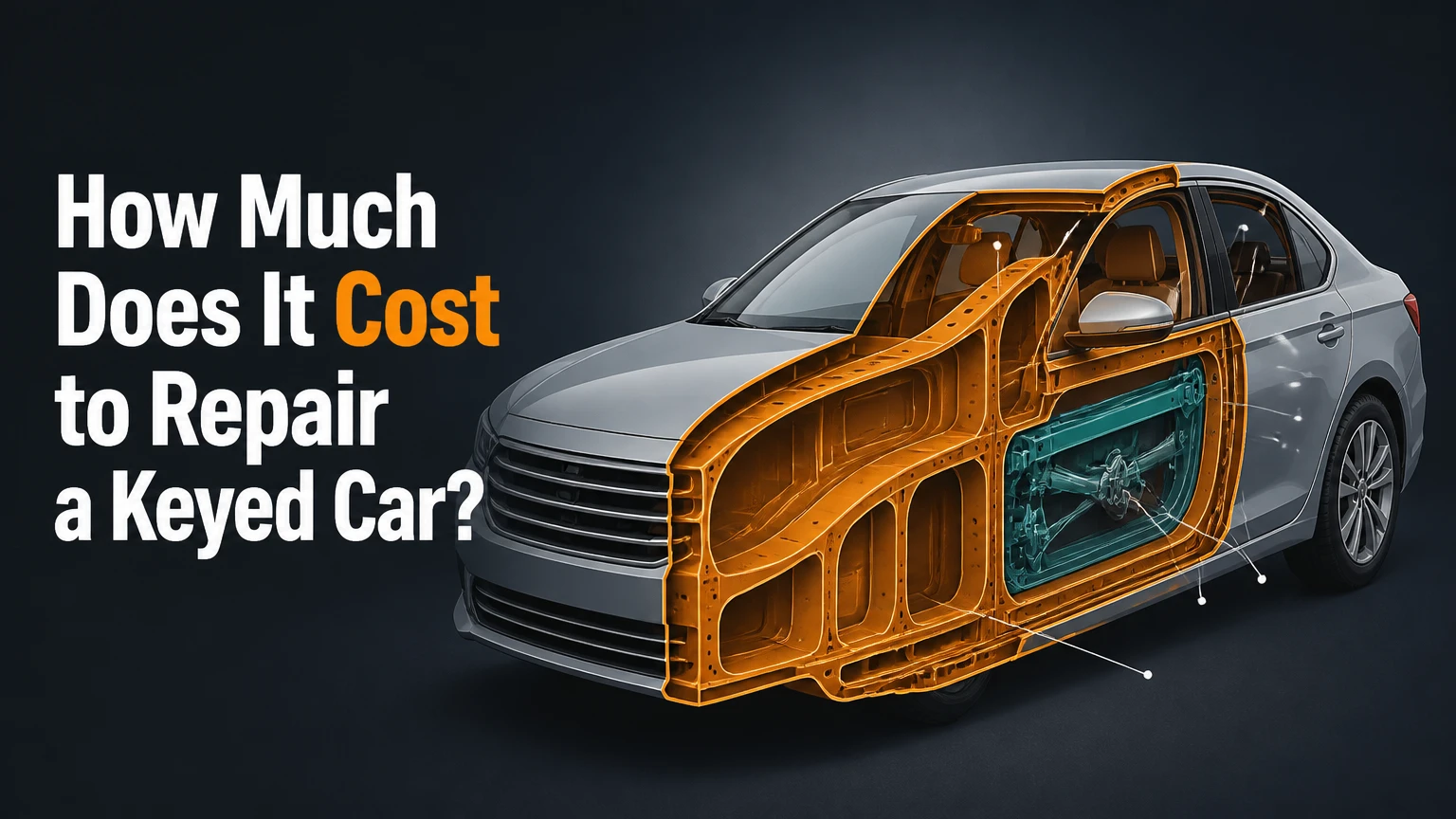
Repairing a keyed car typically costs $150-$4,000 or more in the United States. A shallow clear-coat mark may cost $150-$400, while a scratch through the paint and primer can cost $800-$1,500 per panel; multiple vandalized panels, specialty finishes, and luxury vehicles push the total above $4,000.
Key facts
A professional keyed-car repair costs approximately $150-$400 for clear-coat damage and $300-$1,500 per panel for deeper damage.
A scratch that exposes primer or bare metal requires sealing and refinishing, not simple polishing.
Multiple panels commonly produce a $2,000-$4,000+ estimate because each panel requires preparation, paint, clear coat, and blending.
Comprehensive auto insurance generally covers intentional keying, subject to the policy deductible and exclusions.
A mobile SMART repair is usually suitable for localized damage, while a traditional body shop is needed for deep, long, or multi-panel scratches.
Bare steel can begin corroding quickly in wet or salty conditions, so exposed metal should be protected promptly.
What Counts as a Keyed-Car Scratch?
A keyed-car scratch is intentional paint vandalism made with a key, blade, or similarly sharp object. The mark often runs horizontally along a door or continues across the fender, doors, and rear quarter panel, which makes the number of affected panels more important than the scratch’s apparent length.
Keying differs from a shopping-cart mark or paint transfer. A transferred object may leave another vehicle’s material on top of the clear coat, while a key typically removes material from the vehicle’s finish. A professional can often remove paint transfer with solvent, clay treatment, and polishing for less than a repaint.
The four relevant layers are:
- Clear coat: transparent protection and gloss.
- Base coat: the vehicle’s colored paint.
- Primer: adhesion and corrosion protection beneath the color.
- Metal, aluminum, or composite substrate: the panel material.
A scratch can cross several layers in one stroke because pressure changes along the line. The deepest section determines the repair method.
How Deep Is the Damage?
Scratch depth determines whether a technician can polish the panel or must rebuild and repaint it. The fingernail test is a useful screening method: a nail that glides over the mark suggests clear-coat damage, while a nail that catches suggests penetration into the color, primer, or substrate.
The test is not a measurement of depth. A sharp shallow groove can catch a nail, and a broad scratch can appear smooth while still removing paint. Inspect the mark after washing it with automotive shampoo, because dirt and residue can make a superficial scuff look worse.
Use these additional clues:
- Gloss remains intact and no contrasting line appears: likely clear-coat damage.
- The vehicle’s color is missing: base-coat damage is likely.
- A white, gray, or beige line appears: primer may be exposed.
- A silver or dark metallic line appears on a steel panel: bare metal may be visible.
- Orange-brown discoloration appears: corrosion has begun.
- The panel edge is bent or the scratch crosses a body gap: additional bodywork or blending may be required.
Do not aggressively polish a deep scratch to test it. Removing surrounding clear coat cannot restore missing paint and may enlarge the refinishing area.
Typical repair prices by severity
| Damage level | Visual indicator | Professional price | Typical time |
|---|---|---|---|
| Clear coat only | Nail does not catch, gloss remains | $150-$400 | 2-4 hours |
| Base coat damaged | Color is missing, primer not visible | $300-$800 per panel | 1-2 days |
| Primer exposed | White, gray, or beige groove | $600-$1,200 per panel | 2-4 days |
| Bare metal exposed | Silver metal or early rust line | $800-$1,500 per panel | 3-5 days |
| Several panels keyed | Continuous damage across side | $2,000-$4,000+ | 5-10 days |
These are typical U.S. consumer ranges, not guaranteed quotes. Labor rates, paint systems, local taxes, shop backlog, and the vehicle’s construction can move the estimate substantially.
How Much Does It Cost to Repair a Keyed Car by Panel?
A single door usually costs $300-$1,200 to refinish, while a long vandalism line across several panels can cost $2,000-$4,000 or more. Panel shape, adjacent paint blending, trim removal, and the need to repair dents determine whether the estimate falls near the low or high end.
| Vehicle area | Clear-coat or SMART repair | Deep professional refinish | Common added complication |
|---|---|---|---|
| Front fender | $150-$450 | $500-$1,000 | Headlamp, bumper, or wheel-arch masking |
| Front or rear door | $200-$500 | $600-$1,200 | Handle, mirror, belt molding, interior edge |
| Rear quarter panel | $300-$700 | $800-$1,500 | Fixed body panel and adjacent-panel blending |
| Plastic bumper cover | $200-$600 | $500-$1,100 | Flexible substrate and sensor removal |
| Hood or liftgate | $250-$700 | $700-$1,400 | Large flat area exposes color mismatch |
| Two to four side panels | $800-$1,600 | $2,000-$4,000+ | Continuous scratch and multiple blends |
A quote priced “per scratch” can be misleading. Body shops usually estimate labor and materials by panel, and a single line that crosses a door seam may require work on both panels. The technician may also blend color into an adjacent panel even when the scratch does not reach it, because factory paint can vary with age, sun exposure, and repair history.
What Does a Professional Repair Include?
A professional repair restores the damaged layers and recreates the surrounding finish. The technician does not normally spray a narrow strip of clear coat over the line, because that creates a visible ridge, inconsistent gloss, and an unstable edge.
The standard sequence is:
- Clean and degrease the panel. Wax, silicone, road film, and contamination are removed before inspection.
- Measure and mark the repair area. The technician determines whether the line needs localized SMART repair or full-panel refinishing.
- Sand and feather the edges. Abrasive work removes loose paint and creates a gradual transition around the groove.
- Fill or prime the damage. Body filler may level a gouge, while epoxy or high-build primer seals exposed substrate.
- Mix paint using the factory code. The code is commonly found on a door-jamb, trunk, hood, or glove-box label, although the code alone may not account for aged paint.
- Spray the base coat. Multiple controlled coats restore color and coverage.
- Blend adjacent paint when necessary. Blending reduces the risk of a visible color boundary at a panel edge.
- Apply clear coat and cure it. The clear coat protects the repaired color and recreates gloss.
- Refinish and inspect. After curing, the technician may denib, wet-sand, compound, polish, and inspect under multiple light angles.
A body shop estimate should identify preparation, refinishing, blending, materials, trim removal, and corrosion treatment separately. A low quote that omits those operations may describe a cosmetic touch-up rather than a durable repair.
Which Repair Option Fits the Damage?
The best option depends on scratch depth, panel count, finish expectations, and vehicle value. DIY products are financially sensible for sealing a tiny isolated mark, mobile SMART repair suits localized cosmetic damage, and a body shop is the safer choice for exposed metal, long scratches, or several panels.
| Option | Typical price | Suitable damage | Turnaround | Main limitation |
|---|---|---|---|---|
| DIY wash and polish | $20-$50 | Clear-coat haze or scuff | 1-3 hours | Cannot replace missing paint |
| DIY touch-up system | $30-$120 | Small chips and short grooves | 1-3 days | Raised or visible repair edge |
| Mobile SMART repair | $150-$600 | Localized clear coat or color loss | Same day | Limited blending and curing control |
| Independent body shop | $300-$1,500 per panel | Deep scratches and panel refinishing | 2-5 days | Vehicle remains at the shop |
| Certified collision center | $700-$1,800 per panel | Luxury finishes, structural or complex work | 3-10 days | Highest labor and materials cost |
When is DIY repair reasonable?
DIY repair is reasonable when the scratch is short, the surrounding paint is stable, and a less-than-invisible result is acceptable. A polish can improve clear-coat scuffs, while exact-match touch-up paint can seal a small exposed spot against moisture.
DIY work is not suitable for a deep line across a door, a metallic or tri-coat finish requiring a large blend, or corrosion already visible on the panel. A retail paint pen also deposits paint unevenly, and its generic applicator may leave a raised ridge that machine polishing cannot completely hide.
If you attempt a minor repair, use automotive shampoo, lint-free towels, an exact paint code, compatible primer when the substrate is exposed, and the product manufacturer’s curing time. Do not wet-sand a fresh touch-up before it has hardened; many products need 48 hours or longer.
Is mobile SMART repair cheaper?
Mobile SMART repair is typically 20%-40% less expensive than a fixed body shop for localized damage because the technician avoids major disassembly and facility overhead. The method works best when the repair area is small, the panel is undamaged, and the paint can be blended without a large color transition.
Mobile repair is a poor choice for a key mark that runs from the front fender through both doors, or for a groove that has rusted. Outdoor temperature, wind, dust, and humidity can also affect spraying and curing. Ask whether the technician uses a controlled spray area, provides a written warranty, and will respray the full panel if a localized repair remains visible.
What Factors Increase the Estimate?
Paint type, vehicle class, panel count, and corrosion are the largest cost multipliers. A standard solid-color door may be refinished for $600-$900, while a luxury vehicle with a tri-coat pearl finish and required trim removal can exceed $1,300 for the same panel.
| Cost driver | Typical increase or range | Why it changes price |
|---|---|---|
| Metallic paint | 10%-20% | Requires controlled flake orientation and blending |
| Pearl or tri-coat paint | 20%-30% | Adds translucent color and test-spray work |
| Luxury or specialty vehicle | 20%-40% | Higher labor rates, materials, and disassembly |
| Aluminum panel | $100-$300 added | Different preparation and corrosion-control steps |
| Existing rust | $100-$500+ added | Rust removal, treatment, and substrate repair |
| Trim or sensor removal | $50-$300 added | Protects handles, moldings, cameras, and radar |
| Rental transportation | $40-$100 per day | Applies during multi-day refinishing |
Tesla, BMW, Mercedes-Benz, Lexus, and other premium vehicles may carry higher rates, but brand alone does not determine price. A large, difficult-to-match white SUV panel can cost more than a small black economy-car fender at a shop with different labor rates.
Color code matching also has limits. Sun exposure and prior repainting can make the current panel differ from the original factory formula, so a technician may create a variant and spray a wider blend for a consistent result.
Can a Keyed Scratch Cause Rust?
A keyed scratch can cause rust when it penetrates the protective coating and exposes ferrous steel to oxygen and moisture. Rust may appear within days or weeks in rainy, humid, or road-salt conditions, although the exact timing depends on the metal, climate, contamination, and whether primer remains.
Aluminum does not rust like steel, but it can oxidize and suffer paint adhesion problems if preparation is incorrect. Plastic bumper covers cannot corrode, yet exposed plastic still needs proper cleaning, adhesion promoter, primer, and paint.
Protect a deep scratch temporarily by washing and drying the area, then applying a compatible touch-up or temporary corrosion barrier. Avoid household oils, tape placed over wet contamination, and abrasive rubbing that enlarges the exposed area. A temporary seal reduces weather exposure but does not replace proper refinishing.
What if the scratch crosses a panel seam?
A scratch crossing a panel seam usually increases the estimate because each panel must be prepared and refinished separately. The door-to-fender gap, door handle, belt molding, and quarter-panel contour also make masking and blending more labor-intensive.
Photograph every panel before cleaning. A continuous mark can support a vandalism claim, but the shop still needs to inspect each surface for depth, dents, and prior repair work.
What Should You Do Immediately After Keying?
Document the damage before attempting cleaning or repair. Immediate evidence preserves insurance and police options, while prompt protection limits contamination and corrosion.
Follow this sequence:
- Photograph the full vehicle from each side.
- Take close images with a ruler for scale.
- Record the date, location, weather, and discovery time.
- Save security-camera, dashcam, neighbor, or parking-lot footage.
- Ask nearby businesses or property managers how long recordings are retained.
- File a police report if required by your insurer or local procedure.
- Contact the insurer before authorizing substantial work.
- Obtain two written estimates when the damage is not urgent.
- Protect exposed steel from rain without sanding or repainting the whole area.
- Keep receipts for temporary protection, inspection, towing, or transportation.
Do not wash away possible residue if investigators may need it. If the car is unsafe because glass, trim, or a mirror was damaged, move it only far enough to prevent additional danger and tell the insurer what changed.
Does Insurance Cover a Keyed Car?
Comprehensive auto insurance generally covers vandalism, including intentional keying, while collision coverage usually applies to crashes rather than deliberate paint damage. The policy deductible, exclusions, claim history, state rules, and insurer handling determine whether filing is financially worthwhile.
Use this calculation:
Expected insurance payment = covered repair estimate minus comprehensive deductible
| Repair estimate | Comprehensive deductible | Approximate insurer payment | Practical choice |
|---|---|---|---|
| $350 | $500 | $0 | Pay privately |
| $900 | $500 | $400 | Compare premium and claim effects |
| $2,500 | $500 | $2,000 | Claim often makes sense |
| $4,000 | $1,000 | $3,000 | Claim commonly makes sense |
A deductible-only rule is more useful than a universal “1.5 times deductible” rule. The 1.5-times test can be a quick screen, but it ignores claim-free discounts, policy conditions, repair urgency, and whether the estimate may grow after disassembly.
Comprehensive claims are generally treated differently from at-fault collision claims, but premium effects vary by insurer and jurisdiction. The Insurance Information Institute identifies vandalism as a comprehensive-loss type, yet policy language controls the actual settlement. Confirm coverage before assuming a claim will not affect renewal pricing.
What evidence does an insurer need?
Insurers commonly request photographs, a police report number when applicable, the incident location and time, a repair estimate, and information about other possible coverage. Do not admit fault, guess at the vandal’s identity, or authorize unrelated repairs before inspection.
Ask whether the policy permits your preferred shop, requires an inspection, covers original-equipment parts, and includes rental reimbursement. A leased or financed vehicle may also require repairs that meet contract or lender standards.
How Can You Compare Two Repair Estimates?
Compare the operations included, not only the total price. A complete estimate identifies panel preparation, primer, color application, blending, clear coat, curing, parts removal, taxes, and warranty terms.
Check these items:
- Number of panels listed.
- Scratch depth and corrosion treatment.
- Paint brand or system and factory color code.
- Whether adjacent panels will be blended.
- OEM, aftermarket, or reused trim and parts.
- Sensor, camera, handle, and molding removal.
- Paint-material surcharge.
- Delivery date and possible parts delays.
- Written warranty duration and exclusions.
- Deductible or customer balance.
A quote of $400 may describe polishing and touch-up, while a $1,000 quote may include panel refinishing and a durable clear coat. Those are different outcomes, not necessarily different prices for the same work.
Get the shop to state whether the final repair will be invisible from normal viewing distances, whether a color mismatch is excluded, and whether the warranty covers peeling, solvent pop, and premature clear-coat failure.
Common Repair Mistakes and Their Fixes
The most expensive mistakes happen when an owner treats missing paint as a polishing problem. Correcting the wrong method can require stripping a larger area and repainting an entire panel.
- Using compound on exposed metal: polishing removes nearby clear coat but cannot replace the missing layers. Stop, clean the area, and arrange primer or professional refinishing.
- Applying a generic paint pen: the color and applicator rarely match precisely. Identify the factory paint code and test the product in an inconspicuous area.
- Sanding too aggressively: coarse abrasive can cut through sound clear coat. Use the least aggressive method and stop when the scratch remains but the surrounding gloss begins changing.
- Painting in direct sun or high humidity: rapid drying, moisture, dust, and poor adhesion can create texture and clouding. Use controlled conditions or hire a technician.
- Ignoring a raised touch-up ridge: leveling too early can pull out uncured paint. Follow the product cure time, then use professional finishing rather than aggressive sanding.
- Accepting a one-line quote: a narrow “scratch repair” may omit corrosion protection and blending. Request a panel-by-panel written scope.
An experienced estimator also checks prior repairs. A previously refinished panel may react differently to solvent, have a thin clear coat, or require a larger blend than an untouched factory panel.
How Long Does Keyed-Car Repair Take?
A clear-coat correction may take 2-4 hours, a single deep panel usually takes 1-5 business days, and multi-panel vandalism commonly takes 5-10 days. Curing, parts availability, paint-system requirements, shop workload, and insurance authorization can extend the calendar time.
| Repair type | Active labor or service time | Typical vehicle downtime | Main delay |
|---|---|---|---|
| Polish and paint correction | 1-3 hours | Same day | Inspection and drying |
| Localized SMART repair | 3-6 hours | Same day | Weather or paint curing |
| Single-panel refinish | 6-12 labor hours | 1-3 days | Primer, paint, and clear curing |
| Deep steel repair with rust | 8-16 labor hours | 3-5 days | Corrosion removal and substrate repair |
| Four-panel vandalism repair | 20-40 labor hours | 5-10 days | Blending, trim, and scheduling |
“Three days” does not mean three full days of technician labor. Paint layers need flash and cure intervals, and the shop may sequence several vehicles in one booth.
Which Repair Choice Fits Your Situation?
The right choice follows the damage and the car’s financial context. A cheap older vehicle may justify sealing a small mark, while a leased luxury vehicle usually justifies professional color matching and a written finish warranty.
Older paid-off vehicle
Paying privately for a small clear-coat or paint-layer repair may be sensible when the estimate is below the car’s resale-value benefit. For bare metal, use a professional or apply a compatible temporary seal immediately, because corrosion can make a $700 repair substantially more expensive.
Leased or financed vehicle
Use a professional repair for damage visible during inspection, especially on doors and quarter panels. Ask the leasing company or lender about acceptable refinishing, retain the invoice, and avoid a low-quality touch-up that could become a charge at vehicle return.
Luxury, classic, or enthusiast vehicle
Choose a certified body shop familiar with the manufacturer’s paint system. A documented blend, correct finish, and written warranty protect appearance and resale value better than a fast localized repair.
Insurance deductible near the estimate
Obtain a written estimate before deciding. If the repair is below the deductible, a claim cannot reduce the payable repair cost; if several panels total $2,000-$4,000, comprehensive coverage may substantially reduce the out-of-pocket amount.
The Bottom Line
The answer to how much does it cost to repair a keyed car is usually $150-$400 for a surface correction, $300-$1,500 per deep panel, or $2,000-$4,000+ for multi-panel vandalism. Scratch depth and panel count control the base price, while paint finish, vehicle class, corrosion, blending, and trim removal create the largest increases.
Use the fingernail test and photographs to triage the damage, but do not treat either method as a substitute for an estimate. Compare a mobile SMART repair with a body shop for minor damage, and contact your insurer before authorizing major work when the estimate exceeds your comprehensive deductible.
FAQ
Can a keyed car be repaired without repainting the whole panel?
A keyed car can avoid full-panel repainting only when the damage remains within the clear coat or is small enough for a controlled SMART repair. A scratch through the base coat, primer, or metal generally requires localized filling and paint application, with clear coat across a larger panel area for a stable finish.
Will polishing remove a scratch from a car door?
Polishing can remove or reduce a car-door scratch that affects only the clear coat. Polishing cannot restore missing color, primer, or metal, and repeated abrasive work can thin the surrounding clear coat enough to require a full refinish.
How much does it cost to fix a keyed Tesla?
A keyed Tesla commonly costs about $700-$1,500 per deep panel and $2,000-$5,000 or more for several panels, depending on finish, location, shop rates, and required trim or sensor removal. Aluminum panels, complex colors, and certified repair requirements can increase the estimate.
Should I report a keyed car to the police?
Report a keyed car when the insurer, property owner, or local procedure requires documentation, or when camera footage may identify the vandal. Photograph the vehicle before repair, record the report number, and preserve video because parking-lot recordings may be overwritten quickly.
Can I claim a keyed car on liability insurance?
Liability-only insurance normally does not pay to repair your own keyed vehicle. Vandalism is generally handled under comprehensive coverage, subject to the policy’s deductible, exclusions, and applicable state requirements.
Is a keyed car worth repairing before selling it?
Repairing a keyed car before selling usually makes financial sense when the repair cost is below the expected reduction in sale price or prevents a buyer from negotiating a larger discount. Obtain a professional estimate and compare it with the vehicle’s age, market value, and documented resale condition.