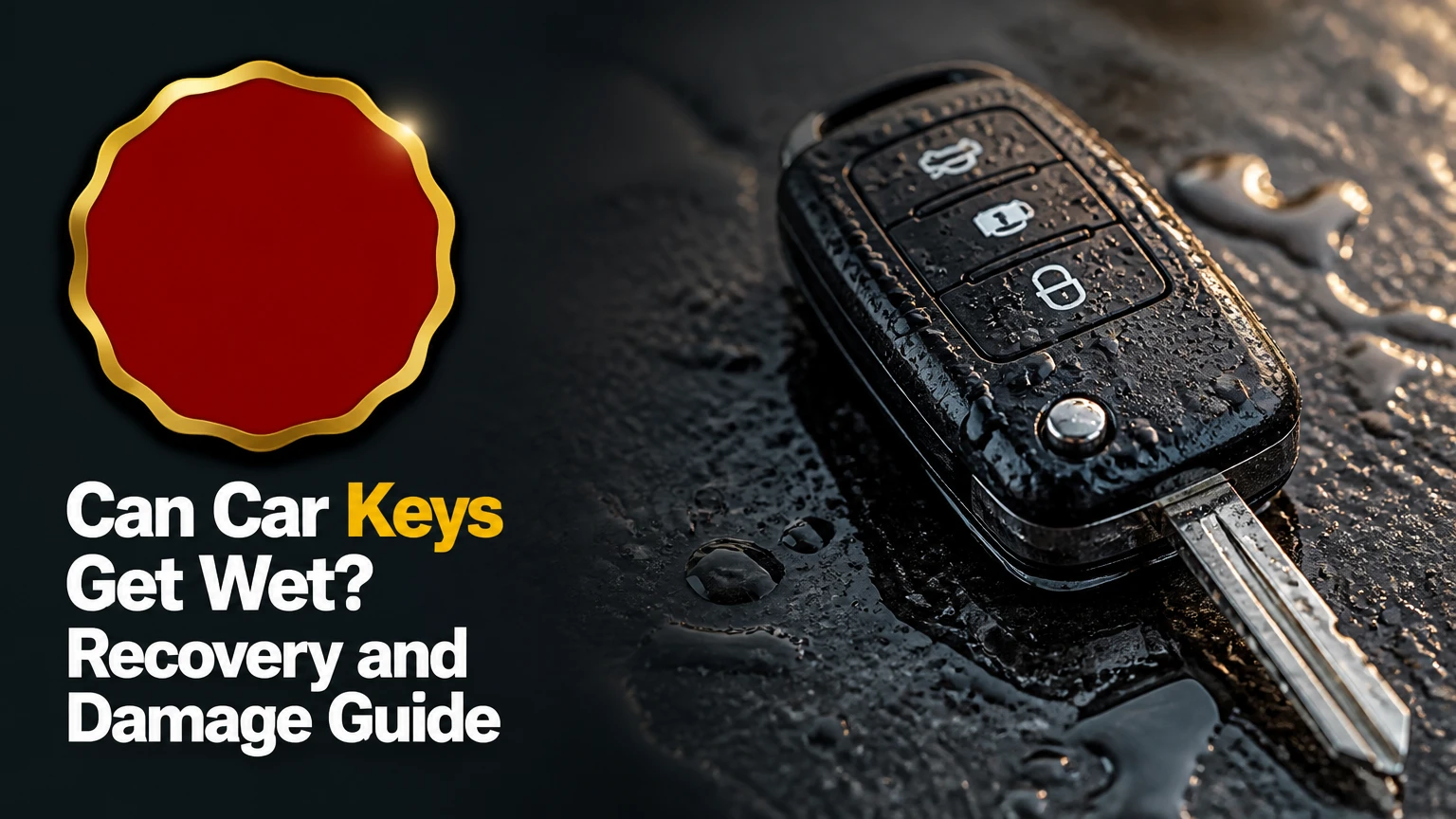
Yes, car keys can get wet, but water affects each key type differently. A plain metal key normally remains usable after immersion, while a remote fob or smart key can suffer short circuits, battery damage, and delayed corrosion. Remove the electronic key’s battery, avoid pressing buttons, dry it completely, and test it only after 24-48 hours.
Key Facts
A metal car key has no circuit board, so freshwater rarely causes immediate functional failure.
A transponder key may still start the vehicle because its immobilizer chip is passive, but the plastic housing and chip are not automatically waterproof.
A remote key fob must be treated as wet electronics: isolate the battery before testing or cleaning.
Saltwater, detergent, and sugary drinks cause more lasting damage than clean rain because they leave conductive or corrosive residue.
Silica gel helps remove residual moisture; uncooked rice is a poor substitute because starch dust can contaminate switches and contacts.
A key fob that works after drying can still fail days later if corrosion remains on the circuit board.
Can Car Keys Get Wet Without Failing?
Car keys can get wet without failing when exposure is brief, the housing is well sealed, and the liquid is clean freshwater. Failure becomes more likely when water reaches the battery compartment or circuit board, when buttons are pressed during exposure, or when salt and detergent remain inside the casing.
The important distinction is between water resistance and waterproofing. Most vehicle manufacturers design key fobs to tolerate ordinary handling, rain, pockets, and occasional splashes. That design does not guarantee survival after swimming, laundering, or prolonged submersion. A rubber gasket may slow entry, but repeated button movement, cracked plastic, worn seals, and an improperly closed battery cover can let liquid through.
A glowing indicator light proves only that some power reaches part of the circuit. It does not prove that the radio transmitter, immobilizer antenna, microswitches, or battery contacts are healthy. Delayed corrosion is a common reason a fob appears recovered and then stops working several days later.
The car itself usually is not harmed by a wet key. The key transmits signals to the vehicle, but water on the outside of a fob does not normally enter the car’s receiver or ignition system. The immediate concern is loss of access, remote functions, or authorization to start.
How Do Different Car Keys Handle Water?
Mechanical keys handle water best because the working part is a metal blade and lock cylinder. Electronic keys contain additional failure points, including a coin-cell battery, printed circuit board, antenna, switches, and immobilizer components.
| Key type | Main components | Typical water risk | Likely result after brief freshwater exposure |
|---|---|---|---|
| Mechanical blade | Steel or brass blade, plastic grip | Low, with surface rust possible | Usually remains functional after wiping and drying |
| Transponder key | Metal blade, passive RFID chip, molded head | Low to moderate | Often starts the vehicle, but housing or chip damage remains possible |
| Remote fob | Coin cell, PCB, RF transmitter, buttons | Moderate to high | Remote locking may become intermittent or stop |
| Smart proximity key | Coin cell, PCB, antennas, passive backup functions | Moderate to high | Keyless entry, push-button authorization, or both may fail |
Mechanical keys
A traditional metal key works by aligning cuts on the blade with pins or wafers inside a lock cylinder. Water cannot short a mechanical lock. Clean freshwater may cause no practical problem, although untreated steel can develop surface oxidation if left wet for hours.
Saltwater changes the recommendation. Rinse a salt-contaminated blade with clean freshwater, dry it thoroughly, and apply a small amount of suitable lock lubricant to the blade or cylinder only if the vehicle manufacturer permits it. Do not pour thick oil into a modern lock because it can collect grit.
Transponder keys
A transponder key contains a passive immobilizer chip that normally receives energy from an antenna near the ignition switch and returns a coded response. Because the chip does not usually rely on its own coin-cell battery for engine authorization, a dead fob battery may leave starting capability intact.
“Passive” does not mean “waterproof.” The chip may be molded into a sealed plastic head, but cracks, prolonged immersion, and contamination can still damage the chip or its connections. A transponder key that starts the car but no longer operates buttons may have a damaged remote section while the immobilizer function survives.
Remote key fobs
A remote fob uses a battery-powered circuit to send radio-frequency commands to the vehicle. Water can bridge contacts, short components, corrode the battery terminals, or damage the tiny microswitches beneath the lock and unlock buttons.
Remote fobs are often the keys people accidentally wash or drop in a drink. A splash may cause no lasting problem, but a washing machine adds detergent, heat, bending, and repeated agitation. That combination is substantially worse than rain.
Smart proximity keys
A smart key communicates with vehicle antennas so the car can detect the key nearby and authorize entry or push-button starting. Smart-key systems do not all operate in exactly the same way, and many alternate between low-power listening, short transmissions, and vehicle-triggered communication rather than broadcasting continuously.
Smart keys also contain a passive emergency function in many vehicles. The location varies by manufacturer and model year. Some vehicles detect a weak fob when it is held against a marked area or directly beside the start button, but the owner’s manual is the authoritative source.
What Should You Do Immediately After a Key Gets Wet?
Dry a wet electronic key in six controlled actions, beginning with battery isolation. The most important factor is stopping electrical current and removing contaminating liquid before corrosion spreads across the circuit board.
Step 1: Remove the key from the liquid
Take the fob out immediately and separate it from any key ring or accessory that traps water. Do not shake it violently, because forceful movement can drive liquid deeper through button gaps and seams.
Wipe the exterior with a lint-free cloth. Keep the fob open-side up until you can remove the battery.
Success checkpoint: No visible liquid remains around the seam, buttons, or battery cover.
Common mistake: Pressing lock, unlock, panic, or trunk buttons to see whether the fob still works.
Step 2: Remove the coin-cell battery
Open the housing using the manufacturer’s intended notch, a plastic pry tool, or a small coin where the design permits. Remove the coin cell and place it aside for recycling if it was submerged, swollen, corroded, or exposed to detergent.
Do not puncture, crush, heat, or recharge a disposable lithium coin cell. A replacement CR2032, CR2025, or other battery must match the number printed on the old cell or specified in the owner’s manual.
Success checkpoint: The battery is physically separated from the circuit board.
Common mistake: Leaving the battery installed because the fob’s LED still flashes.
Step 3: Drain and wipe the housing
Hold the opened case with the battery compartment facing downward. Use gentle tapping and gravity to release trapped water, then blot the case, rubber membrane, and circuit board with a lint-free cloth.
Avoid cotton swabs that shed fibers around microswitches. Do not scrape green or white residue from the board with a metal tool.
Success checkpoint: No droplets collect when the housing is tilted in different directions.
Common mistake: Closing the fob immediately after wiping the outside.
Step 4: Displace residue with isopropyl alcohol
For clean freshwater exposure, air drying may be enough. For saltwater, detergent, coffee, soda, or pool water, clean the disconnected circuit board with 90% or higher isopropyl alcohol and a soft, clean brush, provided the board has no manufacturer warning against liquid cleaning.
Isopropyl alcohol helps displace water and evaporates more readily than water, but it does not reverse corrosion or repair burnt components. Keep alcohol away from the battery, painted surfaces, adhesive labels, and the rubber seal unless the material is known to tolerate it.
Success checkpoint: Visible residue is gone and the board has no wet-looking pools.
Common mistake: Using rubbing alcohol with a low concentration, which may add more water than it removes.
Step 5: Dry with airflow and desiccant
Leave the housing open in a dry, ventilated room. Add fresh silica-gel packets to a sealed container, keeping the packets separated from the board so dust or fibers cannot contact electrical surfaces.
A 24-hour period may be sufficient after a small splash. Use 48 hours after immersion, washing-machine exposure, saltwater, or detergent. Rice is less effective than purpose-made desiccant and can leave particles inside switches.
Success checkpoint: The board, gasket, and case feel dry, with no fogging or moisture under the rubber membrane.
Common mistake: Using a heat gun, radiator, oven, or high-temperature hairdryer.
Step 6: Reassemble with a fresh battery
Inspect the board under bright light before closing the housing. Look for green corrosion, white crystalline deposits, blackened components, lifted copper tracks, or a torn rubber button membrane.
Install a new battery with the polarity shown inside the case. Close the housing evenly so its seal sits in its channel rather than folding over.
Success checkpoint: The case closes flush and the battery does not move inside its holder.
Common mistake: Reusing a coin cell that was wet, corroded, or already weak.
How Long Should a Wet Key Fob Dry?
A wet key fob should dry for at least 24 hours after a splash and 48 hours after immersion, washing, saltwater exposure, or detergent contact. Longer drying cannot repair corrosion, but testing too early can energize damp circuitry and turn a recoverable fob into a damaged one.
The 24-48-hour period is a practical household rule, not a universal manufacturer specification. Liquid can remain beneath a shield, inside a button membrane, or between the circuit board and plastic carrier even when the visible surface looks dry. Warm, moving air can speed evaporation, but excessive heat can deform the case, gasket, or soldered components.
Do not place a wet fob in a freezer. Condensation can form during removal, and freezing does not remove dissolved salts or detergent. Do not use compressed air at close range because it can push moisture beneath switches and seals.
For a key that was submerged in seawater, drying alone is not enough. Contaminants remain after evaporation, so the board needs careful cleaning or professional inspection. A fob that has been through a complete wash cycle deserves the same treatment.
Which Car Key Type Is Most Resistant to Water?
A plain mechanical key is the most water-resistant option, followed by some molded transponder keys. Remote fobs and proximity keys offer more functions but expose more electronic components to water and usually cost more to replace.
| Decision factor | Mechanical key | Transponder key | Remote fob | Smart key |
|---|---|---|---|---|
| Primary power source | None | Vehicle induction coil | CR2032 or CR2025 | CR2032 or CR2025 |
| Manual blade present | Yes | Usually yes | Sometimes hidden | Usually hidden |
| Typical replacement hardware cost | $5-$25 | $40-$150 | $75-$250 | $150-$600+ |
| Typical programming time | 5-15 minutes | 15-45 minutes | 20-60 minutes | 30-120 minutes |
| Swimming suitability | High, if secured | Low to moderate | Low | Low |
| Delayed corrosion exposure | Minimal | Possible | High | High |
Replacement figures are typical independent-locksmith and aftermarket ranges in the United States, not guaranteed prices. Dealer pricing, vehicle security architecture, regional labor rates, and whether all keys must be present can change the total substantially.
A metal “surf key” is useful for people who swim, paddle, dive, or work around water. It should be cut specifically for the vehicle and kept in a secure waterproof pouch or worn where losing it does not create a security problem. A bare key on a lanyard can still be lost or used to identify the vehicle.
Can a Wet Key Fob Damage the Car?
A wet key fob normally cannot damage the vehicle’s locks, receiver, or engine control system. The more realistic risk is that the fob sends corrupted or incomplete signals, fails to authorize entry, or becomes unable to start the vehicle.
The vehicle receiver is designed to interpret valid radio commands, not to accept arbitrary electrical noise from a wet handheld device. A damaged fob may produce no signal or an invalid signal. It does not usually short the car through the air.
The exception involves physical contact. A dripping key inserted into an ignition cylinder can introduce moisture and contaminants into the cylinder, while a wet metal blade placed into a dirty lock can transport grit or salt. Wipe and dry the blade before insertion.
A separate risk applies when the fob’s battery leaks or overheats. Stop handling a swollen, cracked, hot, or chemically damaged battery and follow local battery-disposal guidance. Do not place a damaged lithium coin cell in household trash where local rules prohibit it.
What Changes After Rain, Saltwater, or a Washing Machine?
Clean rain is the least severe common exposure, while seawater and washing-machine detergent create the highest corrosion risk. The liquid’s residue, exposure duration, heat, and mechanical agitation matter as much as the amount of water.
| Exposure scenario | Main contaminant or stress | Recommended response | Professional assessment threshold |
|---|---|---|---|
| Light rain for 1-5 minutes | Mostly freshwater | Wipe, inspect, replace battery if needed | Fob remains dead after 24 hours |
| Sink or puddle immersion | Freshwater inside housing | Open, remove battery, dry 24-48 hours | Any corrosion or intermittent operation |
| Swimming pool | Chlorine and dissolved minerals | Battery removal, IPA cleaning, 48-hour dry | Buttons or start authorization fail |
| Seawater | Salt and conductive residue | Rinse board carefully, IPA clean, inspect | Immediate locksmith or electronics repair is sensible |
| Washing machine | Detergent, heat, agitation | Do not test, clean board, dry 48 hours | Replacement often beats uncertain repair |
| Soda, juice, or coffee | Sugar, acids, sticky residue | Disconnect battery, clean residue, dry 48 hours | Sticky switches or visible deposits remain |
Saltwater is especially deceptive because evaporation leaves salt crystals behind. Those crystals can attract moisture from humid air and create new conductive paths even after the fob seems dry.
Detergent can attack protective coatings and leave surfactant residue around microswitches. A fob that went through a wash cycle may need board-level cleaning, and a replacement is often more reliable when corrosion has reached multiple components.
Why Does a Key Work After Drying and Then Fail?
A key fob can work after drying and fail later because corrosion continues beneath components, battery contacts remain contaminated, or a weakened microswitch finally loses continuity. Delayed failure is more likely after saltwater, soda, and detergent exposure than after clean rain.
Replace the coin cell first if the range is short, the LED is dim, or operation is intermittent. Clean accessible battery contacts with high-percentage isopropyl alcohol and allow them to dry before installing the new cell.
| Symptom after drying | Most likely area | Safe first action | Replacement or repair signal |
|---|---|---|---|
| LED does not light | Battery, holder, or board power path | Install correct fresh cell | Corroded holder or blackened board |
| LED lights, car does not respond | RF circuit, antenna, or pairing | Test spare fob and vehicle receiver | Spare works, wet fob remains dead |
| Lock buttons fail, start works | Remote section or switches | Clean contacts and re-pair only if manual allows | Passive immobilizer survives but RF fails |
| Range is under 3 meters | Weak cell or antenna damage | Replace battery and inspect case | Range remains poor with fresh cell |
| Key works only when pressed hard | Microswitch or membrane | Inspect button membrane | Physical switch damage |
| Vehicle says key not detected | Fob battery, proximity antenna, or pairing | Use emergency detection location | Manual emergency method also fails |
Do not repeatedly press a failing fob for several minutes. Each test can increase battery current through contaminated circuits and can make diagnosis less clear.
Can You Start a Car With a Wet or Dead Fob?
Many push-button vehicles can start with a dead fob battery by placing the fob at a designated emergency detection point, often against or beside the start button. The exact location and procedure vary by make, model, and year, so the owner’s manual takes priority over generic instructions.
Many fobs also contain a mechanical emergency key. Release the small latch on the housing, withdraw the blade, and use it to unlock the driver’s door. Some vehicles hide the key cylinder beneath a removable door-handle cap.
A passive transponder may continue to authorize starting even when remote buttons fail. That outcome is common enough to test, but it is not universal. Some vehicles require a functioning battery, a recognized programmed key, or a specific placement procedure.
Use this order when stranded:
- Remove the wet fob from the vehicle and stop pressing buttons.
- Use the hidden blade to unlock the driver’s door if necessary.
- Hold the fob against the marked start-button area or manufacturer-specified backup point.
- Press the brake or clutch and attempt the normal start procedure.
- If the vehicle still reports no key, use the spare or contact roadside assistance.
A dead fob battery and a water-damaged circuit board are different problems. Emergency detection may bypass a weak battery, but it cannot restore a destroyed antenna or immobilizer chip.
How Much Does a Water-Damaged Car Key Cost to Replace?
A water-damaged car key typically costs $5-$25 for a simple metal duplicate, $40-$150 for a transponder key, $75-$250 for a remote fob, and $150-$600 or more for a smart proximity key. Programming, emergency service, towing, and a missing original can add to the bill.
| Replacement category | Typical hardware price | Typical programming or cutting time | Main price variable |
|---|---|---|---|
| Basic metal duplicate | $5-$25 | 5-15 minutes | Blade profile and local labor |
| Transponder key | $40-$150 | 15-45 minutes | Immobilizer programming method |
| Remote fob | $75-$250 | 20-60 minutes | OEM versus aftermarket hardware |
| Smart proximity key | $150-$600+ | 30-120 minutes | Security gateway and pairing access |
| Dealer emergency replacement | $200-$900+ | Same day to several days | Vehicle brand and parts availability |
These are typical planning ranges, not quotes. Luxury brands, newer models, vehicles that require online security authorization, and situations with no working key can exceed them.
A locksmith may repair a contaminated board, replace a battery holder, or supply a compatible programmed fob. Repair makes financial sense when the housing and immobilizer are intact and board-level corrosion is limited. Replacement is more sensible when the board is blackened, tracks are lifted, or several functions remain unreliable after cleaning.
When should a locksmith or dealer inspect it?
Contact a qualified automotive locksmith or dealer when the fob has been submerged in saltwater, has visible corrosion, becomes hot, has a swollen battery, or remains intermittent after cleaning and a fresh battery. Professional equipment can test radio output, immobilizer response, switch continuity, and programming status.
A dealer is usually necessary for brand-specific online programming or security credentials. An automotive locksmith may offer lower labor cost and faster mobile service, but verify that the provider handles the vehicle’s make and model before authorizing a replacement.
What Are the Best Ways to Prevent Water Damage?
The most effective prevention is separating the electronic fob from water-intensive activities. A silicone cover reduces splash entry and impact damage, but a cover is not a license to swim with a non-rated smart key.
Use these practical controls:
- Keep the spare key in a dry, separate location rather than carrying both keys together.
- Replace a cracked fob housing or hardened gasket before the next rainy season.
- Carry a waterproof pouch for boating, kayaking, and beach trips.
- Ask an automotive locksmith whether the vehicle supports a plain mechanical or “surf” key.
- Keep a programmed spare accessible to a trusted household member or fleet manager.
- Check the battery cover after every battery change so the seal sits flat.
- Do not leave an electronic fob inside a wet jacket pocket, washing-machine hamper, or tool bag.
A protective TPU or silicone cover helps with rain and spills but does not create certified submersion protection unless the product specifically states an immersion rating. The vehicle manufacturer’s guidance controls, because key housings differ substantially between models.
Common Expert Mistakes With Wet Car Keys
The most damaging household mistake is testing the fob repeatedly before isolating the battery. Button presses are not guaranteed to cause immediate failure, but they can energize contaminated circuits and make corrosion more extensive.
A second mistake is assuming that a working engine proves the entire key is healthy. The immobilizer, remote transmitter, proximity antenna, and button switches can fail independently. Starting the car successfully does not confirm remote locking or future reliability.
A third mistake is using heat instead of time. High heat may warp a case or membrane while leaving moisture trapped beneath a component. Gentle airflow, an opened housing, and 24-48 hours of controlled drying are safer.
A fourth mistake is treating all liquids as water. Salt, chlorine, detergent, sugar, and acids remain after evaporation. Cleaning is therefore more important after contaminated liquids than after a brief freshwater splash.
The final practitioner rule is simple: intermittent operation is evidence, not reassurance. Replace the battery and inspect the board as soon as symptoms appear, because delayed corrosion is easier to address before contacts and copper traces deteriorate.
Frequently Asked Questions
Can a key fob go through the washing machine?
A key fob can survive a wash cycle, but detergent, heat, and agitation create a high risk of permanent damage. Remove the battery without pressing buttons, clean contaminated residue with suitable high-percentage isopropyl alcohol, and dry the open housing for at least 48 hours. Test with a new battery only afterward.
Can a wet car key drain its battery?
A wet car key can drain its coin-cell battery if water creates a conductive path between contacts or keeps a button electrically engaged. Remove the battery immediately, especially after immersion. Replace cells that were submerged, corroded, swollen, or contaminated rather than reinstalling them.
Does rice fix a wet electronic key?
Rice does not reliably fix a wet electronic key. Rice absorbs some ambient moisture, but silica gel is cleaner and more effective inside a sealed container, while rice particles can enter button gaps and switches. Neither desiccant repairs corrosion, shorted components, or damaged antennas.
Are car key fob covers waterproof?
Most car key fob covers are splash-resistant rather than waterproof. Silicone and TPU covers can reduce exposure from rain, spills, and abrasion, but they cannot guarantee survival during swimming or prolonged immersion unless the specific product provides a tested immersion rating.
Can a locksmith repair a water-damaged smart key?
An automotive locksmith can sometimes repair or replace a water-damaged smart key, depending on board corrosion, immobilizer condition, and vehicle programming requirements. A fresh battery will not solve burnt components or damaged antennas. Obtain a repair assessment before buying a replacement, particularly for expensive proximity keys.
Will a spare key still work if the main key gets wet?
A correctly programmed spare key should still work if only the primary key was exposed to water. Test the spare once, keep it dry, and avoid storing both keys together during water activities. If both keys fail, investigate the vehicle battery or receiver rather than assuming both fobs were damaged.
The Bottom Line
Can car keys get wet? Yes, but a mechanical blade usually tolerates water far better than a remote or smart key. Remove a wet electronic fob’s battery, avoid pressing its buttons, clean contaminated residue, dry it open for 24-48 hours, and install a fresh battery before testing. A key that starts the vehicle but loses remote functions may have partial electronic damage, so replace or professionally inspect it before relying on it.